Showing posts with label record temperatures. Show all posts

Monday, December 14, 2015

GISTEMP November: +1.05C

h/t Gavin Schmidt, via Twitter


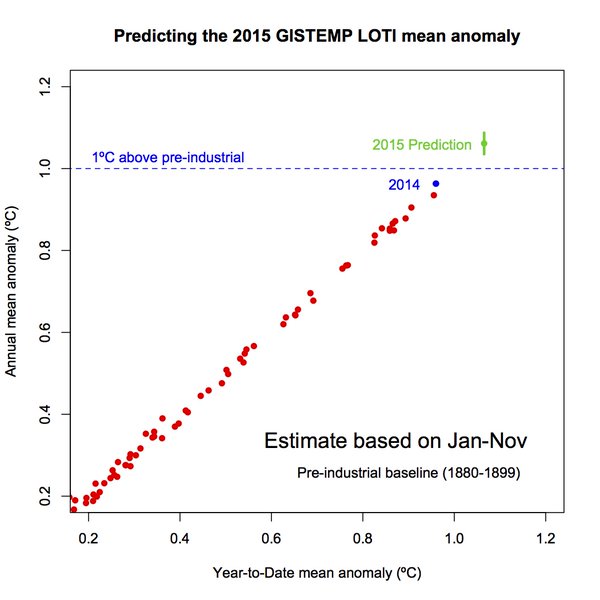
Another month, another record. 2015 is now all but certain to go into the books as the hottest ever, claiming the title from 2014(!)

We are in the grip of a strong El Nino, so the coming years will likely see some regression towards the mean. I fully expect to see a "no warming since 2015" denier talking point by mid-2017 at the latest.

Beneath the noise, the world will continue to warm.


Saturday, August 15, 2015

GISTEMP: +0.75C, Hottest July in the record

GIStemp has updated and the +0.75C anomaly makes July 2015 the hottest July in the instrumental record, setting another 12-month running average record and increasing the likelihood 2015 will break the record set in 2014(!).

Somebody tell me, I'm just a poor amateur -- are the records in a 135-year-old dataset supposed to come one right after another like that? Seems . . . concerning.

Friday, July 17, 2015

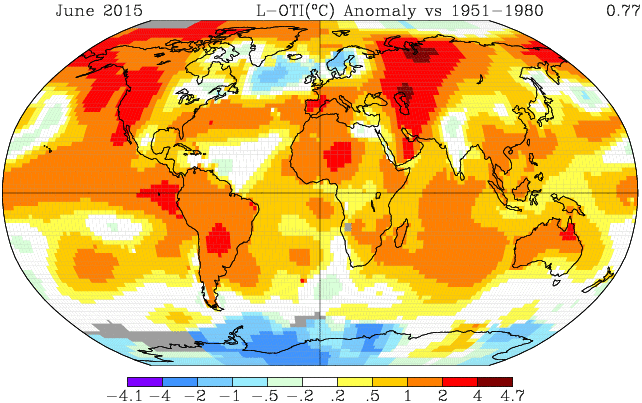
GISTEMP: June 2015 tied for hottest ever

GISTEMP has finally updated, and it's a doozy: June clocked in at +0.76 C, tied with June 1998 as the hottest June in the surface record.

This also makes this the hottest Jan-June on record. With 2015 clocking in at +0.805 C, only 2010 comes close at +0.795 C.

UPDATE: Just when I thought I was done correcting this post, GISTEMP has updated its numbers again, rendering all the numbers in the post just a little bit wrong. Here's the new map:

 June 2015 now comes in at +0.80 C, and June 1998 is a little warmer as well, +0.77 C. That makes June 2015 the warmest June in the GISTEMP records.

Monday, July 6, 2015

Anybody notice NOAA has disappeared El Nino?

A couple of months ago, NOAA had declared a long-awaited El Nino event, after an unprecedented 54-month Nino-less period with two declared La Ninas and multiple abortive flirtations with El Nino status.

Their longstanding requirements for El Nino require at least five consecutive three-month averages at or above +0.5C. The new El Nino, as we've seen, inspired some commentators to literally incoherent levels of excitement:

Eric Holthas' unstoppable global juggernaught looked like this in the NOAA data:

And if you're thinking that looks pretty tame compared to the other El Ninos since 2003, you're right. In fact, those months were so marginal that they have now slipped out of El Nino status altogether. A few weeks ago NOAA made a quiet adjustment to its January-Febuary-March numbers, downward by 0.1C. This had the somewhat starting result of disappearing El Nino from NOAA's data:
Instead of a El Nino entering its eighth month, we now have two 3-month averages on either side of a Nino-spoiling 0.4C January-Febuary-March.

This means that when NOAA re-welcomes El Nino in a couple months, we will have had gap of 58 months, just a hair under 5 years, between El Nino events. Whereas the prior record was just 52 months (1959-1963, if you're curious.)

There is no serious point to this, other than the fact that scientists reassess and adjust data sets all the time, as better information becomes available. It's not the mark of a grand conspiracy to control a narrative, just researchers going about their business -- so routinely that a change like this can go almost unnoticed.

Friday, January 16, 2015

GISTEMP is in: 2014 is the hottest year; there's still a tiger in your bedroom

Anomaly +0.68C. 2014 edged out 2010 at +0.66C.

Warming continues to be closely in line with the trend since 1970:

Many people have tried to explain this to climate deniers, who chose not to understand it (1). If anyone else is confused by it, this is the bottom line: you need to apply the same standard of proof to a hypothetical change in the warming trend as you would to determining the existence of a trend in the first place.

Having determined that there has been a warming trend of about 0.16C/decade for the 30 years between 1970 and 2000, the correct question is not has the warming stopped OMG (a question you will never be able to answer with a few years of data) but rather is there any reason to think the trend is different from what it was before?

If you determine there's a tiger in your bedroom, and then (wisely) don't go into your bedroom for a while, the test for whether there's still a tiger there in not whether you've heard it roar in the last 5 minutes. Unless you have convincing evidence, you probably should conclude that the tiger's still there, until and unless you get some strong evidence something has changed.

-------
1. 
So, what is wrong with Cruz’s statement?  Well, assuming that by ‘recorded warming’, he means the satellite-derived lower atmospheric surface temperatures his statement is absolutely correct.  If he is referring to globally averaged surface temperatures since 2000, there is only a very small amount of warming; this small amount of warming is indeed contrary to the theory of AGW.
Who? Who else?

Wednesday, June 11, 2014

GISTEMP redux: (Still) 2nd warmest April in the temperature record

+.73C, an increase of .03C compared to March and the hottest April ever, bar 2010 (as an aside, the first half of 2010 was a scorcher.)

How hot is that? Well, prior to 1970, the hottest April since records begin was in May 1969, +0.15C. The people alive in 1970 had never seen a April within half a degree of what we just saw. Given the inherent variability of monthly temperatures, that's pretty amazing.

Wednesday, August 15, 2012

Hot times in Phoenix


The last time the temperature dipped below 90 degrees in Phoenix was at 6 a.m. on Aug. 6. Two days later came the hottest day of the current heat wave — “I guess we can call it that,” Mr. Waters conceded — and the hottest Aug. 8 ever in Phoenix, when the high reached 116. (The record of 122 degrees was reached on June 26, 1990.)
As of Monday, the average August temperature was 100.2 degrees, or 6.2 degrees higher than normal, Mr. Waters said. By Tuesday, the temperature had reached 110 degrees for nine consecutive days; last year, the longest stretch where temperatures reached or surpassed 110 degrees was six days. Tuesday was also the 31st consecutive day the mercury hit 100 degrees (NYTimes).
People are dying in that heat; count on it. But it could be so much worse.

 Just eyeballing it, New Mexico looks to be +4C (+7.2 F) compared to the present. Imagine a similar heat wave, same distribution of temperatures, after +4C of warming. The highs hit 117 F, day after day, and for over a week, it never dropped below 97 F.

But wait, it gets worse:
The urban climate will probably continue to warm as the population of the region increases. Using a projection of regional climate change for the SW US (Sprigg and Hinkley [18]), estimates of Phoenix growth rates (GPRA [19]), and empirical relationship between population and magnitude of urban warming (e.g., Oke [20]), Brazel [21] determined that urban dwellers may experience a further rise in annual mean temperatures of 1.7 to 2.5 ( Environmental consequences of rapid urbanization in warm, arid lands: case study of Phoenix, Arizona" (registration required)).
 So we set our scene in Phoenix proper, in the year 2100 (4C + 2.1C = 6.1C = 11 F). Same distribution as today (although the extremes could actually become worse as the Arctic melts):
The last time the temperature dipped below 90 degrees 101 degrees in Phoenix was at 6 a.m. on Aug. 6. Two days later came the hottest day of the current heat wave — “I guess we can call it that,” Mr. Waters conceded — and the hottest Aug. 8 ever in Phoenix, when the high reached 116 127. . . . As of Monday, the average August temperature was 100.2 degrees  111.2 degrees, or 6.2 degrees higher than normal, Mr. Waters said. By Tuesday, the temperature had reached 110 degrees 121 degrees for nine consecutive days . . . Tuesday was also the 31st consecutive day the mercury hit 100 degrees 111 degrees.
 Imagine day after day in which temperatures never dropped below 100 degrees (even the 90 degrees beggars belief). The heat stress would be enormous. Outside of air conditioned environments, people would be severely limited in any activities. And some people would just drop dead:
Hyperthermia following heat stress results in profound brain edema formation and damage to the central nervous system (CNS). However, whether acute or chronic diseases such as cardiovascular, endocrine, or metabolic ailments further influence the vulnerability of human populations to heat-related deaths is still unclear. In this investigation, we examined the effect of hyperthermia on chronic hypertensive rats. The influence of growth hormone (GH) as a therapy to attenuate brain dysfunction was also evaluated. Subjecting rats to 4 h of heat stress at 38°C in a biological oxygen demand (BOD) incubator resulted in profound impairment of motor and cognitive functions, breakdown of the blood–brain barrier (BBB), reduction in regional cerebral blood flow (CBF), edema formation, and brain damage. These effects were further aggravated when chronic hypertensive rats (two-kidney, one-clip model for 4 weeks) were subjected to similar hyperthermic conditions (38°C for 4 h). Interestingly, the behavioral alterations and impairment of motor and cognitive functions in hypertensive rats were much worse than those in the normotensive animals subjected to heat stress.
Fortunately it's not as if Americans are going to be older and sicker in the future . . . [/sarc]

Explosive unplanned growth in the middle of a desert; rapid climate change; obesity and terrible preventative care. As an American, it sometimes seems as though our chickens, not being content with coming home to roost, are in the process of forming gigantic rabid flocks a la The Birds.

Uh, I thought you were going to cut our emissions. Did you at least start exercising and eating better?

Thursday, November 10, 2011

Solar activity hits seven-year high


Solar cycle 24 continues to ramp up, as expected. When La Nina falters -- it's now expected to persist through the middle of 2012 -- temperature records will fall. Until then, enjoy another data set following the trajectory predicted by scientists based on a model.

Saturday, October 8, 2011

Hello Sunshine, ctd

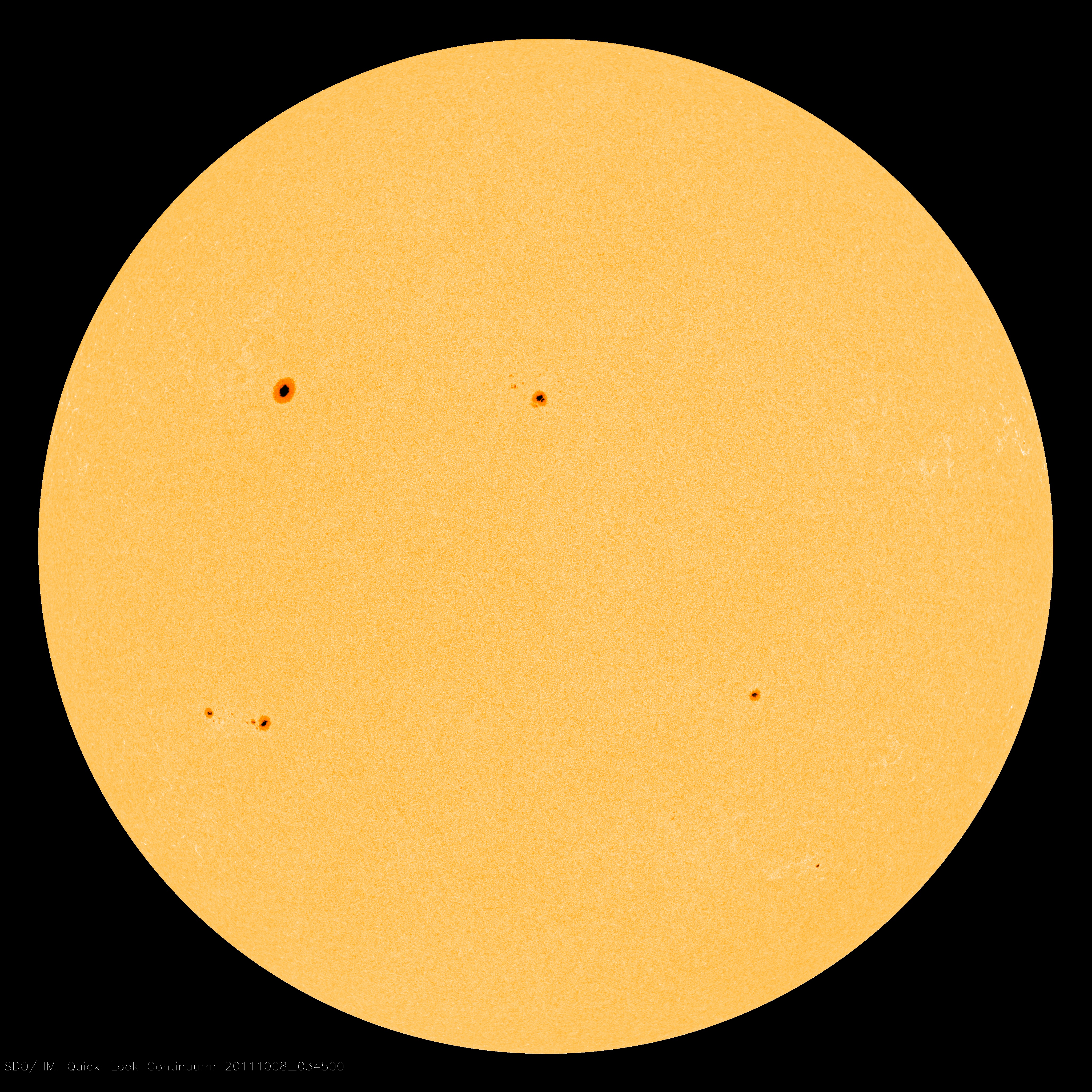
Highest solar activity in seven years. Which is to be expected. If you look at the smoothed monthly values, we are tracking the predicted values very well.

We have about three more years of rising solar activity this cycle. It's a modest influence, maybe 0.1C, but if we flip back into El Nino during that time, you'll see some impressive warmth. The fact that GISTEMP recorded the fourth warmest August in the record despite the sun being mid-cycle and the Pacific dipping back into La Nina, is a good indication of the underlying trend.

"My Eye is upon you -- do no wrong!"


Monday, September 12, 2011

GISS: +0.61C, 4th warmest August on record


From the third warmest July (+0.59C) to the fourth warmest August, the persistence of Nina-ish conditions does not seem to be helping cool this torrid summer. (H/t to the sharp eyes of Quark Soup.)

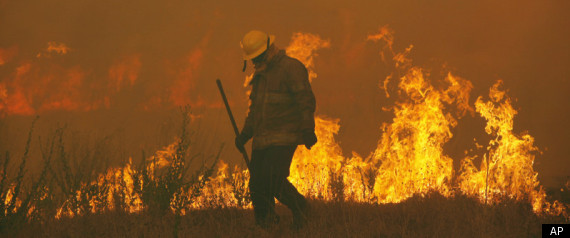
Have a kind thought for fire fighters in Texas, coping with the worst of all possible worlds: record heat (thanks to global warming), record drought (thanks to La Nina and, again, global warming), and vicious cuts to fire services that have left firefighters ponying up for their own gear (thanks to a jackass climate denier governor whose prayers for rain have gone unanswered -- apparently Perry is not familiar with the old saw that God helps those that help themselves.)


Wednesday, June 1, 2011

A simple way to think about uncertainty


Lukewarmers like to complain about the state of our scientific knowledge; they like to complain about uncertainty, especially in impacts, where there is in fact a lot of uncertainty.

Is there a way to make good policy despite this very real uncertainty? Can it be true the uncertainty reinforces the case for action, or is that a contradiction?

We have been enjoying a very stable climate over the past 8,000 years. The entirety of recorded history has taken place within a narrow range of long-term average temperature, +/- 0.5C. Now we are increasing the temperature far outside that range, to a level not seen on Earth for millions of years. Is that safe?

Forget about sea levels, extreme weather, drought, food production and all the rest of it for a moment. There is, indeed, significant uncertainty about how much of the above will happen and how fast, even if, in truth, the uncertainty is more between "expensive and destructive" versus "catastrophic" rather than between "good" or "bad." Forget about the specifics, and imagine a spaceship.

This ship includes the entire population of humanity -- one billion people, say (never mind what happened to the old Earth -- Death Star got it, or something). And it is going to travel to one and only one planet. That planet will now be humanity's new home. And you know literally nothing about it (scenario one).

Suppose the ship's computer informs the crew that the climate on New Earth is changing, and unless you expend significant resources to prevent it (deploying solar mirrors in advance of your arrival, or what have you) the temperature will be 3C warmer when you arrive.

What is your response? Clearly, you don't care. The planet may be just three degrees to cold to support life now. Or it might be an uninhabitable volcanic hell, and 3C more will be nothing. Warming could make things better, or worse, or make no difference. With no way to know, you aren't going to spend resources to try and control the climate.

This is the circumstance some pseudoskeptics and "lukewarmers" feel we are in. We don't know what the effects of warming will be, they could be good or bad, so it would be folly to decarbonize our economy on that basis.

But scenario one is unrealistic; we don't know nothing about this warming planet. We know a large number of us are living on it and have been for some time. So change the scenario a little bit. Suppose we know exactly one thing about New Earth; we know that it will support one billion human lives. Now, same question. Three degrees warmer, or expend the resources to prevent it.

This is a totally different calculation. You know the planet's climate will support human civilization, that the people on the spaceship can live there; you do not know if a new, warmer climate would. If you have a climate that will support human civilization on the one and only planet on which humans can live, you would be uncommonly stupid to do anything to significantly alter that climate. And the less you knew or could predict about the response of that climate, the more stupid it would be.

We know one important thing about the earth's climate system; we know that the temperatures of the last 8,000 years will allow billions of humans and complex industrial civilization to thrive. We do not know that about a world that is warmer than has existed since humans came down from the trees. Scientists are doing their useful work to increase our understand of the climate and to predict the effects of warming. But as citizens evaluating policy, we do not need to know what will happen to the sea level or the rainfall, to the methyl hydrate deposits or the thermohaline circulation. This climate allows our civilization to survive; a new climate may or may not. That's what you need to know.
Sunday, March 14, 2010

Think global warming is a myth? Head over to Intrade and make some money

Over at Intrade, the odds are running five-to-one in favor of 2010 being one of the five hottest years on record (as measured by GIStemp). If you believe that there's no warming trend, global cooling has begun, etc., this should be easy money if you're right. The odds of 2010 being one of the five warmest years by simple chance variation is 5/131 (3.8%). But Intrade is pricing the contract as if the chance were 82% -- greater by a factor of twenty!

Or maybe you want to play it safe -- betting only against 2010 being the hottest year ever recorded (see the new widget on the right). The odds of this happening by chance are only 1/131 -- 0.76%. But as of tonight, Intrade has it as an even-money bet! All you have to do to double your money is to bet (and be right in betting) that this will not be the hottest year since record-keeping began in the 19th century. Easy!

Of course, January and February were both the second hottest months ever recorded in GIStemp. So the short end of the bet is not looking good. But be bold! Clearly investors have bought into this whole "warming" scam and are ready to put their money are the table.

Aren't you?

Monday, March 1, 2010

End of the solar minimum

February 2010 was the first month in three years in which the Sun has sunspots every day of the month. This is a sign of the end of an unusually long and deep "solar minimum" -- which is the term for the lower portion of a regular eleven-year cycle of sunspots. In 2009, there were 260(!) days without sunspots. Nevertheless, 2009 was tied for the second-warmest year in the instrument record.

The influence of solar variability on the climate is modest -- the sun's intensity varies by a maximum of about 1 W/m^2. But in the short term, especially given the likely persistence of an El Nino through Spring, the upswing in solar radiance may contribute to record-breaking warmth. January and February 2010 were the hottest and second-hottest months in the satellite record, respectively -- which likely makes them among the hottest in the last 1,200 years.