Showing posts with label Judith Curry. Show all posts

Thursday, August 20, 2015

Judith Curry hides the decline . . . in her own self-respect

In hindsight, the way the Climategate emails was rolled out, after very careful scrutiny by the targeted bloggers, was handled pretty responsibly.  Lets face it – “Mike’s Nature trick to hide the decline” means . . . “Mike’s Nature trick to hide the decline.[1]”

Wow. Judith Curry, ladies and gentlemen and deniers. Former serious person. What a joke.

In hindsight, we can say the Climategate witch hunt failed utterly. Michael Mann is better-known and better-regarded than he would have been without the denier crusade. Deniers humiliated themselves trying to discredit a "hockey stick" that has now been reproduced dozens of times.

The criminals who stole the emails passed them to their denier allies who used them deceptively, using every variety of quote sniping and ridiculous double standards -- hateful vicious right-wing crusaders picking through thousands of pages of emails, looking for a few lines where responsible scientists, in the course of private communications with each other, said mean things about idiots.

This was used by right-wingers already in denial of the facts to craft a mythology for their gullible dittoheads. Said dittoheads went on to threaten working scientists with imprisonment, murder, the rape of their children, lynchings in the street -- such was the fruit of the handling of stolen emails, to morons by way of liars.

"Pretty responsibly" . . . keep telling yourselves that.

Tuesday, July 21, 2015

Judith Curry: Please save me from my belief in +10C of warming


Judith Curry has found a climate risk assessment report she likes, nay, loves. A red-letter day!
I haven’t found climate change risk assessments to be very satisfactory, for a range of reasons.  There is a new report out, entitled Climate Change: A Risk Assessment.  IMO  this is far and away the best risk assessment for AGW that I have seen. . .
Exciting! So what does the report say?
On a medium-high emissions pathway (RCP61), a rise of more than 4°C appears to be as likely as not by 2150. On the highest emissions pathway (RCP8.5), a rise of 7°C is a very low probability at the end of this century, but appears to become more likely than not during the course of the 22nd century. A rise of more than 10°C over the next few centuries cannot be ruled out.
So "far and away the best risk assessment for AGW" Curry has ever seen considers +7C "more likely than not" along a business-as-usual pathway and feels that +10C "cannot be ruled out." Since this would obviously be a catastrophic outcome, Dr Curry goes on to apologize to the scientists she has vilified and pledges to turn her blog over to serious scientific study of AGW and educating the public about these risks.

Kidding! Instead she closes her post with a frankly pathetic plea for someone to please find her a way out of the logical consequences of the report she's just endorsed:
The plausible worst case scenario is arguably where we should focus our efforts (both science and policy).  Working to falsify high values of RCP and sensitivity based on the background knowledge that we do have, should be a high priority.
So the takeaway is that the best risk assessment Dr Curry has ever seen considers +10C as a plausible worst case scenario. Said risk assessment recommends constructing policy around the plausible worst case scenario, and Curry agrees with that too. Her conclusion: I do not like where this science leads, so somebody find me some new science that leads us where I want to go (which is nowhere.)

If someone could find a way out of the logical consequences of her own beliefs and the basic science, she would be eternally grateful to you. In the meantime she will wait patiently and not draw any conclusions until the facts change (1).

---------------------------------------------------------
1. This reminds me of how the early Zionists pledged their support for democracy -- but opposed democratic elections explicitly and violently during the days of the British Mandate on the grounds that they were heavily outnumbered by Palestinians and would lose them.

Since you can't ethnically cleanse the facts of radiative physics, the same strategy will probably not work for Judith.

Thursday, June 18, 2015

In which Judith Curry reads an article

. . . which turns out to be wrong.

Apparently, while visiting the UK, Curry read an article about how greedy biomass-burning greens are destroying everything, leaving the virgin forests of Britain an apocolyptic hellscape. Skeptic that she is, she swallows this premise whole and reguritates for her readers, despite the fact that literally ten seconds of Googling shows it to be pure fiction.

But first, the heart-wrenching tale of a rabid biomass industry run amok [Trigger warning: graphic scene of 50 trees being cut down]:
But what ex-teacher Pountney and Wilson saw looked to them like utter desolation. They came across a stand where about 50 mature oaks, some 300 years old, had been felled the previous winter. Their trunks lay in ragged piles, some sawn into roundels.
The oaks’ fate, the Trust has confirmed, was to be burnt: as ‘sustainable’ heating fuel in log-burning stoves – a market which is expanding rapidly. According to trade group HETUS, almost 200,000 such stoves are installed every year – a five-fold increase since 2007.
 Those fifty trees become the core evidence for the claim that biomass fanatics have sent England into a downward spiral of desertification set to cumulate in a "Mad Max" style countryside.

[And then we spend the aforementioned ten seconds fact-checking.]

Surprisingly, not so:

England's forests and woods had dwindled to just 5.2% by 1905.

The first world war was the low point, and in 1916 Herbert Asquith's government established the Acland committee to study the problem. They said England desperately needed to replenish and maintain "strategic reserves of timber", and within a few years the Forestry Act would lead to the establishment of the Forestry Commission to carry this out.

In the years since, a steady programme of afforestation has increased England's forest cover back to 13% – not far off the levels of 1,000 years ago. To put that in context, many other European countries average about 37% coverage, so England still has one of the continent's lowest levels. But the commitment to afforestation is clear, with modern English foresters using a wide variety of native broadleaf, conifers and species that could thrive in our changing climate.
How is that Britain's forest cover continues to expand, having more than doubled in the course of the 20th century? Private owners making use of generous tax breaks:

The new Forestry Commission report, conducted for the UN’s food and agriculture department, disclosed that the amount of woodland owned by individuals now accounts for almost half of all our tree cover, having grown by 22 per cent in 15 years, the Sunday Times reported.

Those buying woodland as an investment have found that it has outperformed shares and commercial property in recent years, with an annual return of 5 per cent. Once owned for two years, it is except from inheritance tax.

Proceeds from the sale of timber are also exempt from income tax and corporation tax and there is no capital gains tax on the growth of value in tree crops.
So the United Kingdom uses tax policy to make forests an attractive investment, with the result that private landowners turn over more of said land to forest, with the result that there is more forest. But, wait! Somewhere in this country of 64 million people, someone cut down 50 trees. Teh horror.

Weak sauce, former scientist/professional fake skeptic Judith Curry.

Wednesday, April 8, 2015

Friday, January 16, 2015

GISTEMP is in: 2014 is the hottest year; there's still a tiger in your bedroom

Anomaly +0.68C. 2014 edged out 2010 at +0.66C.

Warming continues to be closely in line with the trend since 1970:

Many people have tried to explain this to climate deniers, who chose not to understand it (1). If anyone else is confused by it, this is the bottom line: you need to apply the same standard of proof to a hypothetical change in the warming trend as you would to determining the existence of a trend in the first place.

Having determined that there has been a warming trend of about 0.16C/decade for the 30 years between 1970 and 2000, the correct question is not has the warming stopped OMG (a question you will never be able to answer with a few years of data) but rather is there any reason to think the trend is different from what it was before?

If you determine there's a tiger in your bedroom, and then (wisely) don't go into your bedroom for a while, the test for whether there's still a tiger there in not whether you've heard it roar in the last 5 minutes. Unless you have convincing evidence, you probably should conclude that the tiger's still there, until and unless you get some strong evidence something has changed.

-------
1. 
So, what is wrong with Cruz’s statement?  Well, assuming that by ‘recorded warming’, he means the satellite-derived lower atmospheric surface temperatures his statement is absolutely correct.  If he is referring to globally averaged surface temperatures since 2000, there is only a very small amount of warming; this small amount of warming is indeed contrary to the theory of AGW.
Who? Who else?

Tuesday, December 10, 2013

The Trouble with Tamsin

Do you trust that face?

During my long and unexplained hiatus -- during which I may or may not have been reforging the sword of my fathers in anticipation of the final confrontation with Steven Goddard -- there was a large amount of buzz about Tamsin Edwards' throwing down the gauntlet and proclaiming that no one in climate science ought to offer any opinion about climate policy.

In the descriptively but unimaginatively titled, "Climate scientists must not advocate particular policies" Edwards lays out her case for abstinence-only public science eduction:
I believe advocacy by climate scientists has damaged trust in the science. We risk our credibility, our reputation for objectivity, if we are not absolutely neutral. At the very least, it leaves us open to criticism. I find much climate scepticism is driven by a belief that environmental activism has influenced how scientists gather and interpret evidence. So I’ve found my hardline approach successful in taking the politics and therefore – pun intended – the heat out of climate science discussions. They call me an “honest broker”, asking for “more Dr. Edwards and fewer zealous advocates”. Crucially, they say this even though my scientific views are absolutely mainstream.
Pace Edwards, scientists who indulge in advocacy can expect to see their reputations trampled in the mud, their credibility shredded, and their careers imploded. Examples are not far to seek. In 1947, for instance, a middle-aged physicist published "Why Socialism?":
[M]ost of the major states of history owed their existence to conquest. The conquering peoples established themselves, legally and economically, as the privileged class of the conquered country. They seized for themselves a monopoly of the land ownership and appointed a priesthood from among their own ranks. The priests, in control of education, made the class division of society into a permanent institution and created a system of values by which the people were thenceforth, to a large extent unconsciously, guided in their social behavior.
There goes his credibility. By the Law of Edwards, he's finto. It's a shame. But for this, I really think that Albert Einstein guy could have made something of himself.

If anyone would like a long list of immortal scientists who argued for particular public policies, I'm happy to provide one, but for the moment let's take that as read and ask why Dr. Edwards has put forward so aggressively an argument that falls apart like tissue paper when applied to real scientists?

Edwards lays out her initial motivation in her first sentence: "As a climate scientist, I’m under pressure to be a political advocate." She doesn't want to be a political advocate. But she obviously feels some defensiveness about this reluctance, or she would simply have said "Fuck off; I'm busy" rather than develop a general theory about why not only should people stop pestering her to take a stand, but that all scientists everywhere should never do so.

Now, if Dr. Edwards had stuck to her own case, and refused to engage in policy debates, her position would be, in my opinion, unassailable. Scientists have an obligation to do good science. They have no obligation to address any question of public policy. If they are reluctant to do so, they had best not do it. No one should bully them into it with expansive doctrines of the scientist's duty to educate. That "duty" has no basis in the traditions of science (1).

But it extrapolating from the personal to the general, Edwards misses the mark. Her argument is threefold:

1) Scientists who advocate for particular policies will lose the public's respect.
2) Scientists who advocate for particular policies will inflame climate deniers (whereas they love and respect Edwards.)
3) Scientists don't know what they are talking about (and anyway, it's all about values and stuff).

The third point I have addressed before. I have little to add, except that I like that post better than when I wrote it, and I think in a small way it contributes to the discourse, in that the nonsense claim that climate change is all about values has a lot of currency on both sides.

The second point is not only thin but somewhat sad:
So I’ve found my hardline approach successful in taking the politics and therefore – pun intended – the heat out of climate science discussions. They call me an “honest broker”, asking for “more Dr. Edwards and fewer zealous advocates”. Crucially, they say this even though my scientific views are absolutely mainstream.
I have no doubt that Edwards is accurately describing how some climate deniers react to her  They are pleased with her, as indeed they should be, because she is not challenging their inactivism in any way. Anyone who knows anything about climate "skeptics" knows that they do not care passionately about the scientific reality, but about the implications of that reality for public policy, so the fact that they like Edwards' stance is utterly predictable. Silent, neutered climate scientists are to deniers almost as good as no climate scientists at all.

Note what Edwards does not say: She does not say any "climate sceptics" have changed their minds about the science. She does not say they have changed their minds about any question of policy. She does not even claim that they accept her "absolutely mainstream" scientific views.

So what is she claiming? Really, only that climate skeptics tolerate her. They don't verbally abuse her. They don't threaten violence against her or her family. They don't sue her, or spam her with FOI requests, or file complaints with her university.

Shorn of sentimentality, this is what Edwards is actually saying: If you refuse to make any connection between your science and public policy, and denounce others who do, climate deniers will spare you the campaign of abuse they inflict upon more dangerous scientists. They may even call you an "honest broker." (No word on whether they call her the Gangster of Love.)

Of course the irony of claiming that title is that Edwards is not an "honest broker." She may be honest, but she can't be a broker, one who "arranges or negotiates (a settlement, deal, or plan)." That is what she has said she will not do, and what climate deniers do not want to do. The irony is thick. Just as many on the right want a government which does not govern, so the climate deniers' ideal "broker" is one who refuses to negotiate a settlement.

Finally we are left with Edwards' claim that scientists who weigh in on matters of policy will lose the public's respect.

This is another place in what Edwards doesn't say is as interesting as what she does. She doesn't say that scientists who advocate policy solutions will lose their objectivity and their science will suffer for it. She is not such a fool. As a working scientist, Edwards knows that scientists working a hypothesis are far from objective. She, like any publishing scientist, could probably list the top ten biases any scientist is fighting to keep at bay upon sitting down at the bench, to wit:

1) I hope this is publishable.
2) I hope my hypothesis is correct.
3) I hope I collected enough data.
4) I hope this work is broadly useful to society.
5) I hope this work shows something substantially different than what my reviewers have read in the last few months.
6) I hope after I publish this it will be easier to get funding.
7) I hope I'm invited to present this at a meeting somewhere nice.

etc. . . .

Edwards, as I said, knows all this, so she doesn't make the claim that you need objectivity to do good science. Instead she claims that scientists need the appearance of objectivity to maintain the respect of the public. Which, if you think about it, reduces to an odd claim: in order to maintain the public's trust, we must all participate in misleading the public about what a scientist is and how science happens.

Because science, in fact, does not depend on objectivity or impartiality. That's why no one cares that Albert Einstein wrote "On Socialism" or that Issac Newton needed a special dispensation of the king to refuse the ordination required of all professors at Trinity College or that Jonas Salk, having invented the polio vaccine, urged its wide adoption.

Science does not require impartial individuals because science can be tested. Science is grounded is data, and the reproduction of results. A baseball umpire or a traffic cop or a federal judge ought to be known for their impartiality, because of the inherent subjectivity of their judgments and the difficulty of revisiting them. Science, ideally, involves careful judgements based upon shared facts and evidence that can be modified or discarded as they are repeatedly reexamined.

Appearing objective, then, is essentially a dodge, a hustle, the opposite of honest. If we are going to try and buttress scientists' respectability by that, we ought to ask Dr Edwards why her blog photo shows neither glasses nor a white coat even though both of those things (2) have been shown to increase the trust of the public in the speaker.

Ultimately I find Edwards position sad. She began with a personal refusal to engage with politics, as is absolutely her right. She extended this to an ill-considered attack on other scientists who made a different choice. Predictably this has led to praise and admiration from the usual suspects who are more than happy to ignore her "mainstream beliefs" (3) and celebrate her rejection of "activism." This praise seems to have turned her head, and only time will tell if she has, as it seems, embarked on the long downward spiral into irrelevance and Curryism.
-------------

1) Compare medicine, where practitioners take an oath "to teach [students] this art; and that by my teaching, I will impart a knowledge of this art to my own sons, and to my teacher's sons, and to disciples bound by an indenture and oath according to the medical laws."

2) Glasses convey the impression the wearer is intelligent and good.
White coats convey the impression the wearer is an authority and is trustworthy.

3) Much like they ignore the multitude of contractions between the various mutually incompatible "skeptic" theories.

Wednesday, August 29, 2012

Curry's Review

 Climate Etc.'s "Week in Review" function is getting more and more erratic, ignoring big stories, trumpeting horribly unprofessional and ill-thought-out editorials, and in general looking more and more like an archaeological record of the self-reinforcing power of cognitive dissonance.
I am trying to figure out what Mann is trying to accomplish with these lawsuits.  I guess he is hoping to intimidate people into not saying negative things about him?
The lack of common sense -- and lack of empathy -- expressed here is startling. Evidently tribal feelings in Dr. Curry have reached a point where she can't comprehend why a person would fight back against slander and defamation.

She highlights a truly God-awful article,  "The Moral Downside of Climate Change." Major parts (not the ones she chooses to quote) rehash a bundle of myths and lies:
It seems likely, after all, that what we are witnessing in the furor over climate change is a rerun of the wildly off-base population explosion announced in the 1960s, or the brief romance with a threatened ice age in the next decade, or the treatment of pregnancy as a disease, or the pressing need for safe sex, or the horrors of growing up in a world in which not everyone respects and affirms our every choice. . . . the actions taken at best waste time, energy and resources and at worst either make the problem worse or create new problems in their wake.
 One wonders if Curry believes condoms are "a waste of time and resources" or if she clings to the discredited myth that scientists in the 70s predicted a new ice age. And speaking of the ice, it's time to spin the free-fall up north:
Depending on which data set you look at, the Arctic sea ice extent is approaching or has surpassed the record minimum extent (for the period since 1979) in 2007.  There are even predictions of an ice free Arctic Ocean by the end of Sept.  I’ll do a post later in Sept on “what is going on and what does all this mean.”   But in the mean time, here is highly confident prediction:  the Arctic Ocean will NOT be ice free by the end of Sept.  In fact, nearly all of thin and loosely consolidated ice has already melted (helped along by the big cyclonic storm in early Aug).  The remaining ice is consolidated near Greenland and the Canadian archipelago, and is at high latitudes where the autumnal cooling is well underway.  So I would suspect that there will be an earlier than usual sea ice minimum this year, with the minimum not getting much lower.
Wow, desperate much? Where are the predictions of an ice-free Arctic Ocean this year to be found? In this one paragraph we have:

1. A straw man fallacy, trying to refocus our attention on the ridiculous idea that the ice will vanish this year, a position I can find no one endorsing.
2. A desperate stab at reassuring her readership that although the ice numbers are presently in free-fall, no doubt everything will be back to normal.

It's shocking (to me at least) that promising "an earlier than usual sea ice minimum this year" is not really substantially different than Goddard's supposed "early recovery" of the sea ice. And when a full professor is starting to echo Steve Goddard, it's time to pour the whiskey and vodka down the drain and take a serious hard look at yourself.

Sunday, July 8, 2012

Threats against climate scientists: Phil Jones' inbox

The looney right did this up themselves, as a "joke."


Glenn Tamblyn at Skeptical Science flags the University of East Anglia's release of threats and hate mail sent to Phil Jones. PDF here, examples below:

1. “Subject: Kill yourself scum
Fuck you for your lies and deceit. You deserve to die. And if you don’t take your own life, I fucking hope somebody does it for you.”

2. “Your children and family will know because we know where you live. expect us at your door to say hello ^\-(”

3. “Faggots like you will be dealt with, as now people know what you need and will beat the living shit out of you every time you show your socialist ass in public. I’d kill you in a second if given the chance. . . . I’m now going to take physical action against you. You deserve it you fucking prick!”

4. "If anyone of those perverted assholes ever steps within the boundries of the U.S., they decimated [sic]. We have 2nd amendment [sic] and you as a stupid Briton probably don't know what that means. We have a right to bear arms and these perverted assholes will be wasted. We will have plans for you as well. If you bring your family all the merrier.

You fuck prick! [Sic.] Britain needs to kill these scam artist [sic]."


 5. "Keep this in mind. Not all will tolerate your thieving lying ways when it impacts their family.

Beware of retribution upon yours.

Someone some where [sic] will hurt you down."

6. "wanker you wanker you nead [sic] to be killed"

7. "i [sic] hope you fuckers die slowly and painfully.

you are the scum of the earth and should be put in front of a firing squad."

8. "update your google search, it should say, widely known group of cocksuckers and liars that tried to enslave the world through a huge scam perpetrated by a bunck of fuckin cocksuckers, if was i charge [sic] you would all be lined up againt [sic] a wall and shot."
----------------------

So what is the significance of this, besides telling us something important about the character about a certain group of "climate skeptics"?

I think it puts the question to people like Judith Curry and Roy Spencer, who still have a foot in the world of science, but derive much of their hit counts and claim to public notice from "climate skeptics" who regularly air similar paranoid ideas and abusive language in their comment threads.

Let me be clear; I am not calling for them to moderate with a heavier hand. What I am saying is that if you put yourself at the head of a mob waving pitchforks and torches, you have some responsibility for the kind of people who take you as an inspiration. I have no hope for people like Anthony Watts, who is merely a "shock jock" of the internet. But I would like to see more grown-up climate deniers and lukewarmers taking pains to isolate and marginalize the violent, paranoid, homophobic and neofacisist elements of their fellow travellers. If they and other vocal opponents of strong mitigation cannot grow up, as a movement, enough to denounce their bigots and terrorists, then they and their movement will be defined as a movement of bigots and terrorists in the public mind, and deserve to be.

The academic that launched a thousand insults.

Earlier posts on threats against climate scientists: 


Coward deniers continue threats
  
UPDATE: Supporting documentation here (h/t Quark Soup).

Tuesday, March 6, 2012

Judith Curry needs living space!

There's a whole series of these posters. They're pretty great.

I kid, she didn't reference that awful rhetorical precedent, but pretty darn close:

With regards to K-12 education, there is no particular reason to teach ‘climate change’ in the K-12 curriculum.  Climate change is a topic that is more suitable high school ‘science and society’ courses.  In such courses, teaching the controversy would seem to be of paramount importance.
"Teaching the controversy" being of course the rallying cry of the Creationists' drive to forbid the teaching of evolution. What a tradition for a professor of atmospheric science to allude to!

Somebody missed the sarcasm here.
I was interested in how far this particular meme had spread, so here you go:

"Teaching the controversy" "evolution": 38,700,000 hits
"Teach the controversy" & "evolution": 229,000 hits.
"Teaching the controversy" "global warming": 42,900 hits.
"Teach the controversy" & "global warming": 62,000 hits.
"Teaching the controversy" "climate change": 32,700 hits. 
"Teach the controversy" & "climate change": 62,100 hits.

I found some hits for other examples of science denial -- "moon landing" and "vaccines" as well as "Holocaust" -- but they seem to be primarily by people criticizing the denial by comparing their arguments to the anti-evolution malarkey. Only the climate denial crowd, as far as I can tell, is seriously trying to adopt this anti-evolution meme as their own.

As a tactic, this seems . . . not inspired. The denial of evolution, as an analogy for the denial of anthropogenic climate change, is perhaps a little too close for comfort in ways that are not flattering to Curry et al:

Denial of Evolution vs Denial of Global Warming

1. Flies in the face of a massive amount of scientific evidence. Check. Check.
2. Utterly rejected by the vast majority of scientists. Check. Check.
3. Driven by the discomfort of a particular ideology with the implications of the science. Check. Check.
4. In lieu of a compelling alternative hypothesis, portrays the uncertainties and persistent unknowns that attend all science as huge, gaping flaws that falsify the science. Check. Check.
5. Unable to come to terms with the vast body of mutually supporting evidence from multiple fields, employ a fallacy of synecdoche: whatever point, major or minor, that they are critiquing at the moment, is treated as the cornerstone of the theory without which the whole corrupt edifice comes tumbling down. Check. Check.

I could go on, pointing out their mutual love for unreliable online lists of supposedly supportive supposed scientists (see here and here) and their common dependence on short memories and highly mobile goalposts. But you get the point. This is not a flattering comparison for either side.


The reason it is not flattering is really simple: this is a method. It is not spontaneous. It is a battle-tested set of strategies and tactics for attacking science and scientists and confusing the public. For it to work, it can't look like a method; it's supposed to be just a purer, better execution of the scientific method. That lie is hard to sell over and over again, especially when the people who pioneered these tactics have long been outed as an arm of the Christian right.

There's a reason magicians don't do the same trick for the same audience over and over again; there's a reason those Nigerian bankers always include a soonish deadline. Time for the mark to think and reflect is deadly to a con artist, who relies on distraction. Distance and perspective are the enemy of the demagogue, who relies on the emotional engagement of the audience. For all these people, showing their tactics to be at work in another cause, showing the same tired arguments and rhetorical fallacies deployed against another compelling scientific theory, is a terrible, terrible move.

Judith Curry is a scientist. She believes in the theory of evolution. There must be a part of her that understands what advocating "teaching the controversy" implies about the position she's taken and the people she's allied herself with. Is this a cry for help?


Tuesday, February 28, 2012

Judith Curry and the fallacy of the excluded middle


Judith Curry has a bad habit of preening over her worst examples of careless and sloppy thinking. In just the past few weeks, for example, she has repeatedly referred back to this awful train wreck of an argument:
There does seem to be an IPCC/UNFCCC ideology, let me try to lay it out here. I am using quotes from Michael Mann’s recent interview in the Bulletin of the Atomic Scientists, which I find to be a lucid statement of some elements of this.
1.  Anthropogenic climate change is real: “there is a very consistent story told by surface, sub-surface, ocean, atmospheric, and ice observations that Earth’s surface is warming, and in a way that is only consistent with human-caused increases in greenhouse gas concentrations.” (Mann)
2.  Anthropogenic climate change is dangerous and we need to something about it: “I believe it’s not too late to take the steps that are necessary to mitigate truly dangerous future climate change. There is still time to take action to stabilize greenhouse gases to a point where they don’t become a dangerous threat to humanity.” (Mann)
3.  The fossil fuel industry is trying to convince people that climate change is a hoax: “[P]owerful special interests in the fossil fuel industry . . . have invested millions of dollars in well-honed disinformation campaigns to convince the public and policy makers that human-caused climate change is either a hoax, or not nearly the threat that the scientific community has established it to be.”
4. Deniers are attacking climate science and scientists: “I’ve been the subject of attacks by climate-change deniers for more than a decade now, because of the prominent role that the “hockey stick” temperature reconstruction has played in the public discourse on climate change.”
5.  Action is needed to prevent dangerous climate change: “There are various episodes in our not-so-distant past when we were threatened by global environmental catastrophe and took action.”  (Mann)
6.  Deniers and fossil fuel industry are delaying UNFCCC mitigatory policies. “[Powerful special interests] have delayed any policy actions by at least a decade, perhaps more. The potential opportunity cost of that delay to humanity is impossible to estimate, but it is certainly staggering.” (Mann)
This is a political ideology.  #1 is about science.  #4 is in principle about science and scientists, except there is the automatic assumption that a bonafide scientific criticism is a political attack.  The rest of it is politics.
Leaving aside the small army of straw men (Michael Mann is synonymous with a "IPCC/UNFCCC ideology," really?) Curry here plunges into a straightforward embrace of the fallacy of the excluded middle, aka a false dilemma. The two tentpoles of her fallacy are "science" and "politics"; anything not science is "politics."

Of course many propositions are neither science nor politics. If you see a Mac truck barreling down on a jogger crossing the street, and you scream "Look out!" is that "science" or "politics"?
Dear idiot, get out of the way. Sincerely, "politics."

"Look out!" as a statement cannot be considered scientific. As some say of the case that climate change is dangerous, it relies on "values" (most statements do). In this particular example, those would be the "values" or not wanting to die of infected bedsores in a nursing home after a speeding truck smashes your spine. That is a matter of placing a "value" on life and health, but it is hardly "political" or "ideological" because both of those adjectives describe positions emerging from values that are not widely shared.

Ferinstance, take Rick Santorum (please). Rick Santorum says contraception is harmful to women. This is a belief that comes from the teachings of the Catholic church, and does not reflect a widely shared notion of "harm." It doesn't reflect harm to one's health (pregnancy being a greater danger to women's health than the expected consequences of contraception-assisted sex) or one's economic or professional position (unplanned children are bad for both) or any widely accepted measure of women's mental or emotional well-being. It is a moral position, which is to say, he believes that contraception and non-procreative sex are morally abhorrent and damaging to the spiritual health of women. That is a position shared by a group of American who share a number of other beliefs. It is ideological.

Is it ideological in the same sense to say "Anthropogenic climate change is dangerous" (point 2a)? Or is it more akin to "Look out!"?

The scientific facts of a multi-meter sea rise mean the loss of land and other resources to the ocean, to erosion, to greater storm surges, to the salinization of the water table. You can argue against the science that says this is likely to happen (the truck's not really headed for the crosswalk; the truck is already braking; I am the favorite of the Sith Lords and will stop the truck at the last minute with the Force, etc.) But that is not a political or ideological argument; it's still a scientific argument.

The political argument would be that, within the accepted facts, the truck hitting us isn't dangerous. That a multi-meter sea level rise would be a good thing for humanity -- or that humanity deserves to suffer. In order for ideology to come into play, as Dr. Curry wishes, we would need an ideology to raise its hand and explain how a poorer, hungrier, storm-wracked, Amazon-to-ash world is something that we should want.

Pseudoskeptics know that there is no argument to be made there: that is why you see them spending their industry millions attacking the teaching of global warming science,  funding dubious research into global warming science, questioning the objectivity, reliability, and veracity of science.

If there was a "values" argument or an "ideological" argument to be made, you would expect them to be promoting ideas like "Rising oceans will purge the sinful coasts" or "Wealth -- the root of all evil and how global warming will save you from it."

If no one wants to live in that poorer, more dangerous, more extreme post-warming world, then there is no ideological question; there is no values question, at least until when get to how to prevent global warming and who should make the biggest adjustments. I think I can safely speak for Michael Mann and many other presumptive members of the so-called "IPCC/UNFCCC ideology" when I say we would love to move the debate forward to the how.

Until we do, as long as we are still debating the whether, there is only the scientific question of whether are current actions are likely to lead to that future. If they are, and that future is dangerous, then our actions are dangerous. No politics come into it.

Many propositions are neither scientific nor political. "Climate change is dangerous" is a statement assuming commonly held ideas about "danger" -- that we don't want to be killed, or lose our homes, or go hungry. "We should do something about it" involves the idea that people can through forethought and action avoid danger. Again, until and unless there arises a political lobby for the proposition "Our fate is inescapable" or "Humans are dirty sinful creatures and deserve to suffer," these aren't political statements, but statements of common sense.

Similarly, points #3 and #4 may not be "scientific," but they are factual. Not all that is factual is science. John Kennedy was assassinated November 22, 1963 -- that is not a scientific proposition, but it is true, and is neither "politics" nor "ideology." Parts of the fossil fuel industry (among others) are trying to convince the public climate change is a hoax. Deniers are attacking science and scientists. Those are objective realities, not "political" claims. Curry is flirting with outright tinfoil-hat membership when she attributes widespread belief in such things to "ideology" whilst failing to even nod at the overwhelming factual evidence that they are true.


Saturday, January 7, 2012

A Judith Curry Nonsense Sampler


I enjoy Climate Etc.,  which in my imagination always carries the subtitle "The decline and fall of a once-respected climate scientist."

For those interested in an introduction, Curry has helpfully provided a brief summary of her major intellectual faceplants, in a post titled, in a notable example of unconscious self-referential irony, "The real holes in climate science." She starts out with one of her very favorite delusions:
People cry ‘fraud’ and ‘misconduct’ when they perceive that scientists are trying to hide uncertainties.
Dr. Curry loves to attribute the science denial emanating from the hard right wing to what in her opinion are the shortcomings in climate scientists' characterization of uncertainty. In Dr. Curry's worldview, Rush Limbaugh was innocently and trustingly perusing his copy of the Journal of Climate when he determined that Michael Mann's use of an invalid principal component method resulted in an understatement of the noisiness of his temperature proxies. This resulted in his denouncing climate science as a hoax to his 15 million listeners on a daily basis.

The ostensible purpose of the post is to highlight the eponymous article, which has just won a journalism prize. The author writes, sensibly, of the problems with our modelling of precipitation:
A 2007 study, published too late to be included into the last IPCC report, found that precipitation changes in the twentieth century bore the clear imprint of human influence, including drying in the Northern Hemisphere tropics and subtropics. But the actual changes were larger than estimated from models — a finding that concerns researchers.
“If the models do systematically underestimate precipitation changes that would be bad news”
This gives Professor Curry the opportunity to elucidate the single most bizarre lacuna in her understanding, which is that, despite writing voluminously on uncertainty and risk, she completely fails to grasp that more uncertainty does not imply less risk:
 The poor performance of the climate models somehow gives rise to greater alarm about the future.  Go figure.
Her position on this is as clear as it is indefensible: the less we understand the radical changes we have set in motion in the earth's climate, the less we need to worry about them. If the science cannot reduce the uncertainty to an unspecified, but very low level (as determined by Curry herself, based on subjective criteria she has never specified), we are asked to ignore the science completely.

The ultimate defense

The truth, which even a bright ten-year-old could grasp, is that there are different kinds of uncertainties, and different degrees of uncertainty, and the effects on risk vary, sometimes implying more risk, sometimes less (but in no case do the reduce the risk to zero.) For someone who claims to be interested in uncertainty and how it impacts our decisions, the character of the uncertainty does not seem to interest Curry at all.

Above we have a particularly egregious example of this. Scientists have accurately projected changes in precipitation, but they are happening faster than the models predict. In the world according to Judith Curry, this is supposed to be reassuring, because:

1. The climate models didn't get it exactly right.
2. Climate models are unreliable.
3. Therefore, the risks climate science is telling us about (based on a heap of evidence, including the models) aren't anything to worry about.

You can see how a first year undergrad who had just learned about the problem might fall into this fallacy, but for a PhD who claims uncertainty as a research interest, it's insane. Curry would have us believe that if somebody comes to your house and tells you your kid was hit by a truck going 60mph, and you rush to the scene only to be told by the highway patrol that your kid was struck by a truck going 80mph, that you ought to relax and go home, since clearly the first person didn't know what they were talking about.

A particular target for Curry's ill-informed pronouncements on uncertainty is the assessment by the IPCC that most of the observed warming is caused by human activities (with high -- >90% -- confidence):
The uncertainties in the paleoclimate record and the aerosol forcing discussed in Schiermeier’s article are alone sufficient to question the high confidence in the IPCC’s attribution statement.
She can, of course, question whatever she wants to, but neither she now anyone else has seriously challenged the reasoning or the evidence of the IPCC's finding. A higher or lower aerosol forcing implies a higher or lower transient climate sensitivity, but doesn't at all affect the reality that the world is warming or the observation that an enhanced greenhouse effect is the primary cause. As for the "uncertainties in the paleoclimate record," they are likely a large part of the reason the assessment says "most" of the warming is human caused, rather than reflecting the central estimate -- that all of it and perhaps and little more than all of it is cause by human activities, with a slightly negative natural forcing.

Even if we presuppose huge uncertainty in the paleoclimate record, between that and a serious challenge to the attribution statement is a whole chain of mutually dependent unsupported premises, a veritable daisy chain of wishful thinking:

1. That the uncertain record involves radical upward and downward spikes in temperature.
2. That these are not only not clearly demonstrated in the record, but were not noted at the time -- despite the fact that a similar warming in the past might be expected to produce dramatic changes in the ice sheets, the glaciers, growing seasons and animal habitats, as we see screaming at us throughout the world today.
3. That besides it being merely possible (based on the imaginary spikes of warming in the radically uncertain record) for natural variation to produce the present warming, that it is producing the current warming, despite the fact that:
3a. No one can detect this mystery forcing or forcings, and;
3b. We observe at that time an increase in the greenhouse gas forcing that would be expected, based on two centuries of settled science, to produce a dramatic warming, as we observe is happening.


I expect scientific illiterates like Christopher Monckton or Willis to pull stunts like this, taking two cents of uncertainty in an active area of research and proceeding via a long string of biased reasoning to terminate in a nonsensical assertion. But it is a source of continuing bafflement to mean that a working scientists should think this way.

Professor Curry is not only emulating the pseudoscientists' reasoning, but even their excuses for their irrelevance:
The article raises the important issue of the holes in climate science, but only seeks perspectives from establishment scientists.
"Establishment scientists," saints preserve us. By all means, let's weigh scientific expertise according to the ideas of balance and equity popularized by the Washington press corps (it's worked so well for Washington.) Don't accept the dominance of "establishment scientists," and while you're at it, tell the airline you want to take your next flight without any stuffy establishment pilots on board. Don't leave your health in the hands of establishment doctors and nurses -- next time you're sick, consult a Galileo-like dissenter from the germ theory of disease. Let me know how your surgery goes.

If you are writing about science, talk to scientists. If they disagree, reflect that disagreement. If they broadly agree, that is not a problem requiring you to expand your search to less and less credible voices until a dissenter is found.


Friday, December 30, 2011

Curry, Burgess-Jackson & Pangloss (2011)


Judith Curry has a post up that -- well, let's let Dr. Keith Burgess-Jackson, her ostensible inspiration, speak for himself:
What we should do about global warming (again, assuming it exists) depends on the consequences of global warming. Few if any changes have only good consequences or only bad consequences. Almost always, there are both good and bad consequences. Whether we should do something to stop the change, therefore, depends on which type of consequence—good or bad—predominates. How often have you heard a dispassionate discussion of the good consequences of climate change? All you hear, day after day, is a depressing litany of bad consequences. This alone shows that global warmists are biased. They want intervention to stop climate change, so they mention only the bad consequences of climate change. A rational person with no ideological axe to grind would attend to good consequences as well as to bad consequences.
I cannot believe I am about to have this conversation with a scientist who studies hurricanes, but this is totally ridiculous. "Almost always, there are both good and bad consequences"? A professional philosopher said this? It sounds like a fortune cookie. But fine, OK, let's dance. A recent study reported that one out of five American women has been molested or raped. Dr. Burgess-Jackson will now enumerate for us all the positive consequences of that.

[Waiting]

[Still waiting . . . millions of rape victims are eager to hear the optimistic corrective . . .]

Well, maybe he'll get back to us. In the meantime he doubles down:
I wish scientists would inform the public [of all] the consequences of global warming, so that the public can decide for itself whether to expend its scarce resources in preventing it. That scientists have not done this is the best evidence yet that they are advocates rather than, as they purport to be, disinterested observers. Is it any wonder that they are not trusted? Do you trust people who are hell-bent on selling you something to the point where they omit relevant information? In law, this is called fraud.
For the love of God, who is this idiot? And why is Judith Curry giving him a platform (no disclaimer this time -- I checked)?

Second question: According the the U.S. Department of Health and Human Services, 700,000 children were abused or neglected in the United States last year. Positive consequences of that: Go.

I'm sure Dr. Keith Burgess-Jackson will consult his colleagues, possibly including Dr Pangloss, and formulate a response. Forget for a moment that scientists (and economists) talk about positive elements of global warming all the time. They make effort to quantify the CO2 fertilization effect, which should (in contrast to worsening heat waves, droughts, or floods) help certain crops. They estimate reduced deaths from hypothermia. They predicted and have since observed the opening of the Northwest Passage, a very convenient shipping lane. I am sure a professor of philosophy knows what a straw man argument is, and would mark down a student's paper if it made so blatant a use of that fallacy.

But, again, leaving that aside, the argument is still senseless. Why might there be little discussion in the popular press, or in informal conversations, of benefits from climate change? Is bias the parsimonious explanation? Of course not. Let's go back to the hurricanes; in particular, Katrina. It had positive and negative consequences, according to Dr. Curry's new friend. Reporting only on the negative consequences should make you suspect bias. So, when the ninth district was under water, did you see a lot of reporters camped out three hundred miles away, looking for a farmer that might say "Well, it's a terrible human tragedy and a catastrophic failure of civil society, but we really needed the rain."

We all remember the scenes from along the coast, where dozens of homes -- entire settlements, in some cases -- were wiped from the face of the earth. When watching that, did you ever see them cut to a yachting race in New England, where they praised the stiff winds moving upwards from the South? In other words, there are lots of social, pragmatic, and commonsensical reasons why in the face of overwhelming disaster, one might not seek out and highlight tiny areas of positive benefit. Reasons like: it's insensitive, it's orders of magnitude less significant, it's just basically kind of stupid. None of which have anything to do with bias; none of which should make you think that maybe hurricanes are really a wonderful blessing to humanity slandered by scientists and the news media.

Another reason, and this is certainly relevant to climate change, is that those minor benefits may prove, in time, to be illusory. Because we do not live in our own hermetically sealed universes of benefit and harm. Maybe Garrison got some rain it needed from Katrina; it also got tens of thousands of refugees. Maybe my hypothetical yachts got a nice stiff breeze; but their owners also got a nice fat tax bill (or a nice fat slice of federal debt). We are more isolated from the harms in other countries, but not completely. It is folly to think that a hundred million people could starve in a nuke-armed India and that Canada would be above it all, grooving on a longer growing season. Good luck with that.

Friday, December 2, 2011

Data socialists

Over at Climate Etc Dr. Curry has penned a guest post selling a romantic vision of what she calls "data libertarianism" quoting an opinion piece by Fred Pierce:


The battle between the two men for the crown jewels was the backdrop — and very possibly the motive — for the still-mysterious hacking of CRU’s emails and their publication online at the end of 2009. Much of the world’s science community sided with Jones in the resulting “climategate” saga, condemning what they regarded as politically and commercially motivated attacks on their research.
But others took McIntyre’s side, seeing him as a data libertarian. And last June, following a new request for the data from Jonathan Jones, an Oxford physicist and “climate agnostic”, the FOI’s commissioner, Christopher Graham, finally ruled that the crown jewels should be handed over. And they were, a month later. The world did not fall in.
If CRU had been more open with its data from the start, a great deal of time and angst on the part of its scientists — and a great deal of public uttering of paranoid nonsense from climate deniers — would have been avoided.
Ignoring the foolish assertion that any amount of cooperation can stem the relentless neap tide of paranoid nonsense from deniers, this account of McIntyre's stance in the FOI wars is exactly wrong.

There has long been a huge amount of climate data freely available to the public. Some of it is not, for reasons that should be evident to any "libertarian": those that own the data (mostly national weather agencies) chose not to make it available to all. The data sets in question cost money to create. Their creators make money by selling licenses (limited licenses) to use the data -- licenses that have no market value if their property is forcible redistributed by the government as soon as a FOI request is made.

Steve McIntyre is what libertarians call a rent-seeker. He uses the coercive power of the state to force other people to give him, gratis, the fruits of their labor. He does not produce himself -- he uses the data of others, repackaged and sensationalized, to fuel the hit count of his blog.

A "data libertarian," if there is such a thing, would be horrified by this. The warp and woof of libertarianism is respect -- a respect that borders on fetishism -- for property rights. Forcing the people who spent time and money creating these data sets and profit by selling access to them -- for the supposed good of science and humankind -- is the opposite of the libertarian model. Making other people's property free to all comers is a philosophy which already has a name -- forced collectivization. In other words, what McIntyre is arguing for is data socialism, not data libertarianism.


Wednesday, October 19, 2011

Mathturbation -- Richard Saumarez joins the circle

Amazingly, Judith Curry's appetite for group mathturbation remains unslaked. First Frank Lemke, and now yet another electrical engineer comes forward with a mathematical trick to blow open this whole "global warming" scam (which he claims to have no opinion about -- but unfortunately is lying.) Observe the smoothness with which he slides past the whole "not a scientist" thing:
As Professor Curry asked me to give some biographical detail, I should explain that after medical school, I did a PhD in biomedical engineering, which before BME became an academic heavy industry, was in an electrical engineering department.
What was that last part, Richard? I think you mumbled a bit at the end. When pressed about the whole not-a-climate-scientist thing, Richard gets testy:
Should we have a point of view? You apparantly think not. Interesting. I wonder how satellites work, how measuring instruments work, how computers work, how the internet works? I wonder how the lights turn on when you throw a switch? I wonder how much of the mathematical techniques used in climate modelling stems from engineering analysis of physical problems. Clearly engineers have had no input in this and are unqualified in every respect.
Shades of Socrates, no?
At last I went to the artisans, for I was conscious that I knew nothing at all, as I may say, and I was sure that they knew many fine things; and in this I was not mistaken, for they did know many things of which I was ignorant, and in this they certainly were wiser than I was. But I observed that even the good artisans fell into the same error as the poets; because they were good workmen they thought that they also knew all sorts of high matters, and this defect in them overshadowed their wisdom . . .

Tuesday, October 18, 2011

Frank Lemke mathturbates in public -- Judith Curry watches

Words fail me.

Briefly said, knowledge mining is data mining that goes steps further. It is a data-driven modeling approach, but in addition to data mining, self-organizing knowledge mining also builds the model itself, autonomously, including self-selection of relevant inputs by extracting the necessary “knowledge” to develop it from observational noisy data, only, most objectively in an inductive, self-organizing way. It generates optimal complex models according to the noise dispersion in the data, which systematically avoids overfitting the data. This is a very important condition for prediction. These models are available then explicitly in form of nonlinear difference equations, for example.

So this approach is different from the vast majority of climate models, which are based on theories.
Frank Lemke -- a face you can trust.
Translating Mr. Lemke into English, he is curve-fitting, ignoring any physical reality, and trying to make predictions for the future and assertions about what elements of the physical system matter according to the mathematical games he is playing with himself. As was foretold:
There seems to be a rash of trying to explain global warming by theories that either ignore, or flatly contradict, the science called “physics.”
Lemke brings this unphysical approach forward as an exciting a new take on scientific inquiry. It's not. Real scientists are quite familiar with how incredibly easy it is to tune and tweak a made-up mathematical construct to say anything you want it to say. As the poet said:

"With four parameters I can fit an elephant, and with five I can make him wiggle his trunk."

 Judith Curry, who has given this clown her increasingly promiscuously bestowed "fascinating"[!], slips in a backhanded acknowledgement that Lemke is selling snake oil:


Conclusions regarding AGW and the role of CO2 cannot be drawn from 23 years of data, but this methodology in principle could be extended to longer time periods.
 Of course Lemke has already drawn such conclusions. That's the point of the whole pointless exercise:
Looking at observational data by high-performance self-organizing predictive knowledge mining, it is not confirmed that atmospheric CO2 is the major force of global warming. In fact, no direct influence of CO2 on global temperature has been identified for the best models.
So Lemke's main argument gets no traction even with Dr. Curry -- so why push this huckster into the limelight?

A while back -- in fact, I'm the only one who even seems to remember this -- Dr. Curry came out with a post called "Meta-expertise" that provided an excellent list of questions with which to evaluate a self-described expert:


Finally, here are a few tests that can be used to evaluate the “experts” in your life:
  1. Credentials: Does the expert possess credentials that have involved testable criteria for demonstrating proficiency?
  2. Walking the walk: Is the expert an active practitioner in their domain (versus being a critic or a commentator)?
  3. Overconfidence: Ask your expert to make yes-no predictions in their domain of expertise, and before any of these predictions can be tested ask them to estimate the percentage of time they’re going to be correct. Compare that estimate with the resulting percentage correct. If their estimate was too high then your expert may suffer from over-confidence.
  4. Confirmation bias: We’re all prone to this, but some more so than others. Is your expert reasonably open to evidence or viewpoints contrary to their own views?
  5. Hedgehog-Fox test: Tetlock found that Foxes were better-calibrated and more able to entertain self-disconfirming counterfactuals than hedgehogs, but allowed that hedgehogs can occasionally be “stunningly right” in a way that foxes cannot. Is your expert a fox or a hedgehog?
  6. Willingness to own up to error: Bad luck is a far more popular explanation for being wrong than good luck is for being right. Is your expert balanced, i.e., equally critical, when assessing their own successes and failures?
 I think these are excellent questions. Put them to your favorite "skeptic" expert today, see how they get on. Based on the howls of outrage that followed when I brought, I think maybe they are only intended for use "outside the family," as it were. But no matter. Let's explore Frank Lemke's claims to climate modelling expertise.

Credentials: Does the expert possess credentials that have involved testable criteria for demonstrating proficiency?
From Lemke's Linkedin profile:

Education: Master, Electricial Engineering and Technical Informatics 

Exciting day, huh? An electrical engineer come to teach us about climate science. Never seen that before. Question two:
Is the expert an active practitioner in their domain (versus being a critic or a commentator)?
The Linkedin profile gives no publications. I did a Google Scholar search for publications authored by "Frank Lemke" in the past five years.

"A Unified DAQ Interconnection Network with Precise Time Synchronization"
"Modeling tool wear in end-milling using enhanced GMDH learning networks"
"A unified interconnection network with precise time synchronization for the CBM DAQ-system" "Knowledge Extraction From High Dimensional Data Using Multileveled Self-organization" (self published on his own website)
"High-density active optical cable: from a new concept to a prototype" "Parallel Self-organizing Modeling" (self published on his own website)
"Algorithms for (Q) SAR model building"

Lemke is not a climate scientist and has not published anything on climate science. He publishes in his field -- electrical engineering. He has tried to apply his mathurbation model to climate systems, but nobody published that stuff -- he posted it on his own website.

Overconfidence: Ask your expert to make yes-no predictions in
their domain of expertise, and before any of these predictions can be
tested ask them to estimate the percentage of time they’re going to be
correct. Compare that estimate with the resulting percentage correct. If
 their estimate was too high then your expert may suffer from
over-confidence.
I doubt Lemke's going to help us with this one, but it's hardly necessary. Curry herself has already called Lemke out for sweeping conclusions not justified by his data. #3 and #6 are pretty similar to one another:

Confirmation bias: We’re all prone to this, but some more so
than others. Is your expert reasonably open to evidence or viewpoints
contrary to their own views?
Willingness to own up to error: Bad luck is a far more popular explanation for being wrong than good luck is for being right. Is your expert balanced, i.e., equally critical, when assessing their own successes and failures?
Fortunately Lemke is participating in the discussion at Climate Etc, so we can see his response to criticism:
knowledgeminer
@anander
“After reading a bit more on the subject, I get a hunch that this is not that mainstream – this is just a hunch mainly based on lowish citation counts. What I was able to find (quickly) were written almost solely by Frank Lemke himself. This doesn’t mean it is somehow false or anything, just wondering!”

Well, this is really an ill-posed task. Try solving it with the info you have and observe yourself how assuming different aspects impacts your answers. :)
Kind of brittle, sarcastic and not to the point, huh? Let's try another:
“There is also some danger in the application of theoretically derived paradigms by individuals without reasonably detailed knowledge of climate physics, because this can easily lead to small misinterpretations that generate inaccurate conclusions.”
Fred, to make it clear: There is no application of theoretically derived paradigms in this modeling approach at all! EVERYTHING, including the model and the composition of inputs is derived from observations, only. Observations, measurements of system variables, hide essential information about the behavior of the system. This knowledge can be extracted by self-organizing modeling and transformed into predictive models.
Not a lot of humility there either -- the questioner is totally wrong, everything (EVERYTHING) Lemke did is right and correct, so there you go. Further down MattStat has a nice critique:
The objective function of the algorithm is not well described. To continue a thought posted by Vaughan Pratt, within a range of 90% of the optimal objective function achieved, and the optimal itself, you can usually find a large set of models that have different entities included, different parameter estimates, and different interpretations. The difference in the objective function between the best and all these second and third raters can’t be known to be other than chance variation. With many variables and few observations, it is next to impossible to avoid overfitting and over-interpreting. So tell us more about how you are not excessively fitting noise.
FWIW, this post reads like an advertisement.
Which leave Lemke sputtering with indignation, but not admitting any shortcomings:

knowledgeminer | October 17, 2011 at 7:10 pm | Reply 1. There is a proven history of this approach of more than 40 years. References are also given in this discussion. 2. Follow the “advertisement”. Sometimes people also call it transparency.
Is Lemke a hedgehog or a fox (#5)? Hard to care particularly when his performance on #1-#4, & #6 is a series of epic fails.

Lemke's not an expert, not a scientist, not even a phD. What does he actually do? Well, funnily enough, he sells software. What kind of software? Modelling software -- the same kind he's using to argue that CO2 doesn't warm the planet. Public mathturbation may be "fascinating" to Dr. Curry, but I doubt very much it will either transform climate science or even sell his software.

Wednesday, October 12, 2011

Judith Curry understood risk in 2007

Judith Curry doesn't understand risk. But it wasn't always so. Check out this 2007 WashPo op-ed:
Think of risk as the product of consequences and likelihood: what can happen and the odds of it happening. A 10-degree rise in global temperatures by 2100 is not likely; the panel gives it a 3 percent probability. Such low-probability, high-impact risks are routinely factored into any analysis and management strategy, whether on Wall Street or at the Pentagon. The rationale for reducing emissions of carbon dioxide is to reduce the risk of the possibility of catastrophic outcomes. Making the transition to cleaner fuels has the added benefit of reducing the impact on public health and ecosystems and improving energy security — providing benefits even if the risk is eventually reduced.
Hard to believe someone so smart has made themselves, in four short years, so dumb.

Sunday, October 2, 2011

Judith Curry gets risk backwards


A haymaker of folly:
With regards to climate change, those who are warning of the dangers need to actually make a case that a warming of several degrees is actually a bad thing.  Tying this warming to extreme weather events seems to be the most straightforward way to do this, but the science of doing this is nowhere near robust at this point.
Minor error first: if you want to make the case that a multiple-degree rise is a bad thing, the most straightforward thing to point to is the multiple-meter sea level rise that commits us to. It's not the worst thing, but it's simple inarguable physics and unquestionable harmful. Our coasts and bays are the most densely populated parts of the earth, and heavily developed. To lose them to the sea will be dangerous and expensive.

Curry also edges by things like ocean acidification, crop failures, the spread of tropical diseases, and the burden of direct heat stress on human beings, along with the extinction of 20% to 50% of all the species currently alive on earth.

Major error: Implementing a radical change in the earth's climate is safe until proven otherwise. We looked at this fallacy at IT before:

Forget about the specifics, and imagine a spaceship.

This ship includes the entire population of humanity -- one billion people, say (never mind what happened to the old Earth -- Death Star got it, or something). And it is going to travel to one and only one planet. That planet will now be humanity's new home. And you know literally nothing about it (scenario one).

Suppose the ship's computer informs the crew that the climate on New Earth is changing, and unless you expend significant resources to prevent it (deploying solar mirrors in advance of your arrival, or what have you) the temperature will be 3C warmer when you arrive.

What is your response? Clearly, you don't care. The planet may be just three degrees to cold to support life now. Or it might be an uninhabitable volcanic hell, and 3C more will be nothing. Warming could make things better, or worse, or make no difference. With no way to know, you aren't going to spend resources to try and control the climate.

This is the circumstance some pseudoskeptics and "lukewarmers" feel we are in. We don't know what the effects of warming will be, they could be good or bad, so it would be folly to decarbonize our economy on that basis.

But scenario one is unrealistic; we don't know nothing about this warming planet. We know a large number of us are living on it and have been for some time. So change the scenario a little bit. Suppose we know exactly one thing about New Earth; we know that it will support one billion human lives. Now, same question. Three degrees warmer, or expend the resources to prevent it.

This is a totally different calculation. You know the planet's climate will support human civilization, that the people on the spaceship can live there; you do not know if a new, warmer climate would. If you have a climate that will support human civilization on the one and only planet on which humans can live, you would be uncommonly stupid to do anything to significantly alter that climate. And the less you knew or could predict about the response of that climate, the more stupid it would be.
The last 8,000 years, coinciding with the entirety of recorded history, have enjoyed a remarkably stable climate:


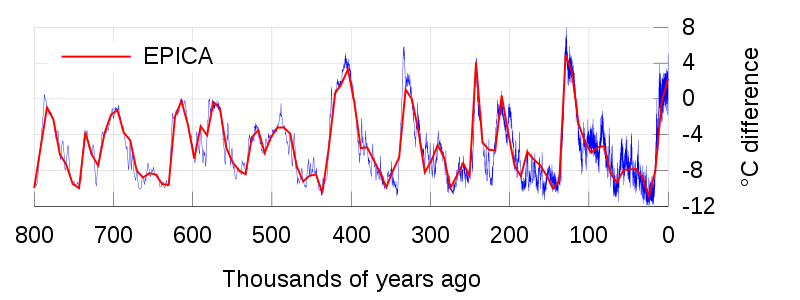
The last 800,000 years have seen a number of ice ages and warming periods (interglacials), some of which were slightly warmer than the present:

Several degrees of warming takes us right off this graph, too. Homo sapiens evolved in Africa 200,000 years ago. If you are middle-aged or younger and in fairly good health, you will likely live to see conditions warmer than any ever before seen by human beings. And the issue is not, "Could this possibly be safe?" but rather "Can we assume this to be safe until such time as we can accurately predict the response of the climate and human civilization to this unprecedented event?

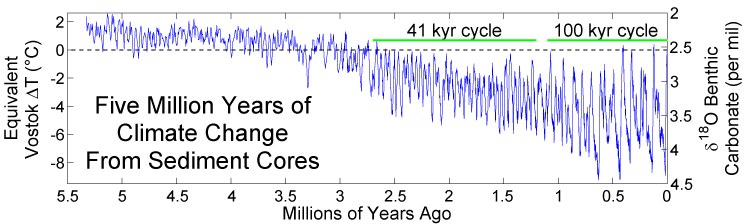
We still haven't gone back far enough.

 We are less than +2C from the warmest temperatures seen on earth in five and a half million years. That's prior to the time, about three million years ago, when apes began to walk upright.

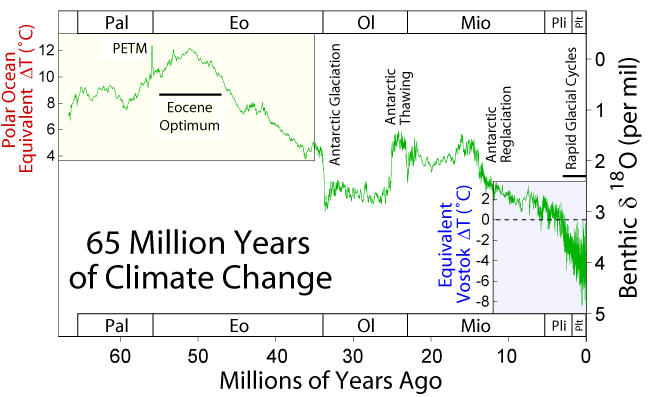
How much further back we can go depends on what range of temperature rise you consider "several degrees." If you consider +8C a possibility, and the AR4 would suggest that it is, you are looking at conditions warmer than any seen on earth in tens of millions of years:


With these changes you are not just changing human living conditions: you are transforming animal and plant ecosystems many times faster than evolution can transform them to cope. You place the earth on a path of mass extinction, from which it will recover, but human civilization as we know it may not. Remember: this unprecedented climate needs to be able to provide food and shelter for nine billion people.

Climate scientists, economists, physicians, biologists and ecologists are all actively researching what the warmer world will means, what effects this radical change will bring. That is their job, but it should not be confused with the need to prove that radically changing the earth's climate without fully understanding the consequences is unsafe. It is unsafe, and stupid, and at the risk of repeating myself, the less you we or can predict about the response of that climate, the more stupid it is.

Thursday, September 22, 2011

Mark Lynas gets Jared Diamond wrong.

Mark Lynas joins the cottage industry of hating on Jared Diamond as he spins a myth of "The myth of Easter Island's ecocide:"

 Few historical tales of ecological collapse have achieved the cultural resonance of that of Easter Island. In the conventional account, best popularised by Jared Diamond in his 2005 book ‘Collapse’, the islanders brought doom upon themselves by over-exploiting their limited environment, thereby providing a compelling analogy for modern times. Yet recent archaeological work suggests that the eco-collapse hypothesis is almost certainly wrong – and that the truth is far more shocking.
As we will see, the most "shocking" thing Lynas brings to bear is evidence of his own incompetence and/or malice in misrepresenting Diamond's argument in the measured, carefully argued Collapse.


Judith Curry spreads the meme, and extends the faulty argument:
[C]omplex coupled social-ecological-environmental systems, simple theories are almost certain to be too simple.  The complexity of such coupled systems precludes simple cause-effect analyses.   If we are arguing about such a system on the scale of Easter Island, what hope do we have of understanding and managing such interactions on  continental or even global scales?  Ecosystems eventually adapt to climate change and insults from humans. 


From arguing that Diamond got Easter Island's tragedy wrong, Curry somehow gets to the point that all of Diamond's thinking is wrong, because it is "too simple," and by the way, climate science is impossible, because it is too simple too. Also, ecological devastation is nothing to worry about because "Ecosystems eventually adapt to climate change and insults from humans." (That single sentence is wrong in so many dimensions -- the moral, the practical, and the scientific -- not just Pollyannish but horribly pantheist and anti-humanist -- that it deserves its own post.)

Judith Curry was once a respected climate scientist. Now she poses for photos like this.

But we should really start with patient zero, Lynas himself. The reality he is describing -- one historian has one idea about how something happened, supported by pieces of evidence, and other historians highlight new evidence that challenges that account -- is really not punchy enough for the kind of "gotcha" post Lynas is writing (those evil environmentalists are trying to scare you!). So he sexes up the allegations with a small army of straw men:
Diamond’s thesis is that the island’s original lush tree-cover was destroyed by the Polynesian colonists, whose cult of making massive statues (for which the island is now famous) required prodigious amounts of wood to transport these huge rock idols. He suggests that as the ecological crisis brought on by deforestation worsened, the islanders tried to appease their apparently angry gods by making and transporting yet more statues, creating a vicious circle of human stupidity.
Anybody who has spent five minutes paying attention to Jared Diamond would know that he would be highly unlikely refer to an entire culture's spiritual practices as a "cult."  The only use of the word "cult" in the entire book refers to a post-disaster religious practice which Diamond regards positively: "The survivors adapted as best they could, both in their subsistence and in religion . . . the new religion developed its own art styles . . ." (141).

 What about the vivid (and given Curry's reaction, unintentionally self-referential) phrase "a vicious circle of human stupidity"? Did Diamond say anything like that?

Actually, if you search Collapse for the word "stupid," you find the opposite -- Diamond stressing the intelligent and cultured native civilizations, whose behavior we unfairly judge, with the benefit of hindsight, to have been unintelligent:

Page 24: "The societies that ended up collapsing were (like the Maya) among the most creative and (for a time) advanced and successful of their times, rather than stupid and primitive."

Page 513: "With the gift of hindsight, we now view it as incredibly stupid that colonists would release into Australia two alien mammals . . . But it's still difficult for professional ecologists to predict which introductions . . . will prove disastrous. . . . Hence, we really shouldn't be surprised."

Page 518: "We unconsciously imagine . . . just a single tree left, which an islander proceeds to fell in an act of incredible self-damaging stupidity. Much more likely, though, the changes in the forest cover from year to year would have been almost undetectable . . ."

Whenever Diamond mentions stupidity (and there's one more reference, on page 624, but it's just the same) it is always to defend societies (and not just native societies; he sticks up for the Australian colonists too) from our harsh judgements, with the benefit of hindsight, that they behaved stupidly.

This is incredibly obvious to anyone that has read any of Diamond's books, including his most famous book, Guns, Germs, and Steel (and if you haven't read it, do). The theme that runs through all of Diamond's writing is that people are people and in the long-term make a similar proportion of good and bad decisions, decisions which however are usually based in a fairly deep understanding of the conditions in which the people at the time lived, decisions that are often smarter and more flexible than we tend to attribute to societies other than our own.

That is Diamond's big idea, and Lynas gets him entirely backwards. So how does he sell this straw man Diamond to the reader? Check out this epic bait and switch:

Diamond was not the first to draw this specific analogy: over a decade earlier, in a 1992 book entitled ‘Easter Island, Earth Island’, Paul Bahn and John Flenley (both palaeoecologists) wrote:
“…the person who felled the last tree could see that it was the last tree. But he (or she) still felled it. This is what is so worrying. Humankind’s covetousness is boundless. Its selfishness appears to be genetically inborn. Selfishness leads to survival. Altruism leads to death. The selfish gene wins. But in a limited ecosystem, selfishness leads to increasing population imbalance, population crash, and ultimately extinction.”
Lynas suggest that Diamond's thesis builds on this one, but as we now know, Diamond's conclusion was precisely the opposite:

“…the person who felled the last tree could see that it was the last tree. But he (or she) still felled it."

Page 518: "We unconsciously imagine . . . just a single tree left, which an islander proceeds to fell in an act of incredible self-damaging stupidity. Much more likely, though, the changes in the forest cover from year to year would have been almost undetectable . . ."

Lynas depicts Diamond as extending the argument of Bahn and Flenley (doubtless the most extreme and unsupportable conclusion he could find) despite the fact that Diamond specifically addresses this theory and categorically refutes it. That's not just a poor argument: it's dishonest to attribute to Diamond a thesis he specifically entertained and vehemently rejected.

There's more here, much more, but after we've caught Lynas using Collapse to attribute beliefs to Diamond which are exactly the opposite of what he wrote in Collapse, that's sort of the end, isn't it? He's committed credibility suicide as that point. As so often with such as Lynas, we are left with the eternal question: is he a liar or just a sloppy incompetent?


UPDATE: Yes, I know I said that catching Lynas in a 180 degree misrepresentation of Diamond was enough to call it right there, but here's one more fun fact about his fallacy-laden screed.

Lynas casually introduces the following reference:

As Benny Peiser points out in this 2005 paper, fish supplies were abundant, and reports from early European explorers that the islanders were thin and miserable-looking are highly contradictory (others report that they lived in comparative luxury). Certainly Diamond’s reading of this seems highly partisan. As Peiser puts it:
“Together with abundant and virtually unlimited sources of seafood, the cultivation of the island’s fertile soil could easily sustain many thousands of inhabitants interminably. In view of the profusion of broadly unlimited food supplies (which also included abundant chickens, their eggs and the islands innumerable rats, a culinary ‘delicacy’ that were always available in abundance), Diamond’s notion that the natives resorted to cannibalism as a result of catastrophic mass starvation is palpably absurd. In fact, there is no archaeological evidence whatsoever for either starvation or cannibalism.”

Sounds bad for Diamond. I'll just do a quick check, as I always do, to make sure this paper is good science by a respected author in a reputable peer-reviewed journal . . .

B. Peiser (2005) From Genocide to Ecocide: The Rape of Rapa Nui Energy & Environment volume 16 No. 3&4 2005
 Energy and Environment. Your source for all your archaeological and archaeometrical needs, without the stress and hassle of peer review. So, Mr. Peiser, how did you come to be publishing in such as illustrious pillar of the historical sciences?

Of course there's a Sourcewatch page:

Benny Peiser is a UK social anthropologist on the Heartland Institute "Global warming experts" list. He runs CCNet (network) and is frequently quoted in Local Transport Today, a transport journal that frequently features the views of climate change skeptics. He is director of the Global Warming Policy Foundation.[1] He is co-editor of the skeptic journal Energy and Environment[2] and is on the editorial board of the Electronic Journal of Sustainable Development.
 An expert in climate change and historical instances of Polynesian cannibalism. Talk about your double threats.

His educational background is not given . . . I'm sure we can all come to a reasonable inference about that. But he is (or was) an academic, to be sure:

Senior Lecturer in Social Anthropology & Sport Sociology, Liverpool John Moores University
 So far Mark Lynas has promoted this clown, and Judith Curry repeats the quote, whilst praising Lynas' "opening mind." Who will be next to join them in embarrassing themselves with lavish praise for psuedoscience? This threatens to become the Jonestown of credibility suicides.