Showing posts with label it's getting hot in here. Show all posts

Monday, July 11, 2011

La Nina officially over


The recent La Nina is officially toast, but we may not see a strong rebound to its opposite, as was the case when the El Nino of 2009 took a whiplash turn for the feminine.


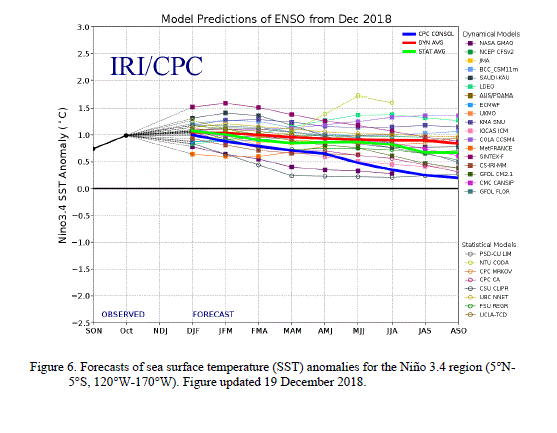
Indeed, some forecasters think we may double dip, falling back into La Nina:


We'll see. I for one would be happy to stay near neutral for a while, given that the solar cycle is also nearing mid-cycle. It could be a rare chance to see some anomalies that may reflect primarily the underlying warming.

Sunday, March 14, 2010

Think global warming is a myth? Head over to Intrade and make some money

Over at Intrade, the odds are running five-to-one in favor of 2010 being one of the five hottest years on record (as measured by GIStemp). If you believe that there's no warming trend, global cooling has begun, etc., this should be easy money if you're right. The odds of 2010 being one of the five warmest years by simple chance variation is 5/131 (3.8%). But Intrade is pricing the contract as if the chance were 82% -- greater by a factor of twenty!

Or maybe you want to play it safe -- betting only against 2010 being the hottest year ever recorded (see the new widget on the right). The odds of this happening by chance are only 1/131 -- 0.76%. But as of tonight, Intrade has it as an even-money bet! All you have to do to double your money is to bet (and be right in betting) that this will not be the hottest year since record-keeping began in the 19th century. Easy!

Of course, January and February were both the second hottest months ever recorded in GIStemp. So the short end of the bet is not looking good. But be bold! Clearly investors have bought into this whole "warming" scam and are ready to put their money are the table.

Aren't you?
Monday, March 1, 2010

End of the solar minimum

February 2010 was the first month in three years in which the Sun has sunspots every day of the month. This is a sign of the end of an unusually long and deep "solar minimum" -- which is the term for the lower portion of a regular eleven-year cycle of sunspots. In 2009, there were 260(!) days without sunspots. Nevertheless, 2009 was tied for the second-warmest year in the instrument record.

The influence of solar variability on the climate is modest -- the sun's intensity varies by a maximum of about 1 W/m^2. But in the short term, especially given the likely persistence of an El Nino through Spring, the upswing in solar radiance may contribute to record-breaking warmth. January and February 2010 were the hottest and second-hottest months in the satellite record, respectively -- which likely makes them among the hottest in the last 1,200 years.