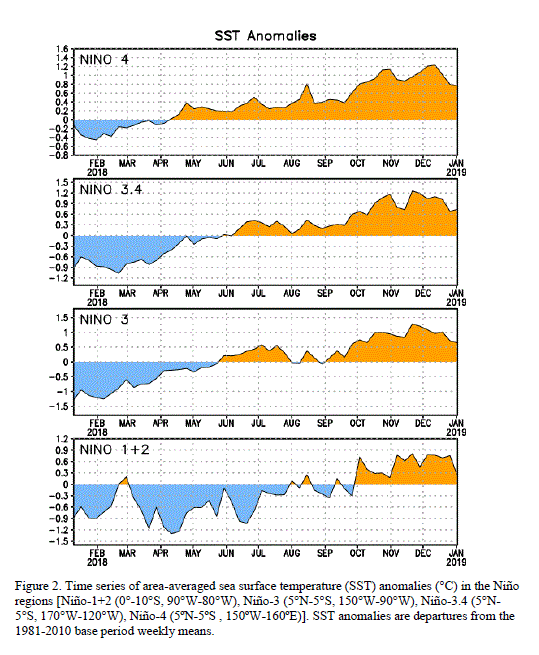
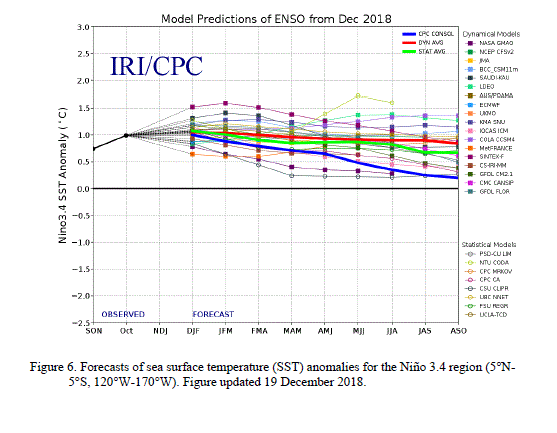
No sooner had we bid farewell to La Nina, with two three-month averages pegging in at 0.0C anomaly, than we started the current abrupt turn back to La Nina conditions in the Pacific. NOAA seems pretty confident now about where this is going:
La Niña conditions have
returned and are expected to gradually strengthen and continue into the
Northern Hemisphere winter 2011-12.
Usually the El Niño-Southern Oscillation (ENSO to its friends) alternates between warm and cool phases. We got a pretty stiff shot of La Nina; we would normally expect El Nino, the warm phase, to be next on our agenda. So how atypical is it for the oscillation to return to baseline and then oscillate right back into the same phase?
It's fairly atypical, but not unheard of.
I hope you can read that, if not, check out a larger color-coded chart in the
NOAA's weekly ENSO update. But here's the gist: when using NOAA's definition of an episode strictly, 24 episodes are followed by the opposite phase, while seven (22.5%) are followed by another episode of the same phase. One chance in five: somewhat unusual, but not rare.
However, if you loosen the definition of an event a little bit, our current circumstances look more atypical than that.
This is the strict definition used by NOAA:
Historical Pacific warm (red) and cold (blue) episodes based on a threshold of +/- 0.5 oC for the Oceanic Nino Index (ONI) [3 month running mean of ERSST.v3b SST anomalies in the Nino 3.4 region (5N-5S, 120-170W)], calculated with respect to the 1971-2000 base period. For historical purposes El Niño and La Niña episodes are defined when the threshold is met for a minimum of 5 consecutive over-lapping seasons.
If you scan the chart, you find two La Nina-ish episodes that just missed the overlapping season cutoff:
1981 from January: -0.3, -0.5, -0.5, -0.4, -0.3, -0.3, -0.4, -0.4, -0.3
2005 from October: -0.4, -0.7, -0.7, -0.6, -0.4
If we count those, we lose two double-Ninos and add four opposite-phase transitions.
We can perform a similar trick with events that counted double after briefly losing their mojo before strengthening again:
1969 from May: 0.7, 0.6, 0.5, 0.4, 0.4, 0.6, 0.7, 0.8
2000 from April: -0.6, -0.5, -0.4, -0.4, -0.4, -0.5, -0.6
Both of those count as back-to-backs because of their brief flirtation with 0.4/-0.4. But the current conditions got to 0.0:
2011: -0.6, -0.2, 0.0, 0.0
If you ask the question of how many times the same phase repeated after making it all the way back to baseline (reaching or crossing 0.0C from either direction),
and didn't have a weak alternate-phase episode that missed counting as such because it was not quite long enough or not quite intense enough,
and then went back into the same phase, the answer is: it's only happened twice in sixty years, out of thirty-five transitions. So what they're projecting will happen would be pretty atypical.
Two caveats: when we mess around with the definitions in looking at a particular present-day event, we are flirting with the
Texas Sharpshooters Fallacy. So except for the entertainment value, we should probably stick with the estimate that this happens about one time in five. Also, while another La Nina episode is forecast, it hasn't happened yet. If it turns out to be too weak to meet the five-seasons cutoff, then goes into an El Nino, then there will have been nothing odd about it at all