Showing posts with label watching the food. Show all posts

Friday, April 19, 2013

WUWT denounces innumeracy, demonstrates illiteracy


Where have all the flowers gone?

Innumeracy is terrible, don't you know (and I suppose they would know):
For any rational discussion of the effects of CO2 on climate, numbers are important.
OK, so far so good, when you mention "rational discussion" in the first sentence the phrase "protesting too much" comes to mind, but numbers are indeed important, so so far, so sane.
 An average temperature increase of 1 C will be a benefit to the planet, as every past warming has been in human history.
 . . . and here comes the crazy. What?
 And the added CO2 will certainly increase agricultural yields substantially and make crops more resistant to drought.
 Evidently the author missed the part where the added CO2 causes warming, droughts, and extreme weather, leading to an estimated 200 million additional food insecure people and 24 million addition malnourished children by 2050.
 But in articles like “Scant Gains Made on CO2 Emissions, Energy Agency Says” by Sarah Kent in the Wall Street Journal on April 18, 2013, we see a graph with a 6 C temperature rise by 2050 – if we don’t reduce “carbon intensity.” Indeed, a 6 C temperature rise may well be cause for concern. But anyone with a little background in mathematics and physics should be able to understand how ridiculous a number like 6 C is.
The article is paywalled, but they also attribute the assertion of 6C by 2050 to Joe Romm, and that we can check:
This is one of the most enlightening calculations I’ve seen in awhile, and it is worth your time to understand it because it speaks clearly to debunk many of the claims of temperature rise in the next 100 years made by activists, such as the 6c by 2050 Joe Romm claims,
Emphasis in the original. But if we follow the link, we discover the headline is the result of a reading comprehension problem:
 “When I look at this data, the trend is perfectly in line with a temperature increase of 6 degrees Celsius [11°F], which would have devastating consequences for the planet.”
2050 is not mentioned. There is a rather obvious error in a Reuters article cited in the post (they've corrected it), but as Romm did not repeat the error, to attribute it to him is simply a lie, and to build a post around "refuting" the red herring is  . . . well, it's what they do. Somewhat more surprisingly, David Appeal made the same obvious mistake. Rabbit is on the case.
Grandpa's favorite climate blog
WUWT, of course, uses this flimsy excuse to launch into a bunch of cargo-cult math, embarking on a "greatest hits" of basic scientific mistakes, including:

  • The warming caused by CO2 is instantaneous! (So the warming caused by 280ppm --> 400ppm is only the warming seen so far.)
  • Never mind, because climate sensitivity is only 1C per doubling! (No evidence for that; it seems to have become an article of faith.)
  • CO2 increases, like any other trend, are completely linear and can be extrapolated infinitely! (If CO2 is rising by 2ppm/year now, that is the rate of change expected for the next 12,000 years.)
WUWT, grandfather of the denialosphere, continues to demonstrate an effortless command of the three Is of full-spectrum ignorance: innumerate, illiterate, and ill-mannered.


Wednesday, August 1, 2012

The body electric


Fact of the day:
The ability to move electricity from power plants to end users will also be threatened by climate change, since electrical transmission lines lose 7 to 8 percent of their transmitting capacity in high temperatures--just when demand for power rises.
This from a study on the effects of climate change on California's grid. Another little bit of knowledge to stew over:
The warmer climate will decrease hydropower generation in the summer months when it is needed most, the report said. High-elevation hydropower plants, which supply about 75 percent of the state's hydropower, are especially at risk, since the small size of their reservoirs allows little flexibility to cope with reduced snowpack.
At the same time, higher temperatures alone will require the state to increase its electricity generating capacity 38 percent over current levels by 2100.
 This is apropos of the crisis this week in India, where a massive blackout left 670 million people in the dark. That's roughly ten percent of the population of the world. Most of the power is back on today, but rolling blackouts and "power holidays" will continue to be a fact of life. (Revkin's roundups here and here.)

India's blackout points to a dangerous climate feedback -- the political feedback. Global warming is going to ramp up demand for electricity and threaten supplies. Not just hydropower but any plant that requires water for cooling (nuclear, coal, gas) can potentially be compromised by the heat. The heat ramps up transmission losses (did you know that? I didn't.) Power lines can be compromised by wildfires, floods, or other extreme weather event.

The political feedback comes when the public demands reliable electricity and doesn't care whether the source of that power makes the long-term problem worse. Some of India's electrical problems stem from a shortage of coal, which in turn is partially the result of the world's largest democracy protecting some of its last dense forests. They are wise to do so, but will they maintain their resolve in the face of events like those of last week?

The adaptive capacity of people is often invoked and praised in the climate debate. (Ironically, those that are most apt to profess unlimited faith in the human capacity to adapt and overcome are the most vehement that we should not start the process of adapting and overcoming.) But humans have another, less admirable characteristic; under pressure people frequently give way to emotional and short-term thinking that worsens the very crisis they are responding to.

The trade protectionism that deepened and prolonged the Great Depression is one classic example. Fighting terrorism by invading Iraq could be considered a recent exhibition. Russia's ban of wheat exports in response to its heat wave disaster is another.

It's critical that the world get on a better energy path before our civilization becomes so stressed that people lack the basic security needed to think about the future.


Tuesday, July 10, 2012

Watching the corn

The extreme heat and drought in the US have cast doubt on the corn harvest, abruptly driving up prices. A useful reminder that, while the continental US comprises only 1.5% of the Earth's surface, we produce 10% of the world's wheat and 20% of the globe's beef, pork, and lamb. And last but not least -- fully half of the world's corn crop, which is America's single bestselling crop.

So this little spot of warm weather we've been having has serious potential consequences for food security around the globe. Which is the problem of global warming in microcosm; it would never be a good idea to radically alter the world's climate to something hotter than any time since we came down to from the trees. But to do so at a time when seven billion people are depending on a complex, interdependent global economic system -- a delicate clockwork mechanism to which we are applying a sledgehammer of abrupt, radial warming -- that is a special kind of idiocy. And we will all pay a price for it.

The USDA is going to release an updated harvest forecast tomorrow. Here's hoping for good news.

UPDATE (7/11): The news from the USDA is not good. They came out of their meeting projecting a brutal 146 bushels an acre, down 20 bushels (%12) in just the last month.

Nor is that all. Expected soybean yield were cut by 8%, and the estimated global wheat harvest was cut by 8 million tons.


Tuesday, March 13, 2012

Watching the maize

From AGWObserver's weekly roundup:

Projected temperature changes indicate significant increase in interannual variability of U.S. maize yields – Urban et al. (2012)

Abstract: “Climate change has the potential to be a source of increased variability if crops are more frequently exposed to damaging weather conditions. Yield variability could respond to a shift in the frequency of extreme events to which crops are susceptible, or if weather becomes more variable. Here we focus on the United States, which produces about 40% of the world’s maize, much of it in areas that are expected to see increased interannual variability in temperature. We combine a statistical crop model based on historical climate and yield data for 1950–2005 with temperature and precipitation projections from 15 different global circulation models. Holding current growing area constant, aggregate yields are projected to decrease by an average of 18% by 2030–2050 relative to 1980–2000 while the coefficient of variation of yield increases by an average of 47%. Projections from 13 out of 15 climate models result in an aggregate increase in national yield coefficient of variation, indicating that maize yields are likely to become more volatile in this key growing region without effective adaptation responses. Rising CO2 could partially dampen this increase in variability through improved water use efficiency in dry years, but we expect any interactions between CO2 and temperature or precipitation to have little effect on mean yield changes.”
 We expect the globe to add 28% more people between now and then. While we can expect improvement in agricultural technology, it would be better to be able to deploy those to meet the expected spike in demand. And what happens in 2080, 2100, 2150? With twice, three times, four times as much warming as 2030-2050?

Increased variability means in the best case more money and energy expended on long-term storage of grain reserves. In the worst case it means shortages and hunger.

Monday, January 2, 2012

Five things I learned in 2011


1. Trees matter. A lot. They sequester more carbon than we thought; they generate cooling aerosols in their own right. We could do a lot to slow the advance of global warming if we decide to stop reducing forests in extent and start intensive reforestation.

2. The howls of outrage from deniers in the blogosphere in response to an argument vary in direct proportion to how effective that argument is with the broader public. There is a scientific consensus, and in many respects, the science is settled. The global is warming, and humans are the cause. Many deniers or "skeptics" get their funding from fossil fuel companies, exaggerate their qualifications, and misrepresent their results. This is simple stuff to those of us that live and breath this stuff, and deniers try to discourage us from making this arguments with howls of rage and jeering contempt. But they are not the people we need to convince, and the people we do need to convince -- the broader disengaged public -- these are powerful messages that should be underscored. Deniers know they are powerful, which is why they try and silence them.


3. Methane and CO2 release from the North (permafrost and methyl hydrates) could be apocalyptic in its effects. But the significance of this is undercut by the fact that the BAU pathway will almost certainly be apocalyptic in its effects. A lot of carbon is going to come out of those frozen deposits, but having studied it a fair bit this year, this quote from Raymond T. Pierrehumbert most closely reflects my own layperson's view:
But the clathrate release problem is in a rather different category from the runaway greenhouse issue. It has to be seen as just one of the many fast or slow carbon catastrophes possibly awaiting us, in a system we are just groping to understand. The models of destabilization are largely based on variants of diffusive heat transport, but the state of understanding of slope avalanches and other more exotic release mechanisms is rather poor — and even if it turns out that rapid methane degassing isn’t in the cards, you still do have to worry about those several trillion metric tons of near-surface carbon and how secure they are. It’s like worrying about the state of security of Soviet nuclear warheads, but where you have no idea what kind of terrorists there might be out there and what their capabilities are — and on what time scales they operate.
Or to put it another way: what would be the state of the climate today if this carbon didn't exist? Call that scenario one:
On a BAU pathway, we face mass extinctions, tremendous human suffering, and unpredictable feedbacks that could greatly accelerate climate change, including ice loss, glacier melt, forest fires, changes in ocean currents, and other known and unknown shifts in the climate and the biosphere.

With intensive mitigation, many of the same problems await us, but will hopefully develop more slowly, over several centuries, blunting the impact somewhat and giving us an opportunity to reverse some of the effects. We still have to worry about unpredictable feedbacks that could greatly accelerate climate change, including ice loss, glacier melt, forest fires, changes in ocean currents, and other known and unknown shifts in the climate and the biosphere, but forcing the system less intensely will, logically, reduce the risk.
Now add the carbon back in:

On a BAU pathway, we face mass extinctions, tremendous human suffering, and unpredictable feedbacks that could greatly accelerate climate change, including ice loss, glacier melt, forest fires, changes in ocean currents, release of methane and CO2 from permafrost and methyl hydrates, and other known and unknown shifts in the climate and the biosphere.


With intensive mitigation, many of the same problems await us, but will hopefully develop more slowly, over several centuries, blunting the impact somewhat and giving us an opportunity to reverse some of the effects. We still have to worry about unpredictable feedbacks that could greatly accelerate climate change, including ice loss, glacier melt, forest fires, changes in ocean currents, release of methane and CO2 from permafrost and methyl hydrates, and other known and unknown shifts in the climate and the biosphere, but forcing the system less intensely will, logically, reduce the risk.
In isolation, the potential for destabilization of this buried carbon would be a looming global catastrophe. But as it is, it becomes one aspect of a global catastrophe already in progress. That's how I see it, anyway.


4. Climate deniers represent a hard fringe of the American right; climate deniers in the blogosphere are an even smaller and more radicalized sub-group. Their views are not only more extreme than the large minority of the public that doubts the science of climate change, or the majority that is not ready to pay a significant price to combat climate change: they are fundamentally different in their outlook. You can see this in the opinion polls; you can see it in the comments and posts they make, in which a extreme anarcho-libertarianism features prominently. This ideology is totally unknown and would be bizarre to most American conservatives; to climate deniers it is practically conventional wisdom. Note also the amazing prevalence of what can only be described as the mentally ill, suffering from delusions that demonstrate grandiosity, paranoia, loose associations, and flight of ideas.

We can win the undecided middle to our side; there is evidence that this is already happening. We do it not by trying to win over or placate deniers, nor by trying to bait them. We win by telling the truth in a clear, simple, understandable way, by being less crazy and more normal, with the caveat that part of being normal is reacting strongly to people who attack hysterically and dishonestly.

5. Even as the overall picture continues to be grim, I found some of the research I came across this year comforting. This is turn reassures me that my filters, such as they are, are not the industrial-strength blast shields one often notes in one's opponents, but can easily overlook in oneself.

Although I remain very concerned about agriculture, I was happy to see that models that incorporated varying the type of crops and where they are sowed found a less severe impact from warming. Some crops will benefit from a CO2 fertilization effect.

Since warming over the last couple of decades has run at about 0.14-0.17C/decade, versus slightly more, 0.18-0.21C, as we would expect from the bulk of the models, the cheerful possibility exists that short-term climate sensitivity is a little lower than we thought, 2-3C instead of 3C-4C (possibly because the aerosol forcing is on the high side). So while the consequences of climate change, like glacier melt, continue to mostly run ahead of the models, it is hopeful that temperatures are running slightly behind. Of course, even a warming of 0.05C/decade or 0.10C/decade would be incredibly fast in geological terms and very dangerous. To see the danger we need only look at the response of the climate and the natural world. Still, better to be warming a little slower than we expected than a little faster.

-----------------------------

What did you learn in 2011?

Sunday, November 6, 2011

Overpopulation as "international socialist" conspiracy


We hit seven billion last week, as per the UN Population Division. Until recently, the world's population was expected to top out at about nine billion and slowly decline. More recent estimates, however, have the population continuing to rise to ten billion and potentially to keep rising (albeit much more slowly) from there.

This is a problem at our present level of development. While we have enough food and water for seven billion people if it were equally distributed, it isn't equally distributed, and it isn't likely to become so in the future. To produce that food and make use of that fresh water, farmers all our the world are using unsustainable practices, from deforestation to overuse of fertilizers and pesticides.

Because of that, even though technology will improve in the future, we don't know if those improvements will keep pace with the degradation of soil, the pollution and depletion of groundwater, the erosion and salinization of coastal lands, the droughts and heat waves of the 21st century. We can reliably expect that, all other things being equal, we will get better at producing food, but meanwhile the physical environment upon which we depend to make food will be becoming significantly more hostile because of our actions. And our food production needs not only to keep pace with these developments, but grow significantly in spite of them.

Of course the savants of WUWT have a simple explanation for all this:
The international socialists see all of this. They figure out: if we can develop an agenda through academia to be followed by the seemingly benevolent, above-the-fray NGOs, then we develop the scholarly agenda of “rights” and “global warming,” then we can feed the govt the science, and tell the govt who to fund to act on the science.

So, the intl socialists have to make up some crises. “Overpopulation,” “reproductive rights,” “global warming,” “pandemic,” etc.
 Yes, just like global warming and disease, overpopulation is a fake problem invented by international socialists to advance their secret agenda via their sinister organs, the NGOs(*).

Concerns about overpopulation are sometimes ad-hom'd to a desire for eugenics or a generally murderous, life-hating outlook:

I maintain that Bonnie Erbe's dopey tribute to Attenborough, "Meanwhile, population explosion ignored" (Courier Times, March 18) reveals "disguised form" eugenics. As Erbe herself notes, "Attenborough points out what I agree with him has become an 'absurd taboo' on speaking out publicly on human population growth and trying to do something about it."
. . .
Erbe parrots Attenborough's hateful bile, which is not even disguised! It would behoove Bonnie Erbe and Sir David to step out of their limos and visit a library.
They would benefit by opening a book once in a while, as there have been many notable ones - AFTER Rachel Carson's Silent Spring.
The logic here (and I use the term loosely) seems to be that if you like people, you want more people, and if you don't want more people, you hate people and you want them to die. The concept that people are nifty but that too many of them could get in each other's way is too subtle, it would seem.

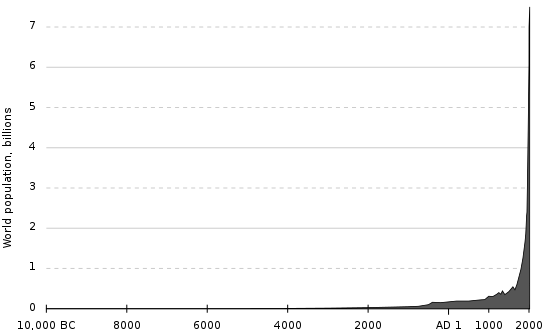
A global population of ten billion people is concerning. Much like what we are doing to the planet's climate at the same time, ten billion humans represent a condition which our civilization has never seen (see the graph above). If they generated greenhouse gases at the same rate per capita as people today, you're talking about a 42% increase in greenhouse gas emissions, at the same time you have a 42% increase in the calories we need to sustain that population. At before you start tilling new fields to feed them, you may want to consider where three Chinas worth of people are going to live.

Since we need more housing and more food, you may want to cut down some forests. Before you do, however, you'd be well advised to read some of the recent literature on terrestrial carbon sinks: "An analysis of inventory data from across the globe suggests that temperate and boreal forests accounted for the majority of the terrestrial carbon sink over the past two decades."

The more people we have, the more difficult it will be to reverse course on greenhouse gas emissions. This is doubly so because many of those new people are going to be born in Sub-Saharan Africa, already the poorest region of the world, and the region expected to experience the most dramatic warming outside the polar regions:

Still, one can make a case that we will be able to cope with overpopulation:
For more than 40 years, climaxing around the first Earth Day, the public has been bombarded with apocalyptic tales of disaster regarding population growth. Paul Ehrlich, for example, a Stanford professor, prominent prophet of population doom and contributor to this op-ed article, predicted in his 1968 bestseller "The Population Bomb" that millions of people would die of starvation during the 1970s because the Earth's inhabitants would multiply at a faster rate than the world's ability to supply food. Six years later, in "The End of Affluence," a book he co-authored with his wife, Anne Ehrlich, the death toll estimates increased to a billion dying from starvation by the mid-1980s. By 1985, Ehrlich predicted, the world would enter a genuine era of scarcity. 
Paul Ehrlich's predicted famines never materialized. While too many people remain hungry, agricultural advances have fought off massive famines. Even as the world's population doubled, per-capita food consumption in poor countries increased from 1,932 calories a day in 1961 to 2,650 in 1998, and malnutrition in those countries fell from 45% of the population in 1949 to about 18%. Furthermore, fertility rates dropped from about five children per woman in the 1960s to about 2.5 today.
 I like how the author drops in that bit about falling fertility -- hey, overpopulation isn't a problem, and anyway, birth rates are falling.

Of course part of the reason birth rates are falling is that some governments, like China's, have actively sought to slow population growth, while other have benefited from rapidly falling birthrates as their people became wealthier and more educated. The collapse of the Soviet Union also led to plummeting birth rates in that part of the world.

It's always going to be possible, in retrospect, to identify wildly overstated or otherwise inaccurate predictions, but we shouldn't conclude, without evidence, that those predictions were universal or  even typical. The same author who fillets Ehrlich toss in this old canard:
[C]oncerns about climate change have shifted from cooling to warming since the 1970s.
Hopefully everyone knows that myth has been repeatedly debunked. Which reminds us to be cautious when someone pulls out an old, inaccurate prediction and asks us to make a number of leaps:

1. That the prediction is being fairly represented.
2. That reality is not different because the warning was heeded (many anti-science folks try to gin up outrage about the "acid rain scare" ignoring the fact that the threat didn't materialize because effective action was taken to mitigate and then reverse the damage.)
3. That the prediction is typical of predictions made at the time.
4. That "those people" making predictions then are similar/the same to "those people" making predictions now (and hence their failures "then" speak to their credibility "now").

That said, I think the author has a point. The green movement does have a history of saying intemperate things. The modern green movement has been largely supported and championed by the left (something of which the left can be proud), and the left has a long history of underestimating the adaptive power of capitalism. Hence leftists of many stripes, from Karl Marx on down, have imagined capitalism collapsing under the weight of its own contradictions in a terrible and glorious smash-up.

That is not going to happen, and those of us who acknowledge the problem of global warming, and the related problem of overpopulation, should make it as clear as possible that that is not our goal. The goal is to use the tremendous productive, inventive and adaptive power of capitalism, not hobble it. This requires a system in which democracy guides money a little bit, rather than money leading democracy by the nose. Markets are a powerful creation, but they are a creation, and they are an expression of human law, not natural law. So to work effectively they need a certain amount of regulation. The pursuit of the individual good will often contribute to the social good, but there are important exceptions. The right-wing climate denial movement would like to equate regulation with central planning and central planning with totalitarianism. Those working to move society towards coping with global warming should not help them by making global warming a proxy fight over the virtues or the sins of a market economy.


* The hostility right-wingers feel towards non-governmental organizations is quite interesting from a philosophical perspective. You'd think that something with "non-governmental" right in the name would appeal to them. The whole "small government" thing assumes that once we "starve the beast" all sorts of voluntary non-governmental organizations will spring up to vaccinate children, clean sewage, sponsor libraries and and provide free education. Private charity is thought to be ready to replace collective action in public good decided upon by our elected representatives.

Yet people actually self-organizing to do good outside the government model are reviled. Corporations are the only nongovernmental organizations of which they approve. Could it be that what they really want is a tyranny of money over people?

Thursday, September 29, 2011

Food prices hockey stick, and the folly of climate isolationism

H/t Climate Progress. When we talk about starvation and climate change, the image that is invoked is one of an apocalyptic future in which absolute scarcity brings hunger to rich and poor alike.That may be in our future, but that's not the way it starts.

We know global warming is already depressing yields of rice, wheat, and corn. This raises the price of these staples -- which, along with soya, ultimately account for three-quarters of the calories we eat. Among those already at the edge of starvation -- the 1.1 billion people living on less than a dollar a day -- sharply higher food prices will push some of them over the edge. Among the 925 million people who are undernourished, some will starve outright (some six million children a year) and many more will have their lives stunted or cut short by ill health. When you double food prices, as has happened over the last ten years, more of those people will go under.


Global warming is not the major driver of the current price rise -- food prices have also spiked due to increasing population and increasing consumption among the wealthy and middle class in the developing world. But they are contributing (and that contribution will only grow), and those that do not have the resources to fight for calories are among the first fatalities from climate change.


There will be some who say, and more who feel, that we can ignore these victims because they are poor, that better governments and better markets could have saved them, and that greenhouse gases and the warming therefrom can be just another export to the developing world from the rich world, that we can live with climate change in which they starve, and we cope with a big hurricane now and then. But that view is willfully blind to the facts. Yes, global warming will hit the poor first and hardest, but it won't stop there.

Eventually, if we do not act, those with the best governments and the best markets will be overcome too. Because of our institutions and our wealth, we have a much greater capacity to adapt, but not a limitless one. The poor, if I may be forgiven a cruel analogy, are canaries in a coal mine. And not just that. We are more connected to each other now than we were in the 20th century. People and their diseases move more freely. Nuclear weapons have spread more widely. Global terrorists have shown their reach. Climate isolationism is no more practical than the traditional sort.


There are those who say, "Let us ignore the continent of Europe. Let us leave it with its hatreds and its armaments, to stew in its own juice, to fight out its own quarrels, and decree its own doom. Let us turn our backs to this melancholy and alarmist view. Let us fix our gaze across the ocean and see our own life in our own dominions and empires." 

There would be very much to this plan if only we could unfasten the British islands from their rock foundations, and could tow them three thousand miles across the Atlantic Ocean, and anchor them safely upon the smiling coasts of Canada; but I have not yet heard of any way in which this could be done. No engineer has come forth with a plan. It would, in any case, take a long time. Have we got a long time?

Wednesday, September 28, 2011

Watching the rice


A new study finds global warming is already depressing rice yields:

Climate change, the monsoon, and rice yield in India – Auffhammer et al. (2011) “Recent research indicates that monsoon rainfall became less frequent but more intense in India during the latter half of the Twentieth Century, thus increasing the risk of drought and flood damage to the country’s wet-season (kharif) rice crop. Our statistical analysis of state-level Indian data confirms that drought and extreme rainfall negatively affected rice yield (harvest per hectare) in predominantly rainfed areas during 1966–2002, with drought having a much greater impact than extreme rainfall. Using Monte Carlo simulation, we find that yield would have been 1.7% higher on average if monsoon characteristics, especially drought frequency, had not changed since 1960. Yield would have received an additional boost of nearly 4% if two other meteorological changes (warmer nights and lower rainfall at the end of the growing season) had not occurred. In combination, these changes would have increased cumulative harvest during 1966–2002 by an amount equivalent to about a fifth of the increase caused by improvements in farming technology. Climate change has evidently already negatively affected India’s hundreds of millions of rice producers and consumers.” Maximilian Auffhammer, V. Ramanathan and Jeffrey R. Vincent, Climatic Change, DOI: 10.1007/s10584-011-0208-4.


H/t AGWObserver. Milo Hamilton, a "global corporate rice buyer for Uncle Ben's," consultant, and president of firstgrain.com, brings the knowledge:

If you have come to hear my short-term price outlook, well here it is: The loss since June of large portions of world wheat and coarse grain production has left us with much higher and more volatile prices for alternatives for farmers to plant in the next year. Even rice may be affected in some areas at the margin by the high prices of corn, wheat and soybeans in particular. Rice as well has suffered some losses in India, Indonesia, Pakistan, China, Cambodia and Thailand as well as in the Western Hemisphere, last year in South America, this year in the United States due to record setting night time temperatures. We may have lost upwards of half a million MT of US paddy rice versus the September estimate from the US Department of Agriculture.
 Increased nighttime warming relative to the average temperature is, of course, one of the telltale features of anthropogenic warming and will be an increasing problem in the years to come.

Hamilton also note the uniquely thirsty nature of rice as a crop:

Water is a particularly difficult issue for all countries with large populations and low levels of ground water per capita. In particular, because rice takes two or three times as much ground water as other rain fed crops, the cost of water can lead to radical changes in how and where rice is grown. A good example is Egypt that is trying to face in to a future where its major River the Nile is projected to stop flowing into the sea within a decade. Notice that Egyptian experts estimate that it takes about six billion cubic meters of water to grow one million acres of Egyptian rice. If folks start charging for water, the price of rice could go to very high levels.
The loss of reliable glacier runoff, worsening droughts, and the salinization of the water table that can be expected with rising seas will all exacerbate a problem of water scarcity created by overpopulation, subsidy and waste.


The long-term outlook for rice is grim:

South Asia is home to nearly 22% of the world’s population, including 40% of the world’s poor. Agriculture plays a critical role in terms of employment and livelihood security for a large majority of people in all countries of the region. The region is prone to climatic extremes, which regularly impact agricultural production and farmers’ livelihood. Himalayan glaciers, a major source of water for the rivers in the Indo-Gangetic plains, are projected to significantly recede in future that could affect food and livelihood security of millions of people in Pakistan, Nepal, Bhutan, India and Bangladesh. Climate change is further projected to cause a 10–40% loss in crop production in the region by the end of the century.
 Accompanied by a 50% increase in population. Remember the number -- 14.5 trillion calories a day. It's non-negotiable. And it's under threat.

Thursday, September 8, 2011

Deniers pwnd


What a week. Texas burned in the midst of its global-warming-fueled drought, and in Somalia hundreds of people were dying every day of hunger and thirst, in a region driven to the edge of mass catastrophe by a combination of critical drought, high food prices, and political and social chaos.

Spencer and Braswell continued to take a beating, as Dessler (2011) exploded their toy models with actual data, and showed their sloppy methods implied ocean warming causing ocean warming. Skeptics were duely chastised and promised to curb their overreaching claims based on unphysical models ignoring actual physical evidence (kidding about that one.)

Rick Perry took the Galileo Effect mainstream in last night's Republican debate, but not before we explored how totally nonsensical such an invocation is:


Perry's bumbling invocation of this minor myth was part of a shrill and unimpressive showing in which he called Social Security a "massive lie" and a "Ponzi scheme." In this the new face of climate denial? Let's hope so.

Meanwhile, two other denier candidates, Michelle Bachmann and Ron Paul, went on record opposing mandatory vaccinations for schoolchildren. As we've noted before, the different strains of anti-science denial have significant overlap.

The Yale Project on Climate Change Communications had some good news for those of us who spend too much time in the blogosphere: outside the Tea Party, every group of voters -- including Republicans, albeit more narrowly than Democrats or independents -- favors a binding international treaty to cut CO2 emissions. The Tea Party -- only 12% of the population -- are the only ones who think global warming isn't happening.

How little influence do "loud and proud" deniers wield? More than three-quarters of the public has never heard of "climategate." Half the Tea Party members have never heard of it.

Sea ice volume is at record lows, area and extent will go down to the wire vs mighty 2007. The sea ice volume chart really tells the tale:


After the plunge in 2007, we see a slight increase in the seasonal low the following year, as you would expect, based on the principle of regression towards the mean. But with that one exception, every year for the past ten years has seen the ice hit a new record low. It's awfully close to the continual steady change that deniers always demand as proof of outside influence -- although since that kind of steady change is rarely seen in large, complex systems, it really implies such a rapid change that the natural variation of the system has been completely overwhelmed.

Climate scientists continue their observations of the natural world, while also, gradually, improving how they communicate scientific findings:


And the public is willing to listen: scientists are still be far the most trusted source of information about climate change -- even among deniers!

All and all, if you deny the physical reality of global warming and view mitigation of these rapid, irreversible changes as an eco-Marxist conspiracy to install the collectivist New World Order, you might want to take a long weekend, start fresh on Monday. Because this week things are just not going your way.

Friday, July 8, 2011

Dry areas have increased, ctd


Yesterday I pointed to this study, which found:

widespread drying over Africa, East and South Asia, and other areas from 1950 to 2008, and most of this drying is due to recent warming.


It was remiss of me not to translate the scientists' calm invocation of "widespread drying" into human terms. The Economist, always prompt, supplied my lack the day before, reporting on some of that "widespread drying over Africa":

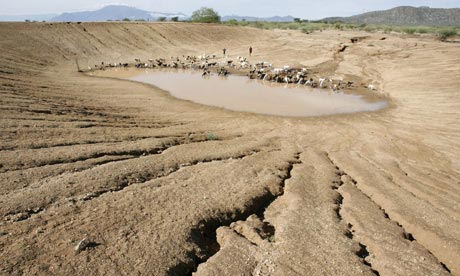
Yet, after the worst drought in 60 years, more than 10m people in the Horn of Africa need emergency food aid. Livestock have been annihilated. Hundreds of thousands of people are streaming into refugee camps in search of help. Malnutrition rates in some areas are five times more severe than the threshold aid agencies use to define a crisis. Many children are already dying of starvation.

The areas most affected by the drought are northern Kenya, south-eastern Ethiopia, southern Somalia and Djibouti. The region’s last two rainy seasons were meagre. Rivers and boreholes are running dry, crops failing, traditional grazing land turning to dust. Up to 60% of cattle and goat herds, the main assets for many of the worst-affected people, have perished, their corpses and skeletons littering the plains.


Keep watching the food:

Soaring world food prices have made matters worse. In Somalia the cost of sorghum, the local staple, has risen 240% since last October. In Kenya the price of maize has tripled. Food hoarding is reportedly aggravating shortages—even where rain has been plentiful.


Bear in mind that humans don't usually respond optimally to crisis:

Soaring world food prices have made matters worse. In Somalia the cost of sorghum, the local staple, has risen 240% since last October. In Kenya the price of maize has tripled. Food hoarding is reportedly aggravating shortages—even where rain has been plentiful.

Saturday, June 4, 2011

The New York Times is watching the food

Yes, it has already begun:

Consumption of the four staples that supply most human calories — wheat, rice, corn and soybeans — has outstripped production for much of the past decade, drawing once-large stockpiles down to worrisome levels. The imbalance between supply and demand has resulted in two huge spikes in international grain prices since 2007, with some grains more than doubling in cost.

Those price jumps, though felt only moderately in the West, have worsened hunger for tens of millions of poor people, destabilizing politics in scores of countries, from Mexico to Uzbekistan to Yemen. The Haitian government was ousted in 2008 amid food riots, and anger over high prices has played a role in the recent Arab uprisings.

Now, the latest scientific research suggests that a previously discounted factor is helping to destabilize the food system: climate change.

Many of the failed harvests of the past decade were a consequence of weather disasters, like floods in the United States, drought in Australia and blistering heat waves in Europe and Russia. Scientists believe some, though not all, of those events were caused or worsened by human-induced global warming.

Temperatures are rising rapidly during the growing season in some of the most important agricultural countries, and a paper published several weeks ago found that this had shaved several percentage points off potential yields, adding to the price gyrations.


More tomorrow on this.

Monday, May 9, 2011

Watch the food, ctd

This study on crop yields and warming has been all over the news recently, with great background here and great analysis here. These results compliment earlier research, which found:

Days above 30°C are particularly damaging. In otherwise normal conditions, every day the temperature is over this threshold diminishes yields by at least 1%. Moreover, days where the temperature exceeds 32°C do twice the harm of those at 31°C. And during a drought, things are worse still. Then, yields take a hit of 1.7% per day over 30°C.

This matters because increasing the average temperature only a bit can multiply the number of the hottest days a lot. The research predicts that a 1°C rise in average temperature will reduce yields across two-thirds of the maize-growing region of Africa, even in the absence of drought. Add drought and that effect spreads over the entire area.


The Economist, bless them, trust their readers know why a linear increase in temperatures produces an exponential increase in really hot days. But for the benefit of my fellow liberal arts majors, let me illustrate. Temperatures, like most quantities determined by the interaction of multiple factors (height and longevity are other examples, but this in fact applies to the behavior of most outputs of most systems) fall along a Gaussian distribution, aka a bell curve:


This is one of the more useful statistical concepts to get comfortable with. It's intuitively obvious, but often we make mistaken deductions about systems with the idea that the outcomes on the edge of the distribution are far more common and representative than they really are.

Does it really work? It really works:


So what happens to this curve if you warm things up a bit, if you shift the average?


(Don't you love it when the very image you want is right there waiting for you on Google images? Isn't the internet grand?)

One thing that happens when you increase the average temperature, shifting the curve to the right, is that the thin edge of the curve goes into new territory . . . and hence you get new temperature records. You also get a lot of days that are one or two degrees warmer than average, but you had a lot of those to begin with, right in the fat part of the curve. Where you are going to see a dramatic change is in the days that used to be in the wedge, but have now been pushed towards the middle. Because if you look just at that part of the curve, you see this:


But by shifting the curve to the right, we move our 30C or 32C day to the left, so if we flip the curve into the conventional orientation, rightward towards the future, we get:


And finally we have a picture of what is going to happen, and in fact is already happening, to the number of crop-wiltingly hot days.

Believe it or not, this is not the worst news in the climate realm this week. That honor goes to the UN study projecting further population growth through the rest of this century, peaking not at nine billion, but reaching ten billion and beyond. More on that anon.