Sunday, April 12, 2015

Desalinization and the fragile society


California is looking towards desalinization to address its water shortage:

Now, for the first time, a major California metropolis is on the verge of turning the Pacific Ocean into an everyday source of drinking water. A $1 billion desalination plant to supply booming San Diego County is under construction here and due to open as early as November, providing a major test of whether California cities will be able to resort to the ocean to solve their water woes.
This is part of a larger trend:
Across the Sun Belt, a technology once dismissed as too expensive and harmful to the environment is getting a second look. Texas, facing persistent dry conditions and a population influx, may build several ocean desalination plants. Florida has one operating already and may be forced to build others as a rising sea invades the state’s freshwater supplies.
In California, small ocean desalination plants are up and running in a handful of towns. Plans are far along for a large plant in Huntington Beach that would supply water to populous Orange County. A mothballed plant in Santa Barbara may soon be reactivated. And more than a dozen communities along the California coast are studying the issue.
This trend shouldn't be viewed in isolation, but rather as part of a broad suite of high-tech, high-capital, energy intensive solutions -- or "solutions" -- to environmental problems created or (more often) intensified by population growth and climate change.

Other examples include the vertical farming movement (a more recent write-up is here) and the increasing reliance of sky resorts on snow machines. Global consumption of air conditioning is rising rapidly and the latent demand for it is already vast.
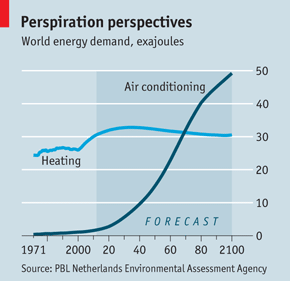
Source
The result of these trends is apt to be a global society that is more comfortable, and more insulated from temporary shifts in weather. These are, of course, good things in and of themselves. They illustrate that there are (as few doubted there were) technological fixes that allow us to adapt (to some extent) to a warmer world.

But while a society that is increasingly dependent on such devices is in the short term more robust, it is in the longer term more fragile. The more you rely on energy-intensive, technologically sophisticated "solutions" to maintain reliable supplies of things as basic to human survival as food and water, the more vulnerable said society is to disruptions that may compromise those work-arounds.

While a society with desalinized drinking water is more resistant to drought, it is only so as long as the power in on, and the engineers come to work, and the spare parts are in supply. Lose that, whether to extreme weather, or war, or terrorism, or some other disruptive force -- and in addition to your other problems you will be very thirsty, very quickly.

We already live in a technological society, of course. I'm under no illusions that we would be able to feed seven billion people without the factories that produce fertilizer or the trucks and ships which move those fertilizers to the farm or the food to the market. Technological dependence exists along a spectrum. Things like desalinization move us further along that spectrum [1]. So while we store up more climate stresses for the society of nine billion people who will be confronting them at mid-century, we are also bequeathing to them an infrastructure which will be more vulnerable to catastrophic collapse -- a tall tower built taller even as the winds begin to howl.

-----------------------------------------
1. This is especially concerning when we push ourselves down that spectrum for no good reason, and desalinization in California is a perfect example of this. In California, as in most other places, the lion's share of the water -- more than three-quarters of it -- is used by agriculture. But when Gov Jerry Brown announced his emergency plan to save water across the state, he asked virtually nothing from the agriculture sector:
Brown's seven-page executive order, issued Wednesday, outlined the first statewide mandatory water use restrictions in California's history.

Among them: He ordered a 25% reduction in urban use statewide compared to 2013 levels. The directive also bans the use of drinking water to irrigate median strips in public roads, initiates the removal of 1,150 football fields worth of grass to be replaced with drought-tolerant plants; and orders golf courses, campuses and cemeteries to significantly cut their water consumption.
Agricultural mandates were fewer and milder. Irrigation districts were directed to develop drought management plans that include supply and demand data. Agencies in basins where groundwater has been overpumped must immediately monitor groundwater levels.


Ignoring three-quarters of the consumption during a period of unprecedented drought is obviously a political decision, not a practical one. In this context, the valuable technological asset of desalinization is not being put to use to adapt to climate change so much as to adapt to political cowardice and a feckless electorate.

Thursday, April 9, 2015

Denier comment of the day: undermedicated at WUWT

So, let's talk about what went wrong here. First question: what is it about the mentally ill that makes them adverse to paragraph breaks? Really, I sincerely wonder this. Lots of great writers and artists in general have been pretty nutty, yet skilled at their craft. But if you wander into the dark corners of the internet where aliens built the pyramids, vaccines cause autism, or "the Greenies" cooked up the global warming scare, you get headache-inducing rambling like this, the written equivalent of pressured speech. At a certain point horror gives way to pity, and I just wish I could help.

The CO2 numbers are wrong in predictable and boring way, debunked by better men than I here and here. But I do find this interesting: "CO2 naturally is . . . ."

Essentialism is, of course, not a scientific concept. It's interesting to me that for all their hostility to "greenies," many deniers partake in this idea of a natural world with a fixed set of characteristics which is set apart from humans and our influence. This set of assumptions clashes with many other parts of their Weltanschauung, but it creeps in over and over.
A trace gas in our atmosphere being blamed for as we all know here, everything bad. Somehow my civilian intellect is screaming WTF? That on the surface does not make any sense to me.
The denier has a high regard for his own intuition, which he confuses with rational thought. They form a false idea of the subject which emerges from their lack of understanding of the physical world and is animated by paranoia. The reminder of their process of deduction will involve seeking out confirmatory evidence and ideas and shunning other facts and arguments as the pleas of the condemned.
I have complained before to the CAGW Alarmists, I want them to explain exactly
Like a particularly obnoxious child, the denier firmly believes that other people owe him "exact" answers to any question he might be able to formulate, and that a free education is his right. Meanwhile, with ignorance his holy shield, he will beat off any effort to actually help him bring his thoughts in line with reality.
When I read these reports and NOAA comes out saying warmest winter ever, I get crazy.
 Your words, man. Your words.


Wednesday, April 8, 2015

Tuesday, April 7, 2015

El Nino leans in

I've written several times about the record-breaking "pause" in El Nino events, which occupied most of 2010 and all of 2011, 2012, and 2013 and continued until the last few months of 2014.

The "pause" lasted 54 months (or rather, 54 three-month averages) which was the longest since NOAA began keeping records, and by a good bit. The runner-up "pause" is 1959-63, 51 months.

This Nino started out anemic and is still, as yet, pretty weak sauce, with a Tmax of +0.7C. For a while it looked as though it might fade out before qualifying as an El Nino (which requires 5 months at or above +0.5C) or might just hit that mark before fading away. And indeed, +0.7C was last seen two months ago and we are presenting clinging to the lower bound of El Nino (+0.5C for the first 3 months of this year.)

But the thing is perking up. This week we're back to +0.7C for the weekly numbers, and the forecasters seem to be coming around to the notion that the event will continue to strengthen:

If the El Nino does strengthen in this way, obviously 2015 could very well break the record set by 2014. And if it is still strong going into 2016, the first part of that year may be very hot as well.

Wednesday, March 4, 2015

Cutting emissions with rail upgrades, or, stuff white people like

Source


A lot of the discussion about carbon emissions is pretty one dimensional -- more low carbon energy means less emissions. Efficiency, when it enters the discussion, is often conflated with conservation -- which, at least to Americans, carries connotations of making do, of cutting back, of low-flow toilets, brief lukewarm showers, and long bus rides to work listening to homeless people ranting about the CIA's implants in their teeth. Somehow, this has not caught on.

It is a mistake to confuse conservation and efficiency. Efficiency can be big, bold, and transformative. For example: doubling and electrifying America's railway system.

About 39.5% of US freight is transported by rail. The vast majority of the American rail system is powered by onboard diesel engines. This is an inefficient, wasteful technology with large associated carbon emissions. Electrified rail has been around for decades, and not only allows you to power your train with zero-carbon energy from whatever source, but also decreases the energy requirement as the train doesn't have to haul a diesel engine with it. Power can be recaptured via regenerative braking, just like a hybrid or electric car.

The second major problem with the American rail system is congestion. In many areas, traffic slows to a crawl, averaging 4mph or less. The Chicago area is a particular offender:
A recent trainload of sulfur took some 27 hours to pass through Chicago — an average speed of 1.13 miles per hour, or about a quarter the pace of many electric wheelchairs.
Obviously the comparably slow speed of rail transport, due to congestion, is one of the reasons the rail system, passenger and freight, have continued to lose market share to the roads. The solution is simple: double the tracks. Most railroads in America are single-track, meaning there's no passing lane. Every mechanical problem, every delay ripples back through the rest of the system. With doubled lines everywhere a slowed or stopped train can simply be bypassed.

So what would be the cost of that? Obviously there would have to be a costly study to determine the cost, but as a back-of the envelope calculation, a recent project in Spain doubled and electrified the tracks of an existing railway at a cost of €2.125million/km. Apply that to the US railway system (ignoring the economies of scale inherent in a far larger project, and cost differences due to terrain, etc.) the cost to double and electrify the entire US rail system would be about $500 billion.

That's a steep bill, but infrastructure spending returns a lot of money to the economy with new jobs and business growth. As a comparison, the Fed's Quantitative Easing program, in which the government essentially prints money and gives it to the banks, has printed up $3.8 trillion so far, a total that continues to rise by $85 billion per month. Yes, really.

We need to think bigger. A zero-emissions future is not going to look like today. Our economy needs to be fundamentally restructured, beyond adding bike lanes and wind farms (as good and helpful as those things are.) And in the political sphere, climate hawks have been caricatured as anti-consumer, anti-growth, neo-Puritan hippies (and some are; not that there's anything wrong with that).

The people buying into this messaging and off-put by it are the white, conservative, hierarchist males. And you can resent 'em if you want, but there are a lot of them and they have a lot of power. Maybe nothing will get them on the right side of history, but if anything can, it will have to start with showing them that our dreams for our country are big, bold, and ambitious, and that the world after fossil fuels is one of abundance and hard-driving industry.

Friday, January 16, 2015

GISTEMP is in: 2014 is the hottest year; there's still a tiger in your bedroom

Anomaly +0.68C. 2014 edged out 2010 at +0.66C.

Warming continues to be closely in line with the trend since 1970:

Many people have tried to explain this to climate deniers, who chose not to understand it (1). If anyone else is confused by it, this is the bottom line: you need to apply the same standard of proof to a hypothetical change in the warming trend as you would to determining the existence of a trend in the first place.

Having determined that there has been a warming trend of about 0.16C/decade for the 30 years between 1970 and 2000, the correct question is not has the warming stopped OMG (a question you will never be able to answer with a few years of data) but rather is there any reason to think the trend is different from what it was before?

If you determine there's a tiger in your bedroom, and then (wisely) don't go into your bedroom for a while, the test for whether there's still a tiger there in not whether you've heard it roar in the last 5 minutes. Unless you have convincing evidence, you probably should conclude that the tiger's still there, until and unless you get some strong evidence something has changed.

-------
1. 
So, what is wrong with Cruz’s statement?  Well, assuming that by ‘recorded warming’, he means the satellite-derived lower atmospheric surface temperatures his statement is absolutely correct.  If he is referring to globally averaged surface temperatures since 2000, there is only a very small amount of warming; this small amount of warming is indeed contrary to the theory of AGW.
Who? Who else?

Wednesday, January 14, 2015

For Whom the Bell Tols: Hot Emotion, Denier Logic in Tol's Latest Screed

Hey, look, Richard Tol knows global warming is real!
It means more or less rain, snow, wind, and clouds in various places. It means different outcomes for plants, whether direct or, since plants compete for resources, indirect. It means changes for the animals that eat those plants. And this includes changes for everything that hitches a ride on those plants and animals, and hence changes for all sorts of pathogens. Nature, agriculture, forestry, and health will all be different in the future. The seas will rise as water expands and glacial ice melts, affecting coastlines and everyone and everything that resides there. Water supplies will be affected by changing rainfall patterns, but water demand will also be altered by changing temperatures. Energy demands will change, too; there may be less need to heat houses in winter and perhaps greater need to cool them in summer. Traffic, transport, building, recreation, and tourism, too, will all feel the impact of a changing climate.
 Unfortunately, his ability to think rationally about what that means is, well, disappointing:
For some, the mere fact of these impacts is reason enough for governments, businesses, and individuals to exert themselves to reduce greenhouse gases to minimize the change. That is strange logic, however. Change, after all, can be for the better or the worse, and at any rate it is inevitable; there has never been a lengthy period of climate stasis.
There are multiple levels of facepalm committed here. None are entirely new (the boring repetitive nature of climate denier is one of the reasons you do not see more debunkings here) but they are startling from the mouth of a once-respected economist.

You have the notion that climate change is no big deal because "climate is always changing." We might equally argue that being shot in the head is no big deal, because the composition of our bodies is always changing. In other words, it's breathtaking stupid know-nothingism trying to pass itself off as judiciousness.

Of course if changes in temperature of the magnitude we see unfolding today were common in human history, Tol might have a hint of a glimmering of a point here. But in fact, as he well knows, the entirety of recorded human history has taken place with the assistance of an 8,000-year period of highly stable climatic conditions -- what one might call a lengthy period of climate stasis.

Eight thousand years of flat
 So in fact, "Change happens" is meaningless as far as it is accurate, and inaccurate as far is it is meaningful.

But that trope is sagacity itself next to Tol's next fallacy:

Just as there is no logical or scientific basis for thinking that climate change is new, there is no self-evident reason to assume that the climate of the past is “better” than the climate of the future. With just as little logic, we might assume that women’s rights, health care, or education were necessarily better in the past.
 Are we here seeing Tol preparing to abandon an unfulfilling career as an economist, and embark on a mid-life career shift to Platonic philosopher? Because it is philosophers who sit in their studies and worry themselves about self-evident truths derived from pure logic alone. Scientists, even of the dismal sort, are expected to look outside into the world from time to time.

What I can't get over about this essay is how much ignorance it express of basic economic principles, principles that Tol, as a trained and extensively published economist, should know in the marrow of his bones.

Do I exaggerate? Well, economic concepts do not get a lot simpler than sunk capital. Sunk capital means that once you've put your money into certain things, you can't get it back. It follows from that, as even a bright eight-year-old could grasp, that rapid changes in the environment pose a risk to sunk capital.

Tol's claim that the future of the climate is just as likely to be good for humans as it is bad would be applicable to the first human beings setting foot on a new world, presuming they knew nothing at all about it to begin with (an analogy I've explored before.)

If you ask the (ludicrously unprepared) space colonists if they would like it a degree warmer or a degree cooler, they have no rational reason to care. It might be better a little warmer or a little cooler, then again, it might be completely uninhabitable either way.

But of course this is not remotely the situation we are in. Besides the fact that we know we can exist in this climate, and we don't know if we can exist, without a horrific die-off, in a world 3C or 4C or 6C degrees warmer, there is the additional problem, which I alluded to above, that we have trillions or dollars in sunk capital investments optimized for this climate, not a radically different one.

There is no rational question as to whether a sea level rise of 5m is "better" for humans, because we know that vast amounts of capital and high-value property would be destroyed. There is no rational question as to whether a +5C world would be better for farms; at best, some new areas may be opened up to agricultural productive, but the existing farms, and the existing communities they support, will suffer horrific (and expensive) harm.

So the "Hey! Rapid radical climate change could just as easily be to something better!" argument makes no sense at all. And the nonsensical nature of the argument is emphasized with odd and completely irrational comparisons to deliberate progressive reforms: "With just as little logic, we might assume that women’s rights, health care, or education were necessarily better in the past"

Now the deliberate change of social rules and government policies to achieve a benefit is compared directly with a massive, unintended set of changes to the earth. What?
The climate of the 21st century may well be unprecedented in the history of human civilization; the number of people living in countries with free and fair elections is unprecedented, too. So what? “Unprecedented” is not a synonym for “bad.”
Does Tol perhaps think that he will appeal to the left with a facile comparison of environmental disaster to the progress of human liberty? Because make no mistake, he is raving. Biological arrangements aren't comparable to social structures. In biological arrangements, unprecedented is bad. If the doctor comes out of your mother's surgery to tell you that they found something "unprecedented," do you think you're about to hear something good about her prognosis?

Rapidly acidifying the oceans versus Thomas Paine publishing Common Sense. Expanding ranges of deadly tropical diseases versus the Voting Rights Act. Are they different? Are they the same? Is Tol seriously arguing this?

He goes on, invoking the shibboleth of "cheap energy" ("Cheap energy fueled the industrial revolution, and lack of access to reliable energy is one factor holding back economic growth in most developing countries" but without offering any evidence for either assertion.) Fundamentally, though, this essay represents a step away from Tol's lukewarmism and towards simple climate denial. For years he's published studies of the costs of climate change, studies which consistently found much lower costs than those of his peers. But fallacies like the above go beyond that. Now he seems to be plunging into outright blog scientist logic and advance-stage Curryism.