Showing posts with label air conditioning. Show all posts

Sunday, April 12, 2015

Desalinization and the fragile society


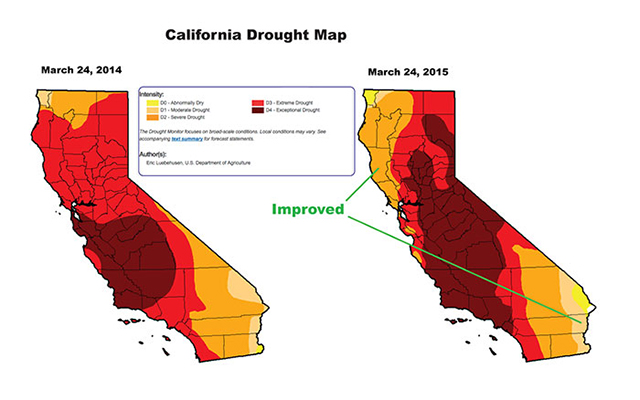
California is looking towards desalinization to address its water shortage:

Now, for the first time, a major California metropolis is on the verge of turning the Pacific Ocean into an everyday source of drinking water. A $1 billion desalination plant to supply booming San Diego County is under construction here and due to open as early as November, providing a major test of whether California cities will be able to resort to the ocean to solve their water woes.
This is part of a larger trend:
Across the Sun Belt, a technology once dismissed as too expensive and harmful to the environment is getting a second look. Texas, facing persistent dry conditions and a population influx, may build several ocean desalination plants. Florida has one operating already and may be forced to build others as a rising sea invades the state’s freshwater supplies.
In California, small ocean desalination plants are up and running in a handful of towns. Plans are far along for a large plant in Huntington Beach that would supply water to populous Orange County. A mothballed plant in Santa Barbara may soon be reactivated. And more than a dozen communities along the California coast are studying the issue.
This trend shouldn't be viewed in isolation, but rather as part of a broad suite of high-tech, high-capital, energy intensive solutions -- or "solutions" -- to environmental problems created or (more often) intensified by population growth and climate change.

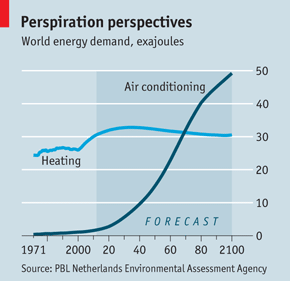
Other examples include the vertical farming movement (a more recent write-up is here) and the increasing reliance of sky resorts on snow machines. Global consumption of air conditioning is rising rapidly and the latent demand for it is already vast.
Source
The result of these trends is apt to be a global society that is more comfortable, and more insulated from temporary shifts in weather. These are, of course, good things in and of themselves. They illustrate that there are (as few doubted there were) technological fixes that allow us to adapt (to some extent) to a warmer world.

But while a society that is increasingly dependent on such devices is in the short term more robust, it is in the longer term more fragile. The more you rely on energy-intensive, technologically sophisticated "solutions" to maintain reliable supplies of things as basic to human survival as food and water, the more vulnerable said society is to disruptions that may compromise those work-arounds.

While a society with desalinized drinking water is more resistant to drought, it is only so as long as the power in on, and the engineers come to work, and the spare parts are in supply. Lose that, whether to extreme weather, or war, or terrorism, or some other disruptive force -- and in addition to your other problems you will be very thirsty, very quickly.

We already live in a technological society, of course. I'm under no illusions that we would be able to feed seven billion people without the factories that produce fertilizer or the trucks and ships which move those fertilizers to the farm or the food to the market. Technological dependence exists along a spectrum. Things like desalinization move us further along that spectrum [1]. So while we store up more climate stresses for the society of nine billion people who will be confronting them at mid-century, we are also bequeathing to them an infrastructure which will be more vulnerable to catastrophic collapse -- a tall tower built taller even as the winds begin to howl.

-----------------------------------------
1. This is especially concerning when we push ourselves down that spectrum for no good reason, and desalinization in California is a perfect example of this. In California, as in most other places, the lion's share of the water -- more than three-quarters of it -- is used by agriculture. But when Gov Jerry Brown announced his emergency plan to save water across the state, he asked virtually nothing from the agriculture sector:
Brown's seven-page executive order, issued Wednesday, outlined the first statewide mandatory water use restrictions in California's history.

Among them: He ordered a 25% reduction in urban use statewide compared to 2013 levels. The directive also bans the use of drinking water to irrigate median strips in public roads, initiates the removal of 1,150 football fields worth of grass to be replaced with drought-tolerant plants; and orders golf courses, campuses and cemeteries to significantly cut their water consumption.
Agricultural mandates were fewer and milder. Irrigation districts were directed to develop drought management plans that include supply and demand data. Agencies in basins where groundwater has been overpumped must immediately monitor groundwater levels.


Ignoring three-quarters of the consumption during a period of unprecedented drought is obviously a political decision, not a practical one. In this context, the valuable technological asset of desalinization is not being put to use to adapt to climate change so much as to adapt to political cowardice and a feckless electorate.

Saturday, December 3, 2011

Air conditioners all the way down

A well-known scientist (some say it was Bertrand Russell) once gave a public lecture on astronomy. He described how the earth orbits around the
sun and how the sun, in turn, orbits around the centre of a vast collection of stars called our galaxy. 
At the end of the lecture, a little old lady at
the back of the room got up and said: "What you have told us is rubbish.
The world is really a flat plate supported on the back of a giant
tortoise." 
The scientist gave a superior smile before replying, "What is
the tortoise standing on?" 
"You're very clever, young man, very clever,"
said the old lady. "But it's turtles all the way down."


I came across this interesting inaction rationale in the latest Economist analysis of Durban:
Recent work by, among others, Michael Greenstone at the Massachusetts Institute of Technology backs that approach. It shows that hot spells kill few people in air-conditioned America; but in India, where 300m have no access to electricity, the death toll is huge. India’s priority is to provide its people with electricity, and one day air-conditioners. That this will increase its emissions is less a problem for India than for the world. It therefore views any suggestion that it should be bound to curb its emissions as a threat.
Assuming that is indeed a line of argument in India (and the Economist is usually quite reliable) I was interested in how practical this approach might be, so I did some back-of-the-envelope calculations. Readers should feel free to point out obvious errors. Here we go:

There are about 1.2 billion people in India. That number is expected to rise to 1.6 billion by 2050. Let's say we want to protect them from global warming by providing them with central air in their homes and businesses (we could preserve their lives by, say, cooling a single room in their homes and making them all rest and sleep there, but let's assume they don't want to lead that sort of miserable existence.) Let's estimate about 200 million households needed residential air; there will probably be more than that by 2050, but let's be conservative. Some of them may live in cool regions; some already have air conditioning, factoring in to India's current power costs and greenhouse gas emissions, which for the record are:

India (thousands of tons of CO2): 1,742,698

We will also give them 50m commercial systems; they can't spend all day in their houses. We don't need people dropping from heat stroke in the factories, offices, the call centers and the banks.

Using this helpful wikipedia article, I estimated the residential systems would need about 3 tons of refrigeration, while I estimated the commercial systems very conservatively at 10 tons. One ton of refrigeration consumes 3,517 Watts whilst in operation (assuming an seasonal energy efficiency ratio (SEER) of 10). So residential systems consume roughly 10,000W, and commercial systems 35,000W (there is no point in false precision when we are throwing around estimates like this.)

A standard estimate for the use of air conditioning is a thousand hours per year (eight hours a day times a hot season of 125 days). That seems reasonable. That puts us at (10Kw * 1000 hours * 200,000,000 systems) = 2.0 * 10^12 Kw-h for the residential, plus (35Kw * 1000 hours * 50,000,000 systems) = 1.75 * 10^12 Kw-h for the commercial, totaling 3.75 * 10^12 Kwh of electricity required.

So how much is that? Well, at eight cents a Kwh, that power will run you $300 billion dollars a year (20% of India's present-day GDP; even if the economy grew by 300% in short order, they would still be spending 5% of their GDP on air conditioners). But more importantly, at an average emissions density for fossil fuel electricity of 750g (I love wikipedia) that air conditioning generates greenhouse gas emissions of:

India air conditioning alone (thousands of tons of CO2): 2,812,500

That's two and a half times India's current emissions. It's roughly 10% of the total global emissions in 2010. In other words, relative to the 80% emissions cut needed by 2050 to (hopefully) stabilize the climate in the short term, the CO2 emissions of Indian air conditioning would consume half of humanity's global CO2 budget.

The alternative is to keep emitting and keep warming -- and keep building air conditioners, and burning fossil fuels to power them, accelerating the warming further. Eventually we will need to run the air conditions harder, and longer, to deal with warming of +4C, +5C, or even more -- driving the cost and the emissions even higher (while we are also paying to resettle climate refugees, relocate coastal towns, and fight the spread of tropical diseases). Of course, we can't air condition our crops, we can't air condition every home in Africa or South America or the rest of Asia. But other than that, smooth sailing. It's air conditioners all the way down.