Showing posts with label renewables. Show all posts

Thursday, June 2, 2016

We can do 100% renewables. But we probably shouldn't.

Source

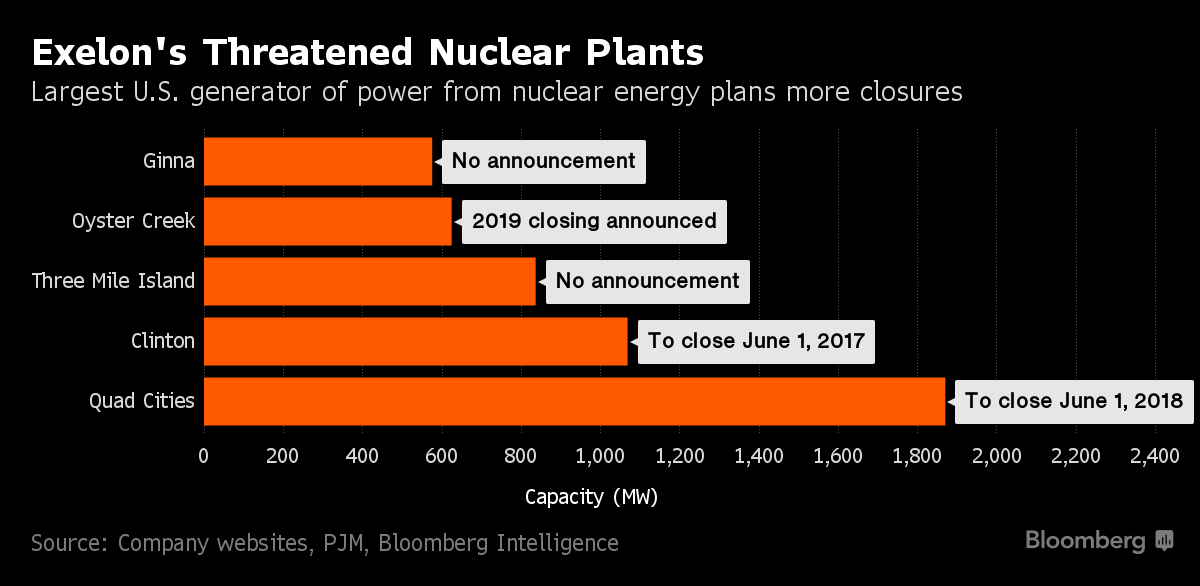
 Peter Sinclair has a post up taunting "renewable haters" who are invited to be embarrassed that nuclear plants, under pressure from cheap natural gas, may require public money to stay in operation. Following hard on the heels of that, Exelon has announced the shuttering of the Clinton and Quad Cities nuclear plants, 3GW of near-zero carbon energy gone for want of $110 million in subsidy per year (which is the combined losses of the two plants in the current market.)

As an enthusiastic taunter of those I feel deserve it, I know the people Sinclair is talking about: people who position nuclear as the honest, work-a-day, practical solution, where as renewables are impractical fairy dust, a con sustained by massive public money. Which is ridiculous on all counts: nuclear energy has always required public support, with the government providing most of the R&D, permanent waste disposal at bargain prices (how's that coming, guys?), loan guarantees, even free insurance against the possibility of a meltdown. Meanwhile wind has reached 5% of US electricity production: sunny counties and regions, such as Jordan, are finding solar energy profitable without subsidies, as prices for modules continue to fall.

But the vices of nuclear advocates should not be confused with the virtues of nuclear energy. And just because we can build a 100% RE grid, does not mean we should.

Looking out into the world today, it is obviously imperative to get human civilization to net zero or net negative GHG emissions as soon as possible. Every year, every month that we don't pushes us further into the heart of a global disaster.

Renewables require careful load-balancing across large areas, storage, and dynamic demand management to begin to approach 100% of the energy supply. Contrawise, every 1% of baseload power you add makes the intermittent load easier to manage and cheaper overall. Science of Doom has a great post on the math here, and it's worth quoting his conclusion at some length:

What is the critical problem? Given that storage is extremely expensive, and given the intermittent nature of renewables with the worst week of low sun and low wind in a given region – how do you actually make it work? Because yes, there is a barrier to making a 100% renewable network operate reliably. It’s not technical, as such, not if you have infinite money..
It should be crystal clear that if you need 500GW of average supply to run the US you can’t just build 500GW of “nameplate” renewable capacity. And you can’t just build 500GW / capacity factor of renewable capacity (e.g. if we required 500GW just from wind we would build something like 1.2-1.5TW due to the 30-40% capacity factor of wind) and just add “affordable storage”.
So, there is no technical barrier to powering the entire US from a renewable grid with lots of storage. Probably $50TR will be enough for the storage. Or forget the storage and just build 10x the nameplate of wind farms and have a transmission grid of 500GW around the entire country. Probably the 5TW of wind farms will only cost $5TR and the redundant transmission grid will only cost $20TR – so that’s only $25TR.
Hopefully, the point is clear. It’s a different story from dispatchable conventional generation. Adding up the possible total energy from wind and solar is step 1 and that’s been done multiple times. The critical item, missing from many papers, is to actually analyze the demand and supply options with respect to a time series and find out what is missing. And find some sensible mix of generation and storage (and transmission, although that was not analyzed in this paper) that matches supply and demand.

What's more, baseload renewable sources such as geothermal, hydroelectric dams, and tidal power, all require large areas with appropriate geography (and geology) to be successful. Geothermal and tidal power are starting from an extremely small base, while hydroelectric dams (which have significant environmental costs of their own) are already close to their saturation point.

Compare the Exelon plants, Clinton and Quad Cities. Their combined capacity is 3GW, which at the industry-standard 0.9 capacity factor is roughly 24,000 MW-h per year. Those two plants, alone, produce more GWh of electricity than all the geothermal plants in the nation, combined. They produce more clean energy than all the utility solar plants in the nation, combined. That would be a bargain for a tiny subsidy of $100-150 million a year. It comes to about $0.05/kWh. We could subsidize our entire electrical grid to that extent and spend less than 2% of the GDP.

Nuclear energy is, by far, the largest source of low-carbon energy in the United States. Doubling or tripling our capacity could be done easily with the political will to do so. At a bare minimum, we should be maintaining the plants we have to the end of their useful life. Subsidies aren't a dirty word here. At least until we have a comprehensive carbon tax, all low-carbon energy will require subsidies or unfunded mandates, including wind and solar, especially once they reach a scale where their fluctuations necessitate storage.

Different countries and regions with different resources, relationships, and geography are going to need different mixes of sources to get to net zero. Ruling out either more RE or more nuclear seems irresponsible to me.

Wednesday, August 12, 2015

Wherein I settle the renewables/nuclear "are expensive" squabble for all time

Lizard (2014) (h/t wikipedia)


The US consumes approximately 4 billion MWh per year. Our GDP is currently about $18 trillion. So if you pay $50/MWh (good wind, unfiltered coal, unfiltered gas) your cost for that is $200 billion annually, or 1.1% of the GDP.

If you pay $100/MWh (nuclear, solar) your cost is 2.2% of GDP.

If you pay $150/MWh (offshore wind, gas with CCS, rooftop solar) your cost is 3.3% of the GDP.

The cost of intermittency is pretty minor:

Apologies for smallness, original here. Bottom line: at a 30% level of penetration, you can add about $30/MWh to the cost of wind or solar, or about 0.7% of the GDP.

In other words, the costs of ALL of the alternatives under discussion are minor. We can do what we want to do. Very high levels of penetration of intermittent sources like wind or solar poses special problems, but we are a long way from having those problems today (1.)

Arguing whether nuclear is cheap or expensive, or what the costs of waste disposal will be, or what the cost is to back up wind or solar, or whether the costs of PV systems will continue to fall, misses the point entirely. We have multiple affordable low-carbon options, and the question is not which is best -- we will learn more about that as we build and operate the plants, and different sources will be optimal for different communities in different circumstances.

The point is that we need to do something, and we have both the technology and the resources to solve this aspect of the global warming problem in the next ten to twenty years. In many ways, this is the easy part -- the electrical grid (easier to green than transportation, land use, or industrial CO2 release) in the richest country in the world. The fact that it is so easy and yet we haven't done it yet underscores that it is political will, not technology or money, that are lacking.

-----------------------------------------------

1. I am optimistic about synthetic fuels, as I explore here. To quote myself:
Conventional batteries continue to get better and cheaper, but right now their capacity is orders of magnitude below what would be needed to store, say two or three weeks of energy.

However we do have a large amount of energy storage in the form of fossil fuels: liquid, solid, and gas. This form of storage is stable on geological time scales and extremely energy dense. Unlike many of the alternatives, including chemical batteries, capicators, pumped hydro storage, or molten sodium, the infrastructure to store and release hydrocarbon energy is simple and cheap -- in the case of petroleum, it can be as simple as a barrel or a hole in the ground. . . .


Start with a conventional gas plant equipped with carbon capture technology (assuming we ever get serious about perfecting and deploying that technology.) Then, rather than put the CO2 in the ground, feed it into a synthetic natural gas plant and use a clean energy source to turn the CO2 back into gas. Burn, capture, and un-burn as needed in a closed cycle that doesn't release CO2 into the atmosphere.
Regardless of how cleverly we deploy storage and smart grids, we will meet our emissions goal much faster with nuclear than without it, which is why I remain a strong supporter of retaining and building out the nuclear power sector, despite the irritating epistemic closure on the value of renewables and general hippie-punching tendencies of nuclear power's more fervent advocates.

Saturday, July 4, 2015

Is nuclear energy expensive?

Spot the leader.

Robert Wilson doesn't think so:
But like it or not, offshore wind is now the only scalable form of renewable energy in Britain. Solar and onshore wind are not. This leaves us with three choices as far as low carbon electricity is concerned: nuclear, offshore wind and CCS. Nuclear is currently much cheaper than offshore wind, and this is not likely to change tomorrow. So, forget about calling nuclear expensive, and be more honest and say that de-carbonisation is expensive. If nuclear energy is expensive then it is time we lowered our expectations when it comes to climate change, because cheaper options are not staring us in the face.
 While Wilson's tone is more dismissive of renewable energy than I would be, I substantially agree with his point -- calling nuclear energy expensive whilst supporting heavy investments in wind, solar, and other non-hydro renewable energy often amounts to the pot calling the kettle black.

Getting our emissions down to 20% or 10% of present-day emissions is going to cost quite a bit of money. In the long run, that investment will pay off. Even in the short run, there are substantial benefits to be had in the form of improved air quality, better transportation networks, more efficient and reliable energy grids, and so on. But there is no getting around the fact that the cost will be several trillion dollars (which, it should be pointed out, is still a tiny share of the world's wealth.)

While renewable energy is getting cheaper, it is the worst kind of motivated reasoning to think that it will continue getting cheaper indefinitely along a linear trend. While intermittancy at high levels of renewable penetration is a problem that can certainly be overcome, fixes all involve additional investment and increased costs.

Smart government policies can make renewables cheaper -- by supporting research into new technologies, encouraging adoption on a wide scale, and by making changes to the utility model and the grid such as dynamic pricing which favor the development of more renewables.

Similarly, though, a smart set of policies could make nuclear energy much cheaper. Settling on a single standard design, providing a steady stream of orders for that design, and streamlining regulatory approval after the initial instances of that design, could bring costs down dramatically. Whether or not you think the US government was right to commit itself to the long-term storage of nuclear waste, it did make that commitment and ought to settle on a site and answer that question once and for all.

Whatever low-carbon energy sources are the most successful, we ought to resign ourselves to spending some serious cash up front. Hydrocarbons are a very efficient way to store energy, and I very much doubt if any alternative energy source in our lifetimes is going to be easier than just pumping the stuff out of the ground. Renewable energy advocates who decry the expense of nuclear energy are sharpening the sword that will be at their throats for the foreseeable future.

Friday, December 5, 2014

A scary graph

Source
Whether or not you think growth in nuclear power is a smart play -- I think, on balance, it is -- nuclear energy production declining in absolute terms is bad, bad, bad news. It's going to eviscerate efforts to cut CO2 emissions via RE. You are going to end up -- as Germany has -- substituting low carbon renewable energy for low carbon nuclear energy. Leaving fossil fuels dominating the energy mix for decades to come. No es bueno.

Tuesday, December 2, 2014

Wind turbines get better

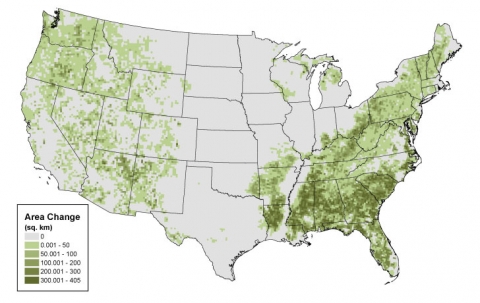
Siemens has just installed a wind turbine with a 154-meter rotor. This is an exciting development because the higher you go, the harder and steadier the wind blows. A report by the US National Renewable Energy Laboratory (h/t The Economist) recently looked at the new generation of giant turbines in terms of the areas they open up for productive wind farms:

They made this calculation by assuming a need for a gross capacity factor of 30%. The larger turbines achieve that over a much larger area than those in common use today.

I'd be interested as to the average capacity factor of these larger turbines in areas with optimal wind conditions. Danish offshore wind farms average a capacity factor of about 40%, compared to a US average (consisting overwhelmingly of onshore turbines) of 29%. However, the wind behaves differently over oceans as opposed to on land. It's probably reasonable, as a back-on-the-envelope calculation, to suppose that onshore installations the size of offshore turbines would achieve a capacity factor that would be intermediate between the two.

Improvements in photovoltaic cells get a lot of press these days, but it is worth noting that wind energy is not a stable technology either. It is rapidly getting cheaper and more productive. Now if we as a country would invest in a grid that can ship power cross-country and manage demand with dynamic pricing, you could really see renewable energy explode.

Thursday, June 19, 2014

Chart from the Wikipedia

Source
So a few interesting things here that we maybe all know, but are worth reviewing. Fossil fuels are dominating the energy mix in every sense. They are the largest component of the energy mix, and they are growing the fastest. We would need between five and six times the amount of low-carbon energy currently in existence to phase out fossil fuels, assuming demand remained static. And demand is not going to remain static.

Renewables produce twice the energy provided by nuclear power plants. An inconvenient truth for climate-conscious white individualist hierarchist males who whilst crying up nuclear power delight in dismissing renewables as pie-in-the-sky hippie moondust, but the truth, nonetheless.

And the excuse that this is mostly hydropower, and hydropower can't be scaled up, won't wash here, because we can see renewable energy as a category is rapidly growing -- if only the hydro resources matter, where is the growth coming from?

When I look at the share of fossil fuels, though, and the tiny shares of its rivals, I'm reminded of how guerrila organizations like the IRA or Fatah and Hamas, faced with an overwhelmingly powerful and dominant force, turn on each other and their own people in sheer frustration, fighting over turf like rival gangs, murdering informants, acting like criminals.

It's stupid and self-destructive, but sometimes when you're tired of losing you ache for a fight you can win. For environmentalists, nuclear is an easy target, because it's unpopular, expensive, and people are just plain afraid of it. All things we wish could be said about fossil fuels. The environmental movement, aided by public mistrust and fear and lack of corporate investment, are within striking distance of shutting down an entire industry. It's just that it's the wrong one.

What the hippie-punching nuke-boosters want is a little more complex. I don't think it's really about the climate for them. They want to fight the cultural wars, bash greens, promote big and manly and heterosexual things -- but they are smart enough not to go down the road of denying the science.

And the beauty of it is, they don't have to! By lining up with James Hansen and other smart greens behind a policy of more clean nuclear energy, they have found the one part of the argument between environmentalists and conservatives that they can actually win. For once they have (a part of the) real solutions, and the other side is sticking their heads in the sand.

Meanwhile the first column keeps growing.

UPDATE:


 H/t blueshift, via the Rabett, from BP.

What this chart adds to our understanding is that, as far as the last decade is concerned, anti-nuclear environmentalists are winning the aforementioned pointless catfight. And what they have won is a total stagnation in the proportional of non-fossil-fuel energy. And make no mistake, the blue line is what history will judge us on.

Wednesday, January 22, 2014

EU backs off rigid renewable targets

The EU is dialing back on rigid, county-by-country targets for renewable energy:
Tempering its environmental ambitions in the face of harsh economic realities, the European Union on Wednesday proposed an end to binding national targets for renewable energy production while aiming for an overall cut of 40 percent in Europe’s carbon emissions by 2030.

Under the plans, outlined after tough internal negotiations, country-by country targets for renewable energy would be replaced by an overall objective for Europe, which would aim to increase the proportion of its energy provided by renewables to 27 percent.
I think this is a good move, climate-wise. It gets the focus back to GHG emissions rather than mandating a particular route to get there.

The old renewable targets, while expensive, have provided some obvious benefits in maturing these technologies and expanding the renewable energy sector:

Source
Obviously in the long run it is not a natural situation for Spain, population 47 million, to have a tenth of the world's installed solar capacity, or Germany, population 81 million, to have over a third of it. Two-thirds of the world's installed PV (1) is found in just a few countries in the EU; obviously the hard targets played a big role in that. Subsidies have driven innovation and adoption; appropriate infrastructure (a smart grid with an HVDC backbone), utility reform (ultra-local power companies with profits set by law are unlikely to nimbly respond to market incentives) and a realistic carbon price are all that's needed for renewables to truly explode in the US.


--------------------------------------------------------------------

1. In 2010; obviously the situation is changing rapidly.

Friday, August 23, 2013

Space-based solar

Source
 With apologies to Roger Pielke, Jr, the problem in tackling the carbon problem is not a lack of technology. It's the inability of our people and our political system to exploit to harness the technology we have through collective political action.

If our country retained the tiniest bit of the ambition and drive that built the Hoover Dam or the Interstate Highway System, we could rip our way through the assumptions of the fossil fuel era like a Sherman tank through a chain-link fence.

Case in point: space-based solar energy.

Space-based solar requires getting a significant amount of mass into geostationary orbit, coping with the degradation of solar panels in that environment, and getting the power back to earth.

There are many speculative technologies for reaching orbit cheaply -- space elevators, magnetic catapults, laser-ablative propulsion, reusable spaceplanes -- but we are approaching a point at which mature conventional rocket technology can, for the first time, move significant masses into orbit without a cost-prohibitive number of launches.

Mature Heavy Lift Launch Vehicles  offer the promise of cutting the cost to low earth orbit (LEO) from $10,000-$15,000/kg today to perhaps $2,200/kg (the estimated cost of a lift from the new Falcon Heavy, a SpaceX rocket in development).

Once you move your payload into LEO, you need to raise it higher, into geostationary orbit (GEO). Fortunately, once in free fall, more stately and deliberate (low-thrust) transportation can be used, such as, for example, ion thrusters. A "tugboat service" could be set up between LEO and GEO, docking with payloads in LEO and gradually moving them into GEO.

Once in geostationary orbit and deployed, a solar panel enjoys half again the power output available on the ground (144%) and can gather that power for >99% of the time. Hence a square meter in orbit will produce between five and ten times as much electricity as the same solar panel on the ground, and it provides baseload power.

The first problem with reaping this bounty is getting their weight into orbit; the second problem is the life expectancy of the panels (the third is getting the power back to earth, which I'll get to in a minute.) It's the second problem, I think, which is the most tricky.

Researchers have succeeded in creating absurdly thin and light solar cells; most recently, the groundwork has been laid for cells two molecules thick. But the orbital environment has an abundance of hard radiation and a certain amount of atomic oxygen that limits the useful life of solar cells. Here too, though, there has been dramatic progress:

Source
A group at NASA took on the challenge of specing out a space-based solar system. Their report is worth a read. They have creative solutions to some of the problems with a space-based system mentioned above (as well as some I hadn't thought about, like waste heat). For example, they limit the mass of expensive and degradable photovoltaics by using a hybrid solar concentrator-PV model -- in plain English, they use reflectors, which are more lightweight and durable, to direct sunlight at a smaller area of solar panels. One model of the end result looks like this:

The large teacup is the reflector array; the small disk is the PV panels. This concentration-PV hybrid approach is also being tried for earth-based systems, and seems promising.

The PV panels, in this design, are cleverly sandwiched together with microwave emitters, which transmit the power to a receiving station below.

The NASA group estimated a final cost of an industrial-scale system along the lines of the above to be about $90/MWh (see page 9). That's a really low number, comparable to new coal plants:


Some have proposed using disposable, foldable ultralight solar panels; your panel collects energy for ten years, and then you simply roll out another thin layer of PV. The article just cited (see part 8) estimates such a system could offer a "power density" (a standard measure of the mass-to-current ratio of space-based PV) of 1.2kW/kg. Ignoring things like the earthbound receiver ("rectenna"), the cost of the panels, and the LEO-GEO shuttle service (because they will essentially be rounding errors for the total cost) a 1,200GW baseload system (supplying about half the current global electrical demand of 20,000TWh/year, or 40% or so after transmission losses) with a forty-year life expectancy would mass about one million tons and cost about $2.3 trillion dollars to orbit with the Falcon Heavy rocket.

That's a staggering sum of money -- almost exactly what we have spent, so far, on the wars in Iraq and Afghanistan.

Despite the remarkably low ROI from that, we are still the richest, most powerful nation in the world, however little it feels that way. It's not about technology. It's about ambition. It's not about how we solve the problem. Contrary to popular opinion, there are many possible solutions. It's about making the decision to solve the problem and concentrating all our efforts on what has to be done.

Update (Oct 2020): The current cost to LEO via a reusable Falcon rocket is approximately $2,000/kg. Starship promises to bring that number down to $270/kg. The latter number would bring launch costs down to $270 billion. That is roughly a tenth of what we have spent on coronavirus relief in the last nine months alone.

Tuesday, March 6, 2012

Republicans against free-market wind power

Teh horror
They're getting scared:

Like many states, Wisconsin has a patchwork of differing local setback rules governing the distance wind developers need to leave between turbines and adjacent homes. To streamline the process, the Wisconsin legislature passed the 2009 Wind Siting Law instructing the Public Service Commission (PSC) to create one overarching state siting law for all wind turbines subject to local review. . . . 

In response, Republican representatives and ALEC members proposed their own legislation to make implementation of larger wind projects much more difficult and protracted.

In October 2011, State Senator Frank Lasee (R) introduced a bill (SB 263) that would declare a moratorium on construction of wind farms over 100 feet, saying larger turbines should not be allowed until the state PSC was in possession of a report that ensures turbines do not cause health problems.
That's not how the conventional wisdom would have it, is it? Supposedly the pro-business conservatives are fighting for profits and against regulations, while the environmentalists are tying up new energy projects in red tape.

Supposedly renewable energy is impractical and expensive, and all that's necessary to ensure its demise is not to subsidize it and not to charge fossil fuel burners the cost that their soot and sulfates and NO2 and CO2 impose on society. Privatized profits and socialized harms -- but still, non-intervention is supposed to be their guiding principle.

Wind is already price-competitive in places where the wind blows hard


Obviously these measures are no longer sufficient. Contrawise conservatives feel sufficiently threatened by the appeal of renewable energy on the open market to strive to strangle it with overregulation. I call that a good sign.