Friday, January 15, 2021

Wherein I am chastised

 Yep…targeted harassment…of fascists. Now I've heard it all.

And heaven forfend anyone suggest soldiers might be called upon to kill people in the discharge of their duties. Where did I get that strange idea?


Friday, February 7, 2020

Climate 2020: Still on a glide-path to diaster, part three ("Peak Coal")

In Parts One & Two, I illustrated how the probability of ongoing exponential economic growth makes RCP8.5 (or something even worse) a quite plausible future. But what are the arguments against RCP8.5 as a plausible future?

Thus Zeke Hausfather in Carbon Brief:

One particular aspect of both the RCP8.5 and the new SSP 8.5 scenarios that has drawn quite a bit of criticism from energy researchers are their assumptions around future coal use. Reaching the CO2 emissions in these scenarios requires a large-scale increase in coal use – with 6.5 times more coal use in 2100 than today.…

With global coal use having declined slightly since its peak in 2014, it is hard to envision a world where coal expands this dramatically in the future even in the absence of new climate policies. This is particularly true given the falling prices of alternative energy technologies in recent years. A forthcoming “expert elicitation” – where energy experts were asked to assess the likelihood of various outcomes – gives RCP8.5 only a 5% chance of occurring among all the possible no-policy baseline scenarios.

Argument I: Coal use peaked in 2014 [or 2013, depending on the source], and is likely to continue to decline, making the expansion of coal use posited in RCP8.5 implausible.

 Truly, it's hard to dispute that, just look at this graph of global coal consumption annually:

Not Really

 No, I'm only kidding! That's part of a graph of global temperatures:


 Here's the real data on annual coal consumption:

Except I'm obvisously still kidding, because I've just taken the September Arctic sea ice area and inverted it:


This is -- I promise, joke over, the real thing -- global annual coal consumption:

Source

You can see that the record-highest annual coal consumption was in 2013. This is true, just as it is true that the record-highest average temperature of the Earth was in 2016, and the record-lowest September Arctic sea ice extent was in 2012. But we cannot say coal consumption "peaked" in 2013 any more than we can that global temperatures "peaked" in 2016. What we can say is that 2013 had the highest coal consumption on record, and the second highest was -- 2018 (the last year for which we have data. We also can say that the last eight years of the data (2011-2018) contained the eight highest coal-consuming years.

When it comes to short-term noise in a long-term trend, climate realists have been round and round this bend before. All the good-faith voices on the climate know the the denialist short con of "no warming since [insert current warmest year on record.] I would suggest we apply the same skeptical attitude to "peak coal."

Certainly these trends are not exactly analogous. We know the temperature record will be broken again (and again, and again) because of the remorseless laws of atmospheric physics. No law of human behavior is half so ironclad. It may be that after the false spring of 2017 & 2018 (when coal consumption appeared to resume its upward march) will be a blip, and 2013 truly will stand as the peak, as the rest of the world follows the United States and Western Europe in aggressively phasing out coal. But is that really the most likely scenario here?

The primary reason for the decline in coal consumption from 2014-2016 (it doesn't sound that impressive when we put dates on it, does it?) was that the rapid growth in Chinese consumption abated and their consumption was steady, not rapidly rising, over the past decade:


This coupled with the continued reduction in coal use in the United States and Europe accounts for coal's modest decline. Will this decline spread rapidly to the rest of the world? Or, to put it another way, is China's transition a function of their increasing wealth and sophistication (intolerance of air pollution, desire to be a leader on climate change, need to develop clean energy exports) or is it a function of global structural change (perhaps caused by inexpensive renewables) which will spread to all corners of the globe BEFORE said corners are as wealthy and powerful as China?

A definitive answer to that question is beyond my powers, but we can check in on some of the large, poor countries who, if they emulate China and the United States, could easily push coal consumption to the levels seen in RCP8.5.

Let's start with India, soon to be the most populous country in the world, currently averaging 6-7% GDP growth annually.
Not much sign of a coal phase-out there. How about in Africa? Data for the whole of Africa or Sub-Saharan Africa as a region is hard to come by (if you have a source, put it and your thoughts about my poor research skills in the comments.) The largest country in terms of population is Nigeria, is coal declining there?
It doesn't seem so. If anything, it seems like it's just getting revved up. Another fast-growing economy, neglected by Western pundits doubtless due to the long shadows of CHina and India, is Indonesia, with a population of 264 millions and average annual GDP growth of 4-6% over the last 20 years. How is the post-coal future unfolding on the great Pacific archipelago?
India has another important neighbor besides China, their former compatriots and current mortal enemies, the Pakistanis. Unfortunately, though they have their share of differences, in regards to burning the dirtiest fuel on Earth, they seem to be of one mind.
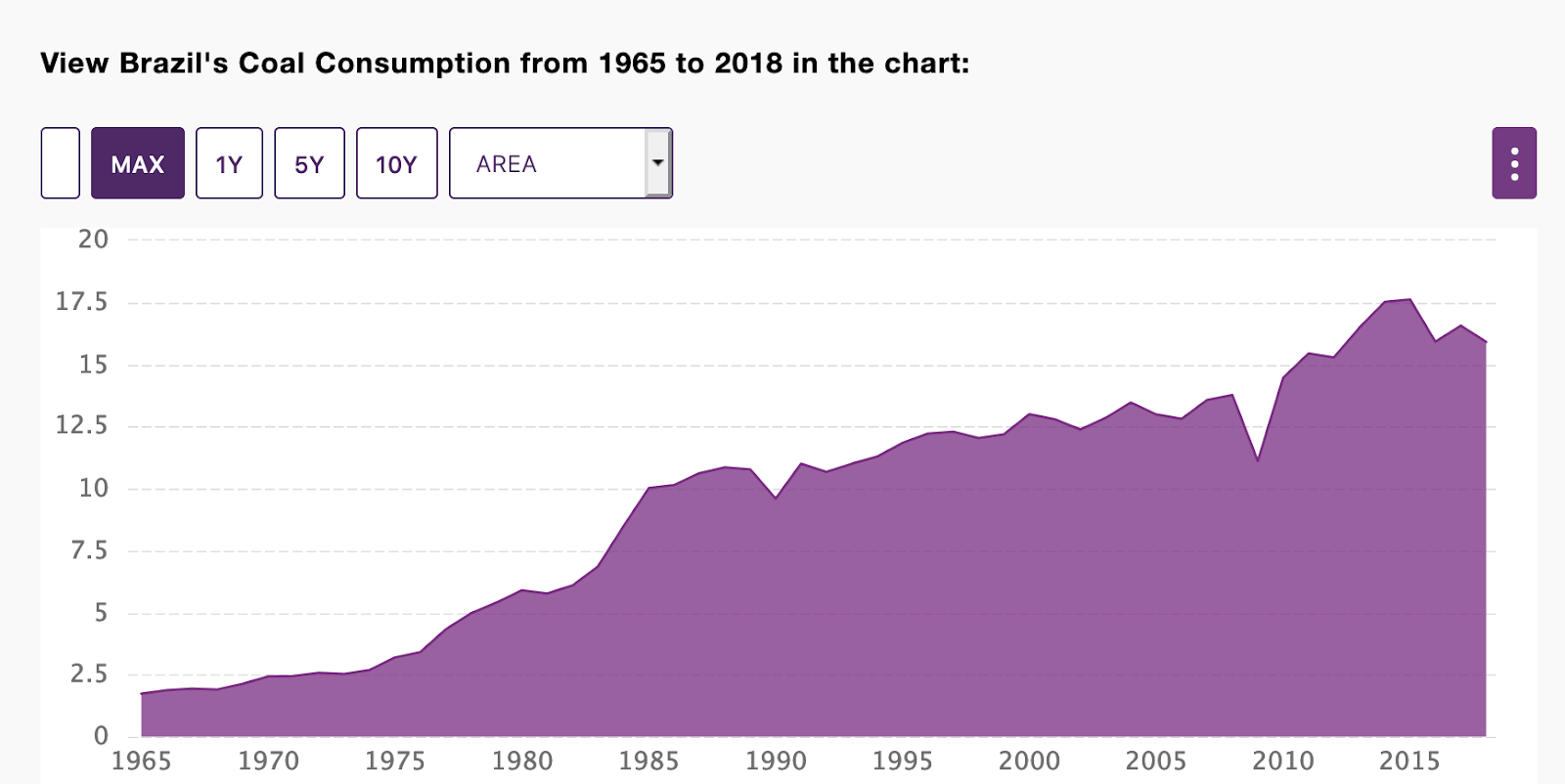
You can see a similar pattern in other large developing countries like Brazil, Bangladesh, the Philippines, and Vietnam (all with rapidly growing economies and with over half a billion people between them):

I have probably contributed substantially to global warming with the bits consumed by all of these graphics, but the point is this: the decline in coal consumption from its "peak" was short-lived, was almost entirely driven by the decisions/economic circumstances of a few wealthy countries and one huge middle-income country (and aspiring superpower) (China.) The trend, if it can even be called that, is not nearly enduring enough, dramatic enough, or widespread enough to lead us to abandon the default assumption that more growth leads to more energy use, and more energy use, in the absence of strong collective political action, means burning more coal.

Thursday, February 6, 2020

Climate Change 2020: Still on a glide-path to disaster, Part Two

Source


In Part One I created a simple model to illustrate how easily the world could reach or exceed the emissions projected by RCP8.5: (Long-term GDP growth) x (smaller annual improvements in emissions intensity) = way too much CO2.

In Part Two, as promised, I'm going to look at some of the "ground truth" of global development that makes those rising emissions in my very simple model plausible.

First, the goal posts: RCP8.5 projects 88Gt/year of CO2 emissions in 2100. Without fussing too much about the area under the curve, if a scenario gives us >88Gt/year of CO2 emissions in 2100, we can conclude that RCP8.5 is realistic, presuming said scenario is realistic. Make sense? So our first data points:

RCP8.5, Co2 emissions in 2100: 88Gt


RCP8.5, CO2e: 120Gt

Current CO2 emissions (2019): 37Gt 
We're going to ignore CO2-equivalents for now, because the non-CO2 forcings are largely short-lived, more easily reversible problems, such as methane, which are less relevant on the century scale.

If I were asked to sum up in a single phrase the reason RCP8.5 cannot be ruled out, and is, in fact, highly plausible, it would be "economic growth."


Leaving aside the bright spot of the Great Depression -- sarcasm very much intended -- and the hangover from WWI and the 1918 influenza pandemic, the world has not seen less than 3% growth over any five-year period for the past hundred years.

It is hoped that population growth will continue to slow in the coming decades, but that is unlikely slow economic growth overall -- if anything, the relationship between economic growth and population growth tends to be the inverse of that.

Even 3% growth, sustained over the next 80 years, leads to a world where the average person is richer -- far richer -- than the average American is today: ($170k/year at purchasing power parity.)

What might such a world look like in terms of greenhouse gas emissions?

We had better hope they don't emit like Americans, because that would be the ball game:

US carbon emissions per capita: 16.5 tons/year


If the world in 2100 emits like the US: 181.5Gt/year


So to put the question in a deliberately stringent way, for RCP8.5 or something worse to NOT unfold over the next 80 years, either long-term GDP growth needs to fall precipitously, which would be a vast crisis of human suffering in its own right, and which virtually no one thinks is just or even sane, OR the population must fall dramatically, OR we are positing a world in which 11 billion people are 2-3 richer than present-day Americans, but produce nothing remotely resembling an American's average greenhouse gas emissions.

Note that this is just another, hopefully slightly more concrete and accessible, way of talking about carbon intensity and the "decoupling" of economic growth: finding a way for 5-10 billion people to be richer than Americans without producing anything remotely like the GHG emissions we do.

I wish "not remotely" were a rhetorical flourish, but it isn't. Doing 20%, 30%, 50% better than we do in terms of CO2 per unit of production is not enough.

Germany, for example, has invested a vast amount in renewable energy, grid improvements, and conservation. The exact figure is debated, but the total investment to date is generally agreed to be on the order of hundreds of billions of dollars. So let's imagine a wealthy world that invests heavily in renewables and makes the progress Germany has made.


German CO2 emissions: 11 tons/year per capita


If the world in 2100 emits like Germany: 121Gt/year

 Again, our simple thought experiment blows past the RCP8.5 scenario and into uncharted territory. The same thing happens in a world that emits like China (although with 3% growth, said world would be an order of magnitude richer than China, $170k/year per capita vs $17k):

China: 8.5 tons


If the world in 2100 emits like China today: 93.5Gt

Just to be clear, this thought experiment imagines a world where carbon intensity is vastly improved, producing ten times as much per unit of CO2 emitted compared to China today. It's not enough. RCP8.5 is still on the table.

These thought experiments illustrate why (Long-term GDP growth) x (smaller annual improvements in emissions intensity) is such a menacing equation. Since the advent of modern capitalism and the Industrial Revolution, two of the most predictable things about human history is that people will make more people and those people will strive to get rich. And eventually, in more or less time depending on things like the level of governmental dysfunction, frequency of wars and revolutions, and availability of capital, people do get rich (compared to where they or their parents started.)

So when assessing the likelihood of RCP8.5 or worse, we can break it down to several simple wagers:
  • The population in 2100 will be dramatically lower than today: bad bet.
  • Economic growth, averaged over decades, will halt or reverse itself, in contradistinction to the entirety of human history since the beginning of the Industrial Revolution: bad bet.
  • Vastly richer and more numerous human societies will, without significant exception, produce vastly more goods and services per unit of emissions: Unknown (policy dependent.)
Given one of these bets must pay off to have any hope of avoiding RCP8.5 or worse, can we really say RCP8.5 is "implausible"?

In Part Three, I'll discuss the four main lines of reasoning offered to justify playing down or ruling out RCP8.5, and why I think these rhetorical mountains are practical molehills.


Wednesday, February 5, 2020

Climate Change 2020: Still on a glide-path to disaster, Part One

In the last few years, some climate analysts have underlined the fact -- which was never in doubt, but was arguably under-emphasized -- that RCP 8.5 was designed more as a worst case than as the shortest-odds bet.

As anyone might anticipate who has spent more than five minutes interacting with climate deniers or lukewarmers/inactivists, numerous bad-faith actors took this as their cue to one the one hand exaggerate the importance of RCP 8.5 to the climate literature and on the other to claim it has been admitted to be impossible.

I only wish I were kidding. Eric Roston's screed is representative:

To justify relegating the "nightmare scenario" to the "dustbin," Rosten cites the following Nature editorial:

RCP8.5 was intended to explore an unlikely high-risk future2. But it has been widely used by some experts, policymakers and the media as something else entirely: as a likely ‘business as usual’ outcome. A sizeable portion of the literature on climate impacts refers to RCP8.5 as business as usual, implying that it is probable in the absence of stringent climate mitigation. The media then often amplifies this message, sometimes without communicating the nuances. This results in further confusion regarding probable emissions outcomes, because many climate researchers are not familiar with the details of these scenarios in the energy-modelling literature.

This is particularly problematic when the worst-case scenario is contrasted with the most optimistic one, especially in high-profile scholarly work. This includes studies by the IPCC, such as AR5 and last year’s special report on the impact of climate change on the ocean and cryosphere4. The focus becomes the extremes, rather than the multitude of more likely pathways in between.

Happily — and that’s a word we climatologists rarely get to use — the world imagined in RCP8.5 is one that, in our view, becomes increasingly implausible with every passing year5. Emission pathways to get to RCP8.5 generally require an unprecedented fivefold increase in coal use by the end of the century, an amount larger than some estimates of recoverable coal reserves6. It is thought that global coal use peaked in 2013, and although increases are still possible, many energy forecasts expect it to flatline over the next few decades7. Furthermore, the falling cost of clean energy sources is a trend that is unlikely to reverse, even in the absence of new climate policies7.
 The first problem here is that, by definition, implausible is not impossible. And when dealing with "nightmare scenarios," identifying them as implausible is far from making the case we should "say goodbye" to the possibilities.

But the major problem with this thinking, in my view, is that RCP 8.5 is quite plausible, and those who say it isn't -- to say nothing of deniers screaming about "the RCP 8.5 fraud" -- are overreacting to short-term trends and politicians' promises.

The case against RCP8.5, in broad strokes, is this:

*Coal use peaked in 2013, and is likely to continue to decline, making the expansion of coal use posited in RCP8.5 implausible.
*Clean energy options (solar and wind) have dramatically fallen in price, making a return to dirter energy unlikely.
*The amount of coal required to make RCP8.5 a reality may not even exist on earth -- certainly it will not be cost-effective to extract it.
*The pledges by the vast majority of the world's governments in the Paris accords and elsewhere suggest a "business as usual" path far below that of RCP8.5.

Before addressing these points one by one, let's construct a simple model to illustrate why RCP8.5 is still quite plausible.

There are two overwhelming important long-time drivers of GHG emissions: population growth, and economic growth. Both can be captured by a single metric: total (not per capita) global GDP, sometimes called Gross World Product (GWP.)

While it is possible to decouple economic production from GHG emissions, in practice this is a slow, halting, process. Since 1980, carbon intensity (emissions per unit of GDP at purchasing power parity) has fallen slowly, by less than 1.5% per annum:


Helpfully, carbon intensity worldwide fell by roughly 50% from 1970 to 2015, making calculations easy: .985 ^ 45 = .51. It's a pretty steady decline. Global GDP was $12 trillion in 1970 and $78 trillion in 2014, yielding an average annual growth rate of 4.2%.

The simplest possible model would just extend these trends into the future. Each year we have 4.2% more GDP, causing 1.5% less emissions per unit. Since 4.2% is quite a bit greater than 1.5%, our uber-simple model projects emissions will continue to grow: .985 (emissions intensity) x 1.042 (GDP) = 1.2637 (CO2 emissions grow by 2.6% per year.)

If you start with the current numbers, plug in the growth rate of 2.6%, and look at 2100, you don't get RCP8.5 -- you get something far, far worse. RCP8.5 projects a leveling off of emissions growth and emissions of less than 30GtC of carbon annually, compared to 10GtC today.

2.6% growth, on the other hand, would see us over 75GtC in 2100 -- more than double RCP8.5. That's without incorporating carbon-cycle feedbacks or assuming any turn for the worse in terms of climate policy. It's just a straight-up extrapolation of current trends. And while I am not a modelling expert, and extrapolating current trends is far from the only way to guess at the shape of the future (and obviously depends heavily on which trends you project forwards) nevertheless, "Things continue as they are" is always a scenario we should give serious consideration to, lest we outsmart ourselves like the political analysts who fail to seriously consider "Person leading in the polls wins" when predicting the outcome of an election.

In Part Two, I'll look at the trends that make continued exponential growth in carbon emissions a frighteningly plausible prospect (Spoiler alert: it's population growth and economic growth, plus a dash of human perversity.

In Part Three, I'll look at the 4 points offered as cause for optimism regarding RCP8.5, and how there's less there than meets the eye.

Thursday, August 15, 2019

Twitter Follies and Our Digital Dystopia

A couple of weeks ago, Twitter locked my account over this tweet:

As far as I can tell, this tweet violated no rules, nor did the block notice tell me what rule I had violated. There was literally a blank line in the notice where the violation was supposed to be.

After waiting two weeks with no action on an appeal, I deleted the tweet (it can live on here for all time, or until the people running Blogger have a similar attack of whimsy.) This is a minor irritation, but it does focus one's mind on the fact that large areas of the public commons -- places where art, politics, propaganda and rebellion happen -- are in the hands of a tiny number of technology companies.

These companies' very size pushes them towards a conservative (small "c") orientation because, like network television of old, they are free services offered to a mass audience. Services like that tend to succeed by being liked by many people and hated by no one -- which is, in the long run, a surefire recipe for mediocrity.

Television stopped sucking when operators like HBO and Netflix created a competing model in which, due to the dynamics of subscription services, lots of people could hate a thing, but if a reasonable number of people loved it enough to keep sending their subscription fee, you could offend, bore, or outrage a bunch of people on the margins. And that is why Three's Company and The Wire are very different kinds of art.

Twitter, Facebook, Instagram, and their rivals are free, mass-market services -- more Friends than BoJack Horseman. And if we're going to continue to organize, advertize, and solipsize online -- and what is the alternative? -- that is going to be a problem.

Friday, April 12, 2019

Fearmongering at the border

David Brooks, attempting to mimic the human emotion of "compassion," in his column today offers the following analogy:
Suppose one night there is a knock on your door. You open it to find 100 bedraggled families shivering in your yard — exhausted, filthy, terrified. The first cry of your heart would be to take them in, but you’d know there were too many.
If there were any confusion, the "100 bedraggled families" are the "hundreds of thousands of people fleeing violence in Central America or seeking economic opportunity"[1].

But the math here does not remotely add up. Let's say there are "hundreds of thousands" of refugees at the southern border (the "yard.") There are 329 million Americans in our "household." A half a million refugees is not "100 bedraggled families" -- which would equate to 33 billion(!) refugees. It's 0.15% of the US population -- which is the equivalent of a family of four letting one person sleep on their couch for one weekend out of the year.

We are not one family facing a hundred impoverished families. We are the richest, most powerful nation in the history of human civilization, occupying the third largest territory (bigger than India! Bigger than China!), overwhelming populated by immigrants and their near descendants.

That so many conservatives are ready to exploit a humanitarian crisis of their own making to argue that the US is just helpless before the brown horde of the 0.15% percent is frankly pathetic at best, racist and deliberately disingenuous at worst.

______________________________________________________________

1. Aficionados of Zionist histories will recognize the strategic ambiguity of "fleeing violence…or seeking economic opportunity" as a near relative of the popular "fled or were expelled" to characterize ethnically cleansed Palestinians. "Centrists" love this phraseology because they can admit the awkward facts whilst giving their more bigoted readers an "out," eg "fled," "economic opportunity."

Saturday, February 23, 2019

The loss of Diablo Canyon and the fallacy of "100% renewable replacement": Part Two: No subsitutions


In part one, I discussed the imminent shutdown of Diablo Canyon, a nuclear plant supplying 18,000 GWh of carbon-free electricity per year. Antinuclear activists rationalize this move with a simple argument -- all of Diablo Canyon's output will be replaced by renewable energy. No harm, no foul. This is nonsense.

After the loss of the San Onofre nuclear plant in 2013, California's fossil fuel emissions increased by 35%. To reassure climate hawks that this will not happen again, the legislature passed SB 1090, which proclaims "The commission shall ensure that integrated resource plans are designed to avoid any increase in emissions of greenhouse gases as a result of the retirement of the Diablo Canyon Units 1 and 2 powerplant."

Both the general logic that treats this kind of supposed substitution as a win, and the specific case of applying this logic to the California of 2019, fall apart under scrutiny.

As to the logic of substitution: put simply, climate change is an emergency: this is no time for lateral moves. The objective is to reduce, then eliminate, greenhouse gas emissions. In the electricity sector, that means eliminating fossil-fuel-burning plants. And California still has (and buys energy from) a lot of those.

It must be said again: swapping out one low carbon source for another is like being caught cheating on your spouse and making amends by promising to give up dairy. It's like responding to flunking out of college by substituting boxers for briefs. It's like being told your child has bacterial meningitis, and going out and buying a Prius. In other words, it's an expensive, time-consuming switch that's completely irrelevant to the problem we are facing.

Antinuclear activists promise that there are 18,000 GWh of wave, wind, and solar, plus efficiency, available at a reasonable cost, cheaper than Diablo Canyon. Great! We will have that, please, and Diablo Canyon -- and cut out a big chunk of the natural gas and coal (still!) that are today part of California's energy mix.

Activists argue we cannot afford new renewable generation unless we redirect the money that would be used to re-license and operate Diablo Canyon. That argument, stated in general form, goes as follows: there is only so much money to fight climate change, and we cannot increase it, so new green energy must cannibalize other green energy for funding.

I doubt very much anti-nuclear environmentalists would accept this line of reasoning outside the context of nuclear energy. As we contemplate a Green New Deal that would cost trillions of dollars to implement (which does not mean it's a bad idea!) the idea that you can only fund one clean source by cannibalizing another is an absurd rationalization of a predetermined anti-nuclear conclusion.

So much for the abstract logic of "substitution." What about California's specific case? What will happen when Diablo Canyon's two reactors shut down (in 2024 and 2025, respectively)?

California is in the midst of a fantastic boom in renewables, during which the California legislature has set ambitious targets for energy from renewable sources, only for California's utilities to surpass those targets again and again. (This in turn has prompted the state to repeatedly raise the bar, increasing the targeted percentage of renewables and shortening the time horizon.) The current standard looks like this:

Source
California's renewable energy sector has been rapidly expending since 2002 and will continue to rapidly expand regardless of whether Diablo Canyon closes in 2025 or 2045 -- that is mandated by law. As of November 2018 an estimated 34% of California's electricity comes from renewable sources:

Source
Over the course of the next 11 years -- again, entirely independent of what happens with Diablo Canyon and its very low carbon (but not "renewable") electricity, California's electricity from renewables has to increase from 34% to 60% of the total (assuming the targets are not revised upwards, as they have been several times already.)
So what will happen when Diablo Canyon goes offline is very predictable. The utility will point to some of the renewable projects that have come on line in the prior few years, and to those coming on line in the following few years, and will designate them as "replacing" the output of Diablo Canyon. Maybe, if they really want to impress, they will temporarily import some renewable energy from other states until their homegrown renewable generation catches up. But presuming they will continue to make smooth progress towards the 2030 goal of 60% renewables, that should take, at most, 2-3 years.
And all of that renewable electricity generation was going to happen anyway. None of it is/will be new or unexpected. Rain or shine, the law says California utilities have to grow the share of renewables by 2-3% of total generation per annum to hit the legislature's targets. With the shuttering of Diablo Canyon, several years of that progress will be designating as "replacement" for those lost ergs. That's bookkeeping. Fossil fuel burning, instead of declining, will (best case) stay at current levels ("avoid any increase.") Exactly as common sense would suggest, eliminating a large amount of non-fossil-fuel electricity generation will result in more fossil fuel burning, with the (state-mandated, pre-existing) increase in renewables being used as a fig leaf. But the climate doesn't care -- more CO2 is more CO2, whether it is from an absolute increase in emissions or from sabotaging a decline in emissions already in progress. Worse is worse.
Coming soon: 
Part Three: Bad excuses

-->

Monday, February 18, 2019

The loss of Diablo Canyon and the fallacy of "100% renewable replacement": Part One: The Stakes

Source


California's last nuclear power plant, Diablo Canyon, is to be decommissioned in 2024 and 2025. This will, at a stroke, eliminate a fifth of California's carbon-free electricity.

Diablo's two reactors, which generate 18,000GWh of carbon-free electricity per year, could be licensed for another 20 years of operation, but the utility, PG&E, has decided not to pursue the renewal. California's anti-nuclear activists, naturally, are celebrating the impending shutdown of the last nuclear plant in the state, but have been less than honest in confronting the fact that from the perspective of preventing CO2 emissions, the premature loss of Diablo Canyon is tragedy, not a victory.


I should say at the outset that I am not one of the partisans of nuclear energy that dismisses renewable energy as impractical and rationalizes the challenges of the nuclear sector. Nuclear energy can be costly, controversial, and very, very slow, as I've written before. It's important, though, to separate the issues of manufacturing new nuclear power plants on the one hand versus maintaining existing nuclear power plants to the end of their safe operating life.

These are the major drawbacks/potential concerns with Nuclear Power, writ large:

1. Construction of the physical plant is expensive, sometimes very expensive. The Hinkley Point C nuclear power station, a 3.2 GW project, is currently projected to cost approximately $25 billion to construct.

2. Construction of the physical plants is energy- and resource-intensive, and is responsible for the vast majority of life-cycle greenhouse emissions (which are small and comparable to those of wind energy, and somewhat better than solar energy.)

3. Construction of the physical plant takes years -- if it becomes embroiled in legal challenges and a target of activists, as is often the case, it's not unusual for it to take decades.

4. Current designs produce long-lived toxic waste, which can be stored indefinitely on site, but remains toxic for a long time.

(Accidents are not listed because while they are feared by the public they are incredibly rare and in terms of human health, not incredibly or even very dangerous. Nuclear energy is an extremely safe power source, and nuclear accidents are the shark attacks of environmental problems -- feared far out of proportion to the danger.)

What all of those drawbacks/concerns have in common is that they are over and done with on the day a nuclear plant enters service. They do not pertain to the question of keeping it in service at all.

Diablo Canyon is a finished product. It's greenhouse emissions going forward are negligible (tiny amounts related to the mining of uranium.) The costs of construction have already been paid. The waste will be stored on the site -- and must be kept safe for centuries -- and this will be true regardless of whether the plant shuts down tomorrow or runs for another 20 years.

Subtract those things and what we are left with is 18,000 GWh of clean electricity every year for the next 20 years. Over 20 years, 360,000 GWh, or 360 TWh.

That is a stunning amount of clean energy to leave on the table. Generating it with natural gas -- currently 40% of California's electrical mix (see above) -- would generate CO2 equivalent emissions of 1.8 billion tons. Using a (very conservative, IMO) social cost of carbon of $40/ton, the damage of those emissions is $7.2 billion.

Continuing to operate the existing nuclear station to the end of its operational life alongside rapidly growing wind and solar energy would speed the elimination of coal and gas from the energy mix and advert those emissions. Who, among those who care about the climate, would say no to that? Only people who hate and fear nuclear power, which as it turns out is a lot of people.

So how do people who purport to be serious about fighting global warming -- people who cheer when AOC proposes we get to net zero emissions in ten years -- rationalize this huge stride in the wrong direction? More to come…

Coming soon: Part Two, the fallacy of "100% renewable replacement"

Thursday, December 13, 2018

What a "Green New Deal" Should Include -- But Probably Wouldn't

Alexandria Ocasio-Cortez's revival of the idea of a "Green New Deal" in recent weeks seems to be getting a little traction, at least among the Washington press corp. It's difficult to say whether it is a good or a bad idea because, like the Paris Accords, it is big on atmosphere and light on specifics.

In general, the idea of a Green New Deal is for an economic stimulus package that accelerates our transition to a more ecologically sustainable society. One might build solar panels and windmills, aggressively retrofit current buildings for greater energy efficiency, or build a network of public charging stations for electric vehicles.

In general, anything that spends money (excuse me "creates jobs") and is environmentally friendly could be considered a potential candidate for inclusion in a "Green New Deal." I am quite skeptical that any such plan, even if it could be articulated and passed into law, would contain the elements that could make a real dent in anthropogenic global warming, water scarcity, habitat loss, or any of our other serious environmental problems.

Most obviously, in the midst of a record-breaking period of economic expansion, with unemployment under 4%, a financial stimulus is hardly what we need at the moment. Rather, this would be an excellent time to make some of the difficult structural changes -- such as a carbon tax, banning the burning of coal, sunsetting federal flood insurance -- that might be impossible politically to undertake during an economic downturn.

But staying with the premise -- spending, not taxing, new programs, not legal or regulatory changes -- there are still many good investments we could make.

Here are ten things that should, but most likely will not, be included in any serious "Green New Deal":

1. A nuclear build-out on federal lands.

A single nuclear complex can incorporate as many as eight reactors, while modern reactor designs generate over a gigawatt of electricity (1.1GW, in the case of the AP1000.)

Twenty such complexes, build on federal lands to minimize commercial and regulatory hurdles, would generate enough electricity to replace every coal-fired plant in the United States, with all the oil, wood, and biomass thrown in. TWENTY. With the waste able to be stored indefinitely at the site itself. Forty could replace every fossil fuel plant in America.

The major obstacles to a nuclear build-out -- something we critically need if we are to have our emissions peak any time in the next few decades -- are NIMBYism and the business case. The federal government building on federal land would be in a better position than a local utility to resist NIMBYism. With the benefit of #4 (see below) the plants need not be located anywhere near where the electricity is being consumed.

And while nuclear can get rather expensive (although dirt cheap in comparison with the ultimate cost of burning fossil fuels) an order for 160-320 identical Westinghouse AP1000s should allow for some economics of scale -- a "mass produced" unit in contradistinction to today's "artisanal" nuclear power designs.

2. Build desalinization plants.

The optimal method of freeing up water resources would be leaning on farmers -- who use 80% of the water -- to adopt more water-efficient methods. But that has proven politically difficult and, for the purposes of this exercise, we aren't regulating. The brute-force solution to water scarcity is to simply make more of the stuff.

Desalinization costs less than half a penny per gallon and we could eliminate our entire consumption of "wild" freshwater (see also #9, below) -- giving our aquifers a much-needed opportunity to recharge -- for less than a billion dollars per year.

3. Electrification of the national rail network.

Currently diesel railroad engines emit between 30-40 million tons of CO2 per year. That can be eliminated via electrified rail, a hundred-year-old technology already well-established all over the world.

4. A high voltage direct current electrical network.

Current AC lines lose current rapidly, resulting in heavy losses over distances over a few hundred miles. A backbone of HVDC lines would make a real national power market possible with the ability to send electricity from any source, to any consumer, coast to coast.


5. Rail-based mass transit in America's 100 largest cities.

While electric cars are making inroads, they are still vastly inferior to mass transit in terms of CO2 emissions. Even when charged from a clean grid, the production of battery-powered vehicles makes their life-cycle emissions -- while far better than a fossil-fuel-burning vehicle -- far from insignificant.

What the cities which get a significant percentage of their people out of cars and into mass transit all share is some sort of fixed-track infrastructure -- a subway, an elevated rail, a light rail system. Each of the top five performers (see graphic) have such a system, while most of the low performers do not.


6. Coastal adaptation (hardening vs planned retreat) for the first 5m of sea level rise.

Does anyone remember when Hurricane Sandy hit New York, and during the approximately five minutes after in which we had a national conversation about the risks of climate change, and Lomborg came out and claimed hardening the coast would be much much cheaper than cutting emissions?

The numbers were wrong, the argument was a disgraceful mess, and to no one's surprise, once the heat died down deniers interest in actual, non-hypothetical adaptation vanished without a trace.

But the need is still there. The oceans are going to continue rising for centuries; that is about as close to an established fact as anything we can say about the future. And on past trends, we aren't going to abandon our economically and culturally central coastal cities. There's no time like the present to get in a Netherlands frame of mind.

7. Evacuated-air trains for long-distance travel.

American air travel is responsible for about 3% of our emissions -- a figure expected to double over the next 30 years. Americans drive 3.22 trillion miles per year, contributing to emissions from cars and trucks ten times those from aircraft.

One approach to this is fixing carbon from the atmosphere and using it to manufacture synthetic fossil fuels, including jet fuel. This is likely the best solution for international air travel. But domestically, a more ambitious solution would be high-speed ground transportation, using technologies with the potential to travel faster than airplanes without the cumbersome infrastructure of airports.

No one knows exactly what a system like that would cost, but at the price quoted for a proposed 560km hyperloop system ($7.5 billion) a nationwide system of 50,000km would cost around $700 billion. That's a lot of money (3.5% of the GDP) -- about what we spend annually on the military.

8. Retrofitting CCS on all remaining fossil fuel electricity generation.

We should not be burning fossil fuels to generate electricity at all, but the rules of this exercise forbid proposing regulations or Pigovian taxes. If, therefore, we must assume coal and gas plants will continue to exists, they must at a minimum capture their CO2 emissions and store them in a stable form.

9. Nationwide water network.

 Once we have abundant fresh water thanks to #1, we need a system to supply it to regions far from desalinization plants, via a system of pipelines.

Evacuated-air trains, a water network, a system of HVDC electric lines -- all of these require the same basic infrastructure layout: track/pipe/lines connecting our major cities (throw in an upgrade of our fiberoptic trunk lines, as well.)

This would require not only large amounts of money but also eminent domain along the course of the "pipes." It could be the Interstate Highway system of the 21st century.

10. Replacement of government-owned internal combustion engines (ICEs) with electric vehicles. 

The United States Post Office owns over 200,000 vehicles. The Border Patrol operates "over 10,000 SUVs and pick-up trucks." In total, the US government, excluding the military, owns or leases about a half a million fuel-burning vehicles. Virtually all of them could be replaced with electric vehicles. This wouldn't be cheap -- assigning a back-of-the-envelope cost of $100,000 per vehicle (an estimate that takes into account that in addition to cars the government owns many pickup trucks, semis, fire engines, and other potentially expensive vehicles) this might cost $50 billion. But it would powerfully demonstrate that the future is not in ICEs and would create the conditions not only for mass production of electric vehicles but for a massive expansion of fast-charging stations -- and a government purchasing such a fleet could chose the charging standard that would become the default.


None of these things are likely to happen any time soon, not simply because of the mismatch between what feels "green" to most people (solar panels, wind turbines, etc.) and things which, although they have great potential to protect the environment, do not (nuclear power, desalinization, an upgraded electrical grid.

There is also a related problem which extends beyond environmental issues -- thinking too small. Private enterprise can be a powerful force for good in human affairs, and efforts to replace it with tight government central planning have been disappointing. But where the government can add value is projects which are too big for any private actor to undertake. The interstate highway system, rural electrification, the postal service, K-12 public education -- these are success stories, both in the sense of generating wealth and in expanding opportunities. But by definition, that sort of thing isn't cheap.

But in recent decades, the right's crusade against "big government" has taken its toll, such that even on the left, small targeted anti-poverty, environmental, infrastructure programs are the rule, and large nation-shaping public investments are the exception.

There are many benefits to thinking small, but there are also things you will never accomplish with a $5 million grant for a needle exchange in LA or $10 million dollars for redevelopment grants in Minot, ND. The above proposals would cost trillions of dollars. But climate change is doing to cost us trillions and trillions of dollars one way or the other, whether we mitigate it or adaptive preemptively or just wait for the hammer-blows of crisis to fall.


Wednesday, November 15, 2017

By 28pt margin, a record number of Americans acknowledge man-made global warming

Even as the Trump administration reverses what were modest (and frankly inadequate) efforts by the Obama administration to reduce GHG emissions, Americans by almost 2-to-1 are acknowledging climate change is real.

One wonders if perhaps the denialists' friend in the White House, rather than strengthening their movement, has undermined it by overusing and thus overexposing the techniques of climate deniers: politicization of basic facts, smearing journalists, trolling, whataboutism -- to a point at which the center is beginning to develop an immunity to these appeals.

It may be that the liars that hawk climate denial may come to rue the day they helped install in the White House's bully pulpit a denier so vain, petty, and self-obsessed he wastes his anti-reality spin cycles on lies as trivial as the size of his inauguration crowds.

Monday, January 23, 2017

Willis is about as wrong as usual

Willis wants us to know that carbon taxes, being regressive, are "cruel." So very, very cruel. This he will prove with data, because he is a Serious Person and not at all a shambolic dishonest embarrassment to the human species.

Immediately, however, we run into the problem that the numbers provided are not remotely plausible. All the numbers look far too high, but the figure on the bottom for thos making less than $20,000 a year is the standout. While poor Americans often spend more of their incomes on basic necessities like energy, the idea that they spend 40% of their income on energy is, frankly, utterly ludicrous.

To get here he cites a number of sources, fucking up in unknown ways to get answers that are wildly wrong:
Someone challenged me on this claim about energy taxes the other day, and I realized I believed it without ever checking it … bad Willis, no cookies. So of course, having had that thought I had to take a look.
The Energy Information Agency (EIA) collects data on this, with the exception of gasoline usage. I got the most recent data, for 2009. (Excel workbook). Gasoline usage figures are here from the Bureau of Labor Statistics. Finally, income averages by tiers are available here from the Census Bureau.
While he laments the loss of his cookie, I would actually offer him two small cookies here. One, he is making an effort to check his intuitions against data. Two, the places he is going for data contain good reliable information: the EIA, the Bureau of Labor Statistics, the Census Bureau.

At that point Willis' cookie supply dries up, because he has mangled the data to get a grossly wrong answer. People who make less than $20,000 per year spend an average of $1,571 dollars a year on energy (slight more if you include gas). So Willis is asking us to accept that the average income of this group is $3,900 a year, and after spend almost half that on energy they are paying for housing, food, and clothes with $200 a month.

The sources Willis cites do not provide numbers for the average income of a household in a given income bracket. Possibly he was using the means as averages, although that would not explain his numbers by itself. The Social Security administration does provide averages, fortunately:

 If you plug those numbers in you get an average income, for those making less than $20,000 per year, of $8,124. That would make the energy costs in this bracket 19% (plus a couple percent for gas), which is quite high compared to expert estimates the very poor spend about 10% of their incomes on energy, but which is less than half the number Willis somehow obtained.

I don't spend as much time chasing the nonsense on WUWT as I used to, because so much of it is repetitive and deadly boring. It's also because those that want to be informed have a much clearer understanding of the workings of ideological alternative realities than was the case when I started this blog in 2010. For reasons I would never chose, the country and the world are much more familiar with the working of denialism than they were then.

This one caught my eye because Willis is trying to be good. He's looking up good sources. He's trying to test his intuitions against the facts.

He fails because he is still operating out of a denier mindset in which he expects to find something all the experts have missed. A simple google search should have altered him that the people who study energy poverty professionally put the cost of energy in the US to the poor at, at worst, 10-20%. He should then have tried hard to figure out where his calculations went wrong.

Willis has never learned how to manage a data set, which is to say, he's never learned the art of doing a little math as you go, checking the numbers against common sense, and circling back to recheck when the answers starting coming out weird. This is basic, habitual skepticism, and the scientists I know do it so adroitly it becomes invisible and almost unconscious, a reflex. Willis clearly doesn't know that he doesn't know how to do this. Despite gestures at an appropriate method of inquiry, the cruel cold talons of Dunning-Kruger still hold him firmly in its grasp.

Friday, January 20, 2017

The last day

January 20th, 2017, marks the last day we will see for a long time -- perhaps ever -- when our nation was worthy of respect. In the coming years our leadership in the world, our moral authority, our economic and military power will all decline under this corrupt, incompetent regime.

Nevertheless, I do not despair. We will have new elections in less than 2 years, another presidential election in four. It may be that the collection of pus known as the Republican party is coming to a head so that it can finally be incised and drained.

We live in a system designed to a great extent with corrupt and incompetent leaders and stupid voters in mind. The coming years will be a race between the implosion of the GOP and its efforts to undermine democracy and free elections to the point that that implosion does not matter. If honest people step to the fight and refuse to cower in fear, I think we are likely to win this race.

The prize, I hope, will not merely be the saving of our democracy but the disgrace and dissolution of what is laughably called the conservative movement in this country, which could bring with it the potential for real substantial policy on climate among other things.

The key principle is resistance. Tyrants dissolve democracies not due their minority of passionate supporters, but due to majorities which are frightened into silence and denied the knowledge of their own strength. Do not be silenced. Do not be afraid. It's time for them to be afraid. They've grabbed a job they can't do by making promises they can't keep and the bills will rapidly come due. Then the people are coming for them.

Say not the Struggle nought Availeth
Say not the struggle nought availeth,
     The labour and the wounds are vain,
The enemy faints not, nor faileth,
     And as things have been they remain.

If hopes were dupes, fears may be liars;
     It may be, in yon smoke concealed,
Your comrades chase e'en now the fliers,
     And, but for you, possess the field.

For while the tired waves, vainly breaking
     Seem here no painful inch to gain,
Far back through creeks and inlets making,
     Comes silent, flooding in, the main.

And not by eastern windows only,
     When daylight comes, comes in the light,
In front the sun climbs slow, how slowly,
     But westward, look, the land is bright.

Thursday, December 22, 2016

EnviroNews's Nuclear Nonsense

India has embarked on the construction of a mammoth 9.9GW nuclear complex, but not everyone is happy. Opining that "Dangerous Coastal Jaitapur Nuclear Power Mega-Plant Should Be Stopped," EnviroNews gifts us with this gem of misinformation:

This is wildly inaccurate. The estimate cost of this plant is $17 billion (of course we have to worry about cost overruns, but the author specifically claims this is true "No matter what the final cost ends up being.") The electricity it can be expected to generate, at a typical-for-nuclear capacity factor of 0.9, is 78 TWh/year. How much solar would it take (ignoring storage costs) to generate 78 TWh?

As it happens, India has recently constructed what is now the world's largest solar plant, a 648MW facility covering 10km^2, costing $679 million to build. At a capacity factor of 0.2, it will generate 1.1 TWh. You would need 71 of them, costing $48 billion, to generate the same amount of electricity.

But EnviroNews is not just angry about the cost, but the footprint. The cruel, cruel footprint:


2,400 acres sounds like quite a bit, and I in no way want to diminish the disruption and loss to those living on those lands. I can't speak to whether this was debated and agreed upon in a democratic way; India has a bad history of pushing people out of the way of its mega-projects, and not providing the compensation promised.

What I can speak to is the incredible hypocrisy of complaining about the footprint of nuclear power. That 2,400 acres? It's 10km^2. Haven't we seen 10km^2 in this post already? That's right, just one of the 71 solar plants required to replace this nuclear plant takes up that much room. If you replace these nuclear reactors with solar panels, a lot more people are going to be displaced.

There are other important factors not considered here, such as the 60-year operational lifespan of this design vs about 20-25 years for current solar designs. Such as the intermittent output of solar panels, requiring solar be held to a small share of the total electricity generated over a particular grid, or expensive storage be added.

I understand the people at EnviroNews are not pro-nuclear energy and are not likely to have a road-to-Damascus moment where they embrace it. But they could, at least, not completely cut loose from the facts whilst smearing it.

The reactor park is slated to engulf approximately 2,400 acres of land, and would destroy the encompassing villages of Varliwada, Niveli, Karel, Mithgavane and Madban. The government has offered to pay villagers for the land they will lose, but only 114 out of 2,375 families affected, have claimed any money — the rest have refused the compensation as an act of protest. - http://www.environews.tv/120716-editorial-construction-dangerous-coastal-jaitapur-nuclear-power-mega-plant-stopped/
Construction of Dangerous Coastal Jaitapur Nuclear Power Mega-Plant Should Be Stopped - http://www.environews.tv/120716-editorial-construction-dangerous-coastal-jaitapur-nuclear-power-mega-plant-stopped/