Thursday, June 18, 2015

In which Judith Curry reads an article

. . . which turns out to be wrong.

Apparently, while visiting the UK, Curry read an article about how greedy biomass-burning greens are destroying everything, leaving the virgin forests of Britain an apocolyptic hellscape. Skeptic that she is, she swallows this premise whole and reguritates for her readers, despite the fact that literally ten seconds of Googling shows it to be pure fiction.

But first, the heart-wrenching tale of a rabid biomass industry run amok [Trigger warning: graphic scene of 50 trees being cut down]:
But what ex-teacher Pountney and Wilson saw looked to them like utter desolation. They came across a stand where about 50 mature oaks, some 300 years old, had been felled the previous winter. Their trunks lay in ragged piles, some sawn into roundels.
The oaks’ fate, the Trust has confirmed, was to be burnt: as ‘sustainable’ heating fuel in log-burning stoves – a market which is expanding rapidly. According to trade group HETUS, almost 200,000 such stoves are installed every year – a five-fold increase since 2007.
 Those fifty trees become the core evidence for the claim that biomass fanatics have sent England into a downward spiral of desertification set to cumulate in a "Mad Max" style countryside.

[And then we spend the aforementioned ten seconds fact-checking.]

Surprisingly, not so:

England's forests and woods had dwindled to just 5.2% by 1905.

The first world war was the low point, and in 1916 Herbert Asquith's government established the Acland committee to study the problem. They said England desperately needed to replenish and maintain "strategic reserves of timber", and within a few years the Forestry Act would lead to the establishment of the Forestry Commission to carry this out.

In the years since, a steady programme of afforestation has increased England's forest cover back to 13% – not far off the levels of 1,000 years ago. To put that in context, many other European countries average about 37% coverage, so England still has one of the continent's lowest levels. But the commitment to afforestation is clear, with modern English foresters using a wide variety of native broadleaf, conifers and species that could thrive in our changing climate.
How is that Britain's forest cover continues to expand, having more than doubled in the course of the 20th century? Private owners making use of generous tax breaks:

The new Forestry Commission report, conducted for the UN’s food and agriculture department, disclosed that the amount of woodland owned by individuals now accounts for almost half of all our tree cover, having grown by 22 per cent in 15 years, the Sunday Times reported.

Those buying woodland as an investment have found that it has outperformed shares and commercial property in recent years, with an annual return of 5 per cent. Once owned for two years, it is except from inheritance tax.

Proceeds from the sale of timber are also exempt from income tax and corporation tax and there is no capital gains tax on the growth of value in tree crops.
So the United Kingdom uses tax policy to make forests an attractive investment, with the result that private landowners turn over more of said land to forest, with the result that there is more forest. But, wait! Somewhere in this country of 64 million people, someone cut down 50 trees. Teh horror.

Weak sauce, former scientist/professional fake skeptic Judith Curry.

Friday, May 15, 2015

Eric Holthas' Dark Night of the Soul

Me: Cruising the interwebs when suddenly . . .

Hmm, sounds interesting. Last time I checked, the current El Nino was anemic threatening to become average. Let's read more!

Last year at this time, I was harping about the "monster" El Niño that seemed to be brewing in the tropical Pacific Ocean. It didn’t pan out. But from the looks of the latest data, I was just one year too early.
OK, for any budding journalists out there, "Despite the appearance of failure, it turns out that I was right all along" is not a great theme for an article.

Ahem.


Eric Holthaus reflects (dramatic reenactment)

Sunday, April 19, 2015

Depressing graph of the day

We will at some point need to talk about the old mayonnaise in new bottle that is "ecomodernism." For today, a pie chart from the IEA that illustrates what is happening in the world while we are distracted by nonsense:

Source 

Wednesday, April 15, 2015

GISTEMP March: +0.84C


GISTEMP updated pretty early this month, it seems. March was very hot; 3rd hottest on record (+0.84C). That should mean another "hottest 12 months" is in the offing.

Sunday, April 12, 2015

Desalinization and the fragile society


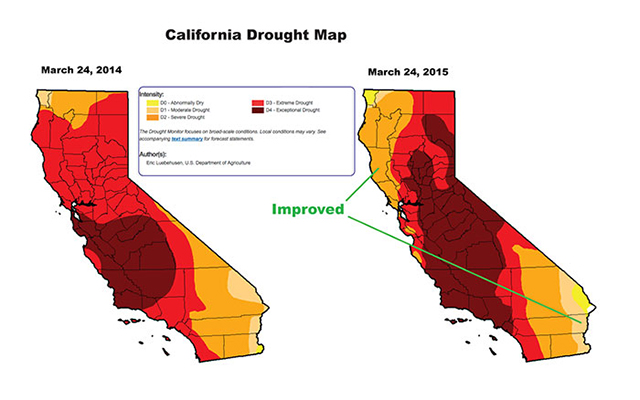
California is looking towards desalinization to address its water shortage:

Now, for the first time, a major California metropolis is on the verge of turning the Pacific Ocean into an everyday source of drinking water. A $1 billion desalination plant to supply booming San Diego County is under construction here and due to open as early as November, providing a major test of whether California cities will be able to resort to the ocean to solve their water woes.
This is part of a larger trend:
Across the Sun Belt, a technology once dismissed as too expensive and harmful to the environment is getting a second look. Texas, facing persistent dry conditions and a population influx, may build several ocean desalination plants. Florida has one operating already and may be forced to build others as a rising sea invades the state’s freshwater supplies.
In California, small ocean desalination plants are up and running in a handful of towns. Plans are far along for a large plant in Huntington Beach that would supply water to populous Orange County. A mothballed plant in Santa Barbara may soon be reactivated. And more than a dozen communities along the California coast are studying the issue.
This trend shouldn't be viewed in isolation, but rather as part of a broad suite of high-tech, high-capital, energy intensive solutions -- or "solutions" -- to environmental problems created or (more often) intensified by population growth and climate change.

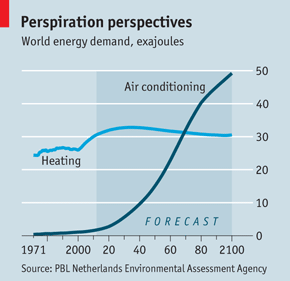
Other examples include the vertical farming movement (a more recent write-up is here) and the increasing reliance of sky resorts on snow machines. Global consumption of air conditioning is rising rapidly and the latent demand for it is already vast.

Source
The result of these trends is apt to be a global society that is more comfortable, and more insulated from temporary shifts in weather. These are, of course, good things in and of themselves. They illustrate that there are (as few doubted there were) technological fixes that allow us to adapt (to some extent) to a warmer world.

But while a society that is increasingly dependent on such devices is in the short term more robust, it is in the longer term more fragile. The more you rely on energy-intensive, technologically sophisticated "solutions" to maintain reliable supplies of things as basic to human survival as food and water, the more vulnerable said society is to disruptions that may compromise those work-arounds.

While a society with desalinized drinking water is more resistant to drought, it is only so as long as the power in on, and the engineers come to work, and the spare parts are in supply. Lose that, whether to extreme weather, or war, or terrorism, or some other disruptive force -- and in addition to your other problems you will be very thirsty, very quickly.

We already live in a technological society, of course. I'm under no illusions that we would be able to feed seven billion people without the factories that produce fertilizer or the trucks and ships which move those fertilizers to the farm or the food to the market. Technological dependence exists along a spectrum. Things like desalinization move us further along that spectrum [1]. So while we store up more climate stresses for the society of nine billion people who will be confronting them at mid-century, we are also bequeathing to them an infrastructure which will be more vulnerable to catastrophic collapse -- a tall tower built taller even as the winds begin to howl.

-----------------------------------------
1. This is especially concerning when we push ourselves down that spectrum for no good reason, and desalinization in California is a perfect example of this. In California, as in most other places, the lion's share of the water -- more than three-quarters of it -- is used by agriculture. But when Gov Jerry Brown announced his emergency plan to save water across the state, he asked virtually nothing from the agriculture sector:
Brown's seven-page executive order, issued Wednesday, outlined the first statewide mandatory water use restrictions in California's history.

Among them: He ordered a 25% reduction in urban use statewide compared to 2013 levels. The directive also bans the use of drinking water to irrigate median strips in public roads, initiates the removal of 1,150 football fields worth of grass to be replaced with drought-tolerant plants; and orders golf courses, campuses and cemeteries to significantly cut their water consumption.
Agricultural mandates were fewer and milder. Irrigation districts were directed to develop drought management plans that include supply and demand data. Agencies in basins where groundwater has been overpumped must immediately monitor groundwater levels.


Ignoring three-quarters of the consumption during a period of unprecedented drought is obviously a political decision, not a practical one. In this context, the valuable technological asset of desalinization is not being put to use to adapt to climate change so much as to adapt to political cowardice and a feckless electorate.

Thursday, April 9, 2015

Denier comment of the day: undermedicated at WUWT

So, let's talk about what went wrong here. First question: what is it about the mentally ill that makes them adverse to paragraph breaks? Really, I sincerely wonder this. Lots of great writers and artists in general have been pretty nutty, yet skilled at their craft. But if you wander into the dark corners of the internet where aliens built the pyramids, vaccines cause autism, or "the Greenies" cooked up the global warming scare, you get headache-inducing rambling like this, the written equivalent of pressured speech. At a certain point horror gives way to pity, and I just wish I could help.

The CO2 numbers are wrong in predictable and boring way, debunked by better men than I here and here. But I do find this interesting: "CO2 naturally is . . . ."

Essentialism is, of course, not a scientific concept. It's interesting to me that for all their hostility to "greenies," many deniers partake in this idea of a natural world with a fixed set of characteristics which is set apart from humans and our influence. This set of assumptions clashes with many other parts of their Weltanschauung, but it creeps in over and over.
A trace gas in our atmosphere being blamed for as we all know here, everything bad. Somehow my civilian intellect is screaming WTF? That on the surface does not make any sense to me.
The denier has a high regard for his own intuition, which he confuses with rational thought. They form a false idea of the subject which emerges from their lack of understanding of the physical world and is animated by paranoia. The reminder of their process of deduction will involve seeking out confirmatory evidence and ideas and shunning other facts and arguments as the pleas of the condemned.
I have complained before to the CAGW Alarmists, I want them to explain exactly
Like a particularly obnoxious child, the denier firmly believes that other people owe him "exact" answers to any question he might be able to formulate, and that a free education is his right. Meanwhile, with ignorance his holy shield, he will beat off any effort to actually help him bring his thoughts in line with reality.
When I read these reports and NOAA comes out saying warmest winter ever, I get crazy.
 Your words, man. Your words.


Wednesday, April 8, 2015