Sunday, March 14, 2010

New paper: air quality benefits migitate the costs of carbon taxes

An interesting paper in Environmental Research Letters ("Implications of incorporating air-quality co-benefits into climate change policymaking") finds that the benefits to human health from reducing air pollution are a very significant benefit of reducing fossil fuel burning, yet are rarely considered in the cost-benefit analysis of measures to reduced carbon emissions (of which by far the most direct and effective would be a simple tax on carbon emissions):

It is well known that many strategies for reducing greenhouse gas emissions also decrease emissions of health-damaging air pollutants and precursor species, including particulate matter, nitrogen oxides, and sulfur dioxide. In a survey of previous studies we found a range of estimates for the air quality co-benefits of climate change mitigation of $2- 196/tCO2 with a mean of $49/tCO2, and the highest co-benefits found in developing countries.


By comparison, an effective carbon tax that would bring our emissions down very sharply (>80% reduction) is estimated at between $75 and $300 per ton. What this study suggests is that apart from any need to mitigate climate change, the benefits to human health alone suggests we ought to be taxing carbon emissions at around half that rate purely to reflect the real cost to the health of society from the crap the fossil fuel economy spews into the air.

Current CO2 emissions world-wide at presently around 28 billion tons a year. Suppose we could reduce that to 3 billion. The cost savings in reduced disease burden would be in the range of about $750 billion to $2 trillion dollars per year. Right on the mean ($50 per ton) we would save 1.25 trillions dollars per year, which is greater than the total cost estimate for reducing our CO2 emissions.

It's often been said that if the deniers are wrong, and we do not act, the result will be a catastrophe, while if the scientists are wrong, and we do act, the worst that will happen is a world with cleaner air, more efficient industries, and less dependence on fossil fuels. This study shows illustrates that point with hard numbers that show that even taking only one aspect -- cleaner air -- of the secondary benefits of discourage the burning of fossil fuels dwarf the cost of transitioning to greater efficiency and other energy supplies.

Addition to the blogroll: Wott's Up With That

This outstanding blog -- found in my obsessive late-night climate Googling -- examines the mendacious WUWT post by slimy post, cleverly dismantling Watts' reality distortion field with facts, context and humor. Check it out!

http://wotsupwiththat.wordpress.com/

Minor myths, part 2: "Science will save us"


From Terry J:

"Evolution is accepted by everyone but the climate types. The entire earth history says it will change, but does not say any given species will like the change. Adaptation is considered a key factor in evolution, but apparently no longer functions."

Katherine offers:

"It’s a mistake to try to control CO2 to the detriment of prosperity when that prosperity is what would enable people to adapt to climate change–whether for warmer or cooler."

The idea behind this meme is that science, aided by the invisible hand of the marketplace, has overcome all obstacles to achieve our current prosperity, and that to argue that climate change is a serious problem that must be addressed is to foolishly ignore the track record of science and innovation in moving society ever forwards. Science will save us.

One way to examine this thesis would be to look at societies that failed in the past, and ask if we are immune to the same failings because we are richer, with more knowledge of the natural world and better technology. A good examination of this can be found in Diamond's Collapse. Another would be to compare the anticipated effects of global warming with a reasonable projection of the technology we are likely to have when, say, sea level rise threatens every coastal city, town and village in the world with inundation.

But here at theIT, we try to keep things simple, and leave the heavy stuff to the real scientists: see the blogroll for a list. ("The Science of Doom," in particular, is an amazing blog that deserves more traffic. And of course RealClimate, they just go from strength to strength over there.) But here we are. Is there an easier way to refute this argument than to delve into the details of the scope of the problems and the powers and limits of science?

In fact, there is. The we need not dispute the literal truth of the statement, in fact, to do so. Will science save us? I put it to you that science has saved us. It's done.

Consider a society which collapsed due primarily to self-inflicted ecological damage: Easter Island (Diamond again!). They deforested their island, lost the ability to build canoes (because they had no suitable wood), lost much of their ability to fish (no canoes), lost soils to erosion, and eventually lost most of their population and civilization, with evidence of widespread cannibalism.

In the time this was happening to them, the Easter Islander did not know what the deforestation would do, had little concept of soil erosion and other ecological disasters, and had no records or history of societies confronting similar challenges, successfully or unsuccessfully.

Consider our situation. What has science done for us so far?

1. Science has clearly demonstrated the world is warming, and that dangerous consequences will follow from that. Without science, we would not even be able to identify the problem (as happened on Easter Island.)

2. Science has determined the cause of the warming (man-made greenhouse gases).

3. Science has provided us with technologies that allow us to address the problem (which requires us to greatly reduce our output of GHGs) without sacrificing our modern lifestyle: Because of science we have nuclear, solar, and wind power; we have efficient insulation and low-drag vehicles; we have trains and buses; we have the internet.

Science has identified the problem, found the source of the problem, outlined a solution, and provided technology to make the solution relatively painless (an estimated two-tenths of a percent of GDP to transition to a low-carbon economy).

Global warming deniers want to position themselves as optimistic people with great faith in science and the future, but there's an old joke about faith that applies here:


A God-fearing man falls from a ship into the ocean. He is frightened, but he knows God loves him and will save him. He prays to God to save him and focuses on his absolute belief that God will save him. After a while a fishing boat comes by. "Here, grab this line and we'll pull you out of the water!" the captain says. "No, thank you, but God is going to save me" the man says. So the boat leaves, and a rich man's yacht comes by. "Here, grab my hand and we'll pull you in!" they say. "No, thank you, God is going to save me" the man says. Finally a Coast Guard cutter comes by, but the same conversation is repeated again.

Finally the man drowns. And because he is a good man, just a little thick, he goes to heaven and comes before God. And he asks him "God, I loved you and believed in you so much. Why didn't you save me?" And God looks at him and says "Didn't you see the fishing boat, the yacht, and the Coast Guard cutter?"


There is no question of whether science will save us: science has provided us with all the tools we need to save ourselves. Are the solutions science and technology provide free of expense or effort? (Are we talking about science or magic?) Do they alleviate the need for preparation and foresight? A parachute does not work unless you put it on -- preferable before you jump out of the plane. Antibiotics don't work unless you take them. And science won't solve global warming unless you listen to the scientists and use the tools that science has provided to actually solve the problem.

Friday, March 5, 2010

All Things Methane: Part One

Given the trouble people have understanding CO2 as a greenhouse gas, it's not surprising methane is confusing. It's a greenhouse gas, OK so far. It is either 25, or 30, or 400 times as powerful as CO2 as a greenhouse gas. Yet, we worry more about CO2. Its levels have doubled since pre-industrial times, but when you read about it, what mostly has people's knickers in a twist is the natural release of methane from the environment. How is that our problem?

And while we're on the subject, what about all those different forms of stored methane in nature? You've got your methane clathrates, methane hydrates, methane locked in permafrost, methane bubbling up from the tropics – I mean, what the hell?

I wish I could say everything clears up when you learn a little bit about methane. Unfortunately, it's not that kind of subject. Questions lead to other questions, like: why did methane concentrations double in the industrial age, level off for ten years, and then start rising rapidly again three years ago? (See: http://www.treehugger.com/20090306-methane-concentrations.jpg.)

Let's start with what methane is up to in the climate today:


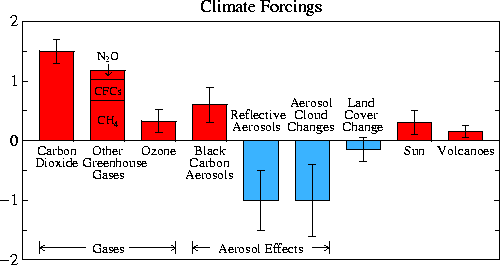
We can see that the forcing of methane (CH4) is about half that for carbon dioxide. Why is that, if it is such a powerful greenhouse gas? The answer is that there's a lot less of it. CO2 is measured in parts per million (about 390), and methane is measured in parts per billion (about 1,750). So CO2 is more important because there is more of it.

The other reason we care more about CO2, and the reason you hear such different numbers for how much more "potent" methane is relative to CO2, is that CO2 hangs around in the atmosphere basically forever (hundreds to thousands of years) and methane breaks down quickly (about a dozen years). So the big numbers (400 times more powerful) refer to a molecule of CH4 vs a molecule of CO2, and the smaller numbers (25 times, 50 times) refer to the fact that CO2 is weaker as a GHG, but hangs around a lot longer.

This matters quite a bit, because of feedbacks. Positive feedbacks (things like loss of the sea ice in the Arctic, leading to a change in albedo and more warming, or warming of the oceans, leading to a reduced ability to store dissolved CO2, more atmospheric CO2, and more warming) mean that front-loaded warming is more dangerous than "slow and steady" warming, even leaving aside the fact that warming sooner rather than later leaves less time for adaptation. If warming today triggers more warming (and it seems very likely that is does) then warming from methane follows those rules of compound interest earnest financial planners try to teach you: warming now (like saving now) leads to bigger results, because it triggers positive feedback (the "interest") which causes warming, which leads to more feedback, which leads to more warming (the interest earns interest; this is the "compound" part.) So a spike in methane levels could be very dangerous; by giving the climate a hard shove for the 12 years or so it is in the atmosphere, methane can set in motion processes that will be warming the climate after the initial bolus of methane is long gone.

Should we be concerned about the possibility of such a spike? Unfortunately, yes. To understand why, we have to delve in to the different forms of stored methane and how they become unstored. I'll explore that in part two.

Wednesday, March 3, 2010

Hat tip

John Quiggin goes to town on the "no global warming since 1995" meme in an all-around awesome post: Four lies and an empty set. So even though on his worst day he has ten times the readers this blog has or is likely to have, I'm going to advise any of the handful of people who may have wandered in here by mistake to go read his stuff -- it's great.

Tuesday, March 2, 2010

Minor myths: "The Arctic sea ice is almost back to normal"

The big dogs do a great job of cataloging the major denialist talking points, the ones with legs, the major hallucinations. See Realclimate's stuff and Skeptical Science's pages. But the work is never done; deniers change memes as often as they change their socks, and for the same reason: at the end of the day, they stink to high heaven.

So this is the first in an occasional series on the minor talking points of the deniers. This week: the claim that after hitting an all-time low in 2007, Arctic ice has "rebounded" and is now "near normal."

You find it on AccuWeather:

So far we have two years of recovery from the 2007 melt. Will it surpass 2007's melt or will it return to normal?


You find it in Watt's echo chamber:


In 2007 the winds caused an anomaly that has been recovering ever since.


[And star idiot Steven Goddard weighs in:]


Ice area is normal and well ahead of 2007 or 2008.


Thirty seconds of looking at the actual data gives the lie to the talking point:


We are running 720,000 square km below the mean. That's far from "normal" or even "near normal." What about the "recovery" part of the myth? Consider the yearly sea ice minimum, still, in 2008 and 2009, far below average levels:


When you look at the chart, you can see what's happened. In 2007 the bottom fell out. No one knows exactly why, but it was a record-shattering year. In the ensuing two years, the summer extent is slightly higher, but every year since 2007 has been far worse than every year prior to 2007. That's a critical point. 2007 remains, so far, an outlier, but the ice has not come back from that decline. Deniers are ignoring that in trying to imagine a recovery to near-normal levels. 2008 and 2009 were the second- and third-worst years for the Arctic ice on record.

Aficionados of idiocy will note that this is the same fallacy that denailists use to argue that 2005 hottest year on record = cooling for the past five years (Sure, and any day Kobe Byrant scores less than 81 points a game (his record, believe it or not) we can say his career is in decline).

We can expect more nasty surprises like 2007 ahead, but in the meantime, we can be buoyed by the denialists' optimistic view that any year that does not set a new record -- whether for temperature or sea ice or glacier loss or whatever -- must mean the trend has reversed itself.

Monday, March 1, 2010

End of the solar minimum

February 2010 was the first month in three years in which the Sun has sunspots every day of the month. This is a sign of the end of an unusually long and deep "solar minimum" -- which is the term for the lower portion of a regular eleven-year cycle of sunspots. In 2009, there were 260(!) days without sunspots. Nevertheless, 2009 was tied for the second-warmest year in the instrument record.

The influence of solar variability on the climate is modest -- the sun's intensity varies by a maximum of about 1 W/m^2. But in the short term, especially given the likely persistence of an El Nino through Spring, the upswing in solar radiance may contribute to record-breaking warmth. January and February 2010 were the hottest and second-hottest months in the satellite record, respectively -- which likely makes them among the hottest in the last 1,200 years.