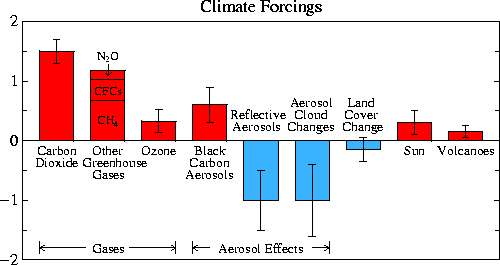
"The adoption of aggressive standards by 2015 would set the world on a course to prevent the deaths of 200,000 people, save 13 million tons of cereal grains from ozone damage, and save $1.5 trillion in health damages each year after 2030," Shindell said.
We all share one atmosphere, and that means international treaties are the only way forward, not just in the effort to contain CO2, but for other types of emissions as well:
While reductions in particulate matter tend to produce local health benefits, the scientists found health and agricultural benefits from reduced ozone disperse more widely. That means for some countries — India, for example — changes in emissions from neighboring countries could have as much impact as local emission changes.
The climate benefit is short-term but significant:
Shindell's modeling shows that stringent emissions standards would reduce 0.20°C (0.36°F) of warming in the Northern Hemisphere from 2040 to 2070. That's largely because more stringent standards would reduce emissions of black carbon, a constituent of soot, and carbon monoxide, a precursor of ozone.
Other recent results have highlighted the benefits of methane emissions reduction, similarly a cheap intervention with secondary benefits and significant short-term impacts on warming, up to 0.4C.
None of this buys us time in the sense that we can put off dealing with CO2 emissions. What it might do, if coupled with the most aggressive CO2 reductions imaginable, is slow down some of the now-not-so-long-term feedbacks, like permafrost melting and forest dieback and wetland losses and breakdown of methyl hydrates and degassing of CO2 from the oceans and the soil. We don't really know, but based on the way those feedbacks are ramping up given 0.8C of warming, it's not hard to imagine how sensitive they are likely to be to twice that much warming.
The article linked to above ("Losing time, not buying time") argues that focusing on these short-term feedbacks could be a fatal distraction:
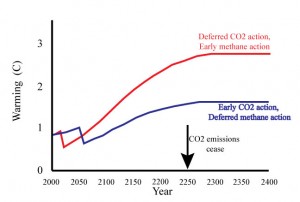
While we are "buying" (or frittering away) time dealing with methane, fossil-fuel CO2 emission rate, and hence cumulative emissions, continue rising at the rate of 3% per year, as they have done since 1900. By 2040, we have put another 573 gigatonnes of carbon into the atmosphere, bringing the cumulative fossil fuel total up to 965 gigatonnes. By controlling methane you have indeed kept the warming in 2040 from broaching the 2C limit, but what happens then? In order to keep the cumulative emissions below the 1 trillion tonne limit, you are faced with the daunting task of bringing the emissions rate (which by 2040 has grown to 22 gigatonnes per year) all the way to zero almost immediately. That wasn’t very helpful, was it? At that point, you’d probably like to return the time you bought and get a refund (but sorry, no refunds on sale items). More realistically, by the time you managed to halt emissions growth and bring it down to nearly zero, another half trillion tonnes or so would have accumulated in the atmosphere, committing the Earth to a yet higher level of long-term warming.
His point is well taken, but I have a different possible scenario that I worry about:
We intensively reduce CO2. This has little effect on temperatures for the next several decades -- they rise by about 0.2C/decade until 2050. Despite forty years without a demonstrable benefit, the people of the world persevere, and keep the anthropogenic carbon added to the system below 1,000 gigatonnes.
Unfortunately, by this point the world is 1.6C warmer than the one we started with. The permafrost alone is releasing 50 gigatonnes of carbon per year. The oceans, half that. At this point the biosphere starts to saturate and becomes a net emitter of CO2, rather than absorbing half of our emissions, as is the case today. The world has done the right thing, too late, and is now condemned to centuries of continued CO2 rises and continued warming.
If the author is right (and I think he is) and I am right (and I'm afraid I might be) the choice is not either/or: we need controls on CO2 to avert disaster by primary CO2 release, and controls on short-term gases and aerosols to give us a chance of averting disaster by secondary releases of carbon from natural sinks.
We need both, but right now we do not have the political strength to get either, even with the evidence that the early stages of mitigation would pay for themselves. Some days it's hard to see a path forward.