Showing posts with label sea level rise. Show all posts

Tuesday, July 17, 2012

Dat PIOMAS -- massive ice news roundup


The melting news is not good. First there is the volume of the Arctic sea ice, which has hit a record low for the third year running. Knowing the powerful influence of local weather conditions on the Arctic sea ice, the steady fall is surprising. The warming-driven melt signal is overpowering the year-to-year variations.

And then there's Greenland.

Smack dab in the middle of high convection cell, hotter than Hades (for them). And because slightly distressed snow is a lot darker than fresh/never melted snow, the overall albedo of the entire ice sheet is shifting in the direction of more heat absorption and even more melting:

h/t Neven, via Michael Tobis
Greenlanders got an up-close-and-personal look at the shape of things to come when roaring glacier runoff smashed through the bridges of Kangerlussuaq (h/t Climate Denial Crock of the Week):


Petermann Glacier also lost a chunk of ice twice the size of Manhattan:

h/t Climate Denial Crock of the Week
Wrap up from Neven here.


But all this may turn out to be the warm-up for the really stunning ice news of the week, which is the birth of a third long-term climate record, supplementing the ice cores of Antarctica and Greenland. "Lake E" is Siberia has come up big with 3 million years of sediment records.

Like most real science, the excitement of the press-release-worthy findings is somewhat mitigated by the boring necessity of having other scientists examine the findings, confirm the findings, etc. Some of the interesting stuff in the record, though, is as follows:

1. There seem to be large climate swings in the record which are far too large to be explained by orbital changes or any other known natural forcing. While this will doubtless be trumpeted by the "science knows nothing crowd," this result, if it holds up, would imply positive feedbacks in the climate system so powerful and exquisitely sensitive that they dwarf the original positive forcing. My sense of the recent literature has been that the most likely suspect for those feedbacks would be the carbon cycle (permafrost, changes in soil respiration, methyl hydrates, etc.) The authors of this study think that's not enough -- see #3, below.

2. The Arctic and Antarctic climates are linked. They tend to warm together and cool together.

3. Melting in Antarctica may turn out to trigger melting in Greenland and the rest of the Arctic:

First, they say, reduced glacial ice cover and loss of ice shelves in Antarctica could have limited formation of cold bottom water masses that flow into the North Pacific Ocean and upwell to the surface, resulting in warmer surface waters, higher temperatures and increased precipitation on land.
Alternatively, disintegration of the West Antarctic Ice Sheet may have led to significant global sea level rise and allowed more warm surface water to reach the Arctic Ocean through the Bering Strait.
Lake E's past, say the researchers, could be the key to our global climate future.
4. The loss of ice from Greenland in Antarctica is likely to accelerate (gee, really?)

Point #3 brings to mind something from Eli's place. Fellow amateurs, gird your loins and follow me:

Shakun et al. find that at the end of the last ice age temperature increased immediately in the Arctic but only slightly, probably as a result of increased radiation during the northern hemisphere summer. As a result a small portion of the Arctic ice melted. The melt water had a lower salt concentration and thus was less dense than the surface water and sank although mostly not to great depths. The result was that the AMOC and thus the associated redistribution of heat between the Arctic and the tropics was interrupted. This meant that the temperature in the high northern latitudes no longer rose, but may, in fact, have even decreased slightly. This is exactly what was found in the data. As a result, the temperature rose in the southern tropics and then the southern temperate latitudes and finally in Antarctica. Only then did the data show an increase in CO2. So somehow warming of the southern latitudes leads to increased emissions of CO2. Simultaneous determination of the isotopic ratio (for example, according to RF Anderson, S. Ali, LI Bradtmiller, SHH Nielsen, MQ Fleisher, BE Anderson, and LH Burckle, Wind-Driven Upwelling in the Southern Ocean and the Deglacial Rise in Atmospheric CO2, Science, 323 , 1443-1448 (2009).) suggests that the CO2 source is a consequence of biological fixation of carbon residues, for example in plankton deposited on the ocean floor. This increase in CO2 concentration is more than twice as strong as expected from outgassing of CO2 from warmer sea water alone.  It indicates that the exchange with the Southern Ocean deep water became more intense and carbon deposits were transferred from the depths to the surface. Only after a significant temperature increase in the south and an increase in CO2 concentration, did the temperature rise again in the northern hemisphere. This is interpreted as providing a feedback mechanism for for greenhouse gases to drive global warming.
What if we put that together with the "Lake E" speculations? To wit:
First, they say, reduced glacial ice cover and loss of ice shelves in Antarctica could have limited formation of cold bottom water masses that flow into the North Pacific Ocean and upwell to the surface, resulting in warmer surface waters, higher temperatures and increased precipitation on land.
Alternatively, disintegration of the West Antarctic Ice Sheet may have led to significant global sea level rise and allowed more warm surface water to reach the Arctic Ocean through the Bering Strait.
Lake E's past, say the researchers, could be the key to our global climate future.
 So I tell myself the story: a slight change in solar forcing heats the North, which interrupts warm ocean currents, causing the South to heat. Ice sheets collapse, southern ocean currents change, and by some combination of unearthing plankton carbon, rising sea levels, and/or changing ocean currents, the North warms further, and more greenhouse gases are released.

Interesting story. Warming gets passed back and forth from North to South, until from modest beginnings you have a climate warmer than the present day. So what happens if, instead of a tiny tap on the Northern latitudes with a modest increase in insolation, you instead hammer the entire planet from stem to stern with a massive greenhouse gas forcing? We're about to find out.

UPDATE: The sharp eyes of the Hawk have spotted the Arctic Monitoring and Assessment Programme's (AMAP) 2011 report on Snow, Water, Ice and Permafrost in the Arctic (SWIPA).His summary of the summary is excellent.


Mostly this is stuff that is not news to regular readers; snow and ice are melting faster and faster. The loss of ice and snow is a positive feedback that leads to further warming. Permafrost is melting, releasing more carbon (we don't know how much yet). Greenland will melt faster and faster, but nobody knows how fast yet. 

Tuesday, July 10, 2012

America burning -- for the rest of our lives

The incomparable Peter Sinclair:


The companion video is also outstanding:


Not only does is give good Colbert, there are chats with the Navy's chief oceanographer and an executive and Munich Re -- which has been warming its shareholder about the impact of global warming since 1973.

Saturday, January 21, 2012

Preparations in the meantime

Population: 158 million

Reported without comment:

According to the Bangladeshi government’s climate change action plan, as many as 20 million Bangladeshis may need to be resettled as soon as 2050. “Preparations in the meantime will be made to convert this population into trained and useful citizens for any country,” the plan (pdf) says.

Saturday, December 10, 2011

Sea Level

New site, h/t WHT: http://www.sealevelreport.com/

As with many climate impacts, the problem of sea level rise is a little more complicated than it appears at first blush. There is, of course, the problem of putting valuable real estate under water. Five million square kilometers of land lies within 10m of sea level; but it is not just any land. For thousands of years, boats have been the most efficient way to move goods; before the advent of railroads, automobiles, and airplanes, they were also by far the fastest. Hence huge numbers of people live at the water's edge. Today, about 37% of the world's people live within a 100km of the coast; by 2030, half the world's people will. About 500 million people currently live within 5m of sea level; those are the people whose homes are likely to be under water sometime between 40 and 400 years from now. There are 800 million people within 10m of sea level; they will probably have to move eventually as well.

But in addition to human settlements from small towns to great metropolises that must either by lost to the sea or protected via a huge and expensive system of dikes, there are additional consequences to sea level rise. One is erosion; higher seas mean the ocean takes bigger and bigger chunks of land away with the waves. This has been estimated at about 10% of rate of inundation -- so if we lose 5 million square km to rising seas, we might expect to lose 500,000 km^2 to erosion.

A more subtle problem is the infiltration of salt water deep inland.


 As the sea level rises, salt water filters into the aquifers, a problem exacerbated by over-pumping. In California, some regions have already been forced to inject fresh water into the aquifer on a regular basis to create a barrier to slow the infiltration of salt water into the aquifer.

An excellent report on sea level rise, its dangers, and the costs of adaptation, is here. The cost of the realistically expected sea level rise in this century alone is in the trillions. These estimates do not take into the loss of historic cities, the destruction of wetlands, corals, and wildlife, or the cost of conflicts over limited water or the resettlement of refugees.


Sunday, October 16, 2011

Curt Stager's Eemian -- cold comfort for a +4C future


Curt Stager has some reassurance for us regarding Greenland's ice sheet:
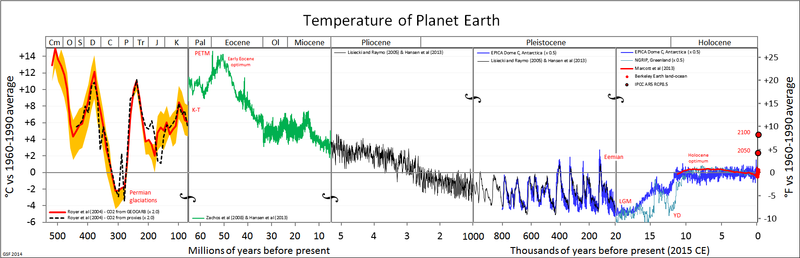
Another way to estimate the durability of Greenland's ice is to look to the distant past. Ice cores and marine sediments show that dozens of cyclic natural warmings have punctuated the last 2 to 3 million years without totally deglaciating the poles. The one before the last ice age, the Eemian Interglacial, kept Arctic summers several degrees warmer than now between 130,000 and 117,000 years ago, but at least half of Greenland remained glaciated even after 13,000 years of Eemian heating.
Oh, good. As long as it doesn't get any warmer than it was in the Eemian, we shouldn't lose more than half of the Greenland ice sheet. But of course, if you lose ice from Greenland you will probably lose ice from elsewhere, too, so we should probably look at what sea levels did in the Eemian, rather than just one source of what. They were about 13 to 20 feet higher than today.

Now one might object that Stager says this took place over 13,000 years. But that's not exactly what he said. He said that after 13,000 years, about half the ice was gone. That's not quite the same thing. Glaciers persist because of a balance of accumulation of new ice and melt. A given amount of warming pushes the equilibrium of the glacier towards a reduced size, but unless the reduced size starts to compromise the accumulation zone, the new equilibrium can be stable. Meaning that Greenland could have lost all that ice in a couple of centuries following the warming, and then remained in a stable half-melted state for the next 12,800 years. We don't know. Our proxies are not detailed enough to tell us. We know half the ice was there after twelve thousand years, but we don't know if that represents a rapid melt and a new equilibrium, or a gradual 13,000-years melting.

But, still. Twenty feet. We can do twenty feet, surely? I see the Bangladeshi delegation have their hands up. Please hold your questions until the end. Thank you.

The trouble with the reassuring anecdote of the Eemian is that it was not really all that much warmer than the present. Some parts of Europe were 1-2C cooler than today. The Arctic may have been "several degrees" warmer -- due to Arctic amplification, which we already observe with regards to the present warming.

SRES A1B, warming per century, from Real Climate
As the map illustrates, we can expect warming in the Arctic to run about double the overall trend. That puts us in line for +8C, +10C or even more over the next century or two. Eight degrees -- eight degrees is beginning to leave the realm of "several" and put a toe over the line into "many." In other words, the end of the next century will be warmer than the Eemian was. 

So what were the sea levels like the last time the world was +4C warmer (+8C at the poles) (the warming expected over the next century or so)?

If you look at the +2C line (which is probably the best case scenario for 2100, with aggressive mitigation; we are +0.8C now) you'll see the world has not seen temperatures that warm in the last ten million years, including the Eemian. The last time we were at +4C was in the Eocene, some 40 million years ago. What were the sea levels then? That turns out to be a tricky question to answer precisely, because over tens of millions of years, the land as well as the seas are moving up and down. But there was little ice in Antarctica, or in Greenland. Which, if it happened today, would equate to a 80 meter sea level rise -- 260 feet.

This is what the United States looks like after an 80 meter rise:


The Eastern seaboard is gone.


The Gulf is gone.


The principle cities of the West Coast are gone.


Essentially the United States as we know it would be destroyed and the nation, if it survived as such, would have to resettle more than a hundred million people and abandon its most valuable, most heavily developed, and most historic lands -- Washington DC and New York, Philadelphia, Miami (and indeed all of Florida), Los Angeles, Portland and Seattle.

I don't know how long we would have to remain at +4C for this to happen. A very long time, I fervently hope. But if you are looking for analogies to the coming warming, mine seems closer to the coming centuries than his. Yet he's a note paleoclimatologist with a book out on this very subject:


So why what seems to be a falsely reassuring analogy? Perhaps I'm missing something basic. He's the climate scientist, not me. To my layman's understanding, he seems to be avoiding the uneasy truth of just how far out of the realm of anything we know we are pushing the world's climate. He's striving to sound reasonable, but the threat is objectively so much bigger than the discourse is prepared to accept, that to sound reasonable you have to downplay the logical implications of the paleoclimate record.