Showing posts with label paleoclimate. Show all posts

Tuesday, January 3, 2012

Could there be a tipping point for the Arctic after all?


The rapid disappearance of the Arctic sea ice raised for many the prospect of a "tipping point" at which ice loss becomes irreversible and an ice-free North becomes a permanent condition.

Especially after the dramatic fall in 2007, efforts have been made to model the probable behavior of the rapidly waning sea ice. That led to an important paper with a simple method and an elegant result. Several scientists at the university of Washington did model runs in which CO2 forcing was gradually increased, looking for a tipping point ("threshold behavior"). They didn't find any. The sea ice disappeared gradually as conditions warmed. When they allowed conditions to cool, the sea ice came back. No tipping points in the model.

Well, brace yourselves for the shock, but "skeptics" missed the point of the paper, and shouted the results from every rooftop. Stupid scientists! "The Next Ice Age Now" crowed "More global warming propaganda debunked."

The actual result, rather than the result deniers fantasized had come about, was this: the dramatic fall in sea ice cover to date represents a steady response to the long-term climate warming. It is progressing fast because the climate is changing fast. The ice cover is still falling apart, not (so far) because of a tipping point, but because of rapid global warming. It could recover if we successfully halted or reversed global warming. Short of that, it will continue its death spiral.

Not really a pro-"skeptic" message, if you read past the headline. Fortunately for their peace of mind, they rarely do.

Work to understand the rapid changes to the Arctic continues. Chris R points us to this 2008 paper:

It is argued that deep atmospheric convection might occur during winter in ice-free high-latitude oceans, and that the surface radiative warming effects of the clouds and water vapor associated with this winter convection could keep high-latitude oceans ice-free through polar night. In such an ice-free high-latitude ocean the annual-mean SST would be much higher and the seasonal cycle would be dramatically reduced - making potential implications for equable climates manifest. The constraints that atmospheric heat transport, ocean heat transport, and CO2 concentration place on this mechanism are established. These ideas are investigated using the NCAR column model, which has state-of-the-art atmospheric physics parameterizations, high vertical resolution, a full seasonal cycle, a thermodynamic sea ice model, and a mixed layer ocean. Citation: Abbot, D. S., and E. Tziperman (2008), Sea ice, high-latitude convection, and equable climates, Geophys. Res. Lett., 35, L03702, doi:10.1029/ 2007GL032286.
It's not bathtub reading, but basically what Abbot and Tziperman set out to do was to explain evidence from the paleoclimate record of a warmer Arctic (1) and a less pronounced seasonal cycle at the poles. Both the late Cretaceous and the early Paleogene climate had these features, but existing climate models do not reproduce them well. When they created a more sophisticated model of the Arctic, they found it could settle into a stable ice-free state secondary to changes in cloud cover and atmospheric circulation (they discuss the same issues in a slightly earlier paper published by the Royal Meteorological Society.) The former has been cited 23 times; the latter 16, according to Google Scholar. So while this is serious science, the theory has not exactly caught fire. That they continue to explore the idea in Feb 2009 and again in July 2009, without a lot of other climate scientists taking up the charge,deepens the suspicion that Abbot/Tziperman have not convinced their colleagues that this is a thing, despite a 2011 paper (h/t Artful Dodger) which Abbot wrote with the great Raymond Pierrehumbert, which cites one of the 2009 papers as part of a broader discussion of possible sea ice tipping points.

On the other hand, it's not as if we have a lot of great explanations for the paleoclimate record laying around:
The consensus among these proxies suggests that Arctic temperatures were ∼19 °C warmer during the Pliocene than at present, while atmospheric CO2 concentrations were ∼390 ppmv. These elevated Arctic Pliocene temperatures result in a greatly reduced and asymmetrical latitudinal temperature gradient that is probably the result of increased poleward heat transport and decreased albedo. These results indicate that Arctic temperatures may be exceedingly sensitive to anthropogenic CO2 emissions.
The specter of an Arctic tipping point has not been laid to rest. If a similar amount of forcing to today's somehow got the Pilocene's Arctic 19C warming than today's, than some kind of hole in the floor seems a logical area of concern. (I wonder idly if the phlegmatic Dmitrenko ever modeled 19 degrees of warming over the East Siberian Arctic Shelf.)

UPDATE: Check out Dosbat,  Chris R's insanely good blog, for even more Arctic/Climate change goodness. Added to the blogroll, as well.

Sunday, October 16, 2011

Curt Stager's Eemian -- cold comfort for a +4C future


Curt Stager has some reassurance for us regarding Greenland's ice sheet:
Another way to estimate the durability of Greenland's ice is to look to the distant past. Ice cores and marine sediments show that dozens of cyclic natural warmings have punctuated the last 2 to 3 million years without totally deglaciating the poles. The one before the last ice age, the Eemian Interglacial, kept Arctic summers several degrees warmer than now between 130,000 and 117,000 years ago, but at least half of Greenland remained glaciated even after 13,000 years of Eemian heating.
Oh, good. As long as it doesn't get any warmer than it was in the Eemian, we shouldn't lose more than half of the Greenland ice sheet. But of course, if you lose ice from Greenland you will probably lose ice from elsewhere, too, so we should probably look at what sea levels did in the Eemian, rather than just one source of what. They were about 13 to 20 feet higher than today.

Now one might object that Stager says this took place over 13,000 years. But that's not exactly what he said. He said that after 13,000 years, about half the ice was gone. That's not quite the same thing. Glaciers persist because of a balance of accumulation of new ice and melt. A given amount of warming pushes the equilibrium of the glacier towards a reduced size, but unless the reduced size starts to compromise the accumulation zone, the new equilibrium can be stable. Meaning that Greenland could have lost all that ice in a couple of centuries following the warming, and then remained in a stable half-melted state for the next 12,800 years. We don't know. Our proxies are not detailed enough to tell us. We know half the ice was there after twelve thousand years, but we don't know if that represents a rapid melt and a new equilibrium, or a gradual 13,000-years melting.

But, still. Twenty feet. We can do twenty feet, surely? I see the Bangladeshi delegation have their hands up. Please hold your questions until the end. Thank you.

The trouble with the reassuring anecdote of the Eemian is that it was not really all that much warmer than the present. Some parts of Europe were 1-2C cooler than today. The Arctic may have been "several degrees" warmer -- due to Arctic amplification, which we already observe with regards to the present warming.

SRES A1B, warming per century, from Real Climate
As the map illustrates, we can expect warming in the Arctic to run about double the overall trend. That puts us in line for +8C, +10C or even more over the next century or two. Eight degrees -- eight degrees is beginning to leave the realm of "several" and put a toe over the line into "many." In other words, the end of the next century will be warmer than the Eemian was. 

So what were the sea levels like the last time the world was +4C warmer (+8C at the poles) (the warming expected over the next century or so)?

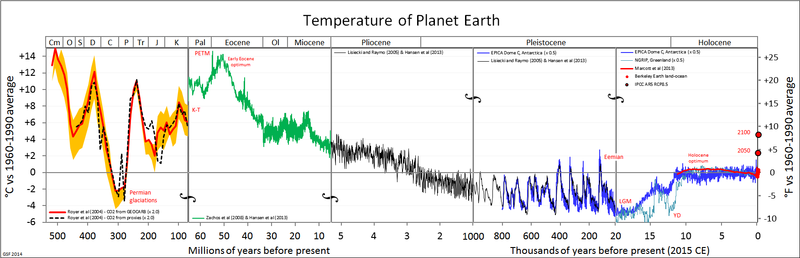
If you look at the +2C line (which is probably the best case scenario for 2100, with aggressive mitigation; we are +0.8C now) you'll see the world has not seen temperatures that warm in the last ten million years, including the Eemian. The last time we were at +4C was in the Eocene, some 40 million years ago. What were the sea levels then? That turns out to be a tricky question to answer precisely, because over tens of millions of years, the land as well as the seas are moving up and down. But there was little ice in Antarctica, or in Greenland. Which, if it happened today, would equate to a 80 meter sea level rise -- 260 feet.

This is what the United States looks like after an 80 meter rise:


The Eastern seaboard is gone.


The Gulf is gone.


The principle cities of the West Coast are gone.


Essentially the United States as we know it would be destroyed and the nation, if it survived as such, would have to resettle more than a hundred million people and abandon its most valuable, most heavily developed, and most historic lands -- Washington DC and New York, Philadelphia, Miami (and indeed all of Florida), Los Angeles, Portland and Seattle.

I don't know how long we would have to remain at +4C for this to happen. A very long time, I fervently hope. But if you are looking for analogies to the coming warming, mine seems closer to the coming centuries than his. Yet he's a note paleoclimatologist with a book out on this very subject:


So why what seems to be a falsely reassuring analogy? Perhaps I'm missing something basic. He's the climate scientist, not me. To my layman's understanding, he seems to be avoiding the uneasy truth of just how far out of the realm of anything we know we are pushing the world's climate. He's striving to sound reasonable, but the threat is objectively so much bigger than the discourse is prepared to accept, that to sound reasonable you have to downplay the logical implications of the paleoclimate record.