Showing posts with label positive feedbacks. Show all posts

Tuesday, July 17, 2012

Dat PIOMAS -- massive ice news roundup


The melting news is not good. First there is the volume of the Arctic sea ice, which has hit a record low for the third year running. Knowing the powerful influence of local weather conditions on the Arctic sea ice, the steady fall is surprising. The warming-driven melt signal is overpowering the year-to-year variations.

And then there's Greenland.

Smack dab in the middle of high convection cell, hotter than Hades (for them). And because slightly distressed snow is a lot darker than fresh/never melted snow, the overall albedo of the entire ice sheet is shifting in the direction of more heat absorption and even more melting:

h/t Neven, via Michael Tobis
Greenlanders got an up-close-and-personal look at the shape of things to come when roaring glacier runoff smashed through the bridges of Kangerlussuaq (h/t Climate Denial Crock of the Week):


Petermann Glacier also lost a chunk of ice twice the size of Manhattan:

h/t Climate Denial Crock of the Week
Wrap up from Neven here.


But all this may turn out to be the warm-up for the really stunning ice news of the week, which is the birth of a third long-term climate record, supplementing the ice cores of Antarctica and Greenland. "Lake E" is Siberia has come up big with 3 million years of sediment records.

Like most real science, the excitement of the press-release-worthy findings is somewhat mitigated by the boring necessity of having other scientists examine the findings, confirm the findings, etc. Some of the interesting stuff in the record, though, is as follows:

1. There seem to be large climate swings in the record which are far too large to be explained by orbital changes or any other known natural forcing. While this will doubtless be trumpeted by the "science knows nothing crowd," this result, if it holds up, would imply positive feedbacks in the climate system so powerful and exquisitely sensitive that they dwarf the original positive forcing. My sense of the recent literature has been that the most likely suspect for those feedbacks would be the carbon cycle (permafrost, changes in soil respiration, methyl hydrates, etc.) The authors of this study think that's not enough -- see #3, below.

2. The Arctic and Antarctic climates are linked. They tend to warm together and cool together.

3. Melting in Antarctica may turn out to trigger melting in Greenland and the rest of the Arctic:

First, they say, reduced glacial ice cover and loss of ice shelves in Antarctica could have limited formation of cold bottom water masses that flow into the North Pacific Ocean and upwell to the surface, resulting in warmer surface waters, higher temperatures and increased precipitation on land.
Alternatively, disintegration of the West Antarctic Ice Sheet may have led to significant global sea level rise and allowed more warm surface water to reach the Arctic Ocean through the Bering Strait.
Lake E's past, say the researchers, could be the key to our global climate future.
4. The loss of ice from Greenland in Antarctica is likely to accelerate (gee, really?)

Point #3 brings to mind something from Eli's place. Fellow amateurs, gird your loins and follow me:

Shakun et al. find that at the end of the last ice age temperature increased immediately in the Arctic but only slightly, probably as a result of increased radiation during the northern hemisphere summer. As a result a small portion of the Arctic ice melted. The melt water had a lower salt concentration and thus was less dense than the surface water and sank although mostly not to great depths. The result was that the AMOC and thus the associated redistribution of heat between the Arctic and the tropics was interrupted. This meant that the temperature in the high northern latitudes no longer rose, but may, in fact, have even decreased slightly. This is exactly what was found in the data. As a result, the temperature rose in the southern tropics and then the southern temperate latitudes and finally in Antarctica. Only then did the data show an increase in CO2. So somehow warming of the southern latitudes leads to increased emissions of CO2. Simultaneous determination of the isotopic ratio (for example, according to RF Anderson, S. Ali, LI Bradtmiller, SHH Nielsen, MQ Fleisher, BE Anderson, and LH Burckle, Wind-Driven Upwelling in the Southern Ocean and the Deglacial Rise in Atmospheric CO2, Science, 323 , 1443-1448 (2009).) suggests that the CO2 source is a consequence of biological fixation of carbon residues, for example in plankton deposited on the ocean floor. This increase in CO2 concentration is more than twice as strong as expected from outgassing of CO2 from warmer sea water alone.  It indicates that the exchange with the Southern Ocean deep water became more intense and carbon deposits were transferred from the depths to the surface. Only after a significant temperature increase in the south and an increase in CO2 concentration, did the temperature rise again in the northern hemisphere. This is interpreted as providing a feedback mechanism for for greenhouse gases to drive global warming.
What if we put that together with the "Lake E" speculations? To wit:
First, they say, reduced glacial ice cover and loss of ice shelves in Antarctica could have limited formation of cold bottom water masses that flow into the North Pacific Ocean and upwell to the surface, resulting in warmer surface waters, higher temperatures and increased precipitation on land.
Alternatively, disintegration of the West Antarctic Ice Sheet may have led to significant global sea level rise and allowed more warm surface water to reach the Arctic Ocean through the Bering Strait.
Lake E's past, say the researchers, could be the key to our global climate future.
 So I tell myself the story: a slight change in solar forcing heats the North, which interrupts warm ocean currents, causing the South to heat. Ice sheets collapse, southern ocean currents change, and by some combination of unearthing plankton carbon, rising sea levels, and/or changing ocean currents, the North warms further, and more greenhouse gases are released.

Interesting story. Warming gets passed back and forth from North to South, until from modest beginnings you have a climate warmer than the present day. So what happens if, instead of a tiny tap on the Northern latitudes with a modest increase in insolation, you instead hammer the entire planet from stem to stern with a massive greenhouse gas forcing? We're about to find out.

UPDATE: The sharp eyes of the Hawk have spotted the Arctic Monitoring and Assessment Programme's (AMAP) 2011 report on Snow, Water, Ice and Permafrost in the Arctic (SWIPA).His summary of the summary is excellent.


Mostly this is stuff that is not news to regular readers; snow and ice are melting faster and faster. The loss of ice and snow is a positive feedback that leads to further warming. Permafrost is melting, releasing more carbon (we don't know how much yet). Greenland will melt faster and faster, but nobody knows how fast yet. 

Wednesday, July 6, 2011

PIOMAS plunges to a new record low


The linear decline in Arctic ice volume is looking less and less plausible. It seems likely that what we are facing is an exponential decline in ice volume and, ultimately, in sea ice extent.

Warming in the Arctic will continue to accelerate, as the open water absorbs far more of the incident sunlight than the highly reflective surface of the ice. While this ice is not going to raise the sea level, since it is already floating over the ocean, the loss of this ice and the attendant local warming are accelerating losses from the northern portion of the Greenland ice sheet, which represents 7 meters of sea level rise in total, enough to put the homes of 700 million people under water.


Greenland's melting season last year shattered records. What will 2011 bring?

Sunday, February 13, 2011

Revkin misses the point

I want to like Andy Revkin. I do. He's a good-hearted soul, and he is the gatekeeper at perhaps the most accessible climate change blog around. But the longer he writes and the more of his epistemology he reveals to us, the more sadly apparent it becomes that he lacks any original insight into either of the science of climate change, or the politics, or the problems of messaging and activism. Nice as he is, he just doesn't get it:

For analysts and campaigners stressing the climate factor as the keystone influence on food prices, it’s also worth remembering that grain stocks these days are also not particularly stressed, from the local (Kansas) level up through a global view. A post from last fall on grain stocks and food (in)security on the Big Picture Agriculture blog (at the time, the unrest was in Mozambique) has some helpful context on the mix of issues affecting food availability:

Governmental policies of export and import restrictions, hoarding, subsidies, panic buying, and infrastructure standards of food storage and transport, as well as investor speculation, currency valuations, individual national inflation rates, weather and climate change, the evolving monoculture genetics, rising input costs, and global macro economic health all impact food security.


Now, I'm not saying he needs to read my blog. Wait a few months, and you can find the very same point made (much more eloquently) in the slightly more regarded Economist:

[U]nlike economies, political systems can be quite brittle. When you look at historical Jared Diamond collapse scenarios, what you see is that they're hyper-local. A complex society develops within a local environment, and when the local environmental conditions change the society collapses. But in the modern world, even substantial local environmental collapses tend not to lead to societal implosion. If Chinese crops fail, China doesn't end; it imports grain from elsewhere. But the ability to limit the damage of modern crises depends upon the institutions that support a liberal global economy, and institutions aren't always as flexible as economies. The world has this marvelous grain market, but if price increases lead to export-restrictions then that grain market suddenly fails. And if the grain markets fail, the unstable governments kept in place only by their ability to keep local markets provisioned fall. And if the governments fall, the refugees will seek asylum elsewhere, and if that happens then borders will be overwhelmed, and who knows what conflicts may erupt.


You can't separate the damage of global warming from the damages caused by "export and import restrictions, hoarding, subsidies, [or] panic buying." The one will lead to the other as night follows day. There are not going to be some new kind of human beings twenty years hence who will cope with unpredictable devastation in a calm, unselfish, rational and farsighted way. That is to say: damage to our adaptive capacities by predictably shortsighted and selfish government responses must be counted among the feedbacks of climate change, even if it is impossible to accurately quantify it.

Please, Andy, and for all our sakes, catch up.

Saturday, November 27, 2010

Bad news from GISS


By combining the newer fire model with an existing climate model developed at GISS, Pechony and Shindell ran their model back to 844 to check how well they could capture past conditions, and forward to 2100 to simulate future wildfire trends under different climate regimes. When projecting forward, they modeled three different greenhouse-gas emissions scenarios, including one that curtailed greenhouse gas emissions significantly, one that assumes they continue unabated, and one in the middle. All three produced rapidly rising temperatures, regional drying, and increases in fire abundance.


This is kind of a tall drink of bad news. It reminds us that a large amount of warming is in the pipeline regardless of what we do . . . a fact which makes it all the more crucial that we put the brakes on this runaway train as soon as possible. And it draws our attention to another tipping point, in this case the point at which rising global temperatures overcome the firefighting infrastructure, and forest fires rage out of control. This will release significant amounts of CO2, and spread black soot which decreases the Earth's albedo -- both of which will cause more warming.

Other important feedbacks include the loss of Arctic sea ice, decreasing the albedo, decreased absorption of CO2 by warming seas, destabilization of methyl hydrates, and the melting of permafrost. Throw in some landslides and tsunamis, and it'll be an interesting century ahead.

Monday, June 21, 2010

The consequences of an ice-free Arctic, part two: Amplifying global warming

We return after an unplanned hiatus to the following question:

Has anyone actually explained exactly WHY and HOW an ice-free Arctic is such a disaster? And for whom would it be a disaster? And in what way it would be a disaster? --Kevin Cave


In part one, I wrote about the loss of biodiversity in the Arctic, and the consequences of that for humans. Another, potentially even more destructive consequence of the loss of the Arctic sea ice is the amplification of global warming via changes in albedo -- the amount of solar energy which is reflected back by the earth's surface. A surface that reflected everything -- like a perfect mirror -- would have an albedo of zero. A "blackbody" that absorbed all the radiation that hit it would have an albedo of one.

Sea ice reflects 70% of the solar energy that hits it. Open water reflects only 8%. Consequently, the replacement of sea ice by open water means more global warming. It's a positive feedback. But is it enough heat to worry about?

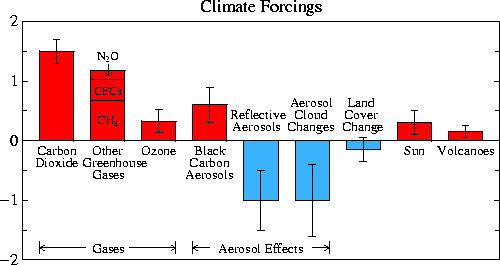
Things that push the climate system towards warming or cooling are called forcings, and are measured in units of watts per square meter (W * m^2). The table below shows recent estimates of climate forcings:


You can see that the CO2 forcing is about 1.5W*m^2. How does the loss of sea ice compare?

First, a few simplifications, since your author is not especially adept at math. Mr. Cave ask about an ice-free Arctic, so we are going to look at the total disappearance of the ice. In reality, there will be sea ice in the winter for the forseeable future. There is very little incoming solar radiation during the "six months of night" (read=none) and so we can more or less ignore any winter ice.

We are also going to ignore clouds, which can push the absorption of the surface up or down. While open water absorbs about 92% of the solar energy coming from directly overhead, radiation from a more oblique angle is reflected much more readily. The calculations of albedo vs latitude vs the position of the sun are complex, but in midsummer the sun is more or less directly overhead. So to estimate this effect, I'm going to have the forcing. Remember, we are not trying to answer the question of what exactly the impact of the loss of sea ice will be, but rather Mr. Cave's "Why should I care?" question. For that, rough estimates should work.

The National Snow and Ice Data Center has a nice description of the incoming solar radiation in the Arctic:

The intensity of solar radiation varies significantly over the course of a year ranging from no solar radiation during the polar winter to a maximum of 350 to 400 watts per square meter (W/m2) in the summer. Over the course of a day, the sun's angle above the horizon (solar altitude) influences the intensity of solar radiation: the noon sun is more intense than the rising or setting sun. The maximum altitude of the sun depends on time of year and latitude. Of course, during the polar winter the sun is below the horizon for 24 hours, and there is no solar radiation, while at midsummer the sun changes little in altitude over the course of a day.


Now we have enough numbers to conjure with:

Surface area of the Earth: 510,072,000 km2
Summer Arctic ice cover: 7,500,000 km2 (estimate)
Summer Arctic ice cover as a % of the Earth's surface: 1.5%
Summer solar radiation: 300W/m2 (estimated summer average compared to 350-400 max)

Now we need a conversion of the change in energy absorbed in the Arctic, in the summer, to the equivalent forcing over the whole Earth, all year round:

300W/m2 * .3 = 90W/m2 (sea ice)
300W/m2 * .92 = 276W/m2 (open water)
Change in absorption = (276 - 90) = 186W/m2

186W/m2 * 1.5% (.015) * 0.5 (summer -- half the year) * 0.5 (angle of incidence fudge factor) = 0.7W/m2 (vs 1.5W/m2 for all the CO2 added the the atmosphere by man since 1750).

Even with a frankly embarrassingly simplified back-of-the-envelope calculation, we can see that the loss of Arctic sea ice will accelerate global warming significantly. Along with the loss of biodiversity, these are two very significant reasons to be concerned by the loss of the Arctic ice cover. I'll look at a third reason, the local effects on methane deposits and land-bound Greenland ice, in part three.