Showing posts with label carbon cycle. Show all posts

Tuesday, September 11, 2012

Permafrost carbon feedback update

There's a new paper out:

Significant contribution to climate warming from the permafrost carbon feedback

Permafrost soils contain an estimated 1,700 Pg of carbon, almost twice the present atmospheric carbon pool1. As permafrost soils thaw owing to climate warming, respiration of organic matter within these soils will transfer carbon to the atmosphere, potentially leading to a positive feedback2. Models in which the carbon cycle is uncoupled from the atmosphere, together with one-dimensional models, suggest that permafrost soils could release 7–138 Pg carbon by 2100 (refs 3, 4). Here, we use a coupled global climate model to quantify the magnitude of the warming generated by the feedback between permafrost carbon release and climate. According to our simulations, permafrost soils will release between 68 and 508 Pg carbon by 2100. We show that the additional surface warming generated by the feedback between permafrost carbon and climate is independent of the pathway of anthropogenic emissions followed in the twenty-first century. We estimate that this feedback could result in an additional warming of 0.13–1.69 °C by 2300. We further show that the upper bound for the strength of the feedback is reached under the less intensive emissions pathways. We suggest that permafrost carbon release could lead to significant warming, even under less intensive emissions trajectories.
Between 68-508 Pg, or 68-508 billion tons of carbon, or, if it all comes out as CO2 (and you'd better hope it does, more or less), 255 to 1,910 billion tons of CO2. For comparison, human emissions in 2010 amounted to 9.1 billion tons of carbon. This feedback could be thought of like continuing on with our current emissions for between seven to fifty-five years, except we don't get any choice in the matter.

This is higher than most of the previous estimates I've seen. Koven et al (2011), for example, estimated 55-69 Pg C of carbon. There are a number of other estimates from a variety of sources using a number of methods. From "Vulnerability of Permafrost Carbon to Climate Change: Implications for the Global Carbon Cycle":
Risk assessments, based on expert opinion, estimated that up to 100 Pg C could be released from thawing permafrost by 2100 (Gruber et al. 2004). On the basis of laboratory incubation experiments and estimated C stocks, Dutta and colleagues (2006) calculated a potential release of about 40 Pg C over four decades if 10% of the C stock frozen in deep soils in Siberia thawed to 5°C. Tarnocai (2006) estimated that 48 Pg C could be released from Canadian permafrost over this century if the mean annual air temperature increased by 4°C. Model predictions incorporate changes in vegetation and other disturbances, as well as C release from permafrost, to determine the net effect of climate warming. Results for Alaska and for the circumpolar region predict the addition of up to 50 to 100 Pg C to the atmosphere by the end of the century, depending on the particular model scenario (Stieglitz et al. 2003, Zhuang et al. 2006).
In other bad news from the Arctic permafrost, Vonk et al (2012) found breakdown of Siberian "Yedoma" permafrost dumping ten times as much CO2 into the Arctic ocean compared to prior estimates.

All of this has, for me, a distinct hint of the Arctic sea ice narrative, to the tune of "Oh-yes-change-will-come-we-see-it-in-the-record-a-few-thousand-years-maybe-OK-maybe-faster-OK-now-we're-getting-good-direct-measurements-could-be-an-issue-in-a-century-or-two-OK-wait-what-WHATTHEHELLISTHAT?"

The analogy is hardly even an analogy at all. The permafrost most at risk, after all, is just another species of Arctic ice. And it should be as clear as crystal that the Arctic is changing faster than experts thought possible just a few years ago. The bits of it impregnated with thousands of gigatonnes of carbon are no exception. Is it a methane bomb, a carbon bomb? It doesn't need to be. When the house is on fire, everything burns.

Sunday, September 2, 2012

The Antarctic carbon feedback: a worst case scenario

It's the single study to end all single studies:
The researchers estimate that 50 per cent of the West Antarctic Ice Sheet (1 million km2) and 25 per cent of the East Antarctic Ice Sheet (2.5 million km2) overlies preglacial sedimentary basins, containing about 21,000 billion tonnes of organic carbon.
If this carbon proves to be vulnerable in the way we now think the northern permafrost carbon is vulnerable, it will mean we could soon be literally incapable of stabilizing the climate without geoengineering.

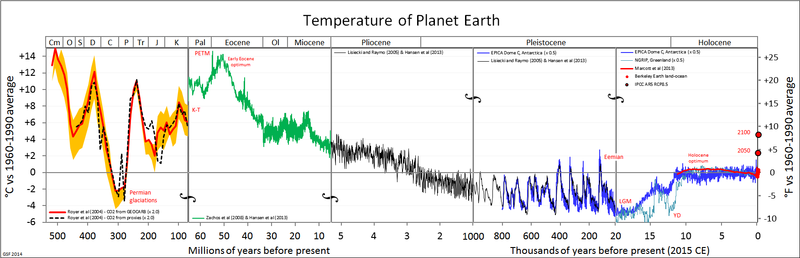
The reason is very simple.  Based on the experience of the Eocene (above), at between 3 and 4 degrees above preindustrial, the Antarctica ice pack can be expected to melt completely (of the course question of exactly what temperature will lead to the deglaciation of Antarctica is a complex scientific question, while the above is an eyeballed guesstimate; see below). If these researchers are right, that will gradually release 21,000 gigatons of carbon.

So let's get down to brass tacks. The carbon is divided between the larger East Antarctic Ice Sheet and the more vulnerable West Antarctic Ice Sheet:
The researchers estimate that 50 per cent of the West Antarctic Ice Sheet (1 million km2) and 25 per cent of the East Antarctic Ice Sheet (2.5 million km2) overlies preglacial sedimentary basins, containing about 21,000 billion tonnes of organic carbon.
Experts place the chances of for the beginning of a total collapse of the WAIS in the next 200 years at upwards of 5%. Estimates of how long such a collapse would take to reach completion range from 300 to 1600 years. The temperature that would trigger that collapse is thought to be somewhere between +1C and +5C compared to 1990 temperatures (2).

Suppose that happened, and, since that's a fairly pessimistic assumption, let's throw in a couple of optimistic assumptions: the EAIS contributes nothing significant, and the northern permafrost and methyl hydrates contribute nothing.

The proportion of the trapped carbon under the WAIS is 4/9 of the total of 21,000 gigatons (about 9,300 gigatons) (1). If the WAIS melts, what proportion of that carbon will enter the atmosphere? Some will obviously remain locked a carbon sink that will develop as the continent warms. Suppose only 60% or so, 6,000 gigatons, ends up in the atmosphere.

A couple hundred billion tons of that will be methane; ignore it. The trapped methane has figured prominently in the news accounts about this research, but compared to the staggering amount of carbon under the ice, most of which would enter the atmosphere as carbon dioxide and the rest of which would be oxidized to carbon dioxide after a brief stint as methane, the news that we have a southern methane time bomb to go with the Arctic one is merely a footnote.

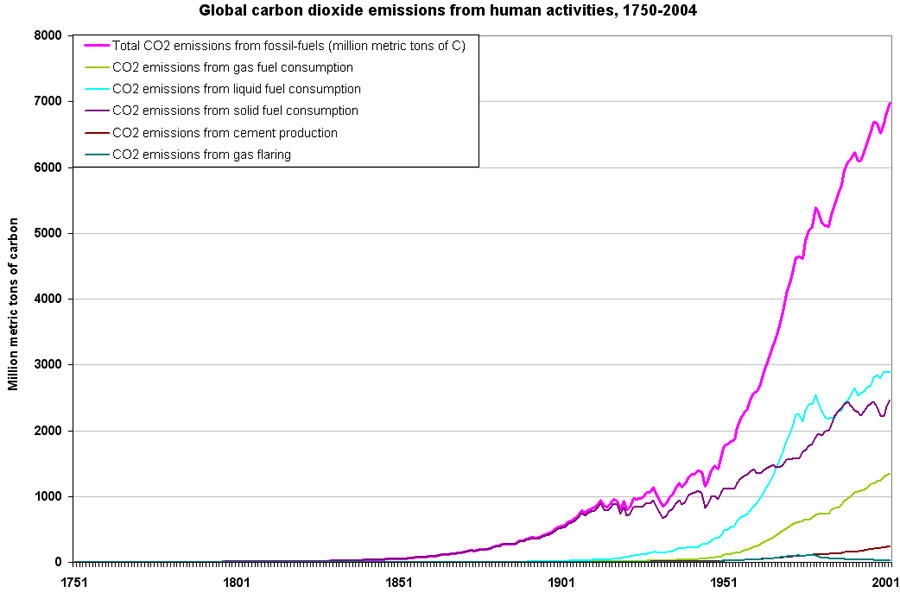
Suppose significant outgassing of the carbon under the WAIS starts in about a hundred years and takes two hundred years to run to completion. Six thousand gigatons over two hundred years is 30 gigatons of carbon per year (on average). By way of comparison, total fossil fuel emissions are running at about 7 gigatons per year:

Source
Thirty gigatons a year is about what the human race is expected to produce at the end of the century is the world economy grows rapidly despite our making no effort to rein in our emissions:

Source
The effect of 6,000 gigatons of carbon entering the atmosphere would be an extinction-level event. One part per million of atmospheric CO2 is equivalent to 2.13 gigatons of carbon. Assuming a 50% airborne fraction (which is incredibly optimistic) 6,000 tons of carbon entering the atmosphere would raise the CO2 concentration by about 1,400ppm. In a worst case in which the carbon sinks finally give up the ghost, the rise is 2,800ppm. Supposing we were at that point at 800ppm and +4C, that would quickly take us to +8C with the EAIS adding its share soon after.

You would be looking at centuries of further warming independent of human emissions -- leading to an increasingly inhospitable climate even if economic collapse reduced the anthropogenic contribution significantly.

There is a large distance between the publication of this one study and a solid scientific case for an Antarctic carbon bomb. The steps along that road are, roughly:

1. Are the authors correct about the scale of the buried carbon?
2. Are the authors right about the distribution of that carbon, specifically about a heavy concentration of it under the most vulnerable part of the ice sheet?
3. Will that ice sheet decay significantly over the next few centuries?
4. If the ice sheet decades, what proportion of the buried carbon will make its way into the atmosphere?
------------------------------------
1. "Potential methane reservoirs beneath Antarctica"  J. L. Wadham, S. Arndt, S. Tulaczyk, M. Stibal,  M. Tranter, J. Telling, G. P. Lis, E. Lawson, A. Ridgwell, A. Dubnick, M. J. Sharp, A. M. Anesio & C. E. H. Butler.  Nature 488, 633–637 (30 August 2012) -- abstract.
2. "The Future of the West Antarctic Ice Sheet: Observed and Predicted Changes, Tipping Points, and Policy Considerations" -- full text.
 ------------------------------------
UPDATE: Round up from around the interwebs.

 "Potential New Methane Risk in Antarctica" -- SustainableBusiness.com News

"Antarctica’s Hidden Carbon Stores Pose Warming Risk in Study" -- Bloomberg

“There’s a potentially large pool of methane hydrate in part of the Earth where we haven’t previously considered it,” Wadham said in a telephone interview. “Depending on where that hydrate is, and how much there is, if the ice thins in those regions, some of that hydrate could come out with a possible feedback on climate.”
"Large methane reservoirs suggested beneath Antarctic ice sheet" -- phys.org

 "Antarctic Methane: A New Factor in the Climate Equation" -- Climate Central
Wadham and her co-authors took soil samples from the margins of glaciers in both Antarctica and Greenland. “We spent a couple of years chain-sawing out sediments frozen into the bottom of the ice,” she said, adding with a connoisseur’s judgment, “They were very nicely preserved.”
They hauled the samples back to the lab and allowed them to thaw under carefully controlled, oxygen-deprived conditions where oxygen-hating, methane-belching bacteria known as methanogens could do their work — assuming they were there. And sure enough, the soil began producing methane.
The same thing should presumably be happening underneath Antarctica’s ice, where heat percolating from the depths of the Earth have prevented sediments from ever having frozen.

Wednesday, October 26, 2011

Skeptical Science on permafrost melting


SkS has a post up on the decay of permafrost. Catnip to me, of course. It's a good summary, and highlights a number of issues. Here's one I hadn't thought about much:
Commercial activities in the Arctic are large, important to national economies and for the viability of local population centres.  Monitoring of permafrost melting and associated greenhouse gas emissions is undertaken by ground instruments and satellites.  However, unless technology able to replace melting permafrost with an affordable, durable load bearing foundation can be applied, it should be accepted that virtually all existing buildings and structures located on permafrost with foundations less than 5 metres deep are likely to be damaged or destroyed before 2100.
That's the homes and businesses of millions of people; oil, gas, and mining infrastructure, utilities and transport infrastructure, etc. The rapid erosion of the Arctic's 100,000km coastline (which is made of little rocks glued together with the aforementioned permafrost) also gets a good treatment.

They don't precisely estimate the amount of feedback from carbon (methane and carbon dioxide) released by melting permafrost. I don't know the answer either, although I discuss some estimates here and here. If you said 25-100ppm of CO2 in additional carbon by 2200, I don't think anyone could tell you you were wrong. If I find a better estimate, I'll post on it.

Permafrost FAQ

1. Why do we never hear about Antarctic permafrost?

Because for complicated reasons it doesn't store very much carbon (touch wood!) Since there are few people there, no one really cares.

2. I'm sick of reading wildly different estimates of the potency of methane as a greenhouse gas compared to CO2. What's the real number?

A molecule of methane traps heat hundreds of times better than a molecule of CO2. But it decays much faster. The really high estimates you see are molecule-to-molecule comparisons; the lower ones are long-term comparisons. The long-term comparisons turn out to be tricky. Methane is worse than CO2; and when it decays it turn into CO2, so it's really a lose-lose proposition.

3. Does melting permafrost release CO2 or methane?

Either CO2 or both. The methane makes headlines but the research I highlighted here suggests the CO2 is actually the bigger problem. More on methane here.


4. Can we stop the melting of the permafrost?

Probably not, given the feedbacks that have already kicked in, and Arctic amplification which we see rapid warming of the North even with radical emissions reductions. Short of large-scale geoengineering, the permafrost is going to go. The additional warming will further accelerate global warming.

Monday, October 3, 2011

Risk of severe climate change impact on the terrestrial biosphere – Heyder et al. (2011)


Risk of severe climate change impact on the terrestrial biosphere – Heyder et al. (2011) [PDF]“The functioning of many ecosystems and their associated resilience could become severely compromised by climate change over the 21st century. We present a global risk analysis of terrestrial ecosystem changes based on an aggregate metric of joint changes in macroscopic ecosystem features including vegetation structure as well as carbon and water fluxes and stores. We apply this metric to global ecosystem simulations with a dynamic global vegetation model (LPJmL) under 58 WCRP CMIP3 climate change projections. Given the current knowledge of ecosystem processes and projected climate change patterns, we find that severe ecosystem changes cannot be excluded on any continent. They are likely to occur (in > 90% of the climate projections) in the boreal–temperate ecotone where heat and drought stress might lead to large-scale forest die-back, along boreal and mountainous tree lines where the temperature limitation will be alleviated, and in water-limited ecosystems where elevated atmospheric CO2 concentration will lead to increased water use efficiency of photosynthesis. Considerable ecosystem changes can be expected above 3 K local temperature change in cold and tropical climates and above 4 K in the temperate zone. Sensitivity to temperature change increases with decreasing precipitation in tropical and temperate ecosystems. In summary, there is a risk of substantial restructuring of the global land biosphere on current trajectories of climate change.”

AGWObserver's weekly summary of new research is up -- and, as is usually the case, there's some amazing papers, including this one. Can I just say, and not for the first time, how awesome AGWObserver is? You not only catch many important papers that I for one would never know to look for, but you also get a window into what an active area of research this is, the different approaches used, and the variety of results -- some reassuring, some positively frightening, and many just plain interesting. 

Heyder & friends explain the rationale for their paper:

Most studies on biospheric climate change impacts focus on one or a few isolated ecosystem processes only (Cramer et al 2001, Friedlingstein 2006, Gerten et al 2007). However, given the many potential responses of an ecosystem to external pressure and the possibility of homoeostasis in key ecosystem functions through compensatory mechanisms (Ernest and Brown 2011), a comprehensive risk assessment of ecosystem changes should comprise several aspects of ecosystem functioning e.g. Scholze et al (2006).
This is a key concept.  Scientists are not to blame for focusing their research on a key variable of interest; looking at one thing at a time, where possible, is basic to the design of an effective experiment. If you don't do that, you'll never untangle what changed what to what extent and why.

But at some point we do have to reintegrate the insights from focused experiments into the broader ecological framework, which is irreducibly complex. Water, warmth, disease, competitive species, and so on. This research echoes the concern among many scientists about the possibility of a profound forest die-off that could accelerate global warming:

Boreal forests change at their leading edge due to alleviated temperature limits and at their trailing edge due to increasing heat and drought stress. Such heat- and drought-related forest die-back (which might be amplified by insect outbreaks) has already been observed over considerable areas in North America (Berg et al 2006, Allen et al 2010).
Increased carbon uptake outside the forests may compensate, but to what extent is unknown:
Dryland ecosystems are projected to experience increased vegetation productivity.    This is in line with the known beneficial effect of elevated atmospheric CO2 concentration on the water use efficiency of plants (Ainsworth and Long 2005), which will—together with warming—lead to increasing NPP and vegetation carbon stocks in many regions. In this study a major factor is not included: NPP could be constrained by nitrogen supply and other nutrients (Norby et al 2010), so that the increased NPP due to enhanced CO2 availability as implied in our results should be interpreted as a maximum effect.

Friday, September 16, 2011

They tried to teach my baby (climate) science


From the "autonomous" but not particularly original thoughts of "Autonomous Mind" comes this example of stellar parenting:

Not education, propaganda


Since Mind Jr arrived home from school this afternoon I have been stewing with barely concealed anger [That must be nice for your middle-school-aged daughter -- they love it when their fathers are furiously angry and barely controlling their rage].  For within minutes of getting in, a very earnest Junior sat down Mrs Mind and myself and solemnly announced that we would no longer eat red meat in our household.
The inevitable question ‘why?’ resulted in a detailed explanation concerning today’s Geography lesson.  It was there Junior was informed that red meat should not be eaten any more than once per week, we were told, because any frequency beyond that will kill us all with strokes or heart attacks – and in any case it contributes to global warming [Leaving aside the exaggeration -- this poor shumuck can't even debate a 13-year-old without a straw man argument! -- both of those assertions are supported by peer-reviewed science].
Conscious of the need to help develop Junior’s critical thinking capability, I asked her why she thought this message had been shared in the lesson [Whilst "stewing with barely concealed anger."]  She opined that the class had been taught this because it is good for us.  And right there was the heart of the matter.  No discussion about it in class, no contrary view presented, no balance to the message, just a binary condition of good v bad and that we must listen to what the ‘experts’ say.  So what we have is a curriculum item check box, duly ticked, relying on an appeal to authority with theory presented as fact and a class of 13-14-yr-olds duly brainwashed [Yes, it just takes one easy lesson to brainwash now!] with the partial and biased opinions [sic] of the political class that formed the syllabus.
In Geography this week and in Science last week, the class had been fed the party line on global warming and health.  I probed further to see just how much they had been taught [Whilst "stewing with barely concealed anger." Can't you just see the flecks of spittle escaping his clenched teeth as he unleashes his blog-honed sophistry on his 13-year-old daughter?].
  • Which greenhouse gas is present in the atmosphere in highest concentration?  Methane.  Wrong, I explained. Had she been told about water vapour?  There had been no mention of it.
  • How much CO2 is there in the atmosphere?  That wasn’t covered either, so I explained it was 385 parts per million.  She was stunned [Because we all know that small things can't be important -- that's why bacteria can't kill humans and atom bombs can't level cities].
  • How much atmospheric CO2 is produced by humans and how much by nature?  Most of it from humans she said.  No, only around 5% with the rest coming from nature.  Now she was bewildered [I can well believe it. Maybe she couldn't believe her father, the climate blogger, didn't know the difference between carbon moving back and forth through the carbon cycle and carbon we burn and add to the atmosphere?].  Her next comment summed everything up when she said, cutting out red meat won’t make much difference then.
As for the dietry aspects, had there been any discussion of the effects of sugary carbohydrates, the benefits of the complex carbs and the relatively benign influence of proteins such as meat?  Clearly that was too much to hope for, nothing of the sort had been covered. [Red meat consumption causes thousands of cases of bowel cancer a year. It's got a lot more to it than "protein," and some of that more is carcinogenic. It's not a huge risk, but it's absolutely real and proven. We see again that anti-science denial does not confine itself to climate change -- any facts can be waved away by an ideology that has convinced themselves that they know all about the science.]
It is simply unacceptable that our children are being plied with propaganda in this way.  This is not an education, it is an indoctrination constructed by special interest groups.  Rarely have the lyrics of Pink Floyd been more appropriate, leave them kids alone.

Schools teaching kids science has been a problem for many years, as the Onion cover reflects.  Might I suggest that since the schools are not going to chuck evolution, climate science, cancer biology, or whatever else disturbs you from the ciriculum, that you plan supplemental education for the kids in the beliefs and practices that their parents expect of them. Sunday morning might be a good time for this activity. Like-minded adults who have mastered the basics could gather together nearby to reaffirm and celebrate the transcendent truth they have been gifted with. There are even tax advantages, so I've been told. Mr. "Mind" should look into it, before some hapless passerby sees him looming over his daughter with "barely concealed anger" and involves the authorities.

Monday, September 12, 2011

What if we took +4C as inevitable?

The range of possible responses to climate change is typically broken down into two main strategies -- "adaptation" -- learning to live with it -- and "mitigation" -- slowing the rate at which we are warming the planet, primarily but not exclusively by reducing the emission of greenhouse gases.

Lukewarmers, as one would expect, don't like mitigation much. That's kind of the point of being a lukewarmer, accepting the main bullet points of the science whilst opposing limits on greenhouse gas emissions. (If you are a lukewarmer who accepts the basic theory of AGW and supports curbs on greenhouse gases -- well, I'm sorry to have to tell you that this is the point in the movie when the tough guy realizes he was bitten in that last skirmish and has began the inevitable transformation into one of them.)

The lukewarmer argument -- which I explored in some detail here and here -- has traditionally been that there's nothing much to worry about. It's a little warming, big whoop. It was a lot warmer a couple hundred million years ago, and the dinosaurs didn't have any problems with it at all.

But more recently it's become clear problems are coming -- big problems -- and they can't be ignored. And the discussion has turned to adaptation, as opposed to mitigation. This is Judith Curry's main line of argument: local adaptation to problems as they emerge.

I was confronting this argument, and I had a revelation: the lukewarmers are right (no, really). Adaptation is the name of the game. Why? Because, in all probability, a +4C world is coming. The only question is when.

The SRES temperature projections are well known:


We passed year 2000 concentrations a decade ago without slowing down, so that ship has pretty much sailed, but no problem; it looks like the B1 scenario limits us to just under +2C. That's great! The earth was warmer than that a mere 120,000 years ago! Should be fine. Onward mitigation!

Here's a little Easter egg of bad news, lurking in the fine print of the AR4 like an unpaid bill:

For the B1 constant composition commitment run, the additional warming after 100 years is also about 0.5°C, and roughly the same for the A1B constant composition commitment (Supplementary Material, Figure S10.3). These new results quantify what was postulated in the TAR in that the warming commitment after stabilising concentrations is about 0.5°C for the first century, and considerably smaller after that, with most of the warming commitment occurring in the first several decades of the 22nd century.

So it's going to continue warming for a hundred years past the right edge of the graph. But then it stops . . . right?


Yeah . . . no. It keeps warming. The deep ocean warming sees to that. The ice-albedo feedback sees to that, too, but it isn't modeled in the AR4. These also aren't the carbon-cycle models we have coming in the AR5, but the expectation is that permafrost melting and other carbon-cycle feedbacks will contribute to warming as well.

How long can this go on? Recent research ("The contribution of timescales to the temperature response of climate models," Jarvis & Li (2011)) is not reassuring:

Both the magnitude and timescale of climate change in response to anthropogenic forcing are important consideration in climate change decision making. . . . As a result of this emergent property of climate models, it is possible to offer credible partitioning of the full equilibrium gain of these models, and hence their equilibrium climate sensitivity, between two discrete timescales; one decadal associated with near surface ocean heat equilibration; and one centennial associated with deep ocean heat equilibration. Timescales of approximately 20 and 700 years with a 60:40 partitioning of the equilibrium gain are found for the models analysed here. A re-analysis of the emulation results of 19 AOGCMs presented by Meinshausen et al. (Atmos Chem Phys Discuss 8:6153–6272, 2008) indicates timescales of 20 and 580 years with an approximate 50:50 partition of the equilibrium gain between the two. This suggests near equal importance of both short and long timescales in determining equilibrium climate sensitivity.

So when does it stop?

After the year 3000, the global mean surface temperature is predicted to be almost constant due to the compensating effects of decreasing atmospheric CO2 concentrations due to oceanic uptake and delayed response to increasing atmospheric CO2 concentrations before. 

That's a comfort.

So here's the sharp end of the argument, and the point where I turn it back (you knew I would) on the adapt-niks. +4C is coming. Even if we follow a B1 (low population, intensive emissions cuts) pathway, and hold concentrations fixed from 2100, we still hit +4C eventually (with +2C in short term warming, Jarvis & Li tells us another +2C is in the pipeline.)

So we have to adapt to a +4C world -- sea levels tens of meters higher, 50% of animals extinct, agricultural production decimated, climate refugees in the hundreds of millions. To adapt we need money -- vast amounts of economic resources to resettle refugees, relocate coastal cities, cope with almost unimaginable heat waves, mega-droughts, and huge storms. We need scientific and technological progress -- a lot of progress, before we can have any confidence in feeding billions of people in a +4C world, before we can cope with the mass extinctions and radical rearrangement of floral and fauna in a +4C world.


There is only one thing that will give us vastly more money, scientific knowledge and technical know-how. Time. We need time to adapt. Buying time has got to be the cornerstone of any adaptation strategy. People like Bjorn Lomborg advocate deferring serious mitigation to the far future, when we have more money and know-how. Adaptation is then presented as the default alternative. But accepting the reality of a +4C world shows that logic to be backwards. If we are going to be richer and smarter in the future, we should defer adaptation to our future selves by pursuing mitigation now.

We know a +4C world in coming. What we don't know is when. If we do nothing by way of mitigation, smart money says it will be before the end of this century. Fifty years -- 2060 -- if we're really unlucky. And without mitigation, we will rapidly pass +4C on the road to something worse.

Fifty years is not a very long time. Fifty years ago people already flew across the country on jets, watched television, got antibiotics when they were sick. They had cars and rockets and fusion bombs. They were like us. 

With intensive mitigation -- holding the short-term warming to under +2C -- +4C is still waiting for us, but in six hundred years. Six hundred years is a very long time. Six hundred years ago the scientific revolution had not been conceived, democracy had not been seen since Athens; there was no internal combustion -- steam engines belonged to the distant future at that point. Medicine was little better than the shaman who drilled holes in heads thousands of years before. Shakespeare was as far in their future as the 23rd century is from us.

In six hundred years, if we don't destroy ourselves, our technical and scientific abilities will be unrecognizably superior to those we have today. As well they should be, before we rely on them to cope with temperatures warmer than the earth has seen in millions of years.

+4C is coming. We're not ready yet. So if you truly believe in human progress, in continual growth and the expansion of human knowledge, the conclusion is clear: mitigation is the best adaptation.

Tuesday, July 26, 2011

Hell freezes over


An interesting article on carbon sequestration is flagged by Watts. Money quote:

When forest harvest levels fell 82 percent on public forest lands in the years after passage of this act, they became a significant carbon “sink” for the first time in decades, absorbing much more carbon from the atmosphere than they released. At the same time, private forest lands became close to carbon neutral.

Carbon emission or sequestration is a key factor in global warming, and a concept now gaining wider interest is the role of forest lands in helping to address concerns about the greenhouse effect.


When they talk about sequestration "gaining wider interest" it is allusion to some science I have been meaning to blog on for some time, namely, that the importance of plant sequestration is larger than once thought, and has been growing with the help of carbon fertilization, whereas the absorption of carbon dioxide by the oceans, which had received more attention up to this point, is not as dominant a player as once thought, and may be showing signs of fatigue.

Since that post requires an overview of the carbon cycle, carbon fertilization, oceanic circulation and ocean acidification, as well as natural and man-made carbon sequestration, it's going to have to wait a little longer. The bottom line? The original "carbon capture and storage" -- growing plants and leaving them in the ground -- has great potential for reducing net greenhouse gas emissions, but continued warming and the problem of deforestation puts this sink in question.