Showing posts with label the Blackboard. Show all posts

Thursday, May 5, 2016

SteveF makes a hash of climate sensitivity; I propose a solution

-->


Over at the Blackboard they are hawking a “heat balance based empirical estimate of climate sensitivity” which delightfully uses the IPCC's own numbers to show that climate sensitivity has got to be low!!! OMG!!! 
I will show how the IPCC AR5 estimate of human forcing (and its uncertainty) leads to an empirical probability density function for climate sensitivity with relatively “long tail”, but with a most probable and median values near the low end of the IPCC ‘likely range’ of 1.5C to 4.5C per doubling.
And how is Steve going to do that? Well, he's going to give us both barrels of the lukewarmer shotgun, oversimplification and argument from incredulity.

Let's leave aside for today the argument from incredulity (in which his own method produces a fat tail of dangerously high climate sensitivities, and he says, basically, "but that can't be true, because hand-waving") and look at the oversimplification at the heart of SteveF's method for estimating climate sensitivity.
We can translate any net forcing value to a corresponding estimate of effective climate sensitivity via a simple heat balance if:
1) We know how much the average surface temperature has warmed since the start of significant human forcing.
2) We assume how much of that warming has been due to human forcing (as opposed to natural variation).
3) We know how much of the net forcing is being currently accumulated on Earth as added heat.
The Effective Sensitivity, in degrees per watt per sq meter, is given by:
ES = ΔT/(F – A)      (eq. 1)
That is fairly close to true, leaving aside changes in the albedo of the earth over time, and problems with taking the average temperature, which I discuss below. The chief problem is that he doesn't know any of those things with sufficient accuracy to constrain climate sensitivity in any meaningful way.

Climate scientists who do actual work with the climate are doing a fine job of reducing the uncertainty of these numbers, but in every case, the opening move is always to average available measurements over a period of time. But a heat balance model by definition requires accurate accounting of how much heat is coming in and how much is going out, and those numbers are changing over time.

How much has the average surface temperature warmed since the start of significant anthropogenic forcing? Right now, the answer is about 1.5C (not 0.9C, as Steve estimates). El Nino will subside and that number will (temporarily) fall, but that is beside the point: if you are using present-day forcings, then you have to use present-day temperatures.

The same goes for ocean heat uptake: if you are going to compare that to surface temperatures, you need to know what the uptake was at the moment when you took values for the forcings and the total warming. That's tricky, because we know ocean heat uptake varies significantly over time. It's lower than usual right now, because of El Nino, but how low?

If you are going to use ocean heat uptake averaged over X number of years (which to my understanding is basically mandatory to get any kind of an accurate number), then you also have to average the net forcing over those same years, and you also have to average the warming compared to preindustrial over those years.

But simple averaging still will not work, because heat loss varies with temperature to the fourth power. An average warming of +0.9C could reflect a steadily linear increase, or a long period of flat temperatures followed by a prolonged spike in temps to +4C. The latter will radiate more heat into space than the former. The average temperature is the same, but the heat balance is not the same. So we had better stick to instants of time if this method is to have any hope of delivering accurate results.

To reiterate: for an estimate of heat balance to give you climate sensitivity, you need the heat balance AT THAT MOMENT, not averaged over time. The amount of heat the oceans were absorbing ten or twenty years ago can only be compared to the temperature ten or twenty years ago, and the net forcing of ten or twenty years ago. If you are comparing the average heat uptake by the oceans since 1993 with the last 13 years of temperatures and forcing estimates from a moment in 2010, you are comparing apples and oranges. All of these things change over time, and to use the relationship between them to estimate climate sensitivity, only contemporaneous estimates can hope to be valid.

Consider a building occupied by an unknown number of people. You want to know how many people are inside. If you know how many people when in the building at midnight Tuesday, how many entered on Wednesday, and how many left on Wednesday, you know how many are in the building when Thursday dawns (assuming no births or deaths, nerds.)

On the other hand, knowing how many people started in the building, the number who left the building on Sunday, and the average number of people entering the building each day over the last year, doesn’t help you a hell of a lot. But this is what Steve has tried to do with his heat balance based empirical estimate of climate sensitivity.”

For this to work, do you need to use the present moment? No, you do not. In fact, there may be excellent reasons to use some instant in the past, such as the benefit of hindsight in estimating warming or forcings or the presence of an exceptional event (like a large volcanic eruption) that lets you really test some of your theories about forcings and heat balance and temperature.

In other words, you need a series of “moments,” for which you estimate the levels of various forcings and the heat uptake of the oceans. Then you can predict what the temperature “should” be, based upon the inputs, and compare it to what the temperature was (and is.)

Since the act of resolving the state of the climate in each of these moments is one fairly powerful method of determining the inputs for the next “moment” (and whether it can do so, compared to historical observations, is a good test of how accurate it is) we might want to calculate a series of moments, each derived from the one before, based upon our best estimates of forcings, ocean heat uptake, and the like. 

Since everything we said about average temperatures over time could also be said about temperatures averaged over the global surface (i.e., that different local temperatures can yield the same average, but different heat loss) we had better break the earth into boxes, or "cells" and calculate temperature, heat uptake, heat loss, etc., for each cell.

Not all the same color
 

With these modest adjustments the calculations will have a much better chance of doing what Steve wants them to do, which is to take measurements of the climate system, account for ocean heat storage, and estimate climate sensitivity.

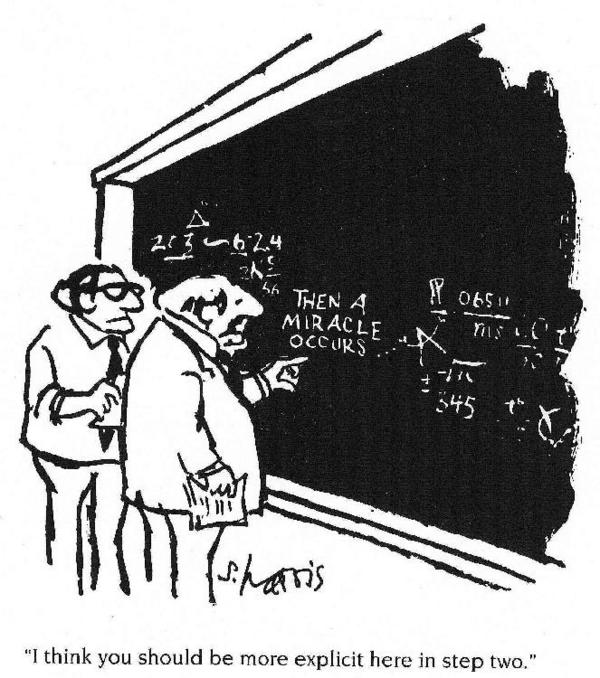
I call it a climate model. Trademark pending.

Sunday, February 13, 2011

O'Donnellgate: O'Donnell flinches, Lucia "the Shameless"

It started like it always starts, with hysterical exaggeration, wild allegations and heaps of abuse:

While there is not much untrue about this statement, there is certainly a lie of omission. . . . There are not enough vulgar words in the English language to properly articulate my disgust at his blatant dishonesty and duplicity.


Thus O'Donnell, in the original.

At once, the useful idiots chime in:

If Eric Steig was reviewer A and he wrote that deceptive mealy mouth comment he is truly the Rod Blagojevich of climate science.


Notably absent from this bay and cry, predictably, is any hint of the quality known as "skepticism." Eric Steig is a demon, and devil, a fraud a liar and a cheat.

And then the commenters get in on the action. Not to argue the facts of the case, heavens no. By now they have seen the same line of patter repeated at Climate Audit, WUWT, and The Blackboard (above), making it established fact. No, the chosen role of the psuedoskeptical thread-monkeys is to consume everything their masters feed them, and respond with uncritical gloating:

"MikeB":

But along comes Steve, Ryan, Jeff, Nic, and others who once again expose the utter incompetence of the Team’s statistical analysis. And the Team resorts, of course, to their usual tactics.

For my money, the most hilarious sequence in this tragicomedy, is when Steig suggested Jeff take his Mathematica course (not knowing anything about Jeff) and now Steig says he can’t get Ryan’s R code to run. Maybe Steve, Jeff, and Ryan could set up a course for Steig and Mann on R. They could sure use it.


"hunter":

The clear take from the letter of 18, to Gavin’s hissie fit and Steig’s demonstration of how the team does science is that their work cannot survive anything like real scrutiny. No wonder they have worked so hard to limit any look at climategate.
They are a construct of carefully controlled media, pal review and government/NGO agenda pushing.
There is no ‘there’ there.
Their work, when we finally get to actually look at it, will turn out to be self-referential, circular, nonesense.
CO2 warms the atmosphere.
BFD.
Give us back our billion$, clowns.


"juilo":

I guess the next step after science by consensus is consensus by intimidation. Or by forceful suppression of all dissent. Something like that.

It still amazes me how tone-deaf these people are. They have a major image problem that is largely of their own making, and they just have no idea how to handle it: they just keep digging themselves in deeper and deeper with ridiculous stunts.

In the end, everybody loses. The purely scientific questions get more and more muddled, through the stubbornness of people who refuse to acknowledge even the slightest mistake; climate scientists continue to lose credibility in the eyes of the general public, as well as more technically knowledgeable outsiders; and, as a result, it only becomes easier to dismiss legitimate concerns and worries about the rate and possible consequences of climate change, for those with a vested interest to do so. Way to go, Team.


All of this has happened before . . . all of it will happen again. And the next step is just as predictable: the original case begins to fall apart; harsh, jarring facts become more and more intrusive on the deniers' passion play. The accuser is caught in multiple lies, and forced to apologize:

Ryan O’Donnell has posted public apology to Eric Steig for the mistake in fact he posted at in his first version of Steig’s Trick; that post has been retitled and edited to eliminate mistaken facts.


Note the causal switch from the singular to the plural; O'Donnell has apologized for one of his lies, but multiple "mistaken facts" have been removed. The nasty smears based on the "mistaken facts" have also been toned down: "Steve: Feb 9, 2011 – some of Ryan’s language, including the original title, breached blog policies and has been edited accordingly."

By now little remains of the original accusations against Steig. He was accused of demanding O'Donnell use a particular statistical method and then criticizing him for it: proven false. He was accused of requesting a copy of a paper he already had (this was the allegation that led lucia to call him the "Ron Blagojevich of science"). But he never got the final version of the paper, as O'Donnell admitted, and he had to apologize for the allegation. (Lucia however, has not.)

Meanwhile, O'Donnell has not only outed himself with his hysterical allegations based on what are now known to be "mistaken facts": he has also publicly admitted to being a lying, two-faced weasel:

I have known that Eric was, indeed, Reviewer A since early December. I knew this because I asked him. When I asked, I promised that I would keep the information in confidence, as I was merely curious if my guess that I had originally posted on tAV had been correct.

Throughout all of the questioning on Climate Audit, tAV, and Andy Revkin’s blog, I kept my mouth shut. When Dr. Thomas Crowley became interested in this, I kept my mouth shut. When Eric asked for a copy of our paper (which, of course, he already had) I kept my mouth shut. I had every intention of keeping my promise . . . and were it not for Eric’s latest post on RC, I would have continued to keep my mouth shut.

However, when someone makes a suggestion during review that we take and then later attempts to use that very same suggestion to disparage our paper, my obligation to keep my mouth shut ends.


Evidently Ryan O'Donnell learned about keeping his word at the same school that taught him about speaking the truth. He's now had to walk back all the allegations he makes in this paragraph, but even had they been true, O'Donnell's attitude demonstrates a -- shall we say a "moral flexibility" that excuses him from honesty the moment he contrives to feel wronged . . . which should alone tell us how seriously to take his "scientific" pretensions.

There are two ways to go from here: Ryan O'Donnell and Lucia Liljegren. Ryan took the hint from his godfather, Steve McIntyre. He's apologized and walked back his allegations to his old statistical shell game, that popular denier meme, which first rose to fame in the various futile attacks on the hockey stick temperature graph, in which choices about the analysis of data sets are treated as black-and-white, and the ability of a denier to produce an alternate analysis by making different choices is treated as proof that the original work erred.

Lucia, in contrast, has ignored the broad hint from her own godfather, who made a rare appearance at the Blackboard:

There’s Got To Be A Better Way Forward

10 February, 2011 (12:53) | politics | By: Chip Knappenberger

Here’s how I see it.

Some of Lucia’s recent blog posts, especially her titles, were a bit on the hot side. . . . And so instead of a public coming together and show of cooperation between “professional” scientists and “citizen” scientists, we got treated to a public spectacle…just what climate science needed. Not.


There may be a better way forward, but it's of no interest to lucia. Despite the fact that all of her outrage and allegations of fraud, duplicity and misrepresentation have now been proven false and indeed rebounded on O'Donnell and by extension those, like lucia, that mindlessly repeated them as fact and added their own slanders and insults, despite all that -- or because of that, lucia cannot admit she made a mistake, and continues to target Steig, engaging in one of the worst case of projection I've ever seen:

Is she embarrassed that she accused someone of fraud based on a fraud? No, it's Steig -- somehow -- who's really embarrassed: Steig the Shameless?

Has her uncritical hurling of insults at Steig only served to heighten the embarrassment of O'Donnell's retreat? No, it's Steig's friends who are hurting his case: Eric To John Nielsen Gammon: it isn’t very useful support.

There is no ending to this story; interest will gradually die away, until, after a respectful interval of time, it reappears as a denier fairy tale, to be alluded to when the true facts are rendered sufficiently obscure by time to resurrect the original denier narrative. For the time being, we are left, again, with the spectecal of deniers' words rebounding upon them with a neatness that is by now familiar but is always startling. Those alleging deception have deceived. Those that paint themselves as the victims of persecution have carrying out a stunningly sloppy campaign of persecution against a man who has often and repeatedly praised their efforts. Those lamenting unprofessionalism and tribalism in climate science, having been graciously welcomed into the community and been published in a prestigious journal, have given us a graphic demonstration of unprofessional behavior, violating confidentiality, slandering colleagues, going off half-cocked on the basis of "mistaken facts" -- only to have the "tribe" of deniers rise up around them and celebrate them as conquering heroes of post-normal science.

Meanwhile, in the midst of the Southern summer:

Thursday, January 20, 2011

The myth of the denialist public

The rhetoric of the deniers would seem to imply a massive mob armed with torches and pitchforks, ready to unleash its fury on rent-seeking scientists, power-hungry governments, and civilization-hating vegan-eating Birkinstocks-wearing hippies. What has been insufficiently attended to, to my mind, is that this mob does not in fact exist. It is purely an artifact of cyberspace, a virtual mob, a mob consistenting of prolific commenters and right-wing bloggers and politicians. Unlike, say, the issue of abortion, or taxes, or the war in Iraq, there is no real political movement on the skeptical side that cares about this issue apart from their reflexive adherence to the party line of the Right.

This may seem harsh, but let's look at the evidence. From a Gallup poll in May:

Meanwhile, 35% say that the effects of global warming either will never happen (19%) or will not happen in their lifetimes (16%).


After all the shouting, all the slander, all the hysteria (most of it not audible to the public outside a fairly narrow group of high-information voters) only 19% of the public believe the "skeptic" line that global warming isn't happening. Those voters are clustered overwhelmingly on the right. Let's compare that to another scientific theory that fell afoul of right-wing groupthink, evolution:


You read it here first: more people absolutely reject the theory of evolution than the theory of global warming. But wait, there's more. Experts broadly agree that the American health system is a disaster, with poor access, unsustainable costs, inconsistent, non-evidence-based practice, and dangerous error-ridden hospitals. The notion that the United States has a fantastic health system, tops in the world, is a ignorant notion promoted, again, by the right wing, to stave off calls for government action to improve the system. How's that basket of lies doing?

 Boston, MA - A recent survey by the Harvard School of Public Health (HSPH) and Harris Interactive, as part of their ongoing series, Debating Health: Election 2008, finds that Americans are generally split on the issue of whether the United States has the best health care system in the world (45% believe the U.S. has the best system; 39% believe other countries have better systems; 15% don't know or refused to answer) and that there is a significant divide along party lines.  Nearly seven-in-ten Republicans (68%) believe the U.S. health care system is the best in the world, compared to just three in ten (32%) Democrats and four in ten (40%) Independents who feel the same way.


Yep, forty-five percent of Americans are "skeptical" of the findings of every major comparative study of health care outcomes and health care economics. Especially if you're a Republican, we've got the best damn healthcare in the world, period.

I humbly suggest to the very smart people working on climate scientists' "communication problem" with the public that no such problem actually exists, which is why they have made so little headway. Judith Curry and Michael Tobis are each in their own way wrong. It is the editors of the Economist who have got it right:

And what of those who were happy Copenhagen had failed? For them, climategate was a more comforting reason for that failure than the real ones. Copenhagen did not fail because governments didn’t want action on the climate, or even because no one is willing to take any action. It failed because they all wanted other countries to take more and different actions than the other countries would agree to. For people who don’t want there ever to be action, though, it is obviously happier to think that the case had been undermined by some dodgy emails than to recognise than that it still stood—and indeed still stands—but had simply failed to compel action. 


Resolve, not belief, is the problem. The mob is an optical illusion created by apathy on the one hand and the new media on the other. People believe in the existence of the mob because the science implies that we must act, a vocal minority say the that we can't trust the scientists, and we don't act. In a rational world, #3 would happen only because people compared #1 and #2 and concluded the latter case was more persuasive than the former. But this isn't a rational world; it's a world in which apathy and denial -- denial the old-fashioned primitive defense mechanism, not denial the political war cry -- lead us to ignore all sorts of festering problems that are not causing us great personal harm just yet. The deficit. Entitlement spending. Public education.

Among the deniers, those that believe create prolific commentaries that can dominate an online discussion and drive out the other side with volume and repetitiveness and no small degree of personal abuse; look at the Dot Earth threads for many examples. This functions much like an old trick of a Confederate general, who would march the same piece of artillery through the same small clearing visible to the opposition, until it seemed like twenty guns rather than one.

Deniers claim this apathy as a judgment on the science and a victory for their blogging and their commenting and their interviews on Fox News. But the sad reality is, the public often fails to take action every when there is not a well-funded interest group stirring up confusion. People fail to act because it is hard and because they identify with a particular partisan outlook, not because a small number of deniers manufacture one bogus allegation after another. Remember, if you are reading this, you are part of a tiny minority hungry for detailed information on climate change.