Showing posts with label Keith Kloor. Show all posts

Saturday, May 18, 2013

Dear Andrew Revkin: Time to rethink your dismissal of Cook et al

Doubling down:
The clear message of the team conducting this fresh assessment of the climate science consensus is that it’s vital to close that gap to have a chance of breaking societal deadlock on cutting greenhouse gas emissions. On his Skeptical Science blog, John Cook, the paper’s lead author, put it this way:
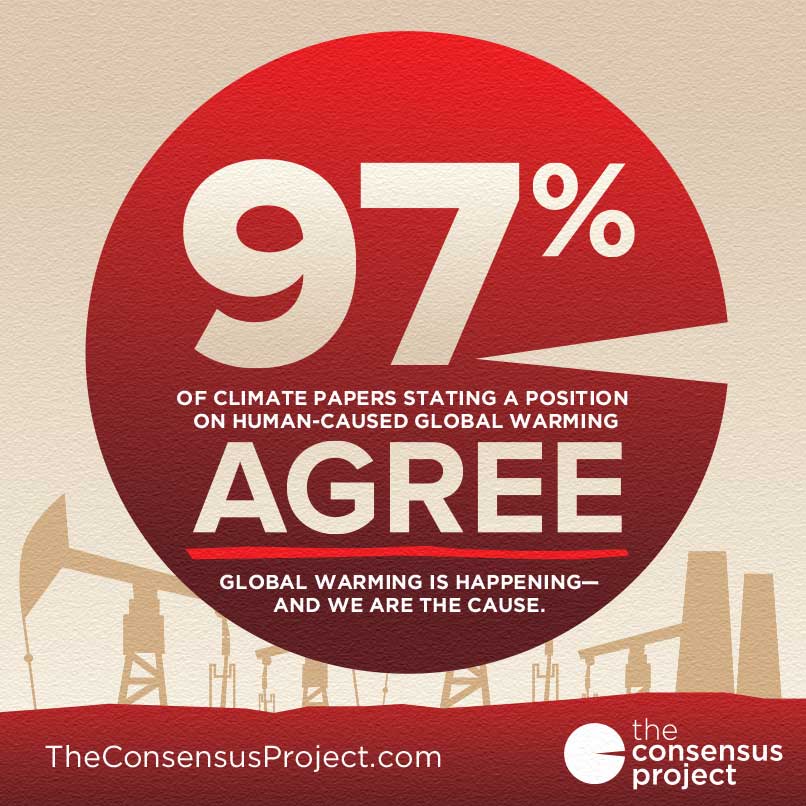
Quite possibly the most important thing to communicate about climate change is that there is a 97% consensus amongst the scientific experts and scientific research that humans are causing global warming. Let’s spread the word and close the consensus gap.
Forgotten [Really? Did they say climate communication was the only thing that mattered? No, they said "to have a chance." I.e., closing the gap is necessary but not sufficient condition, not the only thing that matters] in much of this is a point made in an e-mail message sent to me and some other science communicators this morning by Dan Kahan, the Yale law professor who studies the cultural filters that influence how people perceive and react to information. Kahan linked to his fresh post reviewing how many times in recent years such studies have been promoted, then asked this:
Climate scientists aren’t the only ones whose message never gets through. The “science of science communication consensus” that deficits in knowledge & rationality are not the problem [there's more than one problem!]— 99.9999999% agree! — never does either, & to the very people it should be of value too, viz., those trying to promote constructive engagement w/ climate science.
Is there someone studying that science communication problem???!
. . . 
This doesn’t mean it’s a waste of time to communicate climate science [in contrast to what you tweeted yesterday]. But it does mean that communicating the science of science communication matters, too.
For more on the wishful nature of hopes that closing such gaps will matter much, read Keith Kloor and David Appell.
Dear Andrew,

I like a lot of what you write, and I respect your ability to take a second look at your positions and well, it's time. Your own shifting justifications for why Cook et al doesn't matter should be a warning sign that something is amiss: "This study will not fundamentally alter the climate debate forever" (*) is quite a climb-down from "This is an irrelevant study that tells us nothing new and changes nothing."

The Cook study added a greater degree of rigor to the evidence that 97% of climate scientists agree global warming is happening and is human caused. Most Americans -- 70% in the 2011 Six Americas study -- do not know this. Attempting to defend the initial, rather rude and ill-thought-out, dismissal of the study reflects a natural and predictable defensiveness, but you should reconsider.

Neither the authors of the study nor anyone else claimed the study solved all the problems in communicating the science of global warming, still less that it showed a way past all the obstacles to collective political action.

But as a piece of science communication -- a subject you have written and lectured about on many occasions, and therefore seem to think is relevant in some way to the challenges we face -- it was a stunning success(**). Both your initial dismissal and the further attempts to justify it are wrongheaded and invite the label of "inactivist" which some have attached to you.


-----------------------------

* A point Appell makes in even more bizarre fashion when he crows ("Climate Candy: The Proof" (!)) that the Huffington Post is no longer leading with the study the next day (?)).

** Let us consider some of the reasons for its success:

1. A simple message.
2. Careful research that sticks to the facts.
3. A message grounded in what we know well, not in new science, extremes, or "single study syndrome."
4. Information that the disengaged (not aware it has been available for some time) have REPEATEDLY TOLD POLLSTERS would increase their concern about global warming.
5. Despite a message well-gauged to increased concern, it is not apocolyptic, not overwhelming, and not likely to make people want to "tune out" the issue.

Thursday, May 16, 2013

The intolerant moderates


Skeptical Science won the internet last week with a superb original paper by Cook, Nuccitelli et al that evaluated over 12,000 sources and found 97% of climate scientists agree that global warming is happening.


Amazingly some people managed to miss the point:
Their names are practically a role call of the "intolerent moderates" -- journalists who have chosen to define themselves as independent-minded thinkers ready to castigate both sides. The intolerant moderates accept that climate change is happening and action is necessary, but struggle to occupy a middle ground condemning the excesses of both sides. Since the excesses in the climate debate are not at all equally distributed between science deniers and the concerned, this positioning often leads to tepid critiques of climate deniers coupled with energetic castigation of the other side for minor, or, as in this case, nonexistent sins.

Dave Appell just doesn't see the point of the study:
I'm not very keen on these kinds of numbers -- they are made for lazy journalists who don't want to examine the complexity of the science, reporters who just want a number that quickly and easily supports their position.
Or maybe reporters who want to convey to their readers a simple, rock-solid case that a majority of climate scientists believe climate change is real and is caused by humans something only 30% of Americans know to be true (Really).

Kloor is spouting the same sort of nonsense:
The latest example is this survey by John Cook et al that is getting a lot of undeserved attention in the mainstream media. I say that because, questionable methodology aside, the survey tells us nothing new and is, as science journalist David Appell noted, “a meaningless exercise.”
I enjoy their quoting one another for added support: but they are both completely, utterly, ludicrously wrong.

It's hard to say which is the more fundamental fail here: that Kloor doesn't understand that replicating results is critical to science, or that he thinks that he has somehow become a scientist, whose responsibility it is to follow and critique the bleeding edge of climate science, rather than his actual role as a science journalist helping the public grasp the critical core of the field, a job that evidently has to be done by scientists, who have pulled off a massive coup of science communication, only to be sneered at by the people who are paid to perform that function themselves.

I really expected better of Revkin than to jump on this bandwagon. This is why the survey is not a "meaningless exercise":

Source
Half of the public in this survey -- HALF -- said that if 90% of climate scientists agreed that global warming is happening, it would increase their concern. This mind-boggling result is possible, again, because SEVENTY PERCENT OF THE PUBLIC DIDN'T KNOW MOST CLIMATE SCIENTISTS THINK GLOBAL WARMING IS HAPPENING.

That three SCIENCE JOURNALISTS do not know this about their audience is scandalous. It borders on professional incompetence. These people are lecturing scientists about science communication?

UPDATE: In the comments, MikeH perceptively notes that the intolerant moderate is a subspecies of the VSP:

They are the Very Serious People (popularised by Paul Krugman in his NYT column)
(http://rationalwiki.org/wiki/Very_Serious_People)

"Valuing common sense over scientific consensus when there is a conflict. When pushed far enough VSP will eventually err on the side of science but will hold a candle for pseudoscience as long as it has a veneer of respectability.
Loves the hell out of the balance fallacy. They feel uncomfortable pointing out flaws concentrated in the right-wing or left-wing without pointing to an opposite example. "Both sides do it!"

Climate scientist 2+2=4
Denier 2+2=5
VSP 2+2=4.5


Sunday, September 9, 2012

Bottom line: Does switching from coal to shale gas slow climate change?

Keith Kloor "asks" Will Fracking Help Or Hinder the Fight Against Climate Change? Unfortunately, it soon becomes clear that he has little interest in trying to answer that question, and instead uses it as an excuse to beat up on his favorite villains, those crazy environmentalists:
Gas emits much less carbon than coal (probably between 25% and 50% less), which is a net plus on the global warming ledger. And shale gas, in case you hadn’t heard, is entering a golden age; it is abundant and newly retrievable across the world, not just in the United States. It’s the bridge fuel to a clean energy future that liberal think tanks and university researchers were touting just a few years ago. Given the political stalemate on climate change, one energy expert gushed in a recent NYT op-ed: “Shale gas to the rescue.”


But a grassroots backlash to the relatively new technology (hydraulic fracturing) that unlocks shale gas has set in motion powerful forces opposed to this bridge getting built. Leading climate campaigners, citing concerns about industry practices and continued reliance on fossil fuels (even if less carbon intensive), are now a big part of the growing anti-fracking coalition. Mainstream environmentalists have also jumped on that bandwagon.
Thus the battle lines are drawn, with enviros and climate activists digging in their heels against a shale gas revolution that could pay big climate dividends.
Lest you think I'm quoting Kloor's conclusions following a careful analysis of the pros and cons of shale gas, the above is from the third, fourth, and fifth paragraphs of Kloor's essay. Really. So the title of the essay is really quite misleading. Kloor spends not a bit of virtual ink on whether fracking will "help or hinder the fight against climate change." Instead he blandly proclaims it "the bridge fuel to the clean energy future" and directs the remainder of his energies to the question of whether "enviros and climate activists" will help or hinder it.

It's a shame, and not just because it is rehash of an essay Kloor has written approximately five hundred times (Enviros crazy! Me sane and moderate!) dressed up as something new. It is a shame because the question itself is very interesting and important: is shale gas a good thing from the perspective of global warming, or not?

There are three major factors to examine in considering the relative impact of shale gas and coal on climate change:

1. CO2 produced per unit of energy.
2. Methane produced per unit of energy (conventionally referred to, with gas, as the methane leakage rate).
3. Aerosol cooling (coal more than gas, by far.)

Non-AGW factors will be left out of the equation for now. These include water pollution, direct harm from inhalation (asthma, COPD, lung cancer), and damage to the landscape. These are not unimportant, but they complicate an analysis that is already quite complicated. So we will stick with the effects on global warming.

Looking at the three factors above, we can see that the long-term factor (CO2) favors gas, while the short-term factors (methane and aerosols with their short half-lives in the atmosphere) favor coal. So we would expect, intuitively, that shale gas would do well in the long term, and less well in the short term. And this is exactly what the literature shows.

Source.
Looking at Hultman et al (2011) (4th abstract below) we see that methane leakage make shale gas worse than coal in the short term (20 years) about the same in the medium term (100 years) and better in the long term (500 years). Hultman et al does not consider the negative aerosol forcing associated with burning coal, so gas is relatively advantaged in these calculations.

When aerosols are included in the calculations, the break-even point for shale gas is even further in the future.

Here are a few of the recent papers examining this question:


We evaluate the greenhouse gas footprint of natural gas obtained by high-volume hydraulic fracturing from shale formations, focusing on methane emissions. Natural gas is composed largely of methane, and 3.6% to 7.9% of the methane from shale-gas production escapes to the atmosphere in venting and leaks over the life-time of a well. These methane emissions are at least 30% more than and perhaps more than twice as great as those from conventional gas. The higher emissions from shale gas occur at the time wells are hydraulically fractured—as methane escapes from flow-back return fluids—and during drill out following the fracturing. Methane is a powerful greenhouse gas, with a global warming potential that is far greater than that of carbon dioxide, particularly over the time horizon of the first few decades following emission. Methane contributes substantially to the greenhouse gas footprint of shale gas on shorter time scales, dominating it on a 20-year time horizon. The footprint for shale gas is greater than that for conventional gas or oil when viewed on any time horizon, but particularly so over 20 years. Compared to coal, the footprint of shale gas is at least 20% greater and perhaps more than twice as great on the 20-year horizon and is comparable when compared over 100 years. [Howarth et al became the focus of a debate between the authors and another group of researchers championed by Anthony Revkin. Cathles et al substituted optimistic estimates of methane leakage for Howarth's pessimistic estimates (which led to a letter, which led to a press release), and ignored the 20-year horizon, arguing that only 100 years and longer are appropriate measures of climate impact. Ignoring the 20-year time horizon is a common tactic of shale gas boosters, as we see below. Cathles goes further by ignoring the difference in aerosol forcing between present-day coal and shale gas, reasoning that we'll have to get rid of dirty coal plants someday anyway!]

"Greater focus needed on methane leakage from natural gas infrastructure"

Natural gas is seen by many as the future of American energy: a fuel that can provide energy independence and reduce greenhouse gas emissions in the process. However, there has also been confusion about the climate implications of increased use of natural gas for electric power and transportation. We propose and illustrate the use of technology warming potentials as a robust and transparent way to compare the cumulative radiative forcing created by alternative technologies fueled by natural gas and oil or coal by using the best available estimates of greenhouse gas emissions from each fuel cycle (i.e., production, transportation and use). We find that a shift to compressed natural gas vehicles from gasoline or diesel vehicles leads to greater radiative forcing of the climate for 80 or 280 yr, respectively, before beginning to produce benefits. Compressed natural gas vehicles could produce climate benefits on all time frames if the well-to-wheels CH4 leakage were capped at a level 45–70% below current estimates. By contrast, using natural gas instead of coal for electric power plants can reduce radiative forcing immediately, and reducing CH4 losses from the production and transportation of natural gas would produce even greater benefits. There is a need for the natural gas industry and science community to help obtain better emissions data and for increased efforts to reduce methane leakage in order to minimize the climate footprint of natural gas. 


Recent reports show growing reserves of unconventional gas are available and that there is an appetite from policy makers, industry, and others to better understand the GHG impact of exploiting reserves such as shale gas. There is little publicly available data comparing unconventional and conventional gas production. Existing studies rely on national inventories, but it is not generally possible to separate emissions from unconventional and conventional sources within these totals. Even if unconventional and conventional sites had been listed separately, it would not be possible to eliminate site-specific factors to compare gas production methods on an equal footing. To address this difficulty, the emissions of gas production have instead been modeled. In this way, parameters common to both methods of production can be held constant, while allowing those parameters which differentiate unconventional gas and conventional gas production to vary. The results are placed into the context of power generation, to give a ″well-to-wire″ (WtW) intensity. It was estimated that shale gas typically has a WtW emissions intensity about 1.8–2.4% higher than conventional gas, arising mainly from higher methane releases in well completion. Even using extreme assumptions, it was found that WtW emissions from shale gas need be no more than 15% higher than conventional gas if flaring or recovery measures are used. In all cases considered, the WtW emissions of shale gas powergen are significantly lower than those of coal.[Note, however, that this paper, brought to you by "Shell Global Solutions," ignores the 20-year horizon completely: "Some authors have considered 20-year global warming potential
factors, but use of these is not widely accepted."]

"The greenhouse impact of unconventional gas for electricity generation" Nathan Hultman, Dylan Rebois, Michael Scholten and Christopher Ramig 2011 Environ. Res. Lett.

 New techniques to extract natural gas from unconventional resources have become economically competitive over the past several years, leading to a rapid and largely unanticipated expansion in natural gas production. The US Energy Information Administration projects that unconventional gas will supply nearly half of US gas production by 2035. In addition, by significantly expanding and diversifying the gas supply internationally, the exploitation of new unconventional gas resources has the potential to reshape energy policy at national and international levels—altering geopolitics and energy security, recasting the economics of energy technology investment decisions, and shifting trends in greenhouse gas (GHG) emissions. In anticipation of this expansion, one of the perceived core advantages of unconventional gas—its relatively moderate GHG impact compared to coal—has recently come under scrutiny. In this paper, we compare the GHG footprints of conventional natural gas, unconventional natural gas (i.e. shale gas that has been produced using the process of hydraulic fracturing, or 'fracking'), and coal in a transparent and consistent way, focusing primarily on the electricity generation sector. We show that for electricity generation the GHG impacts of shale gas are 11% higher than those of conventional gas, and only 56% that of coal for standard assumptions. [But see above.]
 Substitution of natural gas for coal is one means of reducing carbon dioxide (CO2) emissions. However, natural gas and coal use also results in emissions of other radiatively active substances including methane (CH4), sulfur dioxide (SO2), a sulfate aerosolprecursor, and black carbon (BC) particles. Will switching from coal to gas reduce the net impact of fossil fuel use on global climate? Using the electric utility sector as an example, changes in emissions of CO2, CH4,SO2 and BC resulting from the replacement of coal by natural gas are evaluated, and their modeled net effect on global mean-annual temperature calculated. Coal-to-gas substitution initially produces higher temperatures relative to continued coal use. This warming is due to reduced SO2 emissionsand possible increases in CH4 emissions, and can last from 1 to 30years, depending on the sulfur controls assumed. This is followed by a net decrease in temperature relative to continued coal use, resulting from lower emissions of CO2 and BC. The length of this period and the extent of the warming or cooling expected from coal-to-gas substitution is found to depend on key uncertainties and characteristics of the substitutions, especially those related to: (1) SO2 emissions and consequentsulphate aerosol forcing; and (2) the relative efficiencies of the power plantsinvolved in the switch. [Short-term: more warming with shale gas. Longer term: gas beats coal. The exact time horizons seem to be quite sensitive to the initial assumptions, but there seems to be fairly broad agreement about the overall picture, and dissenters -- like "Shell Global Solutions" -- get around these facts by simply ignoring the short-term time frame.]

Coal to gas: the influence of methane leakage
Tom M. L. Wigley

Carbon dioxide (CO2) emissions from fossil fuel combustion may be reduced by
using natural gas rather than coal to produce energy. Gas produces approximately half the amount of CO2 per unit of primary energy compared with coal. Here we consider a scenario where a fraction of coal usage is replaced by natural gas (i.e., methane, CH4) over a given time period, and where a percentage of the gas production is assumed to leak into the atmosphere. The additional CH4 from leakage adds to the radiative forcing of the climate system, offsetting the reduction in CO2 forcing that accompanies the transition from coal to gas. We also consider the effects of: methane leakage from coal mining; changes in radiative forcing due to changes in the emissions of sulfur dioxide and carbonaceous aerosols; and differences in the efficiency of electricity production between coal- and gas-fired power generation. On balance, these factors more than offset the reduction in warming due to reduced CO2 emissions. When gas replaces coal there is additional warming out to 2,050 with an assumed leakage rate of 0%, and out to 2,140 if the leakage rate is as high as 10%.
. . .
In our analyses, the temperature differences between the baseline and coal-to-gas
scenarios are small (less than 0.1°C) out to at least 2100. The most important result,
however, in accord with the above authors, is that, unless leakage rates for new
methane can be kept below 2%, substituting gas for coal is not an effective means for reducing the magnitude of future climate change.
This is contrary to claims such as that by Ridley (2011) who states (p. 5), with regard to the exploitation of shale gas, that it will “accelerate the decarbonisation of the world economy”. The key point here is that it is not decarbonisation per se that is the goal, but the attendant reduction of climate
change. Indeed, the shorter-term effects are in the opposite direction. Given the small
climate differences between the baseline and the coal-to-gas scenarios, decisions regarding further exploitation of gas reserves should be based on resource availability (both gas and water), the economics of extraction, and environmental impacts unrelated
to climate change.

----------------------------

So after this whirlwind tour of shale gas research, what do we know? There is no consensus about whether or not substituting shale gas for coal will slow global warming this century. This is not going to be one of those issues where all the science is lined up on one side, and all the partisan kooks are lined up on the other. The exact effect of switching from coal to shale gas depends upon a number of factors that are difficult to pin down, including:

1. The size of the aerosol forcing. After many decades of trying to pin it down, we still do not know exactly how much cooling the SO2 and other coal-burning byproducts are causing. Obviously the effects of switching from coal to gas depend on how much coal-burning byproducts temporarily cool the planet.

2. The amount of methane leakage. This is a function of not just how well we measure methane leakage, but whether we aggressively regulate methane leakage to hold it to an absolute minimum.

3. The discount rate. Not really a physical constant, but more of a philosophical question: how important is relative cooling 300 years from now compared to worsening global warming over the next twenty years (or fifty years, or hundred years)?

4. The half-life of methane in the atmosphere. As far as I know, no one has discussed this relative to the shale gas question, but the oxidization of methane to CO2 by free radicals is subject to saturation, which is the science-y way of saying that the more methane you put in the atmosphere, the longer each molecule stays in the atmosphere:

The magnitude and feedbacks of future methane release from the Arctic region are unknown. Despite limited documentation of potential future releases associated with thawing permafrost and degassing methane hydrates, the large potential for future methane releases calls for improved understanding of the interaction of a changing climate with processes in the Arctic and chemical feedbacks in the atmosphere. Here we apply a “state of the art” atmospheric chemistry transport model to show that large emissions of CH 4 would likely have an unexpectedly large impact on the chemical composition of the atmosphere and on radiative forcing (RF). The indirect contribution to RF of additional methane emission is particularly important. It is shown that if global methane emissions were to increase by factors of 2.5 and 5.2 above current emissions, the indirect contributions to RF would be about 250% and 400%, respectively, of the RF that can be attributed to directly emitted methane alone. Assuming several hypothetical scenarios of CH 4 release associated with permafrost thaw, shallow marine hydrate degassing, and submarine landslides, we find a strong positive feedback on RF through atmospheric chemistry. In particular, the impact of CH 4 is enhanced through increase of its lifetime, and of atmospheric abundances of ozone, stratospheric water vapor, and CO 2 as a result of atmospheric chemical processes. Despite uncertainties in emission scenarios, our results provide a better understanding of the feedbacks in the atmospheric chemistry that would amplify climate warming.
So depending on how widely shale gas is adopted, and on whether other sources of methane such as permafrost melting or methyl hydrates come into play, methane leaks from shale gas could have double or even quadruple the impact on the climate presently assumed.

Given these uncertainties, what can we say with at least moderate confidence?

1. Shale gas is probably worse than coal on the 20 year horizon. Apart from all the other evidence, the determination of shale gas boosters to avoid talking about the 20 year horizon suggests that this is the case.

2. There is a time horizon out there at which shale gas becomes better from a warming perspective than coal. It's just not clear yet whether it is at 25, 100, or 300 years . . . i.e., whether it is soon enough to do us any real good.

3. Shale gas is significantly worse than every other sort of energy except coal and oil. In the absence of a carbon price, cheap shale gas will tend to displace all energy sources, not just coal. Thus a realistic analysis of a Tea Partyesque policy of letting frackers "do their thing" with minimal regulation would compare shale gas to a basket of power sources that would be displaced, including hydro, geothermal, solar, wind, and nuclear, as well as discouraging investments in efficiency or decisions to conserve. Shale gas is unlikely to look good on this basis.

So, can shale gas be a "bridge fuel"? In my opinion, not in the way shale gas is happening right now. To have any hope of a real net benefit in terms of global warming this century, we need draconian limits on methane leakage and a carbon price (including both CO2 and methane) to ensure that shale gas replaces coal, not low-carbon energy sources or improvements in efficiency. The narrative of "the free market slashed CO2 emissions while the enviros weren't looking HAHAHA" has no basis in fact. The blind squirrel of the free market may stumble into an instance of profit-driven accidental mitigation once in a while (like the Russians controlling methane leakage from pipelines after the fall of the Soviet Union), but this ain't it. Similarly the idea that shale gas is an unambiguous "win" in mitigation terms, so much so that those questioning it are self-evidently trolls lurking under "the bridge to the clean energy future" is also not supported by the research.
Sea level rise to 2500. Source.

How we do shale gas is going to determine whether there is a window where there might be some net benefit. Both proponents and opponents of mitigation have tended to stress the 100-year time frame, for different reasons. If you accept that framing, even optimal shale gas substitution is probably going to show, at best, moderate benefits. If you are looking 500 years into the future, shale gas instead of coal is the best thing since sliced bread, but then, if you're looking 500 years into the future,  you can hardly help but realize that stopping all fossil fuel use as soon as possible should be our overarching priority.


Thursday, August 30, 2012

Fighting climate denial: the Akin line

Source


Pity Todd Akin. It must seem to him as if the world makes no sense.

One minute he is living the life of a normal House Republican gunning for a vulnerable Senate seat, and the next he's a virtual pariah, with most of his own supporters saying he should drop out of the race. And all for making a comment not substantially different than those he and his colleagues make every day. Here is the line that turned his own party against him:
Well you know, people always want to try to make that as one of those things, well how do you, how do you slice this particularly tough sort of ethical question. First of all, from what I understand from doctors, that’s really rare. If it’s a legitimate rape, the female body has ways to try to shut that whole thing down.
Instant pandemonium. But why should that be so? What did Akin actually do?

It's a five-step process:

1. You have a rigid ideology that is absolutely opposed to a given action (like abortion).
2. There are empirical facts that make your absolutist position untenable (sometimes women are pregnant not because they chose to be, but because they were raped.)
3. Find a crackpot scientist (one sharing your ideological idiosyncrasies) who will explain away the inconveint fact (Women who have really been raped don't get pregnant!)
4. Ignore the vast scientific evidence to the contrary.
5. Promote the conspiracy theory as scientific fact.

Why did Akin think he was going to get away with this sophistry? Because he and his party have been playing this game, routinely and increasingly blatantly, for years. How would he know that all of a sudden ignoring the scientific consensus and promoting pseudoscience would blow up in his face? Compare his remarks on climate change
AKIN: This whole thing strikes me if it weren’t so serious as being a comedy you know. I mean, we just went from winter to spring. In Missouri when we go from winter to spring, that’s a good climate change. I don’t want to stop that climate change you know. Who in the world want to put politicians in charge of the weather anyways? What a dumb idea….
Some of the models said that we’re going to have surf at the front steps of the Capitol pretty soon. I was really looking forward to that….
 His official website trots out some more old canards (h/t Grist):
Although some of the physics and meteorology surrounding climate is well understood, the question of predicting future climate trends as well as man’s ability to definitively influence them is still an active field of scientific research. Moreover, despite our desire for complete certainty, we must understand that global climate is very complex phenomena. No one variable can be taken as the sole driver of climate and there exist cycles within cycles of meteorological variability. Scientists state that the planet has gone through many natural heating and cooling cycles over the last thousand years.
While scientists understand that increased levels of CO2 and other greenhouse gases work to trap heat, those gases are not the only variables when it comes to Earth’s temperature trends. For example, the sun itself has variable output, which affects temperature cycles. Currently, scientists are somewhat puzzled by a current-extended minimum in solar activity. Such a long-term lack of solar output in the early 18th century, referred to as the Maunder Minimum, is thought to have contributed to the last mini-ice age. Of course, factors such as solar variability — that could cause a mini-ice age — would probably not afford a man-made solution.
So here's the real question: why does the one public endorsement of pseudoscience spark outrage, while the other gets ignored? What's the difference? Where is the "Akin line" that separates comments like Michele Bachmann's, blaming the HPV vaccine for mental retardation, with these, from Akin's colleagues:
The committee’s chair, Ralph Hall (R-Texas), lumps “global freezing” together with global warming, which he doesn’t believe humans can significantly impact because “I don’t think we can control what God controls.” Dana Rohrbacher (R-CA) thinks cutting down trees reduces levels of greenhouse gases they absorb. Mo Brooks (R-Alabama) still trots out the debunked notion that a scientific consensus existed in the 1970s on “global cooling,” which he portrays as a scare concocted by scientists “in order to generate funds for their pet projects.”

Dan Benishek (R-Michigan) strikes that climate-scientists-as-charlatans note, dismissing contemporary research as “all baloney. I think it’s just some scheme.” Paul Broun (R-Georgia) says that “Scientists all over this world say that the idea of human-induced global climate change is one of the greatest hoaxes perpetrated out of the scientific community.”
Watching the Deniers asks: How would you counter the denial movement? And I think the answer is very simple; we need to bring them across the Akin line. We need to gently and truthfully shape the public debate such that outrageous comments provoke outrage, that laughable ignorance provokes laughter, until we reach a point that those that advocate science denial get shunned by their own political allies as liabilities in the battle for electoral success.

So why did Akin and Bachmann instantly provoke national scorn, while Benishek and Broun have not?

A) In each case, there was a simple, testable scientific assertion. Vaccine = mental retardation. Rape = no pregnancy. It's easier to see why that more easily trips up a science denier as compared to "It's all very complicated" or "Climate models are unreliable."

B) The puppet strings are short and colorful -- there is no problem at all reading the minds of Akin and Bachmann and understanding why they are making stuff up. Akin wants abortion to be completely illegal, always, in all circumstances. That women get pregnant from rape is an awkward fact for him, so he tries to suppress it by invoking pseudoscience. Bachmann is against the HPV vaccine because it makes sex a little less dangerous for women, and in her mind, that encourages promiscuity.

In both cases the lies play into the speakers' established positions in culture wars that have been raging for a generation. Even the most low-information voter knows how conservative Republicans feel about abortion and safe sex. That makes it easy to connect the dots.

C) There is a clear scientific consensus, and the audience knows that, even if they don't know the details. Physicians and medical science have a much stronger presence in American life than does climate science or climate scientists. Most people know a physician personally. The science denial wing of the Republican party has not constructed a campaign to slander and defame physicians, attacking them as frauds or incompetent or self-interested rent-seekers. They would not find it easy to do if they tried. But in the absence of such preparation, voters have little reason to reject the scientific consensus. The total rejection by the medical community of these lies ends the debate.

D) These comments were deeply insensitive and hurtful to other Americans. Rape victims were insulted by Akin. People with actual learning disabilities or cognitive limitations and the families that care for them were insulted by Bachmann. This brought anger and contempt into the response to the speakers as well as mockery.

If we go back to the statements by Akin and friends on climate change, it's clear they are missing most of the attributes listed above. Take "Scientists state that the planet has gone through many natural heating and cooling cycles over the last thousand years." It's vague, not clear and testable (A). If you strongly connect Akin to fossil fuel interests, it could be said to meet (B). The public does not have a clear idea of the scientific consensus that the current global warming is orders of magnitude different from natural climate variations of the recent past (C). Those that do know this have also been exposed to a relentless campaign to undermine the scientific consensus by slandering the scientists themselves (C). The comment is deeply offensive to people who understand what Akin is trying to accomplish and what the actual state of affairs is, but they do not have the visceral offensiveness of someone blaming rape victims or the parents of the mentally retarded for their situation (D).

So, if we think Akin's pseudoscience about climate change deserves the same contempt as his pseudoscience about rape and pregnancy, how can we encourage the public to see things similarly?

A) In each case, there was a simple, testable scientific assertion. Focus on deniers' assertions about science. Don't let them get away with vague statements of doubt, and endless one-sided interrogations of others. Encourage them to explicitly state their beliefs.

B) The puppet strings are short and colorful -- there is no problem at all reading the minds of Akin and Bachmann and understanding why they are making stuff up. Highlight the connection between right-wing extremism and climate denial. Make the connection between science denial and other right-wing views. As entertaining as it is to show how climate denial relates to the conspiracy-theory-prone mindset, the critical driver of climate denial in politics is the broader radicalization of the Republican Party.

C) There is a clear scientific consensus, and the audience knows that, even if they don't know the details. The contempt of hardcore climate deniers for the concept of scientific consensus is born of fear. Despite deniers' whining and jeering and embrace of the Galileo gambit, the public knows very well that the consensus of the vast majority of scientists on a given issue is as close to the truth as anything we can lay hands on. And survey after survey shows that even "alarmists" vastly understate the strength of the scientific consensus on global warming -- the meaning the fact of the scientific consensus has not been "priced in" by the public.

So, while sticking to the stuff we clearly know to be true, and not venturing into unsupported speculation, it's important to highlight the contrast: Consensus vs. crackpots on the fringe.  Consensus vs. crackpots on the fringe. Consensus vs. crackpots on the fringe.

D) These comments were deeply insensitive and hurtful to other Americans. This one is hard -- I don't know it is achievable in the short term. It's difficult to "put a face" on global warming. But perhaps, as with "consensus," the deniers are giving us a hint, by vehemently attacking the arguments they most fear. And what is the single most jeered-at, eye-rolling, cliched picture in all of climate change? You know what it is. It's this:

Deniers jeer at what works.
When the deniers deny, they are insulting those that have already been hurt by climate change. They are insulting the other creatures we share the planet with. We have to make those people -- Inuits whose villages are being washed out to sea, elderly people without air conditioning dying in record-breaking heat waves, children in temperate climates suffering with tropical diseases previously unknown there -- we need to make them as real, as familiar, as indisputably linked with AGW as that bear on his shrinking ice floe. 

Compare the argument over gays in the military. While they were theoretical, people could say (and did) all sorts of ignorant and hurtful things, with little political fallout. But as the culture gradually changed, as gay service members dared to speak out more, as the ban was finally ended, gays in the military stopped being theoretical people, and they became actual, flesh-and-blood people with their lives on the line for their country. And suddenly as a social conservative you had to be very careful what you said. This social changed went very slowly, until it reached that critical point where it was hard to attack "gays in the military" as an abstraction without insulting the actual people you were talking about. Then the culture and the discussion changed more in six month than it had in the previous sixty years. And where is that debate today? Gone and virtually forgotten.

Even cuter than polar bears.
I've written about confronting climate denial before, and as before, I find a reasonable approximation of my views is to take all the well-meaning advice of the self-identified "moderates" in the climate debate, the Kloors and the Revkins and so forth, and do the exact opposite of what they recommend.

Don't be a free educational resource to people with no actual sincere desire to learn. Ask them questions -- be skeptical about their skepticism -- put their beliefs and opinions on the record and under the microscope.

Don't waste your time searching for a mythical middle ground. Climate deniers are in this in order to have an ideological battle. It is part of their war with modern life and Western civilization. You will not win them to your way of thinking with a clever compromise, any more than the NRA is going to wake up one morning at say "Wow, we've got all the pro-gun legislation we could ever need! Now, back to regional shooting competitions!" Instead, embrace the polarization of the debate -- among other things, this helps the public understand what motives climate deniers to lie and distort.

Don't try and convey uncertainty. If you have a complex message while your opponents have a simple one you will lose. Plain and simple. Deniers want us to spending our time trying to educate the public to grasp complex scientific ideas. They are delighted when they can provoke us into doing that by accusing us of oversimplifying the story. (They will just be at this little table over here on the other side of the room, saying FRAUD LIES FRAUD TAXES SOCIALISTS GREEDY SCIENTISTS NATURAL NATURE FRAUD FRAUD.)

So find a simple message, well inside the borders of the consensus, and hammer it home relentlessly. Show the people being hurt by global warming. Show them over and over again, until the public gets a visceral sense that deniers are denying not just the scientific understanding of where the climate is going, but of what is happening in the world right now. People are dying while the right-wing fringe lies and defames. When the public understands that -- understands it in their bones -- deniers will find themselves across the Akin line.

Monday, August 20, 2012

Keith Kloor proposes killing millions of deniers -- I try to talk him down

Unmanageable.

 I've been reading this "Keith Kloor" guy over at Collide-a-Scape. Call me crazy, I think the kid has potential. I came across this:
Like the never-ending war on drugs, the conventional paradigm for addressing climate change has proven to be a colossal failure–yet it remains in place. In case anyone needs a reminder of where things stand:
The global output of heat-trapping carbon dioxide has jumped by a record amount, according to the US department of energy, a sign of how feeble the world’s efforts are at slowing man-made global warming.
This quote summed up the situation well:
“The more we talk about the need to control emissions, the more they are growing,” said John Reilly, the co-director of MIT’s Joint Program on the Science and Policy of Global Change.
There appears to be growing recognition that a different approach might be necessary.
Keith is right, people. The first approach doesn't always work. The American anti-slavery movement, for example, kicked off in 1688 with the Germantown Quaker Petition Against Slavery. But despite a hundred and sixty years of petitions, pamphlets, demonstrations, speaking tours, and assistance to fugitive slaves, they couldn't rid the country of slavery. It took a massive war spanning five years and killing over one million Americans to do that.

Or take the European response to the rise of Hitler. There was subtle maneuvering, diplomatic protests, multiple compromises forged. Didn't work -- ultimately it took a global war to deal with the problem, a war that would claim over 50 million dead and see the invention and first use of nuclear weapons.

So what is Keith's "different approach"? Is someone going to have to be delegated to go over to his house and secure his firearms? Perhaps not:
Along these lines, do read a new essay by Roger Pielke Jr. posted at the Foreign Policy website. He writes:
For years — decades, even — science has shown convincingly that human activities have an impact on the planet. That impact includes but is not limited to carbon dioxide. We are indeed running risks with the future climate through the unmitigated release of carbon dioxide into the atmosphere, and none of the schemes attempted so far has made even a dent in the problem. While the climate wars will go on, characterized by a poisonous mix of dodgy science, personal attacks, and partisan warfare, the good news is that progress can yet be made outside of this battle.
The key to securing action on climate change may be to break the problem into more manageable parts.
Can we have a constructive debate that explores this avenue? We’ll find out soon enough.
 Ah. Mr. Kloor's "different approach" is to"break the problem into more manageable parts" and abandon the "schemes" for checking "the unmitigated release of carbon dioxide."

I am perhaps having a little fun at Mr. Kloor's expense, but isn't this always the way of it? When people say of the fight to cut GHG emissions, "this isn't working; let's try something else" they are never referring to making our (if it really is "our") actions bigger; they always want to make our goals smaller.

There is always a prominent complaint of how "poisonous" the climate debate has become, but like those that rue our "poisonous" tax debates or our "poisonous" social debates, their solution to the poison is typically to concede the debate to the people who have done the most to make it poisonous.

There is no solution to the problem of global warming without cutting emissions of greenhouse gases. There is no way to cut greenhouse gas emissions globally without collective political action. I know of no one, literally no one, who is for this but against adaptation, or who is for this but against action on land use or black carbon or any of the other "manageable" climate problems. Working on those angles is admirable, but it doesn't break the problem into manageable parts; it abandons the problem in favor of more manageable problems.

Major social change can take a long time. Much like reading the climate, you need more than ten or twenty years of data to call a social movement a failure. Abolitionism, feminism, the welfare state, the civil rights movement all took longer than that from their inception to their great victories. Perhaps the current approach is a failure, or perhaps we are simply in the middle of a long, painful, exhausting struggle.

We should be willing to consider new strategies; but this strategy, the "managable parts" strategy, sometimes called the "no regrets" approach or the "adaptation first" approach, is not a strategy as much as it is a plan for surrender.