Tuesday, February 28, 2012

Judith Curry and the fallacy of the excluded middle


Judith Curry has a bad habit of preening over her worst examples of careless and sloppy thinking. In just the past few weeks, for example, she has repeatedly referred back to this awful train wreck of an argument:
There does seem to be an IPCC/UNFCCC ideology, let me try to lay it out here. I am using quotes from Michael Mann’s recent interview in the Bulletin of the Atomic Scientists, which I find to be a lucid statement of some elements of this.
1.  Anthropogenic climate change is real: “there is a very consistent story told by surface, sub-surface, ocean, atmospheric, and ice observations that Earth’s surface is warming, and in a way that is only consistent with human-caused increases in greenhouse gas concentrations.” (Mann)
2.  Anthropogenic climate change is dangerous and we need to something about it: “I believe it’s not too late to take the steps that are necessary to mitigate truly dangerous future climate change. There is still time to take action to stabilize greenhouse gases to a point where they don’t become a dangerous threat to humanity.” (Mann)
3.  The fossil fuel industry is trying to convince people that climate change is a hoax: “[P]owerful special interests in the fossil fuel industry . . . have invested millions of dollars in well-honed disinformation campaigns to convince the public and policy makers that human-caused climate change is either a hoax, or not nearly the threat that the scientific community has established it to be.”
4. Deniers are attacking climate science and scientists: “I’ve been the subject of attacks by climate-change deniers for more than a decade now, because of the prominent role that the “hockey stick” temperature reconstruction has played in the public discourse on climate change.”
5.  Action is needed to prevent dangerous climate change: “There are various episodes in our not-so-distant past when we were threatened by global environmental catastrophe and took action.”  (Mann)
6.  Deniers and fossil fuel industry are delaying UNFCCC mitigatory policies. “[Powerful special interests] have delayed any policy actions by at least a decade, perhaps more. The potential opportunity cost of that delay to humanity is impossible to estimate, but it is certainly staggering.” (Mann)
This is a political ideology.  #1 is about science.  #4 is in principle about science and scientists, except there is the automatic assumption that a bonafide scientific criticism is a political attack.  The rest of it is politics.
Leaving aside the small army of straw men (Michael Mann is synonymous with a "IPCC/UNFCCC ideology," really?) Curry here plunges into a straightforward embrace of the fallacy of the excluded middle, aka a false dilemma. The two tentpoles of her fallacy are "science" and "politics"; anything not science is "politics."

Of course many propositions are neither science nor politics. If you see a Mac truck barreling down on a jogger crossing the street, and you scream "Look out!" is that "science" or "politics"?
Dear idiot, get out of the way. Sincerely, "politics."

"Look out!" as a statement cannot be considered scientific. As some say of the case that climate change is dangerous, it relies on "values" (most statements do). In this particular example, those would be the "values" or not wanting to die of infected bedsores in a nursing home after a speeding truck smashes your spine. That is a matter of placing a "value" on life and health, but it is hardly "political" or "ideological" because both of those adjectives describe positions emerging from values that are not widely shared.

Ferinstance, take Rick Santorum (please). Rick Santorum says contraception is harmful to women. This is a belief that comes from the teachings of the Catholic church, and does not reflect a widely shared notion of "harm." It doesn't reflect harm to one's health (pregnancy being a greater danger to women's health than the expected consequences of contraception-assisted sex) or one's economic or professional position (unplanned children are bad for both) or any widely accepted measure of women's mental or emotional well-being. It is a moral position, which is to say, he believes that contraception and non-procreative sex are morally abhorrent and damaging to the spiritual health of women. That is a position shared by a group of American who share a number of other beliefs. It is ideological.

Is it ideological in the same sense to say "Anthropogenic climate change is dangerous" (point 2a)? Or is it more akin to "Look out!"?

The scientific facts of a multi-meter sea rise mean the loss of land and other resources to the ocean, to erosion, to greater storm surges, to the salinization of the water table. You can argue against the science that says this is likely to happen (the truck's not really headed for the crosswalk; the truck is already braking; I am the favorite of the Sith Lords and will stop the truck at the last minute with the Force, etc.) But that is not a political or ideological argument; it's still a scientific argument.

The political argument would be that, within the accepted facts, the truck hitting us isn't dangerous. That a multi-meter sea level rise would be a good thing for humanity -- or that humanity deserves to suffer. In order for ideology to come into play, as Dr. Curry wishes, we would need an ideology to raise its hand and explain how a poorer, hungrier, storm-wracked, Amazon-to-ash world is something that we should want.

Pseudoskeptics know that there is no argument to be made there: that is why you see them spending their industry millions attacking the teaching of global warming science,  funding dubious research into global warming science, questioning the objectivity, reliability, and veracity of science.

If there was a "values" argument or an "ideological" argument to be made, you would expect them to be promoting ideas like "Rising oceans will purge the sinful coasts" or "Wealth -- the root of all evil and how global warming will save you from it."

If no one wants to live in that poorer, more dangerous, more extreme post-warming world, then there is no ideological question; there is no values question, at least until when get to how to prevent global warming and who should make the biggest adjustments. I think I can safely speak for Michael Mann and many other presumptive members of the so-called "IPCC/UNFCCC ideology" when I say we would love to move the debate forward to the how.

Until we do, as long as we are still debating the whether, there is only the scientific question of whether are current actions are likely to lead to that future. If they are, and that future is dangerous, then our actions are dangerous. No politics come into it.

Many propositions are neither scientific nor political. "Climate change is dangerous" is a statement assuming commonly held ideas about "danger" -- that we don't want to be killed, or lose our homes, or go hungry. "We should do something about it" involves the idea that people can through forethought and action avoid danger. Again, until and unless there arises a political lobby for the proposition "Our fate is inescapable" or "Humans are dirty sinful creatures and deserve to suffer," these aren't political statements, but statements of common sense.

Similarly, points #3 and #4 may not be "scientific," but they are factual. Not all that is factual is science. John Kennedy was assassinated November 22, 1963 -- that is not a scientific proposition, but it is true, and is neither "politics" nor "ideology." Parts of the fossil fuel industry (among others) are trying to convince the public climate change is a hoax. Deniers are attacking science and scientists. Those are objective realities, not "political" claims. Curry is flirting with outright tinfoil-hat membership when she attributes widespread belief in such things to "ideology" whilst failing to even nod at the overwhelming factual evidence that they are true.



Monday, February 27, 2012

Santorum 2012!


Climatecrocks points to this eloquent call for a carbon tax from a conservative icon, none other than Arthur B. Laffer:

We need to impose a tax on the thing we want less of (carbon dioxide) and reduce taxes on the things we want more of (income and jobs). A carbon tax would attach the national security and environmental costs to carbon-based fuels like oil, causing the market to recognize the price of these negative externalities.
Nuclear power plants would then compete with coal-fired plants. Wind and solar power would have a shot against natural gas. Trains would compete with trucks. We would clean the air, create wealth and jobs through a new technology boom and drastically improve our national security.
The United States can’t solve climate change alone. The Kyoto climate treaty was rightly rejected by the Senate because China and India weren’t subject to its provisions. If China and India join the United States in attaching a price to carbon, their goods should come into this country without a carbon adjustment. But if they do not, every item they place on our shelves should be subject to the same carbon tax that we would place on our domestically produced goods, again offset by a revenue-neutral tax cut.
If World Trade Organization rules entitle members to an unwarranted exemption from such a carbon tax, then we should change them. Outliers should not be allowed to frustrate the decision-making of the countries that are trying to prevent the security and environmental train wrecks of this century.
Former Representative Bob Inglis, interviewed above, co-authored the piece quoted.

Inglis and Laffer illustrate why we need more conservatives on the right side of this issue, and need them front and center. Their arguments effortlessly hit a number of the major hot-button concepts needed to connect with conservatives and low information voters of all stripes. Fairness. Competitiveness. Climate change migitation imposed by American power, not conceded to an international agreement:
If China and India join the United States in attaching a price to carbon, their goods should come into this country without a carbon adjustment. But if they do not, every item they place on our shelves should be subject to the same carbon tax that we would place on our domestically produced goods, again offset by a revenue-neutral tax cut.
I love this. Instead of a hypothetical multinational agreement, you have instead a hypothetical international trade war with hypothetical punitive tariffs. (Notice that the possibility of an agreement with other powers is there, but deemphasized -- essentially, and agreement is reduced to "They are going to do their share and pull their weight or they'll pay the price (assessed and exacted by us).

This is good. Yes! I'm not kidding. Hopefully the belligerence gets taken down a notch in the execution, but we need proposals that make Americans feel empowered, not impeded; like leaders, not followers, leveling the playing field, not meddling in the market. These are the only sorts of programs that have any chance of coming to fruition.

Obviously the conservative radicalism in this country is going to have to take a pretty epic faceplant in national elections -- maybe a couple -- before strong action on climate change has a chance to be recognized as the essentially conservative program that it is. Michigan Democrats for Santorum, godspeed.

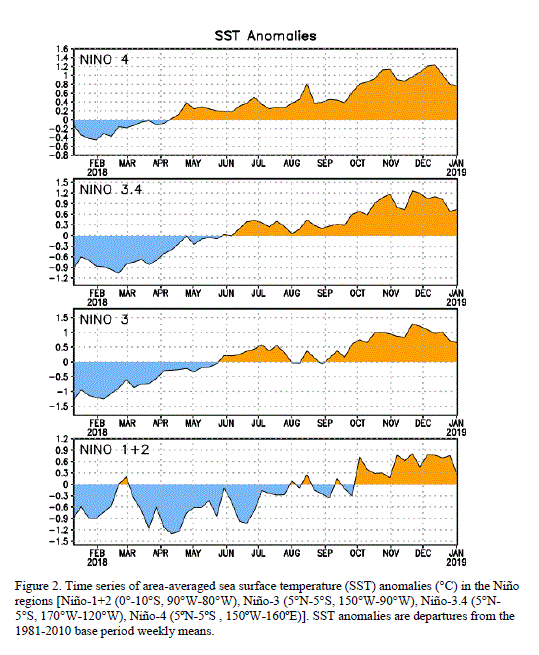
La Nina fading faster


The sharp turn for the warmer in the Pacific is continuing. Last week we saw a dramatic difference between the resurrected La Nina at the beginning of the year:


Versus last week:


And finally today's update:

Zones 3 and 1 + 2 are in positive territory; 3.4 (where the official ENSO index is measured) is still negative, but only just. The anomaly, at -0.4C, puts us back in ENSO neutral territory. This calls to mind what I said when it looked like we were headed for a double-dip La Nina:

If you ask the question of how many times the same phase repeated after making it all the way back to baseline (reaching or crossing 0.0C from either direction), and didn't have a weak alternate-phase episode that missed counting as such because it was not quite long enough or not quite intense enough, and then went back into the same phase, the answer is: it's only happened twice in sixty years, out of thirty-five transitions. So what they're projecting will happen would be pretty atypical.

. . . [But] while another La Nina episode is forecast, it hasn't happened yet. If it turns out to be too weak to meet the five-seasons cutoff, then goes into an El Nino, then there will have been nothing odd about it at all.
Right now there have been three overlapping three-month rolling averages that show La Nina conditions (3.4 anomaly < -0.5C):

 We have 2 months to go to meet the definition of a double-dip: December-January-February, and January-February-March. I doubt the former will shoot above -0.5C; it's already the end of February, and we will have had maybe a week or two total (in three months) above that mark. January-February-March, then, is ground zero for whether we end up with back-to-back La Ninas, or the oscillation gets another chance to live up to its name.

Friday, February 24, 2012

Heartland apologizes to donors for sunlight

From an email to Heartland donors in the wake of Heartlandgate:

I Apologize
I am very sorry that the identities of some of our donors were revealed by this theft. I apologize to them, from the bottom of my heart.
We are calling everyone who was named in these documents to give them the bad news and offer whatever assistance we can to repair the damage.
We promise anonymity to many of our donors because nobody wants the risk of nutty environmentalists or Occupy Wall Street goons harassing them. We know that privacy is important to you.
Literally the first Google Image for "Occupy Wall Street goon." Terrifying.
 

Thursday, February 23, 2012

What on earth is Criag Idso doing for Heartland's $11,600 a month?

Making Dad proud
From the annals of corruption:
Funding for selected individuals outside of Heartland. 

Our current budget includes funding for high-profile individuals who regularly and publicly counter the alarmist AGW message. At the moment, this funding goes primarily to Craig Idso ($11,600 per month), Fred Singer ($5,000 per month, plus expenses), Robert Carter ($1,667 per month), and a number of other individuals, but we will consider expanding it, if funding can be found.
This is all the more disturbing because I am not entirely sure who Craig Idso is. And yet he's pulling down six figures courtesy of the denialosphere? I am wasting my life.

As to who this guy is:
Craig D. Idso is Chairman, founder and former President of the Center for the Study of Carbon Dioxide and Global Change, a contrarian Arizona-based group funded in part by ExxonMobil. He is the son of its president, Sherwood B. Idso[1], and the brother of its vice president, Keith E. Idso.[2]
 Thus Sourcewatch, raising more questions than they answer. How many denialist think tanks are running on the mom-and-pop family business model, where the kids go off to college to secure their degrees in Agronomy and Geography before taking up the mantle of pretending to be a scientist? Is the Idso clan grooming the grandkids? When in 2030 the Arctic flips over into an ice-free state, are we going to be subjected to the analysis of William Howell Keith Idso the Third, on the strength of his degrees in Sports Marketing and Biblical Anthropology?

Maybe we'll get lucky and young William will be the black sheep of the family. "I'm leaving all this behind, Dad, and when you see me again, I'm going to have a degree in atmospheric physics!" "No son of mine!" "You can't stop me!" "Two weeks on a grad student stipend grading papers and you'll come crawling back!" "You can change the biometric security settings for the Compound, because I'm never coming back!"

Alternately, the rebellious young William could chose a career as a male escort, which would be more of a lateral move.


Wednesday, February 22, 2012

La Nina whiplash fading fast

The mini-me La Nina has taken a dramatic swing for the warmer. This was the picture at the end of January:

You can see the brief flirtation with ENSO neutrality before the Pacific's evident determination to resume La Nina bigger and badder and colder than before. What a difference three weeks makes:
The weather-masters now think we could enter the ENSO neutral zone as soon as March. With solar activity still headed upwards, we could be in for a hot summer.

Tuesday, February 21, 2012

Romm v Revkin

Andy "the horror, the horror" Revkin on Gleick:
Now, Gleick has admitted to an act that leaves his reputation in ruins and threatens to undercut the cause he spent so much time pursuing.

Joe Romm and Andy Revkin often clash over this or that, with the more measured Revkin coming out on top in most cases, in my view. This one, though, goes to Romm by a knockout:

First off, if one act of this nature could ruin a reputation or destroy his credibility, then what precisely is Revkin doing routinely quoting and citing people who have been repeatedly debunked, the disinformers and confusionists.
 I think those of us on the pro-science side accept a little bit of a double standard, but not when it's taken to a ridiculous, hyperventilating extreme. A little trickery to expose Heartland's illegal war on science? That "leaves his reputation in ruins"? Why, if it didn't involve his scientific work? Are we under the impression that all scientists are impeccably honest and forthright in all their personal and public affairs? And if they've ever breathed a word that wasn't true, told a girl she looked pretty when she didn't, promised a parent to call and didn't, parked in a loading zone -- that's it. No more reputation for you!

C'mon. Am I the only one who thinks Revkin calls it "an act" because to actually describe it would make it abundantly clear that it is an "ethical lapse" in the same way driving five miles over the speed limit is a "criminal act"?

UPDATE: Revkin has walked back his "reputation in ruins" remark:
 I will acknowledge that certain phrases, written in haste, were overstated. Gleick’s reputation and credibility are seriously damaged, not necessarily in ruins or destroyed.
As I noted the last time I blogged on Revkin, he has an impressive ability to respond to new information, and his second and third looks are the best in the business.

I'd move towards Revkin on this one a little bit, too. I don't think Peter Gleick's  scientific credibility ought to be affected by his deception of the Heartland Institute. His credibility as an authority on ethics, however, might reasonably be expected to take a hit. Especially given that he, himself considers what he did a serious ethical lapse. I don't necessarily agree, but he's the expert.