Hypothesis: Americans are not very bright.
Hence we predict their level of concern about global warming will vary quite a bit with the short-term flucuations in warming, despite the strong, persistent long-term trend.
The most important driver of temperature variability, in the short term, in ENSO (El Ninos and La Ninas):

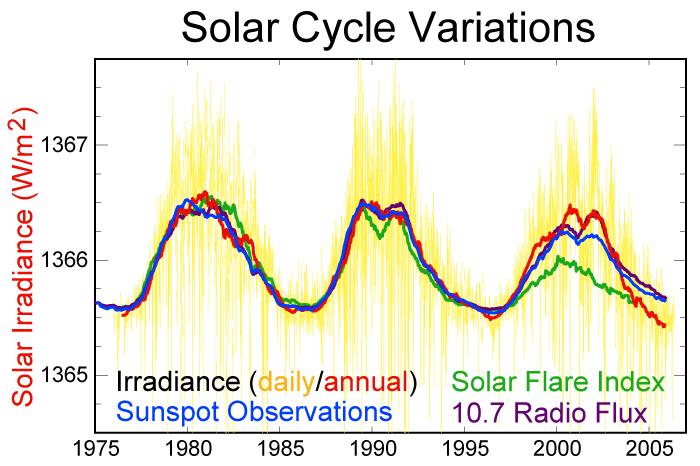
A similar but less powerful short-term influence is the phase of the solar cycle:

So giving people a year or two to process news stories about temperature records, extreme weather, ice cover losses and the like, we might expect to see the levels of concern rising in 1999-2000 after the big El Nino, with a rise starting in 2004-2005 related to the second large recent El Nino, with concern falling in 2009-2010, related to a La Nina event.
The phase of the solar cycle would make the peak in concern from 1998-2002 slightly higher, while the lower solar activity after that, as well as the lack of a similarly intense El Nino event, could be expected to make the peaks of concern lower, and the troughs deeper. In late 2011 we saw the next solar cycle finally start to wake up, but this will not have had a big impact yet.
So how did we do? Here's the gallup polling on concern for global warming:
 Not bad. We don't see the brief 2009 El Nino in the data, but it may be too early (the polling stops in May 2011), or it may be the rapid return to La Nina conditions blunted the effect.
Of course, this is all fun and games with graphs, and if we were attaching any seriousness to it it would come dangerously close to mathdurbation. It's just as easy to come up with a different correlation, for example:
Hypothesis: Americans care about global warming only when they are not much more worried about the economy:

When people felt relatively better, in 2008, concern about global warming was high. When economic worry spiked in 2009, concern about global warming fell. The slight increase in economic confidence recently may show up in 2012's climate polling, especially if the economy continues its still painful slow but accelerating recovery.
Should we expect these short-term reactions to subside as the long-term warming continues to push the earth's climate further out of the Holocene range? Unfortunately, we cannot assume that. Gradual changes and shifts over time are difficult to perceive. This is often described via the (apocryphal) anecdote of the frog placed in lukewarm water that is slowly boiled alive. People rapidly normalize their present experiences, unless there is a readily identifiable shift. The gradual erosion of my paycheck by inflation is not as striking as being swindled out of some portion of my savings, even if they cost me the same amount of money. That is one reason we as a society are prepared to invest huge amounts in speculative measures to reduce tiny risks (dying in a terrorist attack, for example) but not, as yet, to invest significant amounts of money, time, or even attention to the overwhelming likelihood of the less vividly imagined but far more globally destructive process of climate change.
Hence we predict their level of concern about global warming will vary quite a bit with the short-term flucuations in warming, despite the strong, persistent long-term trend.
The most important driver of temperature variability, in the short term, in ENSO (El Ninos and La Ninas):

A similar but less powerful short-term influence is the phase of the solar cycle:
So giving people a year or two to process news stories about temperature records, extreme weather, ice cover losses and the like, we might expect to see the levels of concern rising in 1999-2000 after the big El Nino, with a rise starting in 2004-2005 related to the second large recent El Nino, with concern falling in 2009-2010, related to a La Nina event.
The phase of the solar cycle would make the peak in concern from 1998-2002 slightly higher, while the lower solar activity after that, as well as the lack of a similarly intense El Nino event, could be expected to make the peaks of concern lower, and the troughs deeper. In late 2011 we saw the next solar cycle finally start to wake up, but this will not have had a big impact yet.
So how did we do? Here's the gallup polling on concern for global warming:

Of course, this is all fun and games with graphs, and if we were attaching any seriousness to it it would come dangerously close to mathdurbation. It's just as easy to come up with a different correlation, for example:
Hypothesis: Americans care about global warming only when they are not much more worried about the economy:

Should we expect these short-term reactions to subside as the long-term warming continues to push the earth's climate further out of the Holocene range? Unfortunately, we cannot assume that. Gradual changes and shifts over time are difficult to perceive. This is often described via the (apocryphal) anecdote of the frog placed in lukewarm water that is slowly boiled alive. People rapidly normalize their present experiences, unless there is a readily identifiable shift. The gradual erosion of my paycheck by inflation is not as striking as being swindled out of some portion of my savings, even if they cost me the same amount of money. That is one reason we as a society are prepared to invest huge amounts in speculative measures to reduce tiny risks (dying in a terrorist attack, for example) but not, as yet, to invest significant amounts of money, time, or even attention to the overwhelming likelihood of the less vividly imagined but far more globally destructive process of climate change.


