Showing posts with label lukewarmers. Show all posts

Thursday, May 5, 2016

SteveF makes a hash of climate sensitivity; I propose a solution

-->


Over at the Blackboard they are hawking a “heat balance based empirical estimate of climate sensitivity” which delightfully uses the IPCC's own numbers to show that climate sensitivity has got to be low!!! OMG!!! 
I will show how the IPCC AR5 estimate of human forcing (and its uncertainty) leads to an empirical probability density function for climate sensitivity with relatively “long tail”, but with a most probable and median values near the low end of the IPCC ‘likely range’ of 1.5C to 4.5C per doubling.
And how is Steve going to do that? Well, he's going to give us both barrels of the lukewarmer shotgun, oversimplification and argument from incredulity.

Let's leave aside for today the argument from incredulity (in which his own method produces a fat tail of dangerously high climate sensitivities, and he says, basically, "but that can't be true, because hand-waving") and look at the oversimplification at the heart of SteveF's method for estimating climate sensitivity.
We can translate any net forcing value to a corresponding estimate of effective climate sensitivity via a simple heat balance if:
1) We know how much the average surface temperature has warmed since the start of significant human forcing.
2) We assume how much of that warming has been due to human forcing (as opposed to natural variation).
3) We know how much of the net forcing is being currently accumulated on Earth as added heat.
The Effective Sensitivity, in degrees per watt per sq meter, is given by:
ES = ΔT/(F – A)      (eq. 1)
That is fairly close to true, leaving aside changes in the albedo of the earth over time, and problems with taking the average temperature, which I discuss below. The chief problem is that he doesn't know any of those things with sufficient accuracy to constrain climate sensitivity in any meaningful way.

Climate scientists who do actual work with the climate are doing a fine job of reducing the uncertainty of these numbers, but in every case, the opening move is always to average available measurements over a period of time. But a heat balance model by definition requires accurate accounting of how much heat is coming in and how much is going out, and those numbers are changing over time.

How much has the average surface temperature warmed since the start of significant anthropogenic forcing? Right now, the answer is about 1.5C (not 0.9C, as Steve estimates). El Nino will subside and that number will (temporarily) fall, but that is beside the point: if you are using present-day forcings, then you have to use present-day temperatures.

The same goes for ocean heat uptake: if you are going to compare that to surface temperatures, you need to know what the uptake was at the moment when you took values for the forcings and the total warming. That's tricky, because we know ocean heat uptake varies significantly over time. It's lower than usual right now, because of El Nino, but how low?

If you are going to use ocean heat uptake averaged over X number of years (which to my understanding is basically mandatory to get any kind of an accurate number), then you also have to average the net forcing over those same years, and you also have to average the warming compared to preindustrial over those years.

But simple averaging still will not work, because heat loss varies with temperature to the fourth power. An average warming of +0.9C could reflect a steadily linear increase, or a long period of flat temperatures followed by a prolonged spike in temps to +4C. The latter will radiate more heat into space than the former. The average temperature is the same, but the heat balance is not the same. So we had better stick to instants of time if this method is to have any hope of delivering accurate results.

To reiterate: for an estimate of heat balance to give you climate sensitivity, you need the heat balance AT THAT MOMENT, not averaged over time. The amount of heat the oceans were absorbing ten or twenty years ago can only be compared to the temperature ten or twenty years ago, and the net forcing of ten or twenty years ago. If you are comparing the average heat uptake by the oceans since 1993 with the last 13 years of temperatures and forcing estimates from a moment in 2010, you are comparing apples and oranges. All of these things change over time, and to use the relationship between them to estimate climate sensitivity, only contemporaneous estimates can hope to be valid.

Consider a building occupied by an unknown number of people. You want to know how many people are inside. If you know how many people when in the building at midnight Tuesday, how many entered on Wednesday, and how many left on Wednesday, you know how many are in the building when Thursday dawns (assuming no births or deaths, nerds.)

On the other hand, knowing how many people started in the building, the number who left the building on Sunday, and the average number of people entering the building each day over the last year, doesn’t help you a hell of a lot. But this is what Steve has tried to do with his heat balance based empirical estimate of climate sensitivity.”

For this to work, do you need to use the present moment? No, you do not. In fact, there may be excellent reasons to use some instant in the past, such as the benefit of hindsight in estimating warming or forcings or the presence of an exceptional event (like a large volcanic eruption) that lets you really test some of your theories about forcings and heat balance and temperature.

In other words, you need a series of “moments,” for which you estimate the levels of various forcings and the heat uptake of the oceans. Then you can predict what the temperature “should” be, based upon the inputs, and compare it to what the temperature was (and is.)

Since the act of resolving the state of the climate in each of these moments is one fairly powerful method of determining the inputs for the next “moment” (and whether it can do so, compared to historical observations, is a good test of how accurate it is) we might want to calculate a series of moments, each derived from the one before, based upon our best estimates of forcings, ocean heat uptake, and the like. 

Since everything we said about average temperatures over time could also be said about temperatures averaged over the global surface (i.e., that different local temperatures can yield the same average, but different heat loss) we had better break the earth into boxes, or "cells" and calculate temperature, heat uptake, heat loss, etc., for each cell.

Not all the same color
 

With these modest adjustments the calculations will have a much better chance of doing what Steve wants them to do, which is to take measurements of the climate system, account for ocean heat storage, and estimate climate sensitivity.

I call it a climate model. Trademark pending.

Wednesday, January 14, 2015

For Whom the Bell Tols: Hot Emotion, Denier Logic in Tol's Latest Screed

Hey, look, Richard Tol knows global warming is real!
It means more or less rain, snow, wind, and clouds in various places. It means different outcomes for plants, whether direct or, since plants compete for resources, indirect. It means changes for the animals that eat those plants. And this includes changes for everything that hitches a ride on those plants and animals, and hence changes for all sorts of pathogens. Nature, agriculture, forestry, and health will all be different in the future. The seas will rise as water expands and glacial ice melts, affecting coastlines and everyone and everything that resides there. Water supplies will be affected by changing rainfall patterns, but water demand will also be altered by changing temperatures. Energy demands will change, too; there may be less need to heat houses in winter and perhaps greater need to cool them in summer. Traffic, transport, building, recreation, and tourism, too, will all feel the impact of a changing climate.
 Unfortunately, his ability to think rationally about what that means is, well, disappointing:
For some, the mere fact of these impacts is reason enough for governments, businesses, and individuals to exert themselves to reduce greenhouse gases to minimize the change. That is strange logic, however. Change, after all, can be for the better or the worse, and at any rate it is inevitable; there has never been a lengthy period of climate stasis.
There are multiple levels of facepalm committed here. None are entirely new (the boring repetitive nature of climate denier is one of the reasons you do not see more debunkings here) but they are startling from the mouth of a once-respected economist.

You have the notion that climate change is no big deal because "climate is always changing." We might equally argue that being shot in the head is no big deal, because the composition of our bodies is always changing. In other words, it's breathtaking stupid know-nothingism trying to pass itself off as judiciousness.

Of course if changes in temperature of the magnitude we see unfolding today were common in human history, Tol might have a hint of a glimmering of a point here. But in fact, as he well knows, the entirety of recorded human history has taken place with the assistance of an 8,000-year period of highly stable climatic conditions -- what one might call a lengthy period of climate stasis.

Eight thousand years of flat
 So in fact, "Change happens" is meaningless as far as it is accurate, and inaccurate as far is it is meaningful.

But that trope is sagacity itself next to Tol's next fallacy:

Just as there is no logical or scientific basis for thinking that climate change is new, there is no self-evident reason to assume that the climate of the past is “better” than the climate of the future. With just as little logic, we might assume that women’s rights, health care, or education were necessarily better in the past.
 Are we here seeing Tol preparing to abandon an unfulfilling career as an economist, and embark on a mid-life career shift to Platonic philosopher? Because it is philosophers who sit in their studies and worry themselves about self-evident truths derived from pure logic alone. Scientists, even of the dismal sort, are expected to look outside into the world from time to time.

What I can't get over about this essay is how much ignorance it express of basic economic principles, principles that Tol, as a trained and extensively published economist, should know in the marrow of his bones.

Do I exaggerate? Well, economic concepts do not get a lot simpler than sunk capital. Sunk capital means that once you've put your money into certain things, you can't get it back. It follows from that, as even a bright eight-year-old could grasp, that rapid changes in the environment pose a risk to sunk capital.

Tol's claim that the future of the climate is just as likely to be good for humans as it is bad would be applicable to the first human beings setting foot on a new world, presuming they knew nothing at all about it to begin with (an analogy I've explored before.)

If you ask the (ludicrously unprepared) space colonists if they would like it a degree warmer or a degree cooler, they have no rational reason to care. It might be better a little warmer or a little cooler, then again, it might be completely uninhabitable either way.

But of course this is not remotely the situation we are in. Besides the fact that we know we can exist in this climate, and we don't know if we can exist, without a horrific die-off, in a world 3C or 4C or 6C degrees warmer, there is the additional problem, which I alluded to above, that we have trillions or dollars in sunk capital investments optimized for this climate, not a radically different one.

There is no rational question as to whether a sea level rise of 5m is "better" for humans, because we know that vast amounts of capital and high-value property would be destroyed. There is no rational question as to whether a +5C world would be better for farms; at best, some new areas may be opened up to agricultural productive, but the existing farms, and the existing communities they support, will suffer horrific (and expensive) harm.

So the "Hey! Rapid radical climate change could just as easily be to something better!" argument makes no sense at all. And the nonsensical nature of the argument is emphasized with odd and completely irrational comparisons to deliberate progressive reforms: "With just as little logic, we might assume that women’s rights, health care, or education were necessarily better in the past"

Now the deliberate change of social rules and government policies to achieve a benefit is compared directly with a massive, unintended set of changes to the earth. What?
The climate of the 21st century may well be unprecedented in the history of human civilization; the number of people living in countries with free and fair elections is unprecedented, too. So what? “Unprecedented” is not a synonym for “bad.”
Does Tol perhaps think that he will appeal to the left with a facile comparison of environmental disaster to the progress of human liberty? Because make no mistake, he is raving. Biological arrangements aren't comparable to social structures. In biological arrangements, unprecedented is bad. If the doctor comes out of your mother's surgery to tell you that they found something "unprecedented," do you think you're about to hear something good about her prognosis?

Rapidly acidifying the oceans versus Thomas Paine publishing Common Sense. Expanding ranges of deadly tropical diseases versus the Voting Rights Act. Are they different? Are they the same? Is Tol seriously arguing this?

He goes on, invoking the shibboleth of "cheap energy" ("Cheap energy fueled the industrial revolution, and lack of access to reliable energy is one factor holding back economic growth in most developing countries" but without offering any evidence for either assertion.) Fundamentally, though, this essay represents a step away from Tol's lukewarmism and towards simple climate denial. For years he's published studies of the costs of climate change, studies which consistently found much lower costs than those of his peers. But fallacies like the above go beyond that. Now he seems to be plunging into outright blog scientist logic and advance-stage Curryism.

Wednesday, March 20, 2013

next, please

Stop the presses, lose your Twitter password, push over windmills with bulldozers, smash your rooftop solar panels with a tire iron. For Joe Nocera has found, at long last "A Real Carbon Solution." (Spoiler alert: It's coal!!!).

The specifics are quite interesting and hopeful. They're building a CCS (carbon capture and storage) plant in Texas. Texas being Texas, their "storage" plan, besides making some fertilizer, is to use the injected CO2 to extract more oil from dying wells.

Joe is excited by this. Finally, "Environmentalists could call off their war against the coal industry, thus saving tens of thousands of jobs." 

That's a huge relief. War, as we know, is hell. I am particularly anxious for the war to be over because, as you may know, I impregnated a coal miner during an extended tour, and I am now trying to get her and my child out of the apocalyptic hellscape that is the West Virginia countryside, but it's hard to get seats on the last chopper out of Charleston.

Mr. Nocera's raptures are of a piece with his, and his fellow travellers', determination to do nothing about climate change. Or really, not so much the determination to do nothing as the need to justify their "war" (to borrow Mr. Nocera's overwrought analogy) on the evil environmentalists and their job-destroying ways.

Nocera recognizes that the status quo, that of thousands of "climate-destroying coal-fired plants," is destructive and wrong. But he has staked out a prominent position as a strong advocate for "climate-destroying" fossil fuel burning. To his credit, he does not pretend that CO2 emissions do not cause climate change or that climate change is not dangerous and destructive. But that leaves him with a couple of options, one more palatable than the other:

  1.  1. He could admitt that yes, it has been evident for some time that we need to stop burning coal ASAP. Those nasty environmentalists were right, and Joe Nocera and friends were wrong.
  2. A miraculous new technology is going to save us! Joe Nocera and friends were right to eschew useless pain as we await the un-midwifed, self-funded, market-driven coal-burning "Real Carbon Solution"!
Let's hope this new experiment with CCS proves to be everything Nocera thinks it is, and more. The cynic in me expects that it, like most innovations, will take longer to build, cost more to operate, and be less perfectly effective than planned. The cynic would similarly like to place a small bet that Nocera and his ilk will soon after find a new miracle solution, which will again obviate in their minds the need to undertake collective political action to cut our emission, wunderwaffes notwithstanding.

Thursday, August 2, 2012

Do you know what this means?

Michael Mann on Richard Muller, in an observation with heady implications:

"Muller's announcement last year that the Earth is indeed warming brought him up to date w/ where the scientific community was in the 1980s. His announcement this week that the warming can only be explained by human influences, brings him up to date with where the science was in the mid 1990s."
Obviously Muller is a scientific genius -- his understanding has advanced by an entire decade in just under a year.

We should check back with him in 2016 when, by the iron laws of linear extrapolation, his science will be the equivalent of the consensus of the 2030s.

Sunday, July 8, 2012

Threats against climate scientists: Phil Jones' inbox

The looney right did this up themselves, as a "joke."


Glenn Tamblyn at Skeptical Science flags the University of East Anglia's release of threats and hate mail sent to Phil Jones. PDF here, examples below:

1. “Subject: Kill yourself scum
Fuck you for your lies and deceit. You deserve to die. And if you don’t take your own life, I fucking hope somebody does it for you.”

2. “Your children and family will know because we know where you live. expect us at your door to say hello ^\-(”

3. “Faggots like you will be dealt with, as now people know what you need and will beat the living shit out of you every time you show your socialist ass in public. I’d kill you in a second if given the chance. . . . I’m now going to take physical action against you. You deserve it you fucking prick!”

4. "If anyone of those perverted assholes ever steps within the boundries of the U.S., they decimated [sic]. We have 2nd amendment [sic] and you as a stupid Briton probably don't know what that means. We have a right to bear arms and these perverted assholes will be wasted. We will have plans for you as well. If you bring your family all the merrier.

You fuck prick! [Sic.] Britain needs to kill these scam artist [sic]."


 5. "Keep this in mind. Not all will tolerate your thieving lying ways when it impacts their family.

Beware of retribution upon yours.

Someone some where [sic] will hurt you down."

6. "wanker you wanker you nead [sic] to be killed"

7. "i [sic] hope you fuckers die slowly and painfully.

you are the scum of the earth and should be put in front of a firing squad."

8. "update your google search, it should say, widely known group of cocksuckers and liars that tried to enslave the world through a huge scam perpetrated by a bunck of fuckin cocksuckers, if was i charge [sic] you would all be lined up againt [sic] a wall and shot."
----------------------

So what is the significance of this, besides telling us something important about the character about a certain group of "climate skeptics"?

I think it puts the question to people like Judith Curry and Roy Spencer, who still have a foot in the world of science, but derive much of their hit counts and claim to public notice from "climate skeptics" who regularly air similar paranoid ideas and abusive language in their comment threads.

Let me be clear; I am not calling for them to moderate with a heavier hand. What I am saying is that if you put yourself at the head of a mob waving pitchforks and torches, you have some responsibility for the kind of people who take you as an inspiration. I have no hope for people like Anthony Watts, who is merely a "shock jock" of the internet. But I would like to see more grown-up climate deniers and lukewarmers taking pains to isolate and marginalize the violent, paranoid, homophobic and neofacisist elements of their fellow travellers. If they and other vocal opponents of strong mitigation cannot grow up, as a movement, enough to denounce their bigots and terrorists, then they and their movement will be defined as a movement of bigots and terrorists in the public mind, and deserve to be.

The academic that launched a thousand insults.

Earlier posts on threats against climate scientists: 


Coward deniers continue threats
  
UPDATE: Supporting documentation here (h/t Quark Soup).

Tuesday, October 11, 2011

A pseudointellectual "beard" for climate folly


Andrew Sullivan, whose taste in climate pundits remains howlingly bad, highlights an online "philosopher's" pretentious right-wing drivel:
The moralisation approach undermines itself since it frames climate change narrowly in terms of righteousness. Inevitably deliberation about action gets bogged down in an interminable blame-game about what justice requires - who had their industrial revolution first, etc. Furthermore, the moral duties of different actors do not all point the same way: poor country governments have a clear and over-riding moral duty to help their citizens achieve the high quality of life which the West takes for granted, and which is inevitably energy (carbon) intensive. And then there is the practical economics: the world still has lots of coal, especially in the poor world, that can produce electricity at 3c per kwh (which renewables cannot possibly compete with without radical technological breakthroughs, even with the strongest moral rhetoric). No comprehensive global political solution to greenhouse gases is possible. We need to go back and think again.
Sullivan hat tips to "The Philosopher's Beard" under the heading "The Hazardous Moralization Of Climate Change." The link leads you to "The Philosopher's Beard: Mini-essays in philosophy, politics, and economics" and "Ethics and Global Climate Change." Via the latter, the author gives us a memorable demonstration of how to make a pseudointellectual argument:
   
1. Use academic-sounding terms which appear specific and objective, which are in fact vague, subjective, and implicitly derogatory.
The global climate change debate has a lopsided empirical basis - in the economy of nature but not political economy - and this has contributed to a peculiar moralising trajectory.
You would think, from the fact that the central point of the whole essay is to make the case against "moralizing" climate change, that what "moralizing" the debate means would be clearly defined. It never is. If you search the essay for clues, what you get back is a right-winger's cardboard stereotype of a loony green:
" the debate has induced a kind of millennarian meltdown in which otherwise sensible people have lost all sense of proportion and hope"
" Morality concerns strict but simple universal rules that everyone should follow without regard to personal situations or consequences - on the model of laws [When your behavior harms me or vice versa, we typically make laws about that behavior. As a general rule, laws are made "on the model of laws."] On this model, one's carbon footprint is a crime (against the planet presumably) [says who?] which one should feel guilty about and strive to mitigate. As of course are other people's carbon emissions: they deserve to be shamed or otherwise forced into submission by the righteous ones."
" The moralisation approach undermines itself since it frames climate change narrowly in terms of righteousness. Inevitably deliberation about action gets bogged down in an interminable blame-game about what justice requires - who had their industrial revolution first, etc."
" The moralisation approach contrasts with a fuller ethical thinking in which values are considered and debated explicitly and openly. Righteousness simplifies but it doesn't try to understand."
What the author is attempting to pass off as an objective characteristic of the "climate debate" proves to be just standard climate denier ad hominem – greens are humorless scolds, socialist-secular anticolonialist navel-gazers, self-righteous Chicken Littles undergoing a "millennarian meltdown" in which they "have lost all sense of proportion and hope."
    
He gives no evidence for this slander, merely repeating it in various forms for most of the post. That, too, is characteristic of the pseudointellectual argument. When a straightforward torch-waving rabble-rouser like me makes an assertion about something or someone I don't care for, I have to support it with examples, usually providing a quote or two to illustrate what I mean. By couching his conventional right-wing op-ed in terms of "philosophy" the author evades any question of evidence or proof.

2. Lard up the verbiage.
The global climate change debate has a lopsided empirical basis - in the economy of nature but not political economy - and this has contributed to a peculiar moralising trajectory.
In other words, the science of climate change is solid and conclusive. Do you really need to torture that thought into this "global climate change debate has a lopsided empirical basis"? The case for action is not (he asserts) as strong – which becomes " in the economy of nature but not political economy."
     
3. Offer analysis, but deliver politics. 

The Beard gives us one fact – the population of the earth – and then sets out on what is ostensiby a description of the situation, but which is in fact an almost unrecognizable right-wing fantasy world:
In trying to tackle climate change by directly dealing with the causal mechanism of CO2 levels we face an enormous collective action problem - how to persuade 6.7 billion people to adopt the new morality of carbon rationing (and prevent free-riding). Everyone but the most delusional accepts that this is impossible without enormous government coercion (which explains many climate change warriors' antipathy to democratic principles on this point - easier to persuade 200 governments than all those people). However even the government coercion approach fails - see the failures of every inter-governmental treaty, from Kyoto to Copenhagen - and the reasons are obvious.
Notice how easily we slip into the conventional internet libertarian's assumptions about the world. Government action has become "enormous government coercion" (is a carbon tax more coercive than a property tax or a sales tax, or does he believe all taxation and regulation to be "enormous government coercion"? He doesn't say, but one suspects.) The people or the right side of that "lopsided empirical basis" have become "climate change warriors" – because while denying climate change "is just silly" proposing that we act on what we know is the moral equivalent of making war on our fellow citizens. And then we have this gem of tortured logic: "which explains many climate change warriors' antipathy to democratic principles on this point - easier to persuade 200 governments than all those people."
   
Lobbying the government to act is now undemocratic. International treaties are undemocratic, too. (We are allowed to persuade people individually, provided we don't make them feel bad by "moralising" the issue.) One wonders how democracy ever recovered from treaties that banned ozone-depleting chemicals, or the use of chemical and biological weapons, or child labor, or those that created trade agreements.
    
This is all stuff that would have readers at mises.org nodding along, but everybody else should be confused and startled by a definition of democratic principles that precludes trying to convince your fellow citizens to agree to collective actions for the benefit of all.

4. Include lots of straw men.

I lost count at ten or so. Here's a particularly egregious example:
No-one emits carbon deliberately 'for fun', but rather we engage in activities which are more or less valuable to us - such as flying across the Atlantic to visit grandparents - which happen to emit carbon as a byproduct. To ignore the value of these human activities and see them instead as moral crimes is to do a violence to the very humanness of the lives (including those of future generations) that we are supposed to be so concerned about preserving.
Who "ignore[s] the value of these human activities"? In what way does saying an action has a consequence, and its utility must be evaluated in light of that, imply that the activity has no value? It does not. He is conjuring up an absurd parody of an eco-warrior scold, while ignoring the very simple and pragmatic point that we have to weigh the unintended consequences of our actions in deciding what we will do.

We should be grateful "Beard" wasn't around when doctors discovered that the cholera epidemics of London were spreading via polluted water. Imagine the screed:
No-one uses water pumps "for fun," but rather we engage in activities which are more or less valuable to us - such as cooking dinner or washing clothes - which happen to spread disease as a byproduct. To ignore the value of these human activities and see them instead as moral crimes is to do a violence to the very humanness of the lives (including those of future generations) that we are supposed to be so concerned about preserving.
The whole exercise is so transparent, and the underlying political spin so obvious, that one wonder if the title of the blog "The Philosopher's Beard" carries a hidden meaning: if the author, aware that his proclivities for hard, grinding, right-winger-on-libertarian action are less than comfortable to a mainstream audience, and has chosen to equip his online persona accordingly with a fictitious air of academic enquiry – "The Philosopher's Beard" being just that – a "beard" of airy intellectualism for a closeted right-wing partisan.


Thursday, October 6, 2011

We have the tech to cut emissions by 85%. Your move, Roger.

Even as Roger Pielke Jr was decrying the folly (as implied by an updated version of the climate wedge analysis) of thinking we have the technology to reduce emissions today, eleven engineering organizations begged to differ:

The technology needed to cut the world’s greenhouse gas emissions by 85% by 2050 already exists, according to a joint statement by eleven of the world’s largest engineering organisations.
The statement was presented on Friday 23 September to the South African Deputy High Commissioner ahead of December’s COP17 climate change talks in Durban.
The statement says that generating electricity from wind, waves and the sun, growing biofuels sustainably, zero emissions transport, low carbon buildings and energy efficiency technologies have all been demonstrated.  . . .
“We are now overdue for government commitment, with ambitious, concrete emissions targets that give the right signals to industry, so they can be rolled out on a global scale.”
The politics of emissions cuts are lagging behind the both the science and the technology. Professor Brian Schmidt, a 2011 winner of the Nobel Prize for Physics, is pessimistic:

“I think the evidence is quite strong that change is happening,” he said. “The science behind climate change predicts there should be a little change right now but in future, the prediction is it will be much more. I think we are going to do that experiment, so in 20 years from now we will see how good those models are.
It would be hard to bet against that prediction, politics-wise, but it is not inevitable. As the engineers are telling us, we have a choice. We have the technology to do the right thing. And when the right thing is politically unpopular, the thing we have to do is work ceaselessly to change the political calculation. Waiting for the public doesn't work: we are the public, and we can talk to the public, and persuade the public. How popular was abolition in the early days? Or women's suffrage? Or Prohibition? So let's not fall into the fallacy of taking the temperature of public opinion while we are trying to change it for the better.

The Future Climate 2 conference took place at the Institution of Mechanical Engineers in London on the 22-23 September 2011. The eleven engineering institutions that signed up to the joint statement were:
o   The Institution of Mechanical Engineers (IMechE) (UK)
o   The Institution of Engineers (India)
o   The Association of German Engineers (VDI) (Germany)
o   The Japanese Society of Mechanical Engineers (JSME) (Japan)
o   The Association of Professional Engineers, Scientists and Managers (APESMA) (Australia)
o   The Danish Society of Engineers (IDA) (Denmark)
o   The Civil Engineer Organisation of Honduras (CICH) (Honduras)
o   The Swedish Association of Graduate Engineers (Sweden)
o   The Norwegian Society of Engineers (NITO) (Norway)
o   The Finnish Association of Graduate Engineers (TEK) (Finland)
o   The Union of Professional Engineers (UIL) (Finland)

Sunday, October 2, 2011

Judith Curry gets risk backwards


A haymaker of folly:
With regards to climate change, those who are warning of the dangers need to actually make a case that a warming of several degrees is actually a bad thing.  Tying this warming to extreme weather events seems to be the most straightforward way to do this, but the science of doing this is nowhere near robust at this point.
Minor error first: if you want to make the case that a multiple-degree rise is a bad thing, the most straightforward thing to point to is the multiple-meter sea level rise that commits us to. It's not the worst thing, but it's simple inarguable physics and unquestionable harmful. Our coasts and bays are the most densely populated parts of the earth, and heavily developed. To lose them to the sea will be dangerous and expensive.

Curry also edges by things like ocean acidification, crop failures, the spread of tropical diseases, and the burden of direct heat stress on human beings, along with the extinction of 20% to 50% of all the species currently alive on earth.

Major error: Implementing a radical change in the earth's climate is safe until proven otherwise. We looked at this fallacy at IT before:

Forget about the specifics, and imagine a spaceship.

This ship includes the entire population of humanity -- one billion people, say (never mind what happened to the old Earth -- Death Star got it, or something). And it is going to travel to one and only one planet. That planet will now be humanity's new home. And you know literally nothing about it (scenario one).

Suppose the ship's computer informs the crew that the climate on New Earth is changing, and unless you expend significant resources to prevent it (deploying solar mirrors in advance of your arrival, or what have you) the temperature will be 3C warmer when you arrive.

What is your response? Clearly, you don't care. The planet may be just three degrees to cold to support life now. Or it might be an uninhabitable volcanic hell, and 3C more will be nothing. Warming could make things better, or worse, or make no difference. With no way to know, you aren't going to spend resources to try and control the climate.

This is the circumstance some pseudoskeptics and "lukewarmers" feel we are in. We don't know what the effects of warming will be, they could be good or bad, so it would be folly to decarbonize our economy on that basis.

But scenario one is unrealistic; we don't know nothing about this warming planet. We know a large number of us are living on it and have been for some time. So change the scenario a little bit. Suppose we know exactly one thing about New Earth; we know that it will support one billion human lives. Now, same question. Three degrees warmer, or expend the resources to prevent it.

This is a totally different calculation. You know the planet's climate will support human civilization, that the people on the spaceship can live there; you do not know if a new, warmer climate would. If you have a climate that will support human civilization on the one and only planet on which humans can live, you would be uncommonly stupid to do anything to significantly alter that climate. And the less you knew or could predict about the response of that climate, the more stupid it would be.
The last 8,000 years, coinciding with the entirety of recorded history, have enjoyed a remarkably stable climate:


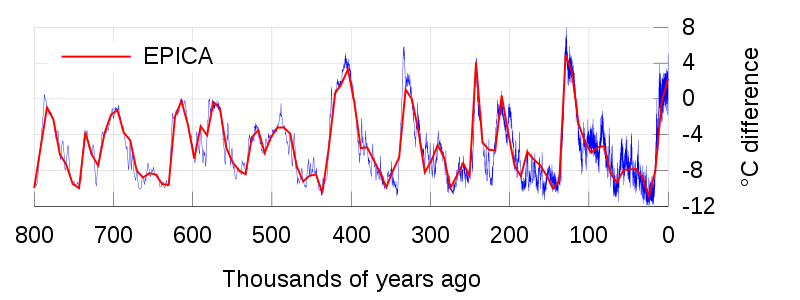
The last 800,000 years have seen a number of ice ages and warming periods (interglacials), some of which were slightly warmer than the present:

Several degrees of warming takes us right off this graph, too. Homo sapiens evolved in Africa 200,000 years ago. If you are middle-aged or younger and in fairly good health, you will likely live to see conditions warmer than any ever before seen by human beings. And the issue is not, "Could this possibly be safe?" but rather "Can we assume this to be safe until such time as we can accurately predict the response of the climate and human civilization to this unprecedented event?

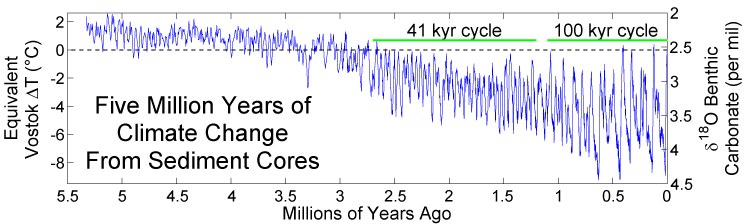
We still haven't gone back far enough.

 We are less than +2C from the warmest temperatures seen on earth in five and a half million years. That's prior to the time, about three million years ago, when apes began to walk upright.

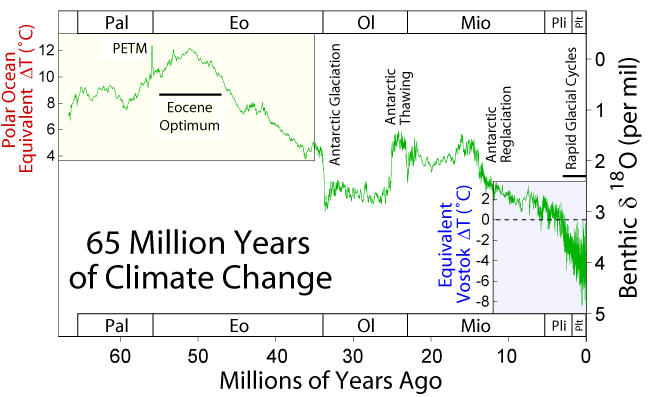
How much further back we can go depends on what range of temperature rise you consider "several degrees." If you consider +8C a possibility, and the AR4 would suggest that it is, you are looking at conditions warmer than any seen on earth in tens of millions of years:


With these changes you are not just changing human living conditions: you are transforming animal and plant ecosystems many times faster than evolution can transform them to cope. You place the earth on a path of mass extinction, from which it will recover, but human civilization as we know it may not. Remember: this unprecedented climate needs to be able to provide food and shelter for nine billion people.

Climate scientists, economists, physicians, biologists and ecologists are all actively researching what the warmer world will means, what effects this radical change will bring. That is their job, but it should not be confused with the need to prove that radically changing the earth's climate without fully understanding the consequences is unsafe. It is unsafe, and stupid, and at the risk of repeating myself, the less you we or can predict about the response of that climate, the more stupid it is.

Wednesday, September 28, 2011

Pielke Jr: Greens hate innovation

The lesser Pielke has a new post reiterating his dislike of of the "climate wedge" analysis, which says, somewhat incontestably one might presume, that stablizing greenhouse gas emissions will require a number of different tactics, which some people like to group together in terms of "wedges" of reduced emissions.

It takes a while for Pielke to get to the point of what he has against wedges, but he does give us this sweet graphic:
Apparently if you disagree with Pielke after he has already said you are wrong, you are a zombie. With ice cream. So what is the wedge analysts' terrible mistake?
The focus on deployment, often to derision if not the exclusion of the need for innovation, is still central to environmental messaging, even as the math of emissions reductions would seem obvious and the policy centerpiece of DTW -- cap-and-trade -- has failed comprehensively.
I'm sorry, what? Environmentalists don't like innovation? That's ridiculous. Environmentalists, like the rest of the public, love the idea of green tech, love to highlight the next newest best solar panel/wind turbine/tidal energy station. And what does that have to do with climate wedges?

One might think that the modern environmental movement is adept enough at simple math to accept this message and thus proceed to advocate policies consistent with our lack of technological capabilities, such as calling for a much greater commitment to innovation. While some have, of course, the loudest, most well funded and arguably most influential parts of the movement have strenuously resisted the notion that we do not have the technology needed to rapidly decarbonize our economy, preferring to hold on to the myth that -- in the words of the original "wedges" paper -- "Humanity can solve the carbon and climate problem in the first half of this century simply by scaling up what we already know how to do."
 So what Pielke is really mad about is the notion that we can start to decarbonize now, today, as opposed to his preferred approach -- waiting and waiting on a magical technological fix whose sheer low-cost high-yield awesomeness will cause it to literally vanish from the Popular Mechanics cover struggling to contain it and materialize in the world.

The climate "wedge" approach gets caught in the crossfire here for no other reason than the fact that by breaking the problem into eight or ten or twenty "wedges," you pre-refute the common "skeptic" counterargument that "Well, that won't be enough [by itself] to solve the problem." Wedge analysis highlights what we can do today by combining the tools and technology we have rather than waiting for a single technological "silver bullet" (which, if we find one at some point, will be a more than welcome development.)

What makes Pielke just furious is the notion that we have the tools to start solving this problem right now, if we chose to use them. That if France get 75% of its energy from nuclear power, nuclear power could provide more of the world's energy. That if Japan gets twice as much economic output from a unit of energy as the US, that a Japan-like commitment to energy efficiency could cut emissions. That solar and wind power costs are falling and while not "competitive" with coal or natural gas, are already cheap enough for widespread deployment without bankrupting ourselves. And so on.

The beauty of a carbon tax is that you never have to chose between a dollar for research and innovation and a dollar to implement the solution you already have. You price the negative externality of carbon correctly, and you let the market make that call. Regardless, Pielke is not being honest with himself here. When he says he has a problem with greens' attitude towards new technology, real issue is their rejection of his rationalization for procrastination -- some day the technology will save us, but not yet, Lord, not yet.

A little Philip Larkin for your Tuesday, Dr. Pielke:


Next, Please 
Always too eager for the future, we
Pick up bad habits of expectancy.
Something is always approaching; every day
Till then we say,

Watching from a bluff the tiny, clear
Sparkling armada of promises draw near.
How slow they are! And how much time they waste,
Refusing to make haste!

Yet still they leave us holding wretched stalks
Of disappointment, for, though nothing balks
Each big approach, leaning with brasswork prinked,
Each rope distinct,

Flagged, and the figurehead wit golden tits
Arching our way, it never anchors; it's
No sooner present than it turns to past.
Right to the last

We think each one will heave to and unload
All good into our lives, all we are owed
For waiting so devoutly and so long.
But we are wrong:

Only one ship is seeking us, a black-
Sailed unfamiliar, towing at her back
A huge and birdless silence. In her wake
No waters breed or break.

Sunday, September 25, 2011

Roy Spencer: the unacknowledged legislator of the world

This quote has been making the rounds, but for anyone who missed it:

Roy Spencer: “I view my job a little like a legislator, supported by the taxpayer, to protect the interests of the taxpayer and to minimize the role of government.”

Seriously. He said that. He doesn't even deny saying it. And is apparently deaf to the irony.
This the guy who raged:

Politicians formed the IPCC over 20 years ago with an endgame in mind: to regulate CO2 emissions. I know, because I witnessed some of the behind-the-scenes planning. It is not a scientific organization. It was organized to use the government-funded scientific research establishment to achieve policy goals.
Now, that’s not necessarily a bad thing. But when they are portrayed as representing unbiased science, that IS a bad thing.


The most vocal climate scientists defending the IPCC have lost their objectivity. . . .
ClimateGate doesn’t prove their science is wrong…but it does reveal their bias.
 This is a classic terrorist/freedom fighter cognitive blind spot. Spencer sees his mission in science as defeating the campaign for certain policy choices . . . specifically emissions cuts. Yet he does not see his own explicit political goals as making him "biased." They did it first! You are hysterical, he is passionate! Roy destroyed scientific objectivity in order to save it!

"I don't have the votes. Time for a filibuster!"

It's a common cognitive glitch, but it is still surprising to see it developed to the point at which he would be denouncing scientists for (supposedly) trying to "achieve policy goals" and then be calling himself "a little like a legislator."

"Seriously, dude, you went too far."
Nothing says scientists can't or shouldn't participate in the public debate. They are citizens, and the democratic ethos, since Athens, has held that whatever your day job, you have the right, and sometimes the responsibility, to be part of the discussion. But you shouldn't see that as your job, "supported by the taxpayer." The only people paid by the taxpayer to be policy advocates are politicians. Roy Spencer is paid by the taxpayer to do science. One wishes he would work a little harder at that, even at the expense of his legislative ambitions.

Thursday, September 22, 2011

Jared Diamond dismantles Lynas: How to politely devastate a "skeptic" loon

Passersby were astonished by the unusually large amount of blood. Diamond sets right to work:

 Among Hunt’s and Lipo’s main conclusions, they say that Easter Island was deforested by rats, not by Polynesian settlers; that settlement was not until AD 1200 rather than earlier as widely assumed; that the tall stone statues of up to 90 tons were not transported horizontally, but were “walked” upright; that the collapse of Easter society was due to European impact, rather than to impacts of the settlers themselves before European arrival; and that the view of Easter society’s collapse as a self-inflicted ecological catastrophe is flawed. Unfortunately, the web postings don’t recognize the compelling reasons why Hunt’s and Lipo’s conclusions are considered transparently wrong by essentially all other archaeologists with active programs on Easter Island.
A "skeptic" with no experience of a given area of scholarship uncritically embracing a single source that claims to overturn all that went before, despite being regarded as  "transparently wrong" by the vast majority of qualified experts? Come on, that would never happen.

The initial reason for positing a role of rats in Easter’s deforestation was that some preserved seeds of Easter’s extinct palm tree, found in caves, show marks of gnawing by rats; and that a study of Hawaii attributed deforestation there to rats. However, evidence that rats played no significant role in Easter’s deforestation includes the following.  Rats occur not only on Easter but also on every other one of the hundreds of other Polynesian islands, most of which nevertheless did not end up deforested.  Over 90% of preserved palm seeds outside caves were not gnawed by rats.  Easter’s forest consisted not only of the palm but also of at least two dozen other species of trees and other plants, all of which also became extinct on Easter although most of them are not known to suffer seed predation by rats and continue to exist in the presence of rats on other Polynesian islands.
So we have "skeptics" who spin an entire narrative out of a single fact: there are some seeds in some caves, some of which were gnawed by rats. They then ignore the larger body of evidence and neglect the basic obligation of any scientist presenting a hypothesis to account for all the facts. Have we seen something like this somewhere before?

How could tall 90-ton statues have been dragged over unpaved hilly terrain?  The only reasonable solution, to avoid their tipping and breaking during transport, is to transport them horizontally and then lever them into an upright position.  Jo Anne Van Tilburg, the leading scholar of Easter statues, who has spent decades cataloging the hundreds of statues, carried out an experiment in which Easter Islanders demonstrated for her their horizontal transport and levering-up of a model statue.  But Hunt and Lipo claim that statues were transported vertically.  This seems an implausible recipe for disaster.  Imagine it yourself: if you were told to transport a 90-ton statue 33 feet high over a dirt road, why would you risk tipping and breaking it by transporting it vertically with all its weight concentrated on its small base, rather than avoiding the risk of tipping by laying it flat and distributing its weight over its entire length?
 Hunt and Lipo think that these statues "waddled" -- in all their 33-foot-tall glory -- up and down unpaved hills. As Diamond says, imagine it. But the problem here is not Hunt and Lipo having dumb ideas -- it's people like Lynas and Curry who spread this stuff to their many devoted fans, without any effort to assess critically the claims of the "skeptics."

This underscores that lukewarmism is not and never has been about a particular stance in relation to the science of global warming. Unfortunately, just like its cousin, denialism, it's about a particular attitude and approach to a given field. It's not primarily a set of erroneous conclusions, but an erroneous method motivated by partisanship.

Postscript on Peiser, Lynas' other crappy source: In a statement against interest by Lynas, a statement I don't know whether to praise for its honesty or condemn for its bald admission of indifference to the use of scholarly garbage, Lynas in his own comments basically admits Benny Peiser is a hack:

Actually Peiser’s paper was published in a special edition of E&E which was specifically devoted to taking apart Diamond’s ‘Collapse’ book, so fitted well into that. (I haven’t read any of the rest of it because Oxford University doesn’t subscribe to E&E!) [Memo to Lynas: Oxford is a thousand-year-old world-famous university with tens of thousands of journal subscriptions -- if they don't even carry the journal you are using to form the tentpole of your argument, that is a red flag.] I think the edition was guest edited by Julian Morris and Kendra Okonski – both very much anti-environment activists, latterly with the ‘International Policy Network’ (now defunct I think) and very much in the ‘climate denial’ line. So not great credentials…[No, really?] but that still doesn’t make the paper wrong – it should be judged on its own merits. Plus, I wouldn’t have given it so much weight except for the Hunt and Lipo book – which does seem very solid in terms of the fieldwork, and has also seen material published in the ‘right’ (specialist) journals. [Well, we know how that turned out for you.]
 Not a great day for Mark and his Curry-endorsed "opening mind," but here's hoping he learned from the experience.

Monday, September 12, 2011

What if we took +4C as inevitable?

The range of possible responses to climate change is typically broken down into two main strategies -- "adaptation" -- learning to live with it -- and "mitigation" -- slowing the rate at which we are warming the planet, primarily but not exclusively by reducing the emission of greenhouse gases.

Lukewarmers, as one would expect, don't like mitigation much. That's kind of the point of being a lukewarmer, accepting the main bullet points of the science whilst opposing limits on greenhouse gas emissions. (If you are a lukewarmer who accepts the basic theory of AGW and supports curbs on greenhouse gases -- well, I'm sorry to have to tell you that this is the point in the movie when the tough guy realizes he was bitten in that last skirmish and has began the inevitable transformation into one of them.)

The lukewarmer argument -- which I explored in some detail here and here -- has traditionally been that there's nothing much to worry about. It's a little warming, big whoop. It was a lot warmer a couple hundred million years ago, and the dinosaurs didn't have any problems with it at all.

But more recently it's become clear problems are coming -- big problems -- and they can't be ignored. And the discussion has turned to adaptation, as opposed to mitigation. This is Judith Curry's main line of argument: local adaptation to problems as they emerge.

I was confronting this argument, and I had a revelation: the lukewarmers are right (no, really). Adaptation is the name of the game. Why? Because, in all probability, a +4C world is coming. The only question is when.

The SRES temperature projections are well known:


We passed year 2000 concentrations a decade ago without slowing down, so that ship has pretty much sailed, but no problem; it looks like the B1 scenario limits us to just under +2C. That's great! The earth was warmer than that a mere 120,000 years ago! Should be fine. Onward mitigation!

Here's a little Easter egg of bad news, lurking in the fine print of the AR4 like an unpaid bill:

For the B1 constant composition commitment run, the additional warming after 100 years is also about 0.5°C, and roughly the same for the A1B constant composition commitment (Supplementary Material, Figure S10.3). These new results quantify what was postulated in the TAR in that the warming commitment after stabilising concentrations is about 0.5°C for the first century, and considerably smaller after that, with most of the warming commitment occurring in the first several decades of the 22nd century.

So it's going to continue warming for a hundred years past the right edge of the graph. But then it stops . . . right?


Yeah . . . no. It keeps warming. The deep ocean warming sees to that. The ice-albedo feedback sees to that, too, but it isn't modeled in the AR4. These also aren't the carbon-cycle models we have coming in the AR5, but the expectation is that permafrost melting and other carbon-cycle feedbacks will contribute to warming as well.

How long can this go on? Recent research ("The contribution of timescales to the temperature response of climate models," Jarvis & Li (2011)) is not reassuring:

Both the magnitude and timescale of climate change in response to anthropogenic forcing are important consideration in climate change decision making. . . . As a result of this emergent property of climate models, it is possible to offer credible partitioning of the full equilibrium gain of these models, and hence their equilibrium climate sensitivity, between two discrete timescales; one decadal associated with near surface ocean heat equilibration; and one centennial associated with deep ocean heat equilibration. Timescales of approximately 20 and 700 years with a 60:40 partitioning of the equilibrium gain are found for the models analysed here. A re-analysis of the emulation results of 19 AOGCMs presented by Meinshausen et al. (Atmos Chem Phys Discuss 8:6153–6272, 2008) indicates timescales of 20 and 580 years with an approximate 50:50 partition of the equilibrium gain between the two. This suggests near equal importance of both short and long timescales in determining equilibrium climate sensitivity.

So when does it stop?

After the year 3000, the global mean surface temperature is predicted to be almost constant due to the compensating effects of decreasing atmospheric CO2 concentrations due to oceanic uptake and delayed response to increasing atmospheric CO2 concentrations before. 

That's a comfort.

So here's the sharp end of the argument, and the point where I turn it back (you knew I would) on the adapt-niks. +4C is coming. Even if we follow a B1 (low population, intensive emissions cuts) pathway, and hold concentrations fixed from 2100, we still hit +4C eventually (with +2C in short term warming, Jarvis & Li tells us another +2C is in the pipeline.)

So we have to adapt to a +4C world -- sea levels tens of meters higher, 50% of animals extinct, agricultural production decimated, climate refugees in the hundreds of millions. To adapt we need money -- vast amounts of economic resources to resettle refugees, relocate coastal cities, cope with almost unimaginable heat waves, mega-droughts, and huge storms. We need scientific and technological progress -- a lot of progress, before we can have any confidence in feeding billions of people in a +4C world, before we can cope with the mass extinctions and radical rearrangement of floral and fauna in a +4C world.


There is only one thing that will give us vastly more money, scientific knowledge and technical know-how. Time. We need time to adapt. Buying time has got to be the cornerstone of any adaptation strategy. People like Bjorn Lomborg advocate deferring serious mitigation to the far future, when we have more money and know-how. Adaptation is then presented as the default alternative. But accepting the reality of a +4C world shows that logic to be backwards. If we are going to be richer and smarter in the future, we should defer adaptation to our future selves by pursuing mitigation now.

We know a +4C world in coming. What we don't know is when. If we do nothing by way of mitigation, smart money says it will be before the end of this century. Fifty years -- 2060 -- if we're really unlucky. And without mitigation, we will rapidly pass +4C on the road to something worse.

Fifty years is not a very long time. Fifty years ago people already flew across the country on jets, watched television, got antibiotics when they were sick. They had cars and rockets and fusion bombs. They were like us. 

With intensive mitigation -- holding the short-term warming to under +2C -- +4C is still waiting for us, but in six hundred years. Six hundred years is a very long time. Six hundred years ago the scientific revolution had not been conceived, democracy had not been seen since Athens; there was no internal combustion -- steam engines belonged to the distant future at that point. Medicine was little better than the shaman who drilled holes in heads thousands of years before. Shakespeare was as far in their future as the 23rd century is from us.

In six hundred years, if we don't destroy ourselves, our technical and scientific abilities will be unrecognizably superior to those we have today. As well they should be, before we rely on them to cope with temperatures warmer than the earth has seen in millions of years.

+4C is coming. We're not ready yet. So if you truly believe in human progress, in continual growth and the expansion of human knowledge, the conclusion is clear: mitigation is the best adaptation.