Showing posts with label lukewarmism. Show all posts

Thursday, May 5, 2016

SteveF makes a hash of climate sensitivity; I propose a solution

-->


Over at the Blackboard they are hawking a “heat balance based empirical estimate of climate sensitivity” which delightfully uses the IPCC's own numbers to show that climate sensitivity has got to be low!!! OMG!!! 
I will show how the IPCC AR5 estimate of human forcing (and its uncertainty) leads to an empirical probability density function for climate sensitivity with relatively “long tail”, but with a most probable and median values near the low end of the IPCC ‘likely range’ of 1.5C to 4.5C per doubling.
And how is Steve going to do that? Well, he's going to give us both barrels of the lukewarmer shotgun, oversimplification and argument from incredulity.

Let's leave aside for today the argument from incredulity (in which his own method produces a fat tail of dangerously high climate sensitivities, and he says, basically, "but that can't be true, because hand-waving") and look at the oversimplification at the heart of SteveF's method for estimating climate sensitivity.
We can translate any net forcing value to a corresponding estimate of effective climate sensitivity via a simple heat balance if:
1) We know how much the average surface temperature has warmed since the start of significant human forcing.
2) We assume how much of that warming has been due to human forcing (as opposed to natural variation).
3) We know how much of the net forcing is being currently accumulated on Earth as added heat.
The Effective Sensitivity, in degrees per watt per sq meter, is given by:
ES = ΔT/(F – A)      (eq. 1)
That is fairly close to true, leaving aside changes in the albedo of the earth over time, and problems with taking the average temperature, which I discuss below. The chief problem is that he doesn't know any of those things with sufficient accuracy to constrain climate sensitivity in any meaningful way.

Climate scientists who do actual work with the climate are doing a fine job of reducing the uncertainty of these numbers, but in every case, the opening move is always to average available measurements over a period of time. But a heat balance model by definition requires accurate accounting of how much heat is coming in and how much is going out, and those numbers are changing over time.

How much has the average surface temperature warmed since the start of significant anthropogenic forcing? Right now, the answer is about 1.5C (not 0.9C, as Steve estimates). El Nino will subside and that number will (temporarily) fall, but that is beside the point: if you are using present-day forcings, then you have to use present-day temperatures.

The same goes for ocean heat uptake: if you are going to compare that to surface temperatures, you need to know what the uptake was at the moment when you took values for the forcings and the total warming. That's tricky, because we know ocean heat uptake varies significantly over time. It's lower than usual right now, because of El Nino, but how low?

If you are going to use ocean heat uptake averaged over X number of years (which to my understanding is basically mandatory to get any kind of an accurate number), then you also have to average the net forcing over those same years, and you also have to average the warming compared to preindustrial over those years.

But simple averaging still will not work, because heat loss varies with temperature to the fourth power. An average warming of +0.9C could reflect a steadily linear increase, or a long period of flat temperatures followed by a prolonged spike in temps to +4C. The latter will radiate more heat into space than the former. The average temperature is the same, but the heat balance is not the same. So we had better stick to instants of time if this method is to have any hope of delivering accurate results.

To reiterate: for an estimate of heat balance to give you climate sensitivity, you need the heat balance AT THAT MOMENT, not averaged over time. The amount of heat the oceans were absorbing ten or twenty years ago can only be compared to the temperature ten or twenty years ago, and the net forcing of ten or twenty years ago. If you are comparing the average heat uptake by the oceans since 1993 with the last 13 years of temperatures and forcing estimates from a moment in 2010, you are comparing apples and oranges. All of these things change over time, and to use the relationship between them to estimate climate sensitivity, only contemporaneous estimates can hope to be valid.

Consider a building occupied by an unknown number of people. You want to know how many people are inside. If you know how many people when in the building at midnight Tuesday, how many entered on Wednesday, and how many left on Wednesday, you know how many are in the building when Thursday dawns (assuming no births or deaths, nerds.)

On the other hand, knowing how many people started in the building, the number who left the building on Sunday, and the average number of people entering the building each day over the last year, doesn’t help you a hell of a lot. But this is what Steve has tried to do with his heat balance based empirical estimate of climate sensitivity.”

For this to work, do you need to use the present moment? No, you do not. In fact, there may be excellent reasons to use some instant in the past, such as the benefit of hindsight in estimating warming or forcings or the presence of an exceptional event (like a large volcanic eruption) that lets you really test some of your theories about forcings and heat balance and temperature.

In other words, you need a series of “moments,” for which you estimate the levels of various forcings and the heat uptake of the oceans. Then you can predict what the temperature “should” be, based upon the inputs, and compare it to what the temperature was (and is.)

Since the act of resolving the state of the climate in each of these moments is one fairly powerful method of determining the inputs for the next “moment” (and whether it can do so, compared to historical observations, is a good test of how accurate it is) we might want to calculate a series of moments, each derived from the one before, based upon our best estimates of forcings, ocean heat uptake, and the like. 

Since everything we said about average temperatures over time could also be said about temperatures averaged over the global surface (i.e., that different local temperatures can yield the same average, but different heat loss) we had better break the earth into boxes, or "cells" and calculate temperature, heat uptake, heat loss, etc., for each cell.

Not all the same color
 

With these modest adjustments the calculations will have a much better chance of doing what Steve wants them to do, which is to take measurements of the climate system, account for ocean heat storage, and estimate climate sensitivity.

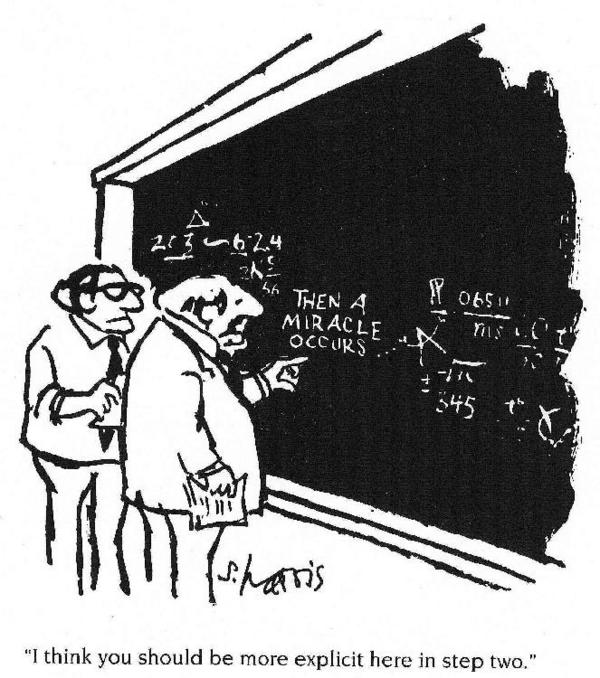
I call it a climate model. Trademark pending.

Saturday, July 7, 2012

Quote of the day: Andy Lacis FTW

Andy Lacis tells it like it is. Read the whole thing. Money quote:
As Garth notes, it is therefore not surprising then, that  “it is indeed vastly more difficult to publish results in climate research journals if they run against the tide of politically correct opinion” (in reality) a fully demonstrated understanding of current climate science. “Which is why most of the sceptic literature on the subject has been forced onto the web, and particularly onto web-logs devoted to the sceptic view of things.”
Why would anyone want stuff that is patently erroneous, irrelevant, or otherwise deficient to be published in the long-established climate science literature? Clearly, there has to be some sense of quality control to define what we reliably understand in science, and what we don’t. Why not just trash out the junky stuff in the web-blogs where that is already happening? Should anything of value be uncovered, it will surely survive the thrashing, and then it will make it into the peer-reviewed climate science literature and become recognized as a recognized part of current climate knowledge.
As I like to remind people "ignorance on your part does not constitute an obligation on my part."

Monday, December 26, 2011

Steven Mosher explained

Why is he the way he is? Now it's a little clearer:

That's right. He's performed deconstructions. You sit with that, four eyes, with your "science" and your "data." You ponder it.


Tuesday, October 11, 2011

A pseudointellectual "beard" for climate folly


Andrew Sullivan, whose taste in climate pundits remains howlingly bad, highlights an online "philosopher's" pretentious right-wing drivel:
The moralisation approach undermines itself since it frames climate change narrowly in terms of righteousness. Inevitably deliberation about action gets bogged down in an interminable blame-game about what justice requires - who had their industrial revolution first, etc. Furthermore, the moral duties of different actors do not all point the same way: poor country governments have a clear and over-riding moral duty to help their citizens achieve the high quality of life which the West takes for granted, and which is inevitably energy (carbon) intensive. And then there is the practical economics: the world still has lots of coal, especially in the poor world, that can produce electricity at 3c per kwh (which renewables cannot possibly compete with without radical technological breakthroughs, even with the strongest moral rhetoric). No comprehensive global political solution to greenhouse gases is possible. We need to go back and think again.
Sullivan hat tips to "The Philosopher's Beard" under the heading "The Hazardous Moralization Of Climate Change." The link leads you to "The Philosopher's Beard: Mini-essays in philosophy, politics, and economics" and "Ethics and Global Climate Change." Via the latter, the author gives us a memorable demonstration of how to make a pseudointellectual argument:
   
1. Use academic-sounding terms which appear specific and objective, which are in fact vague, subjective, and implicitly derogatory.
The global climate change debate has a lopsided empirical basis - in the economy of nature but not political economy - and this has contributed to a peculiar moralising trajectory.
You would think, from the fact that the central point of the whole essay is to make the case against "moralizing" climate change, that what "moralizing" the debate means would be clearly defined. It never is. If you search the essay for clues, what you get back is a right-winger's cardboard stereotype of a loony green:
" the debate has induced a kind of millennarian meltdown in which otherwise sensible people have lost all sense of proportion and hope"
" Morality concerns strict but simple universal rules that everyone should follow without regard to personal situations or consequences - on the model of laws [When your behavior harms me or vice versa, we typically make laws about that behavior. As a general rule, laws are made "on the model of laws."] On this model, one's carbon footprint is a crime (against the planet presumably) [says who?] which one should feel guilty about and strive to mitigate. As of course are other people's carbon emissions: they deserve to be shamed or otherwise forced into submission by the righteous ones."
" The moralisation approach undermines itself since it frames climate change narrowly in terms of righteousness. Inevitably deliberation about action gets bogged down in an interminable blame-game about what justice requires - who had their industrial revolution first, etc."
" The moralisation approach contrasts with a fuller ethical thinking in which values are considered and debated explicitly and openly. Righteousness simplifies but it doesn't try to understand."
What the author is attempting to pass off as an objective characteristic of the "climate debate" proves to be just standard climate denier ad hominem – greens are humorless scolds, socialist-secular anticolonialist navel-gazers, self-righteous Chicken Littles undergoing a "millennarian meltdown" in which they "have lost all sense of proportion and hope."
    
He gives no evidence for this slander, merely repeating it in various forms for most of the post. That, too, is characteristic of the pseudointellectual argument. When a straightforward torch-waving rabble-rouser like me makes an assertion about something or someone I don't care for, I have to support it with examples, usually providing a quote or two to illustrate what I mean. By couching his conventional right-wing op-ed in terms of "philosophy" the author evades any question of evidence or proof.

2. Lard up the verbiage.
The global climate change debate has a lopsided empirical basis - in the economy of nature but not political economy - and this has contributed to a peculiar moralising trajectory.
In other words, the science of climate change is solid and conclusive. Do you really need to torture that thought into this "global climate change debate has a lopsided empirical basis"? The case for action is not (he asserts) as strong – which becomes " in the economy of nature but not political economy."
     
3. Offer analysis, but deliver politics. 

The Beard gives us one fact – the population of the earth – and then sets out on what is ostensiby a description of the situation, but which is in fact an almost unrecognizable right-wing fantasy world:
In trying to tackle climate change by directly dealing with the causal mechanism of CO2 levels we face an enormous collective action problem - how to persuade 6.7 billion people to adopt the new morality of carbon rationing (and prevent free-riding). Everyone but the most delusional accepts that this is impossible without enormous government coercion (which explains many climate change warriors' antipathy to democratic principles on this point - easier to persuade 200 governments than all those people). However even the government coercion approach fails - see the failures of every inter-governmental treaty, from Kyoto to Copenhagen - and the reasons are obvious.
Notice how easily we slip into the conventional internet libertarian's assumptions about the world. Government action has become "enormous government coercion" (is a carbon tax more coercive than a property tax or a sales tax, or does he believe all taxation and regulation to be "enormous government coercion"? He doesn't say, but one suspects.) The people or the right side of that "lopsided empirical basis" have become "climate change warriors" – because while denying climate change "is just silly" proposing that we act on what we know is the moral equivalent of making war on our fellow citizens. And then we have this gem of tortured logic: "which explains many climate change warriors' antipathy to democratic principles on this point - easier to persuade 200 governments than all those people."
   
Lobbying the government to act is now undemocratic. International treaties are undemocratic, too. (We are allowed to persuade people individually, provided we don't make them feel bad by "moralising" the issue.) One wonders how democracy ever recovered from treaties that banned ozone-depleting chemicals, or the use of chemical and biological weapons, or child labor, or those that created trade agreements.
    
This is all stuff that would have readers at mises.org nodding along, but everybody else should be confused and startled by a definition of democratic principles that precludes trying to convince your fellow citizens to agree to collective actions for the benefit of all.

4. Include lots of straw men.

I lost count at ten or so. Here's a particularly egregious example:
No-one emits carbon deliberately 'for fun', but rather we engage in activities which are more or less valuable to us - such as flying across the Atlantic to visit grandparents - which happen to emit carbon as a byproduct. To ignore the value of these human activities and see them instead as moral crimes is to do a violence to the very humanness of the lives (including those of future generations) that we are supposed to be so concerned about preserving.
Who "ignore[s] the value of these human activities"? In what way does saying an action has a consequence, and its utility must be evaluated in light of that, imply that the activity has no value? It does not. He is conjuring up an absurd parody of an eco-warrior scold, while ignoring the very simple and pragmatic point that we have to weigh the unintended consequences of our actions in deciding what we will do.

We should be grateful "Beard" wasn't around when doctors discovered that the cholera epidemics of London were spreading via polluted water. Imagine the screed:
No-one uses water pumps "for fun," but rather we engage in activities which are more or less valuable to us - such as cooking dinner or washing clothes - which happen to spread disease as a byproduct. To ignore the value of these human activities and see them instead as moral crimes is to do a violence to the very humanness of the lives (including those of future generations) that we are supposed to be so concerned about preserving.
The whole exercise is so transparent, and the underlying political spin so obvious, that one wonder if the title of the blog "The Philosopher's Beard" carries a hidden meaning: if the author, aware that his proclivities for hard, grinding, right-winger-on-libertarian action are less than comfortable to a mainstream audience, and has chosen to equip his online persona accordingly with a fictitious air of academic enquiry – "The Philosopher's Beard" being just that – a "beard" of airy intellectualism for a closeted right-wing partisan.