Showing posts with label Andrew Revkin. Show all posts

Saturday, June 28, 2014

"Good Anthropocene" and other clickbait

Well, Andrew Revkin successfully suckered me into listening to his talk. The faux-controversy over the title and Clive Hamilton's hissy fit sucked me in.

Nowhere in the talk does Revkin actually say that we are going to have a good Anthropocene. It's mostly just Revkin being Revkin -- "Don't scare the nice people, wear more bright colors, you'll never find a husband if you don't smile more."

Clive Hamilton's response, meanwhile, could be a prearranged piece of performance art intended to strengthen Revkin's argument about the limitations of "Woe is me, shame on you" rhetoric:
In the end, grasping at delusions like “the good Anthropocene” is a failure of courage, courage to face the facts. The power of positive thinking can’t turn malignant tumours into benign growths, and it can’t turn planetary overreach into endless lifestyle improvements. Declaring oneself to be an optimist is often used as a means of gaining the moral upper hand: “Things may look bad but, O ye of little faith, be bold and cheerful like me.”
Things are bad, and if we carry on as we are things will be very bad. It is the possibility of preventing bad turning into very bad that motivates many of us to work harder than ever. But pretending that bad can be turned into good with a large dose of positive thinking is, even more so than denying things are bad, a sure-fire way of ending up in a situation that is very bad indeed.
- See more at: http://clivehamilton.com/the-delusion-of-the-good-anthropocene-reply-to-andrew-revkin/#sthash.elSdryoA.dpuf
In the end, grasping at delusions like “the good Anthropocene” is a failure of courage, courage to face the facts. The power of positive thinking can’t turn malignant tumours into benign growths, and it can’t turn planetary overreach into endless lifestyle improvements. Declaring oneself to be an optimist is often used as a means of gaining the moral upper hand: “Things may look bad but, O ye of little faith, be bold and cheerful like me.”
Things are bad, and if we carry on as we are things will be very bad. It is the possibility of preventing bad turning into very bad that motivates many of us to work harder than ever. But pretending that bad can be turned into good with a large dose of positive thinking is, even more so than denying things are bad, a sure-fire way of ending up in a situation that is very bad indeed.
- See more at: http://clivehamilton.com/the-delusion-of-the-good-anthropocene-reply-to-andrew-revkin/#sthash.elSdryoA.dpuf
In the end, grasping at delusions like “the good Anthropocene” is a failure of courage, courage to face the facts. The power of positive thinking can’t turn malignant tumours into benign growths, and it can’t turn planetary overreach into endless lifestyle improvements. Declaring oneself to be an optimist is often used as a means of gaining the moral upper hand: “Things may look bad but, O ye of little faith, be bold and cheerful like me.”
Things are bad, and if we carry on as we are things will be very bad. It is the possibility of preventing bad turning into very bad that motivates many of us to work harder than ever. But pretending that bad can be turned into good with a large dose of positive thinking is, even more so than denying things are bad, a sure-fire way of ending up in a situation that is very bad indeed.
- See more at: http://clivehamilton.com/the-delusion-of-the-good-anthropocene-reply-to-andrew-revkin/#sthash.elSdryoA.dpuf
In the end, grasping at delusions like “the good Anthropocene” is a failure of courage, courage to face the facts. The power of positive thinking can’t turn malignant tumours into benign growths, and it can’t turn planetary overreach into endless lifestyle improvements. Declaring oneself to be an optimist is often used as a means of gaining the moral upper hand: “Things may look bad but, O ye of little faith, be bold and cheerful like me.”
Things are bad, and if we carry on as we are things will be very bad. It is the possibility of preventing bad turning into very bad that motivates many of us to work harder than ever. But pretending that bad can be turned into good with a large dose of positive thinking is, even more so than denying things are bad, a sure-fire way of ending up in a situation that is very bad indeed.
- See more at: http://clivehamilton.com/the-delusion-of-the-good-anthropocene-reply-to-andrew-revkin/#sthash.elSdryoA.dpuf
In the end, grasping at delusions like “the good Anthropocene” is a failure of courage, courage to face the facts. The power of positive thinking can’t turn malignant tumours into benign growths, and it can’t turn planetary overreach into endless lifestyle improvements. Declaring oneself to be an optimist is often used as a means of gaining the moral upper hand: “Things may look bad but, O ye of little faith, be bold and cheerful like me.”
Things are bad, and if we carry on as we are things will be very bad. It is the possibility of preventing bad turning into very bad that motivates many of us to work harder than ever. But pretending that bad can be turned into good with a large dose of positive thinking is, even more so than denying things are bad, a sure-fire way of ending up in a situation that is very bad indeed.
- See more at: http://clivehamilton.com/the-delusion-of-the-good-anthropocene-reply-to-andrew-revkin/#sthash.elSdryoA.dp
In the end, grasping at delusions like “the good Anthropocene” is a failure of courage, courage to face the facts. The power of positive thinking can’t turn malignant tumours into benign growths, and it can’t turn planetary overreach into endless lifestyle improvements. Declaring oneself to be an optimist is often used as a means of gaining the moral upper hand: “Things may look bad but, O ye of little faith, be bold and cheerful like me.”

Things are bad, and if we carry on as we are things will be very bad. It is the possibility of preventing bad turning into very bad that motivates many of us to work harder than ever. But pretending that bad can be turned into good with a large dose of positive thinking is, even more so than denying things are bad, a sure-fire way of ending up in a situation that is very bad indeed.
untly. In short, I think those who argue for the “good Anthropocene” are unscientific and live in a fantasy world of their own construction. - See more at: file:///Users/robertfarrell8/Downloads/The%20Delusion%20of%20the%20%E2%80%9CGood%20Anthropocene%E2%80%9D_%20Reply%20to%20Andrew%20Revkin%20@%20Clive%20Hamilton.html#sthash.zbjDOsCe.dpuf
In the end, grasping at delusions like “the good Anthropocene” is a failure of courage, courage to face the facts. The power of positive thinking can’t turn malignant tumours into benign growths, and it can’t turn planetary overreach into endless lifestyle improvements. Declaring oneself to be an optimist is often used as a means of gaining the moral upper hand: “Things may look bad but, O ye of little faith, be bold and cheerful like me.”
Things are bad, and if we carry on as we are things will be very bad. It is the possibility of preventing bad turning into very bad that motivates many of us to work harder than ever. But pretending that bad can be turned into good with a large dose of positive thinking is, even more so than denying things are bad, a sure-fire way of ending up in a situation that is very bad indeed.
- See more at: http://clivehamilton.com/the-delusion-of-the-good-anthropocene-reply-to-andrew-revkin/#sthash.elSdryoA.dpuf
In the end, grasping at delusions like “the good Anthropocene” is a failure of courage, courage to face the facts. The power of positive thinking can’t turn malignant tumours into benign growths, and it can’t turn planetary overreach into endless lifestyle improvements. Declaring oneself to be an optimist is often used as a means of gaining the moral upper hand: “Things may look bad but, O ye of little faith, be bold and cheerful like me.”
Things are bad, and if we carry on as we are things will be very bad. It is the possibility of preventing bad turning into very bad that motivates many of us to work harder than ever. But pretending that bad can be turned into good with a large dose of positive thinking is, even more so than denying things are bad, a sure-fire way of ending up in a situation that is very bad indeed.
- See more at: http://clivehamilton.com/the-delusion-of-the-good-anthropocene-reply-to-andrew-revkin/#sthash.elSdryoA.dpuf
Why not say the word "bad" a few more times, Clive, then I'm sure we'll get it.

The irony of this is that Revkin's "Smile more" argument cuts very little ice with me or, really, anyone, but if you wanted to drive the point home that the rhetoric of "Woe is me, shame on you" is dominating the climate discourse to an unhealthy extent, you could not do better than to point to Clive's demand that we all unite behind a vision of the 21st century as an unending hell of pain and despair in which the living will envy the dead.

I think Revkin underestimates the power of shaming and blaming in the process of achieving social change, as I've argued before. But that doesn't excuse Hamilton. Look, one of the fundamental principles of rhetoric is that you vary your approach. From Lincoln to King to Kennedy, you can see this principle in action. Long sentences and short sentences. More formal language and more colloquial language. Conciliation and righteous anger. Anything which is unvarying and repetitive becomes wearying and, ultimately, background noise.

So what if Revkin wants to spin things a little happier and Hamilton wants to play the role of a discount Hebrew prophet? Can that variety not also be a source of strength and persuasiveness? Has Hamilton never heard of Good cop/Bad cop?
In the end, grasping at delusions like “the good Anthropocene” is a failure of courage, courage to face the facts. The power of positive thinking can’t turn malignant tumours into benign growths, and it can’t turn planetary overreach into endless lifestyle improvements. Declaring oneself to be an optimist is often used as a means of gaining the moral upper hand: “Things may look bad but, O ye of little faith, be bold and cheerful like me.”
Things are bad, and if we carry on as we are things will be very bad. It is the possibility of preventing bad turning into very bad that motivates many of us to work harder than ever. But pretending that bad can be turned into good with a large dose of positive thinking is, even more so than denying things are bad, a sure-fire way of ending up in a situation that is very bad indeed.
- See more at: http://clivehamilton.com/the-delusion-of-the-good-anthropocene-reply-to-andrew-revkin/#sthash.pOAOt3bb.dpuf
In the end, grasping at delusions like “the good Anthropocene” is a failure of courage, courage to face the facts. The power of positive thinking can’t turn malignant tumours into benign growths, and it can’t turn planetary overreach into endless lifestyle improvements. Declaring oneself to be an optimist is often used as a means of gaining the moral upper hand: “Things may look bad but, O ye of little faith, be bold and cheerful like me.”
Things are bad, and if we carry on as we are things will be very bad. It is the possibility of preventing bad turning into very bad that motivates many of us to work harder than ever. But pretending that bad can be turned into good with a large dose of positive thinking is, even more so than denying things are bad, a sure-fire way of ending up in a situation that is very bad indeed.
- See more at: http://clivehamilton.com/the-delusion-of-the-good-anthropocene-reply-to-andrew-revkin/#sthash.pOAOt3bb.dpuf
In the end, grasping at delusions like “the good Anthropocene” is a failure of courage, courage to face the facts. The power of positive thinking can’t turn malignant tumours into benign growths, and it can’t turn planetary overreach into endless lifestyle improvements. Declaring oneself to be an optimist is often used as a means of gaining the moral upper hand: “Things may look bad but, O ye of little faith, be bold and cheerful like me.”
Things are bad, and if we carry on as we are things will be very bad. It is the possibility of preventing bad turning into very bad that motivates many of us to work harder than ever. But pretending that bad can be turned into good with a large dose of positive thinking is, even more so than denying things are bad, a sure-fire way of ending up in a situation that is very bad indeed.
- See more at: http://clivehamilton.com/the-delusion-of-the-good-anthropocene-reply-to-andrew-revkin/#sthash.pOAOt3bb.dpuf
In the end, grasping at delusions like “the good Anthropocene” is a failure of courage, courage to face the facts. The power of positive thinking can’t turn malignant tumours into benign growths, and it can’t turn planetary overreach into endless lifestyle improvements. Declaring oneself to be an optimist is often used as a means of gaining the moral upper hand: “Things may look bad but, O ye of little faith, be bold and cheerful like me.”
Things are bad, and if we carry on as we are things will be very bad. It is the possibility of preventing bad turning into very bad that motivates many of us to work harder than ever. But pretending that bad can be turned into good with a large dose of positive thinking is, even more so than denying things are bad, a sure-fire way of ending up in a situation that is very bad indeed.
- See more at: http://clivehamilton.com/the-delusion-of-the-good-anthropocene-reply-to-andrew-revkin/#sthash.pOAOt3bb.dpuf

Monday, December 16, 2013

Yes, Virgina, there are simple villains in climate change

Andrew Revkin, in his continuing efforts to be the bard of inactivism, wants us to know the climate change is everyone's (and thereby no one's) fault:
We grew up in the twentieth century when everything about the environment was either “woe is me” or “shame on you.” It’s all coming undone, and it’s your fault. That is so antiquated when you look at a problem like climate change, where there’s no whodunit. It’s, ‘We all dunit.’ We’re all using energy. You can punish Exxon, but I still have to fill up my Prius once in awhile and my mini van, which I need because we have two dogs, is not the most efficient vehicle in the world. So whodunit? Me. But the old model was that it had to be someone else’s fault and the other part of the old model was we had to pass a law, which basically means the solution is someone else’s solution. It’s government, a treaty, a law that’ll solve it. Things like climate change are just so much more wicked than the kind of problem you would solve that way. We have to get comfortable with the story when there is no simple villain….
This reminds me of nothing so much as Megyn Kelly's recent rant against evil historical revisionists who question the unquestionable reality that "Santa Claus is just white": 


Prompting Jon Stewart and friends to respond along the lines of "Uh, Megyn? Santa Claus isn't real."

Similarly, it's time the internet had a talk with Mr Revkin and explained to him another of the hard truths of adulthood: simple villains aren't real. Truly, they aren't any more real than Santa Claus. Climate change is no exception to the general rule of life that most big problems implicate a large number of people to a lesser or greater degree.

Whilst the civil rights movement was making simple villains out of Bull Connor and Strom Thurmond, there was endemic racism throughout both South and North. Whites everywhere benefited from employment and housing opportunities denied to blacks and other minorities. To this day Americans continue to benefit from centuries of unpaid labor by black slaves which contributed to our economy, for which reparations have never been made, or even attempted.
You are all me!


Stories of simple villainy exist for the same reason stories about Santa Claus exist: they make people happy. Specifically, they make people happier in undertaking just what Revkin wants them to undertake; reform of a social ill to which many people are a party, which will require short-term sacrifices from a lot of people.

The campaign against Jim Crow is one example of how this can be successful. The campaign against smoking is a still more recent example. Smoking has been steadily losing its grip on the American people over the past fifty years:

Smoking rates in the US over time
The simple villains of the tobacco wars were not the individual smokers (of course) but the tobacco companies who concealed evidence of the health risks of smoking, and waged an aggressive campaign of disinformation to cast doubt on the strong scientific evidence of harm (sound familiar?)

The tobacco companies ended up paying out hundreds of billions of dollars in settlements. But were they the only, or even the primary source of the harm caused by smoking? Certainly not. Farmers had to grow the foul stuff. The government subsidized that growth with taxpayer dollars, which makes it pretty rich, one might argue, for the government to go after the tobacco companies.

Hundreds of thousands of supermarkets, corner stores, bars, smoking shops and other businesses sold (and continue to sell) these death-dealing products, to make money.

Tens of millions of Americans chose to smoke this unhealthy product, to expose other people (most damagingly, their own children) to the smoke, and continued to do so, in many cases, long after their own health had been destroyed.

Did the campaign against tobacco target these people? No it did not. Should it have? Obviously not. As targets they are too numerous, too diffuse, too varied in their level of responsibility, too weak individually to alter the course of the epidemic.

Were the tobacco companies unfairly targeted? No! They lied to the public, lied about the science, and did tremendous damage to the public health in the service of their own bottom lines. Nevertheless, making them the simple villains of the tobacco wars was a political decision by those activists working on the problem -- a very successful one. While waging a rhetorical and later legal war on the tobacco companies, they very successfully encouraged a large portion of Big Tobacco's customers to divest themselves from its product. They convinced legislators to heavily tax cigarettes and heavily restrict where you could smoke them. They did this without making the individual smokers targets. They used their simple villains, the tobacco companies, to cast them as victims.

Revkin speaks dismissively of targeting Exxon as a villain of climate change, or using the kind of legislation used against tobacco companies to restrict the activities of big polluters. But he doesn't actually give any real reason why this won't work. Yes, everyone is implicated in the release of GHGs to some extent. Just as everyone is implicated in structural racism to some extent, or in the labor conditions that produce the cheap plastic products Americans so love, or as tens millions of Americans willing participated (many still do) in the tobacco epidemic. But that is no reason why we cannot identify big, destructive actors profiting hugely and deceiving the public and go after them.

Simple villains are a story, a rhetorical choice. In real life nothing is perfectly simple. But identifying bad guys and going after them can be a spoonful of sugar to help social change go down. Action is easier when there is a villain to target; that is why the government has taken vast amounts of action (much of it ill-considered) against the threat of terrorism, and virtually none against the far more dire threat of climate change. And in the complex tale of our fossil fuel addiction, there's no shortage of serious bad guys begging to be highlighted.

Saturday, May 18, 2013

Dear Andrew Revkin: Time to rethink your dismissal of Cook et al

Doubling down:
The clear message of the team conducting this fresh assessment of the climate science consensus is that it’s vital to close that gap to have a chance of breaking societal deadlock on cutting greenhouse gas emissions. On his Skeptical Science blog, John Cook, the paper’s lead author, put it this way:
Quite possibly the most important thing to communicate about climate change is that there is a 97% consensus amongst the scientific experts and scientific research that humans are causing global warming. Let’s spread the word and close the consensus gap.
Forgotten [Really? Did they say climate communication was the only thing that mattered? No, they said "to have a chance." I.e., closing the gap is necessary but not sufficient condition, not the only thing that matters] in much of this is a point made in an e-mail message sent to me and some other science communicators this morning by Dan Kahan, the Yale law professor who studies the cultural filters that influence how people perceive and react to information. Kahan linked to his fresh post reviewing how many times in recent years such studies have been promoted, then asked this:
Climate scientists aren’t the only ones whose message never gets through. The “science of science communication consensus” that deficits in knowledge & rationality are not the problem [there's more than one problem!]— 99.9999999% agree! — never does either, & to the very people it should be of value too, viz., those trying to promote constructive engagement w/ climate science.
Is there someone studying that science communication problem???!
. . . 
This doesn’t mean it’s a waste of time to communicate climate science [in contrast to what you tweeted yesterday]. But it does mean that communicating the science of science communication matters, too.
For more on the wishful nature of hopes that closing such gaps will matter much, read Keith Kloor and David Appell.
Dear Andrew,

I like a lot of what you write, and I respect your ability to take a second look at your positions and well, it's time. Your own shifting justifications for why Cook et al doesn't matter should be a warning sign that something is amiss: "This study will not fundamentally alter the climate debate forever" (*) is quite a climb-down from "This is an irrelevant study that tells us nothing new and changes nothing."

The Cook study added a greater degree of rigor to the evidence that 97% of climate scientists agree global warming is happening and is human caused. Most Americans -- 70% in the 2011 Six Americas study -- do not know this. Attempting to defend the initial, rather rude and ill-thought-out, dismissal of the study reflects a natural and predictable defensiveness, but you should reconsider.

Neither the authors of the study nor anyone else claimed the study solved all the problems in communicating the science of global warming, still less that it showed a way past all the obstacles to collective political action.

But as a piece of science communication -- a subject you have written and lectured about on many occasions, and therefore seem to think is relevant in some way to the challenges we face -- it was a stunning success(**). Both your initial dismissal and the further attempts to justify it are wrongheaded and invite the label of "inactivist" which some have attached to you.


-----------------------------

* A point Appell makes in even more bizarre fashion when he crows ("Climate Candy: The Proof" (!)) that the Huffington Post is no longer leading with the study the next day (?)).

** Let us consider some of the reasons for its success:

1. A simple message.
2. Careful research that sticks to the facts.
3. A message grounded in what we know well, not in new science, extremes, or "single study syndrome."
4. Information that the disengaged (not aware it has been available for some time) have REPEATEDLY TOLD POLLSTERS would increase their concern about global warming.
5. Despite a message well-gauged to increased concern, it is not apocolyptic, not overwhelming, and not likely to make people want to "tune out" the issue.

Thursday, May 16, 2013

The intolerant moderates


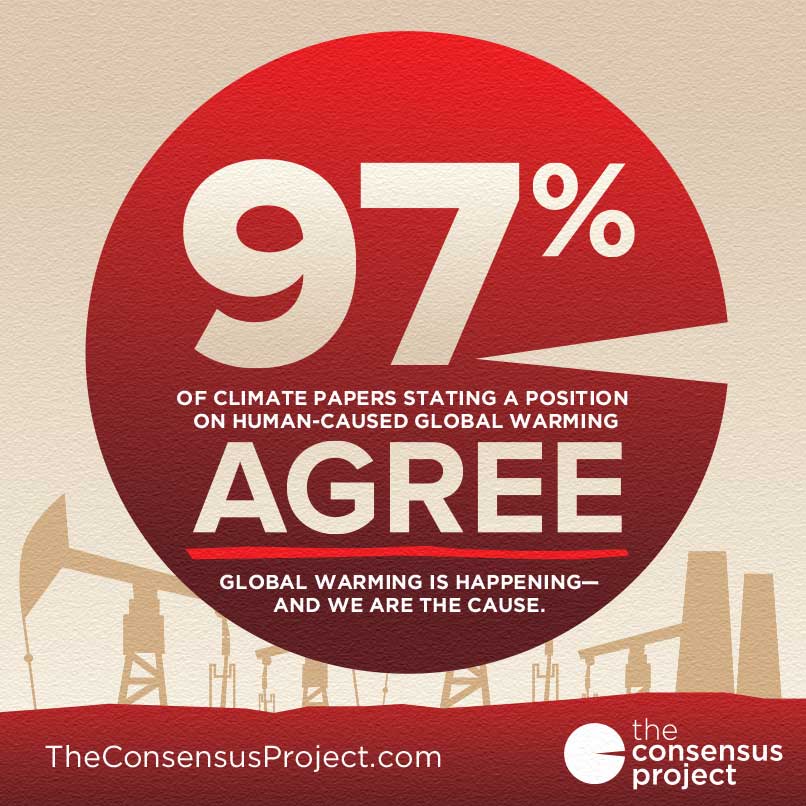
Skeptical Science won the internet last week with a superb original paper by Cook, Nuccitelli et al that evaluated over 12,000 sources and found 97% of climate scientists agree that global warming is happening.


Amazingly some people managed to miss the point:
Their names are practically a role call of the "intolerent moderates" -- journalists who have chosen to define themselves as independent-minded thinkers ready to castigate both sides. The intolerant moderates accept that climate change is happening and action is necessary, but struggle to occupy a middle ground condemning the excesses of both sides. Since the excesses in the climate debate are not at all equally distributed between science deniers and the concerned, this positioning often leads to tepid critiques of climate deniers coupled with energetic castigation of the other side for minor, or, as in this case, nonexistent sins.

Dave Appell just doesn't see the point of the study:
I'm not very keen on these kinds of numbers -- they are made for lazy journalists who don't want to examine the complexity of the science, reporters who just want a number that quickly and easily supports their position.
Or maybe reporters who want to convey to their readers a simple, rock-solid case that a majority of climate scientists believe climate change is real and is caused by humans something only 30% of Americans know to be true (Really).

Kloor is spouting the same sort of nonsense:
The latest example is this survey by John Cook et al that is getting a lot of undeserved attention in the mainstream media. I say that because, questionable methodology aside, the survey tells us nothing new and is, as science journalist David Appell noted, “a meaningless exercise.”
I enjoy their quoting one another for added support: but they are both completely, utterly, ludicrously wrong.

It's hard to say which is the more fundamental fail here: that Kloor doesn't understand that replicating results is critical to science, or that he thinks that he has somehow become a scientist, whose responsibility it is to follow and critique the bleeding edge of climate science, rather than his actual role as a science journalist helping the public grasp the critical core of the field, a job that evidently has to be done by scientists, who have pulled off a massive coup of science communication, only to be sneered at by the people who are paid to perform that function themselves.

I really expected better of Revkin than to jump on this bandwagon. This is why the survey is not a "meaningless exercise":

Source
Half of the public in this survey -- HALF -- said that if 90% of climate scientists agreed that global warming is happening, it would increase their concern. This mind-boggling result is possible, again, because SEVENTY PERCENT OF THE PUBLIC DIDN'T KNOW MOST CLIMATE SCIENTISTS THINK GLOBAL WARMING IS HAPPENING.

That three SCIENCE JOURNALISTS do not know this about their audience is scandalous. It borders on professional incompetence. These people are lecturing scientists about science communication?

UPDATE: In the comments, MikeH perceptively notes that the intolerant moderate is a subspecies of the VSP:

They are the Very Serious People (popularised by Paul Krugman in his NYT column)
(http://rationalwiki.org/wiki/Very_Serious_People)

"Valuing common sense over scientific consensus when there is a conflict. When pushed far enough VSP will eventually err on the side of science but will hold a candle for pseudoscience as long as it has a veneer of respectability.
Loves the hell out of the balance fallacy. They feel uncomfortable pointing out flaws concentrated in the right-wing or left-wing without pointing to an opposite example. "Both sides do it!"

Climate scientist 2+2=4
Denier 2+2=5
VSP 2+2=4.5


Thursday, September 20, 2012

When not to quote yourself


Revkin gives us an example:

But I’ve long recognized the complexities in ice behavior that will probably result in some ice persisting, even in summer, through that span in some places and that also guarantee the path toward largely open Arctic waters will not be smooth. This was evident to Arctic researchers as far back as 2005, as I wrote in our “Big Melt” series at that time:
Arctic researchers caution that there is something of a paradox in Arctic trends: while the long-term fate of the region may be mostly sealed, no one should presume that the recent sharp warming and seasonal ice retreats that have caught the world’s attention will continue smoothly into the future.
“The same Arctic feedbacks that are amplifying human-induced climate changes are amplifying natural variability,” explained Asgeir Sorteberg, a climate modeler at the Bjerknes Centre for Climate Research in Bergen, Norway.
Indeed, experts say, there could easily be periods in the next few decades when the region cools and ice grows.
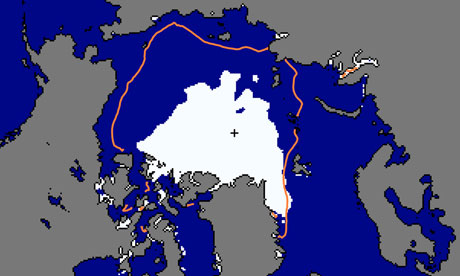
 I'm sure that cautious prediction made all sorts of sense . . . in 2005. Besides Mr. Revkin's level-headed commentary, what else did we have going for us in 2005? Fifty percent more sea ice than we have today (by area). Two hundred and fifty percent more sea ice (by volume):

August 2005, 9.2; August 2012 3.6 -- what a difference seven years makes.
 To look at it from another perspective: from 1979 to 2005 (26 years) the ice fell from 16.9 km^3 to 9.2 km^3, a decline of 46%. Andrew Revkin cautions us the road ahead may be long and winding. From 2005 to 2012, the volume of ice falls from 9.2 km^3 to 3.6 km^3: a fall, in less than one third the time of more than 60%.

The world has changed. Recycled judiciousness from half a decade ago is a bit past its sell-by date.

Thursday, August 30, 2012

Fighting climate denial: the Akin line

Source


Pity Todd Akin. It must seem to him as if the world makes no sense.

One minute he is living the life of a normal House Republican gunning for a vulnerable Senate seat, and the next he's a virtual pariah, with most of his own supporters saying he should drop out of the race. And all for making a comment not substantially different than those he and his colleagues make every day. Here is the line that turned his own party against him:
Well you know, people always want to try to make that as one of those things, well how do you, how do you slice this particularly tough sort of ethical question. First of all, from what I understand from doctors, that’s really rare. If it’s a legitimate rape, the female body has ways to try to shut that whole thing down.
Instant pandemonium. But why should that be so? What did Akin actually do?

It's a five-step process:

1. You have a rigid ideology that is absolutely opposed to a given action (like abortion).
2. There are empirical facts that make your absolutist position untenable (sometimes women are pregnant not because they chose to be, but because they were raped.)
3. Find a crackpot scientist (one sharing your ideological idiosyncrasies) who will explain away the inconveint fact (Women who have really been raped don't get pregnant!)
4. Ignore the vast scientific evidence to the contrary.
5. Promote the conspiracy theory as scientific fact.

Why did Akin think he was going to get away with this sophistry? Because he and his party have been playing this game, routinely and increasingly blatantly, for years. How would he know that all of a sudden ignoring the scientific consensus and promoting pseudoscience would blow up in his face? Compare his remarks on climate change
AKIN: This whole thing strikes me if it weren’t so serious as being a comedy you know. I mean, we just went from winter to spring. In Missouri when we go from winter to spring, that’s a good climate change. I don’t want to stop that climate change you know. Who in the world want to put politicians in charge of the weather anyways? What a dumb idea….
Some of the models said that we’re going to have surf at the front steps of the Capitol pretty soon. I was really looking forward to that….
 His official website trots out some more old canards (h/t Grist):
Although some of the physics and meteorology surrounding climate is well understood, the question of predicting future climate trends as well as man’s ability to definitively influence them is still an active field of scientific research. Moreover, despite our desire for complete certainty, we must understand that global climate is very complex phenomena. No one variable can be taken as the sole driver of climate and there exist cycles within cycles of meteorological variability. Scientists state that the planet has gone through many natural heating and cooling cycles over the last thousand years.
While scientists understand that increased levels of CO2 and other greenhouse gases work to trap heat, those gases are not the only variables when it comes to Earth’s temperature trends. For example, the sun itself has variable output, which affects temperature cycles. Currently, scientists are somewhat puzzled by a current-extended minimum in solar activity. Such a long-term lack of solar output in the early 18th century, referred to as the Maunder Minimum, is thought to have contributed to the last mini-ice age. Of course, factors such as solar variability — that could cause a mini-ice age — would probably not afford a man-made solution.
So here's the real question: why does the one public endorsement of pseudoscience spark outrage, while the other gets ignored? What's the difference? Where is the "Akin line" that separates comments like Michele Bachmann's, blaming the HPV vaccine for mental retardation, with these, from Akin's colleagues:
The committee’s chair, Ralph Hall (R-Texas), lumps “global freezing” together with global warming, which he doesn’t believe humans can significantly impact because “I don’t think we can control what God controls.” Dana Rohrbacher (R-CA) thinks cutting down trees reduces levels of greenhouse gases they absorb. Mo Brooks (R-Alabama) still trots out the debunked notion that a scientific consensus existed in the 1970s on “global cooling,” which he portrays as a scare concocted by scientists “in order to generate funds for their pet projects.”

Dan Benishek (R-Michigan) strikes that climate-scientists-as-charlatans note, dismissing contemporary research as “all baloney. I think it’s just some scheme.” Paul Broun (R-Georgia) says that “Scientists all over this world say that the idea of human-induced global climate change is one of the greatest hoaxes perpetrated out of the scientific community.”
Watching the Deniers asks: How would you counter the denial movement? And I think the answer is very simple; we need to bring them across the Akin line. We need to gently and truthfully shape the public debate such that outrageous comments provoke outrage, that laughable ignorance provokes laughter, until we reach a point that those that advocate science denial get shunned by their own political allies as liabilities in the battle for electoral success.

So why did Akin and Bachmann instantly provoke national scorn, while Benishek and Broun have not?

A) In each case, there was a simple, testable scientific assertion. Vaccine = mental retardation. Rape = no pregnancy. It's easier to see why that more easily trips up a science denier as compared to "It's all very complicated" or "Climate models are unreliable."

B) The puppet strings are short and colorful -- there is no problem at all reading the minds of Akin and Bachmann and understanding why they are making stuff up. Akin wants abortion to be completely illegal, always, in all circumstances. That women get pregnant from rape is an awkward fact for him, so he tries to suppress it by invoking pseudoscience. Bachmann is against the HPV vaccine because it makes sex a little less dangerous for women, and in her mind, that encourages promiscuity.

In both cases the lies play into the speakers' established positions in culture wars that have been raging for a generation. Even the most low-information voter knows how conservative Republicans feel about abortion and safe sex. That makes it easy to connect the dots.

C) There is a clear scientific consensus, and the audience knows that, even if they don't know the details. Physicians and medical science have a much stronger presence in American life than does climate science or climate scientists. Most people know a physician personally. The science denial wing of the Republican party has not constructed a campaign to slander and defame physicians, attacking them as frauds or incompetent or self-interested rent-seekers. They would not find it easy to do if they tried. But in the absence of such preparation, voters have little reason to reject the scientific consensus. The total rejection by the medical community of these lies ends the debate.

D) These comments were deeply insensitive and hurtful to other Americans. Rape victims were insulted by Akin. People with actual learning disabilities or cognitive limitations and the families that care for them were insulted by Bachmann. This brought anger and contempt into the response to the speakers as well as mockery.

If we go back to the statements by Akin and friends on climate change, it's clear they are missing most of the attributes listed above. Take "Scientists state that the planet has gone through many natural heating and cooling cycles over the last thousand years." It's vague, not clear and testable (A). If you strongly connect Akin to fossil fuel interests, it could be said to meet (B). The public does not have a clear idea of the scientific consensus that the current global warming is orders of magnitude different from natural climate variations of the recent past (C). Those that do know this have also been exposed to a relentless campaign to undermine the scientific consensus by slandering the scientists themselves (C). The comment is deeply offensive to people who understand what Akin is trying to accomplish and what the actual state of affairs is, but they do not have the visceral offensiveness of someone blaming rape victims or the parents of the mentally retarded for their situation (D).

So, if we think Akin's pseudoscience about climate change deserves the same contempt as his pseudoscience about rape and pregnancy, how can we encourage the public to see things similarly?

A) In each case, there was a simple, testable scientific assertion. Focus on deniers' assertions about science. Don't let them get away with vague statements of doubt, and endless one-sided interrogations of others. Encourage them to explicitly state their beliefs.

B) The puppet strings are short and colorful -- there is no problem at all reading the minds of Akin and Bachmann and understanding why they are making stuff up. Highlight the connection between right-wing extremism and climate denial. Make the connection between science denial and other right-wing views. As entertaining as it is to show how climate denial relates to the conspiracy-theory-prone mindset, the critical driver of climate denial in politics is the broader radicalization of the Republican Party.

C) There is a clear scientific consensus, and the audience knows that, even if they don't know the details. The contempt of hardcore climate deniers for the concept of scientific consensus is born of fear. Despite deniers' whining and jeering and embrace of the Galileo gambit, the public knows very well that the consensus of the vast majority of scientists on a given issue is as close to the truth as anything we can lay hands on. And survey after survey shows that even "alarmists" vastly understate the strength of the scientific consensus on global warming -- the meaning the fact of the scientific consensus has not been "priced in" by the public.

So, while sticking to the stuff we clearly know to be true, and not venturing into unsupported speculation, it's important to highlight the contrast: Consensus vs. crackpots on the fringe.  Consensus vs. crackpots on the fringe. Consensus vs. crackpots on the fringe.

D) These comments were deeply insensitive and hurtful to other Americans. This one is hard -- I don't know it is achievable in the short term. It's difficult to "put a face" on global warming. But perhaps, as with "consensus," the deniers are giving us a hint, by vehemently attacking the arguments they most fear. And what is the single most jeered-at, eye-rolling, cliched picture in all of climate change? You know what it is. It's this:

Deniers jeer at what works.
When the deniers deny, they are insulting those that have already been hurt by climate change. They are insulting the other creatures we share the planet with. We have to make those people -- Inuits whose villages are being washed out to sea, elderly people without air conditioning dying in record-breaking heat waves, children in temperate climates suffering with tropical diseases previously unknown there -- we need to make them as real, as familiar, as indisputably linked with AGW as that bear on his shrinking ice floe. 

Compare the argument over gays in the military. While they were theoretical, people could say (and did) all sorts of ignorant and hurtful things, with little political fallout. But as the culture gradually changed, as gay service members dared to speak out more, as the ban was finally ended, gays in the military stopped being theoretical people, and they became actual, flesh-and-blood people with their lives on the line for their country. And suddenly as a social conservative you had to be very careful what you said. This social changed went very slowly, until it reached that critical point where it was hard to attack "gays in the military" as an abstraction without insulting the actual people you were talking about. Then the culture and the discussion changed more in six month than it had in the previous sixty years. And where is that debate today? Gone and virtually forgotten.

Even cuter than polar bears.
I've written about confronting climate denial before, and as before, I find a reasonable approximation of my views is to take all the well-meaning advice of the self-identified "moderates" in the climate debate, the Kloors and the Revkins and so forth, and do the exact opposite of what they recommend.

Don't be a free educational resource to people with no actual sincere desire to learn. Ask them questions -- be skeptical about their skepticism -- put their beliefs and opinions on the record and under the microscope.

Don't waste your time searching for a mythical middle ground. Climate deniers are in this in order to have an ideological battle. It is part of their war with modern life and Western civilization. You will not win them to your way of thinking with a clever compromise, any more than the NRA is going to wake up one morning at say "Wow, we've got all the pro-gun legislation we could ever need! Now, back to regional shooting competitions!" Instead, embrace the polarization of the debate -- among other things, this helps the public understand what motives climate deniers to lie and distort.

Don't try and convey uncertainty. If you have a complex message while your opponents have a simple one you will lose. Plain and simple. Deniers want us to spending our time trying to educate the public to grasp complex scientific ideas. They are delighted when they can provoke us into doing that by accusing us of oversimplifying the story. (They will just be at this little table over here on the other side of the room, saying FRAUD LIES FRAUD TAXES SOCIALISTS GREEDY SCIENTISTS NATURAL NATURE FRAUD FRAUD.)

So find a simple message, well inside the borders of the consensus, and hammer it home relentlessly. Show the people being hurt by global warming. Show them over and over again, until the public gets a visceral sense that deniers are denying not just the scientific understanding of where the climate is going, but of what is happening in the world right now. People are dying while the right-wing fringe lies and defames. When the public understands that -- understands it in their bones -- deniers will find themselves across the Akin line.

Monday, March 12, 2012

Pragmatism

The inevitable Revkin headline:

The argument is one we've seen before:

Many of my conservative friends are deeply suspicious of climate change, and they hate carbon taxes and cap and trade. They’re not interested in adapting to a supposedly hypothetical future. Fair enough. Everyone is entitled to an opinion [But not their own . . .] . . . .

Guess what? Many of the things that help reduce the threats of climate change can also be good for our economy and national security, and vice versa. Many of the changes proposed to adapt to climate change are readily justifiable as approaches to shelter our wealth and well-being against the erratic forces of nature such as Hurricane Katrina and the recent floods in Australia. Why not work to boost innovation, the economy, disaster preparedness and national security, and be pleasantly surprised when greenhouse gas emissions and vulnerability to climate change go down, too? Why not approach the debate from another direction, and be happy that we find allies instead of adversaries?
I'd like to think I'm very happy to find allies wherever on the political spectrum they might reside. But this specific approach is fraught, and not just because we have watched for the last three years as our tax- and spending-cutting, moderate-appointing, terrorist-killing president has been universally vilified by the right as the second coming of Lenin. As Revkin says, if you can grab the middle you can marginalize the fringes, and we're going to have to, whatever the game plan.

But is it worth it to dilute and muddy a very clear message -- we are radically change the climate in dangerous ways -- in order to frame action in terms of goals that haven't motivated the public to act by themselves? The benefits of mitigation and adaptation both for national security, the economy, innovation etc. have been extensively discussed and, on the right, dismissed. Fighting climate change has been discursively "coded" as a left-wing thing, and arguing that it advances right-wing and all-wing goals isn't going to change that. It's the different-values fallacy again; the idea that the right wants different things, and by offering them different things you bring them over to your side.

But the right doesn't want different things, and the appeal to the middle is the appeal to our shared values, to our shared interest in fighting climate change. We need to change, subtly, the emotional coding of the fight against climate change, not abandon what we have argued and believe is the central challenge to our 21st century civilization just so we can sell tired, nonspecific election year patter about "innovation" and "national security." The winning angle to not to make people respond to the idea of "national security," but to give them in a form they understand a visceral sense of the literal, specific threat to our nation and our world. It's about our common fate, not issues potpourri. As one master of the revolutionary middle ground put it:

"For, in the final analysis, our most basic common link is that we all inhabit this small planet. We all breathe the same air. We all cherish our children's future. And we are all mortal."


Tuesday, February 21, 2012

Romm v Revkin

Andy "the horror, the horror" Revkin on Gleick:
Now, Gleick has admitted to an act that leaves his reputation in ruins and threatens to undercut the cause he spent so much time pursuing.

Joe Romm and Andy Revkin often clash over this or that, with the more measured Revkin coming out on top in most cases, in my view. This one, though, goes to Romm by a knockout:

First off, if one act of this nature could ruin a reputation or destroy his credibility, then what precisely is Revkin doing routinely quoting and citing people who have been repeatedly debunked, the disinformers and confusionists.
 I think those of us on the pro-science side accept a little bit of a double standard, but not when it's taken to a ridiculous, hyperventilating extreme. A little trickery to expose Heartland's illegal war on science? That "leaves his reputation in ruins"? Why, if it didn't involve his scientific work? Are we under the impression that all scientists are impeccably honest and forthright in all their personal and public affairs? And if they've ever breathed a word that wasn't true, told a girl she looked pretty when she didn't, promised a parent to call and didn't, parked in a loading zone -- that's it. No more reputation for you!

C'mon. Am I the only one who thinks Revkin calls it "an act" because to actually describe it would make it abundantly clear that it is an "ethical lapse" in the same way driving five miles over the speed limit is a "criminal act"?

UPDATE: Revkin has walked back his "reputation in ruins" remark:
 I will acknowledge that certain phrases, written in haste, were overstated. Gleick’s reputation and credibility are seriously damaged, not necessarily in ruins or destroyed.
As I noted the last time I blogged on Revkin, he has an impressive ability to respond to new information, and his second and third looks are the best in the business.

I'd move towards Revkin on this one a little bit, too. I don't think Peter Gleick's  scientific credibility ought to be affected by his deception of the Heartland Institute. His credibility as an authority on ethics, however, might reasonably be expected to take a hit. Especially given that he, himself considers what he did a serious ethical lapse. I don't necessarily agree, but he's the expert.

Thursday, December 29, 2011

Revkin vs Revkin: the final battle


Andrew Revkin has completed his methane trilogy. The final installment, "More Views on Climate Risk and Arctic Methane," like part two "Leaders of Arctic Methane Project Clarify Climate Concerns" could be taken as a debunking of his original post on the subject ("Methane Time Bomb in Arctic Seas – Apocalypse Not"). But I prefer to think of it as journalism (very good journalism, when all is said and done) in real time.

 Revkin begins his journey with the piece in the Independent, which he (correctly) recognizes as overhyped. He thinks he already knows this is rubbish, based upon his reporting in 2010:

This all builds on what I was told in 2010, when I last visited the question of methane releases from Arctic seas. . . .  I urge you to read, and pass around, the 2010 post — “The Heat Over Bubbling Arctic Methane.”
He talks to a couple of scientists, and gets a couple of quotes bolstering his view that nothing can have changed:

To review, the authors confirm “drastic bottom layer heating over the coastal zone” that they attribute to warming of the Arctic atmosphere, but conclude that “recent climate change cannot produce an immediate response in sub-sea permafrost.” That’s the understatement of the year considering their conclusion that even under sustained heating, the brunt of the sub-sea methane won’t be affected in this millennium.
We of course do not need the brunt of it, but only, say 2% of it, to radically transform the world(1). No matter. Onward to the "publish" button!

Yet, he cannot have been without the nagging feeling that he forgot something. Something kind of important. Something like talking to the scientists being debunked. But they were on vacation! (2)

So, to his credit, he does a follow-up to that post when Natalia Shakhova and Igor Semiletov check in. And Revkin is no Michael Bay; his sequels are all better than the original. In part two, we find that these researchers were not panicky about methane plumes, as the Independent made them sound, be had real and legitimate concerns about the accuracy of the models Revkin spent his first post praising:

Yes, modeling is important. However, we know that modeling results cannot prove or disprove real observations because modeling always assumes significant simplification and should be validated with observational data, not vice versa. Much of our work includes this field validation. Last spring, we extracted a 53-meter long core sample from the East Siberian Arctic Shelf, to validate our conclusions about the current state of subsea permafrost. We found that the temperatures of the sediments were from 1.2 to 0.6 degrees below zero, Celsius, yet they were completely thawed. The model in the Dmitrenko paper [link] assumed a thaw point of zero degrees. Our observations show that the cornerstone assumption taken in their modeling was wrong.
The obvious thing to do after this bombshell was to talk to even more scientists, which Revkin has now done. While none of them look like retreating to a compound in the Rockies just yet, no one appears quite as sanguine as the December 14 Revkin of "Apocalypse Not":

Raymond T. Pierrehumbert: But the clathrate release problem is in a rather different category from the runaway greenhouse issue. It has to be seen as just one of the many fast or slow carbon catastrophes possibly awaiting us, in a system we are just groping to understand. The models of destabilization are largely based on variants of diffusive heat transport, but the state of understanding of slope avalanches and other more exotic release mechanisms is rather poor — and even if it turns out that rapid methane degassing isn’t in the cards, you still do have to worry about those several trillion metric tons of near-surface carbon and how secure they are. It’s like worrying about the state of security of Soviet nuclear warheads, but where you have no idea what kind of terrorists there might be out there and what their capabilities are — and on what time scales they operate.

Edward Brook: One problem with this discussion is that there is no definition of “time bomb” so people get confused. It seems quite likely that continued global warming will increase the emissions of methane from permafrost deposits and marine hydrates. Some of that will get in to the atmosphere, though … some will also be consumed in the water column and in soils. This “chronic” source may increase over time, and affect climate, but for the reasons you discussed it is likely to be slow, and not a catastrophic risk. [So we can't say there's nothing to worry about for a millennium?] Of course it is still important
He goes on to quote a few other scientists to the effect that yes, methyl hydrates may contribute to climate change as a feedback, but no, massive near-instantaneous releases don't seem very likely. Which is comforting, of course, but only up to a point. Besides the fact that they could be wrong (and we know that climate science is not at its best when predicting when stuff is gonna melt) even if they are spot on, how gradual are we talking? Suppose a linear release over a thousands years -- 0.1% per year. That's 1.7 Gt of methane -- roughly half the amount of methane in the atmosphere today. Even if half of it were oxidized in the water column, you would still double the amount of methane in the atmosphere in four years and increase it by a factor of ten in fairly short order. Sweet dreams.

I can't judge Andrew Revkin harshly in this. It's impossible for me to dislike the man (how could I -- he left a comment on my blog!) The worst thing you can say about him is, he's a blogger. He's quick off the draw. Sometimes he'll print first and collect more facts afterwards. He has hobbyhorses and is the more likely to launch into debate to defend positions he's staked out before. But he will keep eleborating, keep talking to people, and correct his original views where they were excessive or misinformed (though you still need to change the date of publication (Oct 19, not Dec 6) in your original post, Andy!) What can I say to that, without being a hypocrite? Let he who has never done a quick edit after reading comments, cast the first stone.


_________________________

1) 2% of 1700Gt = 34Gt, increasing the existing methane burden in the atmosphere by a factor of tem, with a change in forcing of about +4W/m^2. Given that such a release over a short time period would overwhelm the supply of reactive species to break it down, despite methane's normally short life in the atmosphere, you'd probably be looking at a good 30 years of that before it even began to wane.

2) If I had ever made that excuse to an editor of mine, they would have fried me in extra virgin olive oil and served me with a light white sauce. Especially if I included nothing in the piece to the effect that "I tried to contact these people, but I couldn't reach them."

Tuesday, December 27, 2011

Semiletov and Shakhova report


The methane researchers who disturbed our rest and inspired immediate, pre-communication debunking by Andrew Revkin, Semiletov and Shakhova, now explain their concerns to him based on the recent findings:
We would first note that we have never stated that the reason for the currently observed methane emissions were due to recent climate change. In fact, we explained in detail the mechanism of subsea permafrost destabilization as a result of inundation with seawater thousands of years ago. We have been working in this scientific field and this region for a decade. We understand its complexity more than anyone.  And like most scientists in our field, we have to deal with slowly improving understanding of ongoing processes that often incorporates different points of views expressed by different groups of researchers.
Yes, modeling is important. However, we know that modeling results cannot prove or disprove real observations because modeling always assumes significant simplification and should be validated with observational data, not vice versa. Much of our work includes this field validation. Last spring, we extracted a 53-meter long core sample from the East Siberian Arctic Shelf, to validate our conclusions about the current state of subsea permafrost. We found that the temperatures of the sediments were from 1.2 to 0.6 degrees below zero, Celsius, yet they were completely thawed. The model in the Dmitrenko paper [link] assumed a thaw point of zero degrees. Our observations show that the cornerstone assumption taken in their modeling was wrong. The rate at which the subsea permafrost is currently degrading largely depends on what state it was in when recent climate change appeared. It makes sense that modeling on an incorrect assumption about thaw point could create inaccurate results.
Observations are at the core of our work now. It is no surprise to us that others monitoring global methane have not found a signal from the Siberian Arctic or increase in global emissions. [This refers to the work of Ed Dlugokencky and others; see his comments in my Dot Earth post.] The number of stations monitoring atmospheric methane concentrations worldwide is very few. In the Arctic there are only three such stations — Barrow, Alert, Zeppelin — and all are far away from the Siberian Arctic. We are doing our multi-year observations, including year-round monitoring, in proximity to the source. In addition to measuring the amount of methane emitted from the area, we are trying to find out whether there is anything specific about those emissions that could distinguish them from other sources. It is incorrect to say that anyone is able to trace that signal yet.
All models must be validated by observations. New data obtained in our 2011 cruise and other unpublished data give us a clue to reevaluate if the scale of methane releases from the East Siberian Arctic Shelf seabed is assessed correctly (papers are now in preparation). This is how science works: step by step, from hypothesis based on limited data and logic to expanded observations in order to gain more facts that could equally prove or disprove the hypothesis. We would urge people to consider this process, not jump to conclusions and be open to the idea that new observations may significantly change what we understand about our world.
So what is the news here? The different thaw point result will need to be replicated. How far down the melt goes should be directly measured in as many locations as possible. Meanwhile, it should be trivial to do model runs at different thaw points and see what effect that might have.

Thursday, December 22, 2011

Justin Gillis on methyl hydrates

Justin Gillis' dead eyes will burn into you until he gets to the truth.

Man, I should buy a lottery ticket.

While we were working our way through the very excited British accounts of the methyl hydrate threat, and the very phlegmatic (but not entirely convincing) response of Andy Revkin, Justin Gillis came out with a fantastic article on permafrost that is already getting rave reviews. And I thought "I wish Justin Gillis would take on this methane thing."

And in less than a day, Justin Gillis took on the methane thing: "Arctic Methane: Is Catastrophe Imminent?" And Gills' sources, like Revkin's are not overly impressed with the threat of massive methane release:


While examples can already be found of warmer ocean currents that are apparently destabilizing such deposits—for example, at this site off Spitsbergen, an island in the Svalbard archipelago in the Arctic—the scientists explained that a pervasive ocean warming sufficient to destabilize a lot of methane hydrates would almost certainly take thousands of years.
And even if that happened, many scientists say that the methane released would largely be consumed in the sea (by bacteria that specialize in eating methane) and would not reach the atmosphere. That is what seems to be happening off Svalbard.
“I think it’s just dead wrong to talk about ‘Arctic Armageddon,’ ” said William S. Reeburgh, an emeritus scientist at the University of California, Irvine, who spent decades studying such matters and says the likely consumption of methane within the ocean should not be underestimated. “Most of this methane is never going to see the atmosphere.”
Nobody regards the case as closed, and more research is necessary, but most of the methane deposits lining the margins of continents would seem to be fairly low on the list of scientific concerns about global warming.
 But the Arctic is, perhaps, something of an exception:

The methane hydrate deposits in the Arctic Ocean may represent a somewhat greater hazard because the Arctic is warming so rapidly. Considerable attention was devoted to a paper published last year that found methane bubbling out across large areas of ocean above the East Siberian Shelf, which has some of the Arctic’s largest methane hydrate deposits.
But that paper did not prove that the methane release was new, much less that it was increasing. Subsequent work by others has in fact suggested that these particular deposits have probably been unstable and slowly breaking down since the end of the last ice age, some 10,000 years ago.
Moreover, the zone from which the methane is escaping appears to represent only a fraction of the total methane beneath the Arctic Ocean. Most methane hydrate is far enough below the sea floor that sediments serve as an insulating layer, limiting how fast heat can spread downward. Again, the most careful calculations seem to put any significant methane release at hundreds or even thousands of years in the future.
As I hope to describe in more detail later this week, methane measurements in the atmosphere are consistent with the picture I just outlined. They do not support the idea that any big new releases of methane are occurring in the Arctic yet, at least not on a sufficient scale to have an overall impact on the planet’s methane burden. So if a methane “time bomb” actually exists in the ocean, as some news stories would have you believe, it seems fairly clear that it hasn’t gone off yet.
Still, there’s no question that some scientists are worried about this issue — less by what we know than what we don’t. Carolyn Ruppel, a geophysicist with the United States Geological Survey, is leading some of the efforts to get better information and especially to map areas off northern Alaska that may contain deposits of methane hydrate. “We need a baseline” against which future changes can be judged, she said.
None of these reassurances are entirely satisfying as regards the recent observations, but until we have some clear numbers on those observations and preferably confirmation from another team at the Shelf, or detect a change in the atmospheric burden of methane, it's hard to judge how, if at all, the new observations are going to change how we see the situation under the East Siberian Arctic Shelf.

We await developments (I do feel somewhat better). Meanwhile, a couple of good sources:


Neven's post and thread are superb, as usual.
The Columbia Journalism Review went over the major articles in this mini-methane-stampede.

Monday, December 19, 2011

Semiletov v Dmitrenko: The tale of the tape


Thanks to Mr. Revkin's intrepid reporting, we now know that there is a bit of a schism afflicting researchers looking at methane release from the East Siberian Arctic Shelf (ESAS). After reporting on the permafrost model presented by Dmitrenko at the recent AGU meeting (a model that suggests methane releases in the Arctic are not going to markedly accelerate with climate change), Revkin relates:
Semiletov is finally in touch with me (he'd gone on vacation right after AGU) and you'll hear more on his work soon. He's very critical of Dmitrenko. This kind of back-and-forthing is the process of science in action.
And indeed it is. And both of these authors have many peer-reviewed climate studies to their name. They are both respectable professionals, and only time will tell who has a better sense of what is happening on the ESAS. I was interested, though, in how they compared to one another in terms of their stature in this field, so I did a little research.

There is no completely reliable and objective way to gauge the impact of a particular researcher in their field, but a commonly used rule of thumb is to look at the number of times their publications have been cited. Once a scientist crosses the great divide of peer-reviewed publication that separates him or her from a Monckton or a Glenn Beck, the next test of relevance is whether or not their work is useful to others in the field; whether it is considered to be work that needs to be addressed or built upon. Science that doesn't stand the test of time gets superseded or just ignored.

Citations, then, are a way to assess, within the scientific community, what Samuel Johnson called the only objective measure of greatness "length and duration of esteem."

One quick example of how this works. Steig (2009) analyzed temperature trends in Antarctica. A "skeptic," Ryan O'Donnell, with assistance from Steig, turned his critique of Steig (2009) into something that successfully navigated peer review -- O'Donnell (2010). Climate Audit then triumphantly proclaimed "O'Donnell et al 2010 Refutes Steig et al 2009." Watts gloated similarly.

With both publications in print for more than a year, let's see how they're doing:

Improved methods for PCA-based reconstructions: case study using the Steig et al. 2009 Antarctic temperature reconstruction (O'Donnell et al, 2010). Cited by 2.
"Warming of the Antarctic ice-sheet surface since the 1957 International Geophysical Year" (Steig et al, 2009). Cited by 163.
 So that's basically how it works. Better science tends to get more citations. So with that in mind, I searched Google Scholar for "Semiletov and methane," and "Dimitrenko and methane," and took the first five articles I could find:

Dimitrenko and methane
IA Dmitrenko, SA Kirillov, LB Tremblay… - Journal of Geophysical …, 2011 - agu.org 

None yet.


IA Dmitrenko, SA Kirillov, LB Tremblay… - Journal of Geophysical …, 2010 - agu.org

Cited by 8.

…, JA Hoelemann, I Dmitrenko… - SPECIAL PAPERS- …, 2007 - books.google.com

Cited by 2.

C Schultz - Eos, Transactions American Geophysical Union, 2011 - agu.org

This is a summary of the first paper. I did it again! But there's nothing else to plug in here. No citations.

J Hoelemann, M Makhotin, C Wegner, I Dmitrenko… - 2008 - utsa.edu

None.

Dmitrenko has a total of ten citations for these papers. I felt a little bad about this, so I looked into the matter some more, and found, based on his publications listed at the International Arctic Research Center, that he is more of a water-and-wind guy, and less of a permafrost-and-methane guy (nothing wrong with that). So I tried again with the publications listed here:

Dmitrenko, I, Kirillov S, Eicken H, Markova N. 2005. Wind-driven summer surface hydrography of the eastern Siberian Shelf. Geophysical Research Letters. 32:L14613.

Cited by 13.

Dmitrenko, I, Holemann J, Kirillov S, Berezovskaya S, Ivanova D, Eicken H, Kassens H. 2006. Sea ice impact on the periodical shallow water dynamics in the Laptev Sea (Siberian Arctic). Proceedings of the 16th IAHR International Symposium on Ice at Dunedin, New Zealand. :375-381.

Cited by 2.

Dmitrenko, I, Kirillov S, Ivanov VV, Woodgate R. 2008. Mesoscale Atlantic water eddy off the Laptev Sea continental slope carries the signature of upstream interaction. Journal of Geophysical Research. 113:C07005.

Cited by 5.

Dmitrenko, I, Tyshko K, Kirillov S, Hƶlemann J, Eicken H, Kassens H. 2005. Impact of flaw polynas on the hydrography of the Laptev Sea. Global and Planetary Change. 48:9-27.

Could not find with Google Scholar.

Dmitrenko, I, Polyakov IV, Kirillov S, Timokhov L, Simmons HL, Ivanov VV, Walsh D. 2006. Seasonal Variability of Atlantic Water on the Continental Slope of the Laptev Sea during 2002-2004. Earth and Planetary Science Letters. 244:735-743.

Cited by 11.

A total of 31 citations, or an average of six per publication (possibly depressed a bit by my inability to find citations for the fourth paper.)

Semiletov and methane
SA Zimov, YV Voropaev, IP Semiletov, SP Davidov… - Science, 1997 - sciencemag.org 

Cited by 116. 

[PDF] from instrument.com.cnN Shakhova, I Semiletov, A Salyuk, V Yusupov… - Science, 2010 - sciencemag.org

Cited by 55.

N Shakhova, I Semiletov… - Geophysical Research Letters, 2005 - agu.org

Cited by 36.

…, I Semiletov - Journal of Marine Systems, 2007 - Elsevier

Cited by 19.

N Shakhova, I Semiletov, A Salyuk… - Geophysical Research …, 2008 - geobc.gov.bc.ca

Cited by 11.

Total citations: 227.


Semiletov's least cited paper is cited almost as many times (11) as Dmitrenko's most cited (13). He has more than seven times as many citations. Also, interestingly, he's clearly something of a specialist in this area; finding five papers about Arctic methane by Semiletov was no trouble at all. Dmitrenko has expertise in the relevant fields of hydrology and the Arctic, but he seems to be something of a methane newbie; only the first paper, which Revkin references, from October 2011, is about methane emissions.

Dmitrenko is a serious scientist; his work should be and will be judged on its merits. Nothing against him. But taking a quick look at their respective records, Dmitrenko is a strange choice for a debunker of Semiletov's concerns. First, basic weight-class stuff:

1. Dmitrenko's top papers have been cited a few dozen times; Semiletov has hundreds of citations.

On methane:

2. Semiletov has been studying methane emissions from waterlogged permafrost for at least 15 years; Dmitrenko published his first paper on the subject three months ago.

On the type of studies:

3. Dmitrenko's is a permafrost modelling study; Semiletov recently returned with direct observations from the ESAS.

Final verdict: ADVANTAGE SEMILETOV for greater experience, and longer record, more respect from peers, and recent direct observations of the phenomenon in question. I award bonus points because the established methane researcher, with a longer record and more citations, would be the one we would expect would be downplaying recent changes and be disposed to assert continuity in the face of excitable newcomers to the field. If the old man is worried, well, it puts me in mind of the old joke shirt: