Showing posts with label methyl hydrates. Show all posts

Thursday, October 25, 2012

Gulf Stream destabilizing methyl hydrates

Thus Nature:

The Gulf Stream is an ocean current that modulates climate in the Northern Hemisphere by transporting warm waters from the Gulf of Mexico into the North Atlantic and Arctic oceans1, 2. A changing Gulf Stream has the potential to thaw and convert hundreds of gigatonnes of frozen methane hydrate trapped below the sea floor into methane gas, increasing the risk of slope failure and methane release3, 4, 5, 6, 7, 8, 9. How the Gulf Stream changes with time and what effect these changes have on methane hydrate stability is unclear. Here, using seismic data combined with thermal models, we show that recent changes in intermediate-depth ocean temperature associated with the Gulf Stream are rapidly destabilizing methane hydrate along a broad swathe of the North American margin. The area of active hydrate destabilization covers at least 10,000 square kilometres of the United States eastern margin, and occurs in a region prone to kilometre-scale slope failures. Previous hypothetical studies3, 5 postulated that an increase of five degrees Celsius in intermediate-depth ocean temperatures could release enough methane to explain extreme global warming events like the Palaeocene–Eocene thermal maximum (PETM) and trigger widespread ocean acidification7. Our analysis suggests that changes in Gulf Stream flow or temperature within the past 5,000 years or so are warming the western North Atlantic margin by up to eight degrees Celsius and are now triggering the destabilization of 2.5 gigatonnes of methane hydrate (about 0.2 per cent of that required to cause the PETM). This destabilization extends along hundreds of kilometres of the margin and may continue for centuries. It is unlikely that the western North Atlantic margin is the only area experiencing changing ocean currents10, 11, 12; our estimate of 2.5 gigatonnes of destabilizing methane hydrate may therefore represent only a fraction of the methane hydrate currently destabilizing globally. The transport from ocean to atmosphere of any methane released—and thus its impact on climate—remains uncertain.
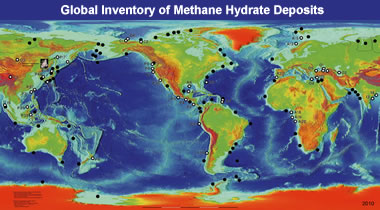
A number of outlets have picked up on this story, and it's easy to see why. This is another classic we-thought-it-would-take-thousands-of-years moment. In recent years methyl hydrate deposits in the Arctic, and especially the shallow deposits in the East Siberian Arctic Shelf, have grabbed the spotlight. Another recent study made headline when it warned of large methane deposits under Antarctica. It seemed that methane was on the move North and South, and the poles grabbed most of the popular attention. But:


Methane hydrates are over over the place. Including places in the ocean dramatically warmed by shifting ocean currents. So there's that.

Key points from the study include:

1. Methyl hydrate deposits are being destabilized by warming oceans right now.
2. We don't know how much of this carbon will make it into the atmosphere, vs contributing to the acidification of the oceans.
3. The study looked at part of the North American coastline, but this process is likely unfolding in other parts of the world as well.
4. Reports of the death of the clathrate gun hypothesis have been greatly exaggerated. This is only one of many recent studies to illustrate that carbon-cycle feedbacks have the potential to add large amounts of greenhouse gases to the atmosphere. How fast? Not overnight, but not necessarily over thousands of years, either.
5. With vulnerable carbon stores in the Arctic, the Antarctic, and on the continental shelves in between, it is becoming painfully clear that anthropogenic global warming is a game of Russian roulette played with a semiautomatic.

Thursday, January 19, 2012

Methane: a worse worst-case scenario

Real Climate has weighed in on the Arctic methane question, and, as always, their contribution is cogent, well-considered, and reasonable:
But the methane worst case does not suddenly spell the extinction of human life on Earth. It does not lead to a runaway greenhouse. The worst-case methane scenario stands comparable to what CO2 can do. What CO2 will do, under business-as-usual, not in a wild blow-the-doors-off unpleasant surprise, but just in the absence of any pleasant surprises (like emission controls). At worst comparable to CO2 except that CO2 lasts essentially forever.
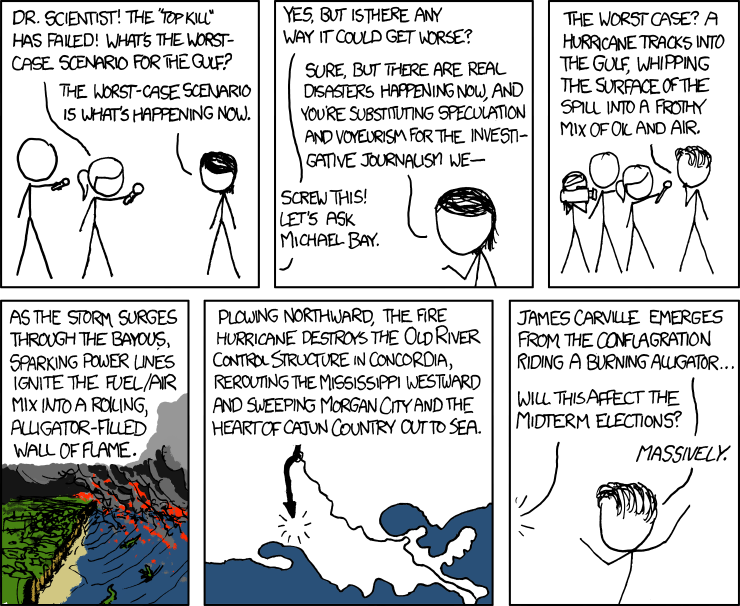
It's comical (which I suppose is the point) the degree to which Randall Munroe captured this perspective in this 2010 cartoon:


"The worst-case scenario is what's happening now." Indeed it is. And we shouldn't allow ourselves to be distracted from the certain disaster of BAU CO2 emissions by the possible disaster of the rapid release of methyl hydrates.

That said -- and at the risk of sounding like stick-figure Michael Bay -- their worst-case scenario is pretty tame -- they increased Arctic emissions by a factor of a hundred compared to today. While that sounds like a lot, a mere 10% annual increase starting in 2010 would push us past that mark in 2060. That's a fair "nasty surprise" scenario, but I don't see how you can really call it "worst-case."

Helpfully, Real Climate rapidly followed the original post with a second one providing an online methane release model. So we can easily look at a Mississippi-rerouting, flaming alligator scenario. Here goes:
While we have estimated the Arctic methyl hydrates at about 2,000Gt, those estimates have varied by a factor of eight from one study to another. In the worst case, we have underestimated the amount of methane, and there is about 8,000Gt under the Arctic, and 40,000Gt worldwide.

In 2023, the Arctic unexpected flips over to a new high-convection state that is ice-free year-round. The Arctic rapidly warms by 15-20C (as it did the last time CO2 hit 390ppm). In this new regime, Arctic methyl hydrates prove far less stable than we thought, and 80% of them are released over the next 170 years. The warming driven by that plus human CO2 even destabilizes a small portion of the global methyl hydrate deposits, previously thought to be safe: 20% of them degas in the same time period.
So 80% of Arctic methyl hydrates (6,400Gt) plus 20% of the rest (6,400Gt) = 12,800Gt over a hundred and seventy years (2023 -- 2193). Plug that into the model and we get:


We rapidly build to a total change in forcing of +25 W/m^2. Because the atmospheric processes that oxidize methane to CO2 cannot keep up, the methane becomes a long-lived greenhouse gas, the average molecule hanging around for decades instead of years:

 With the radiative forcing of seven doublings of CO2, total warming quickly exceeds +15C (on its way to +20C), rendering most of the earth's surface uninhabitable:

Sherwood (2010). +12C.
The blue and red (and black) on the graph indicate areas likely habitable by humans (absent 24-hour climate-controlled environments) in a +15C world. At +20C, it's Greenland, Iceland, Antarctica or fry.

The Amazon and the boreal forest burns; massive anoxic events spread across the oceans; billions fight over the last scraps of habitable land even as plummeting agricultural yields kill billions by starvation. The living envy the dead.

And that, my friends, is a real worst-case scenario.


Thursday, December 29, 2011

Revkin vs Revkin: the final battle


Andrew Revkin has completed his methane trilogy. The final installment, "More Views on Climate Risk and Arctic Methane," like part two "Leaders of Arctic Methane Project Clarify Climate Concerns" could be taken as a debunking of his original post on the subject ("Methane Time Bomb in Arctic Seas – Apocalypse Not"). But I prefer to think of it as journalism (very good journalism, when all is said and done) in real time.

 Revkin begins his journey with the piece in the Independent, which he (correctly) recognizes as overhyped. He thinks he already knows this is rubbish, based upon his reporting in 2010:

This all builds on what I was told in 2010, when I last visited the question of methane releases from Arctic seas. . . .  I urge you to read, and pass around, the 2010 post — “The Heat Over Bubbling Arctic Methane.”
He talks to a couple of scientists, and gets a couple of quotes bolstering his view that nothing can have changed:

To review, the authors confirm “drastic bottom layer heating over the coastal zone” that they attribute to warming of the Arctic atmosphere, but conclude that “recent climate change cannot produce an immediate response in sub-sea permafrost.” That’s the understatement of the year considering their conclusion that even under sustained heating, the brunt of the sub-sea methane won’t be affected in this millennium.
We of course do not need the brunt of it, but only, say 2% of it, to radically transform the world(1). No matter. Onward to the "publish" button!

Yet, he cannot have been without the nagging feeling that he forgot something. Something kind of important. Something like talking to the scientists being debunked. But they were on vacation! (2)

So, to his credit, he does a follow-up to that post when Natalia Shakhova and Igor Semiletov check in. And Revkin is no Michael Bay; his sequels are all better than the original. In part two, we find that these researchers were not panicky about methane plumes, as the Independent made them sound, be had real and legitimate concerns about the accuracy of the models Revkin spent his first post praising:

Yes, modeling is important. However, we know that modeling results cannot prove or disprove real observations because modeling always assumes significant simplification and should be validated with observational data, not vice versa. Much of our work includes this field validation. Last spring, we extracted a 53-meter long core sample from the East Siberian Arctic Shelf, to validate our conclusions about the current state of subsea permafrost. We found that the temperatures of the sediments were from 1.2 to 0.6 degrees below zero, Celsius, yet they were completely thawed. The model in the Dmitrenko paper [link] assumed a thaw point of zero degrees. Our observations show that the cornerstone assumption taken in their modeling was wrong.
The obvious thing to do after this bombshell was to talk to even more scientists, which Revkin has now done. While none of them look like retreating to a compound in the Rockies just yet, no one appears quite as sanguine as the December 14 Revkin of "Apocalypse Not":

Raymond T. Pierrehumbert: But the clathrate release problem is in a rather different category from the runaway greenhouse issue. It has to be seen as just one of the many fast or slow carbon catastrophes possibly awaiting us, in a system we are just groping to understand. The models of destabilization are largely based on variants of diffusive heat transport, but the state of understanding of slope avalanches and other more exotic release mechanisms is rather poor — and even if it turns out that rapid methane degassing isn’t in the cards, you still do have to worry about those several trillion metric tons of near-surface carbon and how secure they are. It’s like worrying about the state of security of Soviet nuclear warheads, but where you have no idea what kind of terrorists there might be out there and what their capabilities are — and on what time scales they operate.

Edward Brook: One problem with this discussion is that there is no definition of “time bomb” so people get confused. It seems quite likely that continued global warming will increase the emissions of methane from permafrost deposits and marine hydrates. Some of that will get in to the atmosphere, though … some will also be consumed in the water column and in soils. This “chronic” source may increase over time, and affect climate, but for the reasons you discussed it is likely to be slow, and not a catastrophic risk. [So we can't say there's nothing to worry about for a millennium?] Of course it is still important
He goes on to quote a few other scientists to the effect that yes, methyl hydrates may contribute to climate change as a feedback, but no, massive near-instantaneous releases don't seem very likely. Which is comforting, of course, but only up to a point. Besides the fact that they could be wrong (and we know that climate science is not at its best when predicting when stuff is gonna melt) even if they are spot on, how gradual are we talking? Suppose a linear release over a thousands years -- 0.1% per year. That's 1.7 Gt of methane -- roughly half the amount of methane in the atmosphere today. Even if half of it were oxidized in the water column, you would still double the amount of methane in the atmosphere in four years and increase it by a factor of ten in fairly short order. Sweet dreams.

I can't judge Andrew Revkin harshly in this. It's impossible for me to dislike the man (how could I -- he left a comment on my blog!) The worst thing you can say about him is, he's a blogger. He's quick off the draw. Sometimes he'll print first and collect more facts afterwards. He has hobbyhorses and is the more likely to launch into debate to defend positions he's staked out before. But he will keep eleborating, keep talking to people, and correct his original views where they were excessive or misinformed (though you still need to change the date of publication (Oct 19, not Dec 6) in your original post, Andy!) What can I say to that, without being a hypocrite? Let he who has never done a quick edit after reading comments, cast the first stone.


_________________________

1) 2% of 1700Gt = 34Gt, increasing the existing methane burden in the atmosphere by a factor of tem, with a change in forcing of about +4W/m^2. Given that such a release over a short time period would overwhelm the supply of reactive species to break it down, despite methane's normally short life in the atmosphere, you'd probably be looking at a good 30 years of that before it even began to wane.

2) If I had ever made that excuse to an editor of mine, they would have fried me in extra virgin olive oil and served me with a light white sauce. Especially if I included nothing in the piece to the effect that "I tried to contact these people, but I couldn't reach them."

Tuesday, December 27, 2011

Semiletov and Shakhova report


The methane researchers who disturbed our rest and inspired immediate, pre-communication debunking by Andrew Revkin, Semiletov and Shakhova, now explain their concerns to him based on the recent findings:
We would first note that we have never stated that the reason for the currently observed methane emissions were due to recent climate change. In fact, we explained in detail the mechanism of subsea permafrost destabilization as a result of inundation with seawater thousands of years ago. We have been working in this scientific field and this region for a decade. We understand its complexity more than anyone.  And like most scientists in our field, we have to deal with slowly improving understanding of ongoing processes that often incorporates different points of views expressed by different groups of researchers.
Yes, modeling is important. However, we know that modeling results cannot prove or disprove real observations because modeling always assumes significant simplification and should be validated with observational data, not vice versa. Much of our work includes this field validation. Last spring, we extracted a 53-meter long core sample from the East Siberian Arctic Shelf, to validate our conclusions about the current state of subsea permafrost. We found that the temperatures of the sediments were from 1.2 to 0.6 degrees below zero, Celsius, yet they were completely thawed. The model in the Dmitrenko paper [link] assumed a thaw point of zero degrees. Our observations show that the cornerstone assumption taken in their modeling was wrong. The rate at which the subsea permafrost is currently degrading largely depends on what state it was in when recent climate change appeared. It makes sense that modeling on an incorrect assumption about thaw point could create inaccurate results.
Observations are at the core of our work now. It is no surprise to us that others monitoring global methane have not found a signal from the Siberian Arctic or increase in global emissions. [This refers to the work of Ed Dlugokencky and others; see his comments in my Dot Earth post.] The number of stations monitoring atmospheric methane concentrations worldwide is very few. In the Arctic there are only three such stations — Barrow, Alert, Zeppelin — and all are far away from the Siberian Arctic. We are doing our multi-year observations, including year-round monitoring, in proximity to the source. In addition to measuring the amount of methane emitted from the area, we are trying to find out whether there is anything specific about those emissions that could distinguish them from other sources. It is incorrect to say that anyone is able to trace that signal yet.
All models must be validated by observations. New data obtained in our 2011 cruise and other unpublished data give us a clue to reevaluate if the scale of methane releases from the East Siberian Arctic Shelf seabed is assessed correctly (papers are now in preparation). This is how science works: step by step, from hypothesis based on limited data and logic to expanded observations in order to gain more facts that could equally prove or disprove the hypothesis. We would urge people to consider this process, not jump to conclusions and be open to the idea that new observations may significantly change what we understand about our world.
So what is the news here? The different thaw point result will need to be replicated. How far down the melt goes should be directly measured in as many locations as possible. Meanwhile, it should be trivial to do model runs at different thaw points and see what effect that might have.

Sunday, December 25, 2011

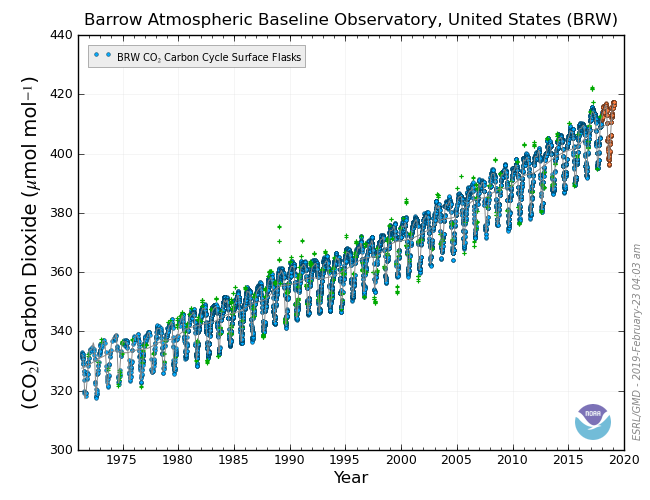
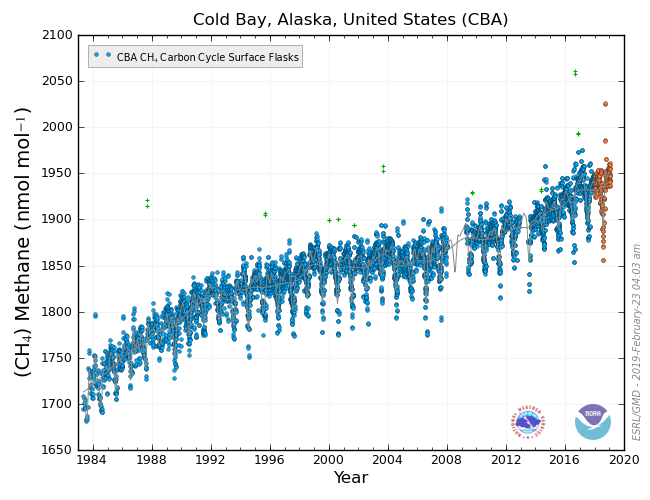
Alaska methane levels spike

Let's hope the data at the far right (which is preliminary and unconfirmed) represents a measurement artifact and not the postscript to Ed Dlugokencky recent reassurances:
[B]ased on what we see in the atmosphere, there is no evidence of substantial increases in methane emissions from the Arctic in the past 20 years.
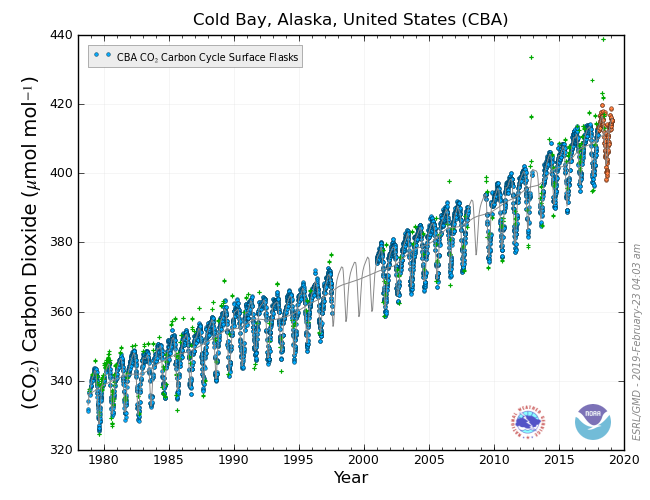
This came up at Neven's, whereupon it was pointed out that CO2 is spiking too:

Which could indicate the sensors are off. On the other hand, we would expect a significant fraction of any undersea methane release to be oxidized to CO2, and melting permafrost also releases both gases . . . so I don't know that the presence of a similar anomalous spike in the CO2 measurements really helps us decide if the methane spike is real. Only time will tell, I suppose . . . updates as I find them.

UPDATE:

Cold Bay shows a spike for CO2:

But nothing out of the ordinary for methane:

While NOAA's interactive map is incredibly helpful, what one would not give for a few Siberian sites.

Friday, December 23, 2011

Making sense of methane

I'm traveling today, but here are a few review articles about methane which are free online:

"Atmospheric Methane: Trends and Impacts"
"As discussed earlier, increasing water vapor from methane could be leading to an increased amount of polar stratospheric clouds. Ramanathan (1988) notes that both water and ice clouds, when formed at cold lower stratospheric temperatures, are extremely efficient in enhancing the atmospheric greenhouse effect. He also notes that there is a distinct possibility that large increases in future methane may lead to a surface warming that increases nonlinearly with the methane concentration."
"Archer: Destabilization of Methane Hydrates: A Risk Analysis"
"Methane is less concentrated than CO2, and its absorption bands less saturated, so a single molecule of additional methane has a larger impact on the radiation balance than a molecule of CO2, by about a factor of 24 [Wuebbles and Hayhoe, 2002]. The radiative impact of CH4 follows the concentration to roughly the 1/3 power, while the CO2 impact follows the log of the concentration. To get an idea of the scale, we note that a doubling of methane from present-day concentration would be equivalent to 60 ppm increase in CO2 from present-day, and 10 times present methane would be equivalent to about a doubling of CO2." 

"Strong atmospheric chemistry feedback to climate warming from Arctic methane emissions"
"The indirect contribution to RF of additional methane emission is particularly important. It is shown that if global methane emissions were to increase by factors of 2.5 and 5.2 above current emissions, the indirect contributions to RF would be about 250% and 400%, respectively, of the RF that can be attributed to directly emitted methane alone. Assuming several hypothetical scenarios of CH4 release associated with permafrost thaw, shallow marine hydrate degassing, and submarine landslides, we find a strong positive feedback on RF through atmospheric chemistry. In particular, the impact of CH4 is enhanced through increase of its lifetime, and of atmospheric abundances of ozone, stratospheric water vapor, and CO2 as a result of atmospheric chemical processes."

. . . so make sense of it your own damn self! Kidding. Here are a some things I gleaned:

* The East Siberian Arctic Shelf is uniquely vulnerable, and this vulnerable formation has its own vulnerable sub-sections. So a leak, while serious, would not necessarily imply a planetary disaster.

* Doubling methane would increase forcing by about 0.4 - 0.6 W/m^2 (that is a harder number to find then you might think.) The calculation is complicated, because the effect of methane on water vapor, ozone, and reactive O2 species effects both the warming caused by the methane and the lifespan of the methane in the atmosphere.

* The impact of an event similar to the Storegga landslide I found helpfully described as "similar in magnitude and duration but opposite in sign to a large volcanic eruption." The largest known "mud volcanoes" have similar potential.


Overall, this is a complex but not unapproachable subject. Worriers like me will find plenty to worry about, but there are also good reasons why oceanic methane release is not the thing keeping methane scientists up at night. And the science and research is really cool.

Thursday, December 22, 2011

Justin Gillis on methyl hydrates

Justin Gillis' dead eyes will burn into you until he gets to the truth.

Man, I should buy a lottery ticket.

While we were working our way through the very excited British accounts of the methyl hydrate threat, and the very phlegmatic (but not entirely convincing) response of Andy Revkin, Justin Gillis came out with a fantastic article on permafrost that is already getting rave reviews. And I thought "I wish Justin Gillis would take on this methane thing."

And in less than a day, Justin Gillis took on the methane thing: "Arctic Methane: Is Catastrophe Imminent?" And Gills' sources, like Revkin's are not overly impressed with the threat of massive methane release:


While examples can already be found of warmer ocean currents that are apparently destabilizing such deposits—for example, at this site off Spitsbergen, an island in the Svalbard archipelago in the Arctic—the scientists explained that a pervasive ocean warming sufficient to destabilize a lot of methane hydrates would almost certainly take thousands of years.
And even if that happened, many scientists say that the methane released would largely be consumed in the sea (by bacteria that specialize in eating methane) and would not reach the atmosphere. That is what seems to be happening off Svalbard.
“I think it’s just dead wrong to talk about ‘Arctic Armageddon,’ ” said William S. Reeburgh, an emeritus scientist at the University of California, Irvine, who spent decades studying such matters and says the likely consumption of methane within the ocean should not be underestimated. “Most of this methane is never going to see the atmosphere.”
Nobody regards the case as closed, and more research is necessary, but most of the methane deposits lining the margins of continents would seem to be fairly low on the list of scientific concerns about global warming.
 But the Arctic is, perhaps, something of an exception:

The methane hydrate deposits in the Arctic Ocean may represent a somewhat greater hazard because the Arctic is warming so rapidly. Considerable attention was devoted to a paper published last year that found methane bubbling out across large areas of ocean above the East Siberian Shelf, which has some of the Arctic’s largest methane hydrate deposits.
But that paper did not prove that the methane release was new, much less that it was increasing. Subsequent work by others has in fact suggested that these particular deposits have probably been unstable and slowly breaking down since the end of the last ice age, some 10,000 years ago.
Moreover, the zone from which the methane is escaping appears to represent only a fraction of the total methane beneath the Arctic Ocean. Most methane hydrate is far enough below the sea floor that sediments serve as an insulating layer, limiting how fast heat can spread downward. Again, the most careful calculations seem to put any significant methane release at hundreds or even thousands of years in the future.
As I hope to describe in more detail later this week, methane measurements in the atmosphere are consistent with the picture I just outlined. They do not support the idea that any big new releases of methane are occurring in the Arctic yet, at least not on a sufficient scale to have an overall impact on the planet’s methane burden. So if a methane “time bomb” actually exists in the ocean, as some news stories would have you believe, it seems fairly clear that it hasn’t gone off yet.
Still, there’s no question that some scientists are worried about this issue — less by what we know than what we don’t. Carolyn Ruppel, a geophysicist with the United States Geological Survey, is leading some of the efforts to get better information and especially to map areas off northern Alaska that may contain deposits of methane hydrate. “We need a baseline” against which future changes can be judged, she said.
None of these reassurances are entirely satisfying as regards the recent observations, but until we have some clear numbers on those observations and preferably confirmation from another team at the Shelf, or detect a change in the atmospheric burden of methane, it's hard to judge how, if at all, the new observations are going to change how we see the situation under the East Siberian Arctic Shelf.

We await developments (I do feel somewhat better). Meanwhile, a couple of good sources:


Neven's post and thread are superb, as usual.
The Columbia Journalism Review went over the major articles in this mini-methane-stampede.

Monday, December 19, 2011

Semiletov v Dmitrenko: The tale of the tape


Thanks to Mr. Revkin's intrepid reporting, we now know that there is a bit of a schism afflicting researchers looking at methane release from the East Siberian Arctic Shelf (ESAS). After reporting on the permafrost model presented by Dmitrenko at the recent AGU meeting (a model that suggests methane releases in the Arctic are not going to markedly accelerate with climate change), Revkin relates:
Semiletov is finally in touch with me (he'd gone on vacation right after AGU) and you'll hear more on his work soon. He's very critical of Dmitrenko. This kind of back-and-forthing is the process of science in action.
And indeed it is. And both of these authors have many peer-reviewed climate studies to their name. They are both respectable professionals, and only time will tell who has a better sense of what is happening on the ESAS. I was interested, though, in how they compared to one another in terms of their stature in this field, so I did a little research.

There is no completely reliable and objective way to gauge the impact of a particular researcher in their field, but a commonly used rule of thumb is to look at the number of times their publications have been cited. Once a scientist crosses the great divide of peer-reviewed publication that separates him or her from a Monckton or a Glenn Beck, the next test of relevance is whether or not their work is useful to others in the field; whether it is considered to be work that needs to be addressed or built upon. Science that doesn't stand the test of time gets superseded or just ignored.

Citations, then, are a way to assess, within the scientific community, what Samuel Johnson called the only objective measure of greatness "length and duration of esteem."

One quick example of how this works. Steig (2009) analyzed temperature trends in Antarctica. A "skeptic," Ryan O'Donnell, with assistance from Steig, turned his critique of Steig (2009) into something that successfully navigated peer review -- O'Donnell (2010). Climate Audit then triumphantly proclaimed "O'Donnell et al 2010 Refutes Steig et al 2009." Watts gloated similarly.

With both publications in print for more than a year, let's see how they're doing:

Improved methods for PCA-based reconstructions: case study using the Steig et al. 2009 Antarctic temperature reconstruction (O'Donnell et al, 2010). Cited by 2.
"Warming of the Antarctic ice-sheet surface since the 1957 International Geophysical Year" (Steig et al, 2009). Cited by 163.
 So that's basically how it works. Better science tends to get more citations. So with that in mind, I searched Google Scholar for "Semiletov and methane," and "Dimitrenko and methane," and took the first five articles I could find:

Dimitrenko and methane
IA Dmitrenko, SA Kirillov, LB Tremblay… - Journal of Geophysical …, 2011 - agu.org 

None yet.


IA Dmitrenko, SA Kirillov, LB Tremblay… - Journal of Geophysical …, 2010 - agu.org

Cited by 8.

…, JA Hoelemann, I Dmitrenko… - SPECIAL PAPERS- …, 2007 - books.google.com

Cited by 2.

C Schultz - Eos, Transactions American Geophysical Union, 2011 - agu.org

This is a summary of the first paper. I did it again! But there's nothing else to plug in here. No citations.

J Hoelemann, M Makhotin, C Wegner, I Dmitrenko… - 2008 - utsa.edu

None.

Dmitrenko has a total of ten citations for these papers. I felt a little bad about this, so I looked into the matter some more, and found, based on his publications listed at the International Arctic Research Center, that he is more of a water-and-wind guy, and less of a permafrost-and-methane guy (nothing wrong with that). So I tried again with the publications listed here:

Dmitrenko, I, Kirillov S, Eicken H, Markova N. 2005. Wind-driven summer surface hydrography of the eastern Siberian Shelf. Geophysical Research Letters. 32:L14613.

Cited by 13.

Dmitrenko, I, Holemann J, Kirillov S, Berezovskaya S, Ivanova D, Eicken H, Kassens H. 2006. Sea ice impact on the periodical shallow water dynamics in the Laptev Sea (Siberian Arctic). Proceedings of the 16th IAHR International Symposium on Ice at Dunedin, New Zealand. :375-381.

Cited by 2.

Dmitrenko, I, Kirillov S, Ivanov VV, Woodgate R. 2008. Mesoscale Atlantic water eddy off the Laptev Sea continental slope carries the signature of upstream interaction. Journal of Geophysical Research. 113:C07005.

Cited by 5.

Dmitrenko, I, Tyshko K, Kirillov S, Hƶlemann J, Eicken H, Kassens H. 2005. Impact of flaw polynas on the hydrography of the Laptev Sea. Global and Planetary Change. 48:9-27.

Could not find with Google Scholar.

Dmitrenko, I, Polyakov IV, Kirillov S, Timokhov L, Simmons HL, Ivanov VV, Walsh D. 2006. Seasonal Variability of Atlantic Water on the Continental Slope of the Laptev Sea during 2002-2004. Earth and Planetary Science Letters. 244:735-743.

Cited by 11.

A total of 31 citations, or an average of six per publication (possibly depressed a bit by my inability to find citations for the fourth paper.)

Semiletov and methane
SA Zimov, YV Voropaev, IP Semiletov, SP Davidov… - Science, 1997 - sciencemag.org 

Cited by 116. 

[PDF] from instrument.com.cnN Shakhova, I Semiletov, A Salyuk, V Yusupov… - Science, 2010 - sciencemag.org

Cited by 55.

N Shakhova, I Semiletov… - Geophysical Research Letters, 2005 - agu.org

Cited by 36.

…, I Semiletov - Journal of Marine Systems, 2007 - Elsevier

Cited by 19.

N Shakhova, I Semiletov, A Salyuk… - Geophysical Research …, 2008 - geobc.gov.bc.ca

Cited by 11.

Total citations: 227.


Semiletov's least cited paper is cited almost as many times (11) as Dmitrenko's most cited (13). He has more than seven times as many citations. Also, interestingly, he's clearly something of a specialist in this area; finding five papers about Arctic methane by Semiletov was no trouble at all. Dmitrenko has expertise in the relevant fields of hydrology and the Arctic, but he seems to be something of a methane newbie; only the first paper, which Revkin references, from October 2011, is about methane emissions.

Dmitrenko is a serious scientist; his work should be and will be judged on its merits. Nothing against him. But taking a quick look at their respective records, Dmitrenko is a strange choice for a debunker of Semiletov's concerns. First, basic weight-class stuff:

1. Dmitrenko's top papers have been cited a few dozen times; Semiletov has hundreds of citations.

On methane:

2. Semiletov has been studying methane emissions from waterlogged permafrost for at least 15 years; Dmitrenko published his first paper on the subject three months ago.

On the type of studies:

3. Dmitrenko's is a permafrost modelling study; Semiletov recently returned with direct observations from the ESAS.

Final verdict: ADVANTAGE SEMILETOV for greater experience, and longer record, more respect from peers, and recent direct observations of the phenomenon in question. I award bonus points because the established methane researcher, with a longer record and more citations, would be the one we would expect would be downplaying recent changes and be disposed to assert continuity in the face of excitable newcomers to the field. If the old man is worried, well, it puts me in mind of the old joke shirt:


Sunday, December 18, 2011

Open letter to Andrew Revkin

Mr. Revkin, thanks for dropping by.

I appreciate your correction on the two sources you cited, the summary by the AGU and the paper itself. I’m sure you can understand how two pieces with different titles, different authors, and different dates of publication would appear to be different papers. I’ll correct the original post.

You may wish to correct this part of your post: “A paper published in Dec. 6. . . .” The summary was posted Dec 6; the paper was published Oct 19.

As to not being a “middleman” and avoiding “whiplash” -- I don’t entirely understand you here. You thought Semiletov et al were important enough to swiftly reply to the Independent piece, but not enough to speak with any of them or get an account of their findings? When you chose to write on Semiletov and the story in the Independent, you decided to get into a back-and-forth discussion. You then omitted Semiletov, leaving us with the -and-forth. I really don’t think that’s how you improve things.

I would be happier if instead of highlighting a paper published two months ago, you had been able to quote Dmitrenko as saying “Yeah, that Semiletov guy is a nut and his data on the ESAS are not to be trusted.” Then you’re telling one side of the story, but at least you’re telling the story. You didn’t do that; you brought out a modeling study from October.

Not that I don’t think you should remind us what the modeling is saying right now, but really. This expedition and the observations that led up to it are news. If they aren’t news, you should ignore them. If they are news, you can’t pull a book off the shelf and say you’ve explained the observations. It’s as if someone reported a mass revolt sweeping Jordan (surprising, unexpected, unlikely) and you replied by quoting a political science professor’s book from 2010 to the effect that popular revolutions were impossible in the Arab world.

Moreover, there is nothing like a consensus among scientists that we don’t need to worry about this issue or that the methane we’re seeing is just a 8,000-year dribbling out. Under the header "'Arctic Armageddon' Needs More Science, Less Hype" Richard Kerr wrote for the Journal Science that:

The threat of global warming amplifying itself by triggering massive methane releases is real and may already be under way, providing plenty of fodder for scary headlines. But what researchers understand about the threat points to a less malevolent, more protracted process.

Both sentences are part of the state of the science; but you appear to have chosen to only relate the latter part of the warning. I like everything you said about the modeling and Dmitrenko's team, but I think you needed to say more.

Saturday, December 17, 2011

Andrew Revkin on methane, ctd

Revkin responded to my criticism in a comment exchange at Quark Soup:

Andy Revkin said...
I sent several emails to Semiletov and others in his group since the AGU presentation. Happy to post when and if there's input from them on the points made by other scientists gauging the long-term risk question. Witnessing a lot of emissions now is important information, and monitoring is essential in such regions. But drawing conclusions about overall risk from this is not possible unless setting those observations against both basic understanding of sub-sea permafrost response to ocean warming and what can be learned by looking back 8,000 years ago etc.
This is a reasonable explanation of why Semiletov et al are not quoted in the article. It is common and uncontroversial to run without an important source when you have made a good faith effort to contact them and haven't been able to.

What confuses me, still, is why he didn't just say that. "I tried to contact Semiletov and others from his group, but no one replied." In addition to being basic good journalism, such a sentence to frame what Revkin is doing in the piece a lot more clearly. If I were his editor, I might suggest a revision, something (preserving Revkin's editorial intent) along the lines of:

There was a story in the Independent last week that tried to get us riled up about the possibility of rapid methane release from the East Siberian Arctic Shelf (ESAS). This story was ostensibly based on a recent expedition to the Shelf by Russian scientists, who were quoted in the article as finding "We carried out checks at about 115 stationary points and discovered methane fields of a fantastic scale – I think on a scale not seen before. Some plumes were a kilometre or more wide and the emissions went directly into the atmosphere – the concentration was a hundred times higher than normal."

While the Independent made this sound terrifying, they ran a very similar story in 2008, right down to the "intense concentrations of methane – sometimes at up to 100 times background levels." Semiletov and his team have not returned emails, and Semiletov's AGU talk is not available online. So the actual results of the trip are not yet available. But there is some important context to the story that the Independent didn't provide:

* Permafrost scientists think that the methane emissions seen from the ESAS over the last few years can be explained by their permafrost models and are part of an 8,000 year process that is not directly linked to global warming.

* They think the bulk of the permafrost is safe for the next thousand years.


Both of these studies are based on modelling and the emissions of prior years, so it's possible Semiletov's team has found something that will challenge those models. Until he publishes his results, or at the very least, starts returning my emails, the state of the science today is still that a rapid, massive release of methane sufficient to accelerate global warming is thought to be unlikely.
That's how I would have written it, not that the highly accomplished Andrew Revkin (no sarc, he's done a lot of great climate writing) needs my imput.

Meanwhile, we need to hear from Semiletov and colleagues. Did anyone hear their talk?

Friday, December 16, 2011

Andrew Revkin on methane -- Reassuring, but inaccurate

After the disturbing piece in the Independent, I was looking for somebody to talk me down, and Andrew Revkin seems to have set himself precisely that task in "Methane Time Bomb in Arctic Seas – Apocalypse Not." He is all reassurance:
If you read the Independent of Britain, you’d certainly be thinking the worst. The newspaper has led the charge in fomenting worry over the gas emissions, with portentous, and remarkably similar, stories in 2008 and this week.
If you read geophysical journals and survey scientists tracking past and future methane emissions, you get an entirely different picture:
A paper published in Dec. 6 in the Journal of Geophysical Research appears to confirm pretty convincingly that the gas emissions seen in recent years are from a thawing process that has been under way for 8,000 years — since seas rose sufficiently to cover the near-shore seabed.
I have to say, however, that the more Andy Revkin tries to play the part of the sane middle ground in the climate debate -- not too denialist, not too excited -- the less I am inclined to trust what he says at face value. "I occupy the sane middle ground" is an ideological self-description like any other, and Revkin regularly illustrates the distorting effects that rigidly pursuing that can have. Let's look at the abstract of the paper:
Summer hydrographic data (1920–2009) show a dramatic warming of the bottom water layer over the eastern Siberian shelf coastal zone (<10 m depth), since the mid-1980s, by 2.1°C. We attribute this warming to changes in the Arctic atmosphere. The enhanced summer cyclonicity results in warmer air temperatures and a reduction in ice extent, mainly through thermodynamic melting. This leads to a lengthening of the summer open-water season and to more solar heating of the water column. The permafrost modeling indicates, however, that a significant change in the permafrost depth lags behind the imposed changes in surface temperature, and after 25 years of summer seafloor warming (as observed from 1985 to 2009), the upper boundary of permafrost deepens only by ∼1 m. Thus, the observed increase in temperature does not lead to a destabilization of methane-bearing subsea permafrost or to an increase in methane emission. The CH4 supersaturation, recently reported from the eastern Siberian shelf, is believed to be the result of the degradation of subsea permafrost that is due to the long-lasting warming initiated by permafrost submergence about 8000 years ago rather than from those triggered by recent Arctic climate changes. A significant degradation of subsea permafrost is expected to be detectable at the beginning of the next millennium. Until that time, the simulated permafrost table shows a deepening down to ∼70 m below the seafloor that is considered to be important for the stability of the subsea permafrost and the permafrost-related gas hydrate stability zone.
Just as important, look at the dates on the paper:
Received 18 April 2011; accepted 28 July 2011; published 19 October 2011.
Sharp readers will note that the dates don't match; the date of publication is Oct 2011, not Dec 2011. We'll get to that in a minute. For the moment let's focus on the paper itself.

Now, I'm not sure this is quite as reassuring vis-a-vis the boiling seas of the East Siberian Arctic Shelf as Revkin seems to think. For although he says "A paper published in Dec. 6 in the Journal of Geophysical Research appears to confirm pretty convincingly that the gas emissions seen in recent years are from a thawing process that has been under way for 8,000 years" this paper was submitted in April, months before scientists were dispatched to the shelf to investigate the expanding methane plumes. So while the study may reassure us about emissions "in recent years" it has nothing to say, specifically, about what the Independent was reporting about -- the very recent trip to examine the area after reports of huge plumes of gas.

Let me be very clear: here at IT, we listen to scientists; we don't dismiss them. Revkin talked to permafrost experts, who feel the recent plumes can be accounted for by their permafrost model. That model also says we don't need to worry about a large amount of methane escaping the East Siberian Arctic Shelf. However, it does not appear that that model was developed with, tested by, or compared to the data from the expedition dispatched in September (remember, the paper was submitted in April!) So unless there is more to the story, the scientists Revkin spoke with may think they can explain the observations, but they haven't explained the observations as yet. Indeed, the observations haven't even been reported yet.

I initially assumed -- I'm sure this wasn't deliberate on Revkin's part -- that when he referred to a paper published Dec 6, which reassures us about the findings of the expedition dispatched in September, that the paper was about the expedition dispatched in September. It is not. It's about a model of permafrost melting. And to be absolutely clear, we do not scorn modelling studies at IT. They are very important. The paper says that the model can adequately explain the small methane plumes observed in prior years as part of a long-term process, not a short-term, rapidly worsening degradation of permafrost. But there is no indication that the model has been tested against the new observations. The timeline doesn't seem to work.

I also thought -- and this time based on what Revkin explicitly stated -- that he had linked to the study published on Dec 6. Here's the quote:
But read this summary of the paper from the American Geophysical Union, which publishes the journal, and see if you feel reassured that the “methane time bomb” there is safe for a long time to come:
[T]he authors found that roughly 1 meter of the subsurface permafrost thawed in the past 25 years, adding to the 25 meters of already thawed soil. Forecasting the expected future permafrost thaw, the authors found that even under the most extreme climatic scenario tested this thawed soil growth will not exceed 10 meters by 2100 or 50 meters by the turn of the next millennium. The authors note that the bulk of the methane stores in the east Siberian shelf are trapped roughly 200 meters below the seafloor… [Read the rest.]
Here’s the link to the paper itself: “Recent changes in shelf hydrography in the Siberian Arctic: Potential for subsea permafrost instability.”

But if you click on the link to the AGU summary, you quickly slowly realize that these are two different papers, one called "Siberian shelf methane emissions not tied to modern warming" by Colin Schultz, and “Recent changes in shelf hydrography in the Siberian Arctic: Potential for subsea permafrost instability,” by Dmitrenko et al. the AGU summary was published Dec 6; the actual paper was published October 19.

So Revkin has conflated two different papers by different authors into one confused the summary's date of publication with the paper itself; he started off talking about the Independent's account of Dr. Semiletov's recent trip to the Arctic and his recent AGU presentation, but he didn't talk to Semiletov or reference that presentation.

So the Independent did publish a sensational story, a story that does look remarkably similar to one they published in 2008 (a good catch by Revkin.) But if you are comparing the two stories, the Independent's has this claim: they actually wrote about the findings of the expedition. They referred to Semiletov's talk at the AGU, which presumably relates to his paper in press "Trace gas emissions from sub-sea permafrost" (no abstract I could find) and not to either of the papers published by different authors about permafrost models developed prior to the recent observations.

So while it is as a general rule wise not to panic, and, especially on the subject of science, to wait for the dust to settle before reaching any conclusions, all the facts cited by Revkin in support of his languor are reported inaccurately and/or oversold.

Andy Revkin now wears the hat of a blogger, but he sometimes seems to have brought with him into his new career the very attributes that brought about the decline of traditional journalism: he is sloppy, he cares more about appearing moderate and fair than reporting the facts accurately, and while tsk-tsking at the sensationalism of the Independent, he neglects to do the basic stuff like talking to the principal people involved and actually getting the facts about the subject of his article.

Update: Revkin's response is below. I reply here.

Wednesday, September 21, 2011

More methane madness


From "arctictransport":

Something strange


Commercial shipping through the Northeast Passage over the last couple weeks has reported the seas bubbling as if they were boiling.  Their observations have been reported to the science ministry who have sent scientists to investigate.
H/t Steve Bloom.

The image above is from "Strong atmospheric chemistry feedback to climate warming from Arctic methane emissions" (Isaksen et al 2011). Although it sounds specialized, the paper, which is available in full, answers a number of basic beginner's questions about methane release (I needed to look those up . . . for a friend. Or for you, the reader. Yeah, that's it. For you the reader.)

1. How much methane is in the atmosphere now?


"The atmospheric concentrations in 2005 correspond to an atmospheric burden of 4,900 Tg CH4 (1 Tg = 1012 g)."


2. How long does it reside in the atmosphere?


"Atmospheric CH4 has a global average atmospheric lifetime of approximately 8 to 10 years [Denman et al., 2007]."


3. Why so brief, compared to CO2?

"Atmospheric CH4 is removed through oxidation by the hydroxyl radical (OH), mainly in the troposphere: R1    CH4 + OH --> H2O + CH3"


4. What is its ultimate fate?


Mostly to decay to CO2 (and ozone). So the best case scenario when you lose a ton of methane into the atmosphere is that it quickly oxidizes into a ton of CO2. Which, since it hangs around a lot longer and is the stuff that got us into this mess, is not so great.

5. There are only so many the hydroxyl radicals (OH) in the atmosphere. What happens if you release a bunch of it all at once?

It hangs around longer -- much longer -- leading to the amplified warming effect that gives the paper its title.


6. How much methane is in methyl hydrate deposits, compared to the atmosphere?

"The most recent review of the numerous published estimates of the amount of methane sequestered in global gas hydrate deposits converges on a range of 3 to 40 × 1015 m3 of methane [Boswell and Collett, 2011], which converts to a range of ∼1,600 to 21,000 Pg C."

1Pg = 1,000 Tg. So the amount of methane in the deposits is estimated to be between 300 times as much and 42,000 times as much as the total amount of methane in the atmosphere today.

7. Fuck me.

If any significant fraction of it escaped into the atmosphere on a human timescale, yes, that would be the general idea.

8. Could that happen? Really?

"Shakhova et al. [2008] speculate that 50 Pg CH4 could be released abruptly at any time from gas hydrates associated with subsea permafrost. Although there is no basis for estimating the rate of such a release, this value is used as a worst case scenario for the numerical model studies."

 9. Do they think such a release is likely?


No. "Although the high‐emission scenarios are unlikely to occur, they are compatible with the current knowledge of the cumulative magnitude of CH4 that might be emitted from permafrost thawing and from CH4 hydrate destabilization."

10. But worse case?

It's hard to call this the worst case, since what they are postulating is the release of less than 1% of the total reserves. But for the estimate they chose as a plausible worst case, 50 Pg, the short-term effect would be a global increase in radiative forcing of about 4W/m^2 (although, confusingly, they say 50 Pg could be released in one year, and then they model it as released over thirty years, significantly blunting the effect.)


The effect would be similar to doubling CO2 concentrations overnight. Temperatures would immediately rise, probably by 1-2C, with further rises in the following decades, depending on just what the actual climate sensitivity turns out to be.


Final thoughts from Iksaksen:


Fossil fuel CO2 emissions have increased substantially over the last decade and is now 40% higher than in 1990 [Le Quéré et al., 2009; Myhre et al., 2009]. The continued increase in greenhouse gas emissions toward the end of this century has the potential to produce significant warming at high northern latitudes well beyond what has been observed during the last decades [Hansen et al., 2007; IPCC, 2007]. There is a possibility that the Arctic temperature increases could be followed by extensive permafrost thawing, with enhanced CH4 emission from thermokarst lakes [Walter et al., 2006], with later release of CH4 from gas hydrates that would eventually be affected by warming temperatures. Considering the large, nonlinear atmospheric chemistry feedbacks discussed here, future CH4 emissions from permafrost deposits could be a larger concern for climate warming than previously thought.


Monday, September 19, 2011

Is there still a clathrate gun pointed at our heads?


"The ice that burns" -- frozen methane


Two hundred and fifty million years ago, massive seafloor deposits of frozen methane destabilized, leading to the release of of thousands of gigatons of stored carbon and a global temperature spike of over +6C. Ninty-six percent of marine species and 70% of terrestrial vertebrates were wiped out. The trigger for this massive release of methyl hydrates was a more gradual global warming of a few degrees.

Extinction events -- intensity


Like any event 250 million years ago, details are hard to come by. But there is at least one reason to implicate methyl hydrate release in the Permian-Triassic extinction event: a hundred and ninety million years later, the same thing happened again. Gradual global warming, followed by a rapid release of massive amounts of carbon with a distinct isotope signature, followed by rapid global warming that ended with tropical fish swimming at the North Pole.


But don't worry. That definitely probably maybe couldn't happen again on a human timescale. As 
McGuire noted for the Royal Society in 2010:
While rising ocean temperatures will tend towards destabilizing hydrates, increasing load pressures as a result of rising sea levels will act in the opposite sense. Maslin et al. (2010) note that, even if marine hydrate dissociation is triggered on a large scale, it may be that all or much of the methane released will not reach the atmosphere because either (i) thermal penetration of marine sediments to the gas-hydrate interface could be sufficiently tardy as to allow a new equilibrium to become established without significant gas release or (ii) a fraction of any gas released may be oxidized in the ocean.
 The paper McGuire alludes too, "Gas hydrates: past and future geohazard?" has been discussed here before. It is linked to on the right. It typifies the cautiously optimistic attitude of climate scientists towards the possibility of a rapid, catastrophic release of methyl hydrates, aka methyl clathrates, the "clathrate gun hypothesis."
It is still unknown whether future ocean warming could lead to significant methane release, as thermal penetration of marine sediments to the clathrate–gas interface could be slow enough to allow a new equilibrium to occur without any gas escaping. Even if methane gas does escape, it is still unclear how much of this could be oxidized in the overlying ocean. Models of the global inventory of hydrates and trapped methane bubbles suggest that a global 3°C warming could release between 35 and 940 GtC, which could add up to an additional 0.5°C to global warming. The destabilization of gas hydrate reserves in permafrost areas is more certain as climate models predict that high-latitude regions will be disproportionately affected by global warming with temperature increases of over 12°C predicted for much of North America and Northern Asia. Our current estimates of gas hydrate storage in the Arctic region are, however, extremely poor and non-existent for Antarctica. The shrinking of both the Greenland and Antarctic ice sheets in response to regional warming may also lead to destabilization of gas hydrates. As ice sheets shrink, the weight removed allows the coastal region and adjacent continental slope to rise through isostacy. This removal of hydrostatic pressure could destabilize gas hydrates, leading to massive slope failure, and may increase the risk of tsunamis.
Hmmm. I have to say, even that article is not as reassuring as I remembered it being. But there has certainly been a period in recent years in which scientists have thrown cold water on some of the more lurid disaster scenarios. Take this very recent paper, focusing on the Arctic, where, Maslin notes, destabilization of methyl hydrates is "more certain":
Vast amounts of methane hydrates are potentially stored in sediments along the continental margins, owing their stability to low temperature - high pressure conditions. Global warming could destabilize these hydrates and cause a release of methane (CH4) into the water column and possibly the atmosphere. Since the Arctic has and will be warmed considerably, Arctic bottom water temperatures and their future evolution projected by a climate model were analyzed. The resulting warming is spatially inhomogeneous, with the strongest impact on shallow regions affected by Atlantic inflow. Within the next 100 years, the warming affects 25% of shallow and mid-depth regions containing methane hydrates. Release of methane from melting hydrates in these areas could enhance ocean acidification and oxygen depletion in the water column. The impact of methane release on global warming, however, would not be significant within the considered time span. 
There may be reasons for concern outside the Arctic as well. The best recent review article on the subject and the inspiration for my revisiting the issue is (full text): "Methane release from gas hydrate systems during the Paleocene-Eocene thermal maximum and other past hyperthermal events: setting appropriate parameters for discussion" (Biastoch et al, GRL, 2011). He cites Zeebe (2009) (which I can't access) for the following: "the Atlantic reservoir . . . is the most likely location of an oceanic carbon release."

And in another of those funny little quirks of the actual vs the model climate, the Atlantic Ocean is warming far faster than expected,  likely due to the "leaking" of warm water from the Indian Ocean caused by the weakening of the mighty Agulhas Current.


Weakening of the Agulhas Current means more of the hot subtropical water you see in the figure above remains behind in the cold Atlantic.

Skeptical Science has more on the disturbing implications of Biastoch (2011):
Carozza et al (2011) find that natural global warming occurred in 2 stages:  First, global warming of 3° to 9° C accompanied by a large bolus of organic carbon released to the atmosphere through the burning of terrestrial biomass (Kurtz et al, 2003) over approximately a 50-year period; second,  a catastrophic release of methane hydrate from sediment, followed by the oxidation of a part of this methane gas in the water column and the escape of the remaining CH4 to the atmosphere over a 50-year period.
The description of Stage 2:  Very rapid and massive release of carbon deficient in ∂13C, does put one in mind of the Methane Gun hypothesis.  It postulates that methane clathrate at shallow depth begins melting and through the feed-back process accelerate atmospheric and oceanic warming, melting even larger and deeper clathrate deposits.  The result:  A relatively sudden massive venting of methane - the firing of the Methane Gun.  Recent discovery by Davy et al (2010) of kilometer-wide (ten 8-11 kilometer and about 1,000 1-kilometer-wide features) eruption craters on the Chatham Rise seafloor off New Zealand adds further ammunition to the Methane Gun hypothesis.
Remember, this is not the methyl hydrate release that wiped out 96% of marine life and 70% of terrestrial vertebrates. That was 250 million years ago. This one was 60 million years ago -- relatively mild by comparison.

Just like we used to with ice loss, we comfort ourselves with the notion that warm air takes a long time to melt anything:
Significant methane release can occur when on-shore permafrost is thawed by a warmer atmosphere (unlikely to occur in significance on less than a century timescale) and undersea clathrate at relatively shallow depths is melted by warming water.  This is now occurring.  In both cases, methane gas bubbles to the surface with little or no oxidation, entering the atmosphere as CH4 – a powerful greenhouse gas which increases local, then Arctic atmospheric and ocean temperature, resulting in progressively deeper and larger deposits of clathrate melting.
However you have the same problem with that projection as befell the reassuring forecasts for ice mass loss: these deposits are surrounded by water. Warm water carries heat far more efficiently than warm air. Increased rainfall and changes in groundwater, ocean currents, and freshwater streams already shows some indications of accelerating permafrost melting, and water dynamics may, by implication, affect shallow methyl hydrates as well.

Skeptical Science continues with these heavily qualified reassurances:
Methane released from deeper deposits such as those found off Svalbard has to pass through a much higher water column (>300 meters) before reaching the surface.  As it does so, it oxidises to CO2, dissolving in seawater or reaching the atmosphere as CO2 which causes far slower warming, but can nevertheless contribute to ocean acidification.
Since the carbon mass of methyl hydrates dwarfs known fossil fuel reserves, the prospect of their release as CO2 is cold comfort. But consider how (again, just like our old, falsely reassuring, ice models) this scenario presumes a gradual, linear process. What if methyl hydrates disassociate rapidly, and produce a local anoxic event? No oxygen in the water, no oxidation of methane. What isf the methane starts to escape in discreet events, producing a column of gas, like this:


Would a large plume of gas shield the methane at the center from oxidization? Would a column of bubbles reduce friction on the individual bubbles, allowing them to rise faster and have less time to oxidize? Stupid questions, maybe. I hope smarter people than me have considered such possibilities and found them unlikely.

Is there a clathrate gun pointed at our heads? Scientists are conservative. They don't like to paint doomsday scenarios. We've all seen interviews with journalists that flounder on the shoals of their rightful, sound reticence:

Worst-Case Scenario

So let's give the last word to somebody determined to be as conservative as possible, titling their article "'Arctic Armageddon' Needs More Science, Less Hype":
 Methane is a powerful greenhouse gas 25 times more potent than carbon dioxide, and the ongoing global warming driven by carbon dioxide will inevitably force it out of its frozen reservoirs and into the atmosphere to amplify the warming. Such an amplifying feedback may have operated in the past, with devastating effects. If the modern version is anything like past episodes, two scientists warned earlier this year, it could mean that "far from the Arctic, crops could fail and nations crumble." Yet, with bubbles of methane streaming from the warming Arctic sea floor and deteriorating permafrost, many scientists are trying to send a more balanced message. The threat of global warming amplifying itself by triggering massive methane releases is real and may already be under way, providing plenty of fodder for scary headlines. But what researchers understand about the threat points to a less malevolent, more protracted process.
I love how reassuring and level-headed the author is trying to be while still being honest about the not-very-reassuring facts. Well, yes, he says, release of methyl hydrates is going to happen. And yes, in the past, when this happened, the results have been "devastating." Yes, this could rapidly accelerate global warming: we know that because there's evidence it's already happening. But there's no reason to panic. Everyone should remain calm. If you don't remain calm you will waste our precious shotgun shells as your trembling hands cause you to miss the looters.

There seems to be cause for concern. No hype needed.

UPDATE: This morning Ari JokimƤki at AGW Observer posted his usual weekly climate news roundup, and, low and behold, there's a methyl hydrates study. Ari's a phlegmatic fellow who highlights middle-of-the-road, non-sensationalist, workaday climate research. Surely this study will talk me down from the clathrate-gun ledge.


Methane release from hydrates may already be occurring
Shit, Ari. What are you doing to me here? I guess we need to read on. After all "'Arctic Armageddon' Needs More Science, Less Hype" turned out to be fairly scary; maybe this one, with a scary headline, will turn out to be soothing. Let's see:

Contribution of Oceanic Gas Hydrate Dissociation to the Formation of Arctic Ocean Methane Plumes – Reagan et al. (2011) “Vast quantities of methane are trapped in oceanic hydrate deposits, and there is concern that a rise in the ocean temperature will induce dissociation of these hydrate accumulations, potentially releasing large amounts of carbon into the atmosphere. Because methane is a powerful greenhouse gas, such a release could have dramatic climatic consequences. The recent discovery of active methane gas venting along the landward limit of the gas hydrate stability zone (GHSZ) on the shallow continental slope (150 m – 400 m) west of Svalbard suggests that this process may already have begun, but the source of the methane has not yet been determined. This study performs 2-D simulations of hydrate dissociation in conditions representative of the Arctic Ocean margin to assess whether such hydrates could contribute to the observed gas release. The results show that shallow, low-saturation hydrate deposits, if subjected to recently observed or future predicted temperature changes at the seafloor, can release quantities of methane at the magnitudes similar to what has been observed, and that the releases will be localized near the landward limit of the GHSZ. Both gradual and rapid warming is simulated, along with a parametric sensitivity analysis, and localized gas release is observed for most of the cases. These results resemble the recently published observations and strongly suggest that hydrate dissociation and methane release as a result of climate change may be a real phenomenon, that it could occur on decadal timescales, and that it already may be occurring.Reagan, M. T., G. J. Moridis, S. Elliott, and M. E. Maltrud (2011), J. Geophys. Res., doi:10.1029/2011JC007189, in press.