Showing posts with label myths about climate change. Show all posts

Monday, January 24, 2011

Minor myth: Russian scientists don't believe in global warming

I came across this meme at The Blackboard recently:

By the looks of the 1970-2010 map, it looks like Russia has warmed by over 1.6, yet we never hear them talking about the warming in Russia.


Strange assertion. As I recall, the Russians were fairly screaming about global warming last summer when half the country was on fire. This particular denialist does not have a firm grasp on reality at the best of times, so I didn't think much of it, but then, further down in the thread, it appears again:

Dave Andrews (Comment#67052) January 24th, 2011 at 2:37 pm

One of the areas that GISS always highlights as a ‘hotspot’ is Siberia.

Why then do Russian scientists seem unimpressed with the evidence for AGW?


There seems to be no basis for this nonsense in fact, as the members of the Russian Academy of Sciences is in agreement with thousands of other scientists around the globe:

“In 2005, the Academies issued a statement emphasising that climate change was occurring and could be attributed mostly to human activities, and calling for efforts to tackle both the causes of climate change and the inevitable consequences of past and unavoidable future emissions. Since then the IPCC has published the Working Group 1 part of the Summary for Policymakers of its fourth assessment report, and further reports are expected later this year from IPCC. Recent research strongly reinforces our previous conclusions.”


This myth may have originated with Yury Izrael, a science adviser to Vladimir Putin who, much like the science advisers of right-wing politicians in the West, feels global warming is no big deal. He is a "lukewarmer" in that he agrees with the scientific consensus that the world will warm significantly by 2100 -- 1.4 to 5.8 degrees, in fact. But, he thinks people will do just fine with that level of warming.

The first instance I can find of denialists attributing particular scientists' views with Russians in general -- "Ruskies call Global Warming Rubbish" -- refers to Habibullah Abdusamatov, who supposedly (we have to remember, Abdusamatov's views are being filtered through journalist, translator, and blogger) thinks that we are at the peak of a natural warming cycle and global cooling will begin in 2012.

The third Russian to make headlines in the denialist blogosphere is Oleg Pokrovsky, who last April, nine months before 2010 became the warmest year on record, projected global cooling. This was, of course, celebrated by WUWT and its commentators, always ready to find a reason to celebrate the like-minded:

#
H.R. says:
April 23, 2010 at 12:43 pm

If anybody knows cold, it’s the Russians.

As best I know, the Russians don’t have a dog in the AGW fight, other than a strategic interest in how the rest of the world can wreck their economies by taxing carbon, so I think their researchers are probably less likely to be looking for a predetermined outcome.
#
wws says:
April 23, 2010 at 12:51 pm

What irony! The Russians have embraced empirical scientific standards, while our elites have embraced the scientific standards of Lysenko!

#
Dave Stephens says:
April 23, 2010 at 1:07 pm

God bless the Russkies! They’ve been saying, “Nyet!” for quite a while now… And the warmistas ignore them at their peril just like they ignore India and China. Consensus? Not on this planet and not on Lenin’s Birth/Earth Day either…
#
Bill Tuttle says:
April 23, 2010 at 1:15 pm

…an Arctic cold snap that began in 1998…

Buh-buh-but what about the melting muskeg releasing all that methane? And the vanishing ice cap, and polar bears bursting into flames?

Darn pragmatic Rooskies, looking at actual temperatures instead of computer models!


So to sum up, we have three Russian scientists out of many thousands who seem to be "skeptics" as their American counterparts style themselves. Like their American counterparts, they all disagree about what is happening. Yury Izrael thinks warming is happening and will continue to happen, but will not be harmful. Habibullah Abdusamatov thinks warming is happening but is not caused by human activities and will shortly reverse itself (in 2012). Oleg Pokrovsky blames the urban heat island effect for measured warming and promised cooling last year (in 2010). Despite the fact that these scientists are repeating discredited denialist claptrap, despite the fact that they all disagree with one another, denialists stand ready to celebrate them not just as individuals, but as "pragmatic Rooskies" who "know[] cold" and have "embraced empirical scientific standards."

A more parsimonous explanation is that Russia, like America, has its deniers and its lukewarmers. As the members of the National Academy of Sciences have demonstrated, deniers there, like deniers here, are a tiny minority of scientists who do not espouse any single coherent critique and offer no evidence to support their "skepticism." Which is why, denialist fantasy to the contrary, most of those "practical Rooskies" are practical in their agreement with their colleagues all around the world in support of the theory of AGW.

Monday, September 13, 2010

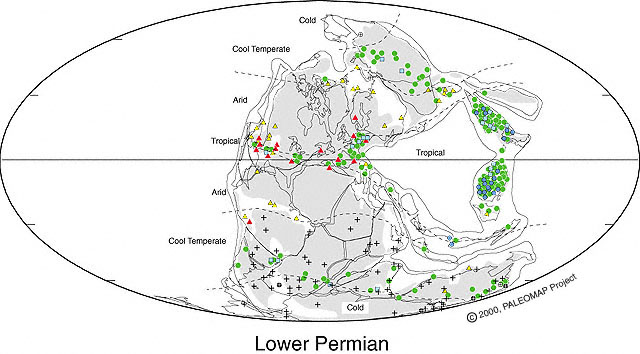
Minor myth: If it's not unprecedented in the last 4 billion years, it's no big deal

Please don’t feed me some line of crap about how all the ice is going to melt. We both know the world has been warmer and the ice caps melted and sometimes they didn’t melt. In fact, the ice caps are actually a rare occurence in earth’s history so we should be surprised that they are even here.

-- Shooshmon, The Blackboard


This is a trope that recurs over and over in "skeptic" arguments: if a state of affairs has ever occurred before (even if we're talking about hundreds of thousands or even hundreds of millions of years ago) then it is not "unprecedented" and hence, no big deal.


I didn't find this myth at Skeptical Science (although #45, "Co2 was higher in the past," could be considered a specific instance) so it is officially in our purview as a minor myth.


Basically, the fallacy here relies on ignorance of just how long the earth has been around and how variable its climate has been over billions of years of geologic time. At times the earth has been covered in ice; at times the ice has melted, and sea levels have been hundreds of feet higher than today. The relevant question, however, is not whether a state of affairs has ever existed before, but what it means for us, people, and our seven (soon nine) billion-strong civilization.

The realistic way to relate these two ideas -- whether a condition has happened before, and what it's likely to be a problem for people -- is obviously not to look at the whole of geological time, but a much briefer span of time, human history, the time in which we have been living in settled communities and growing food to feed ourselves. Those are the conditions in which humans have prospered.

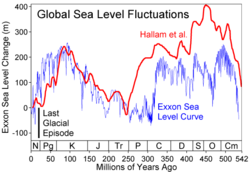
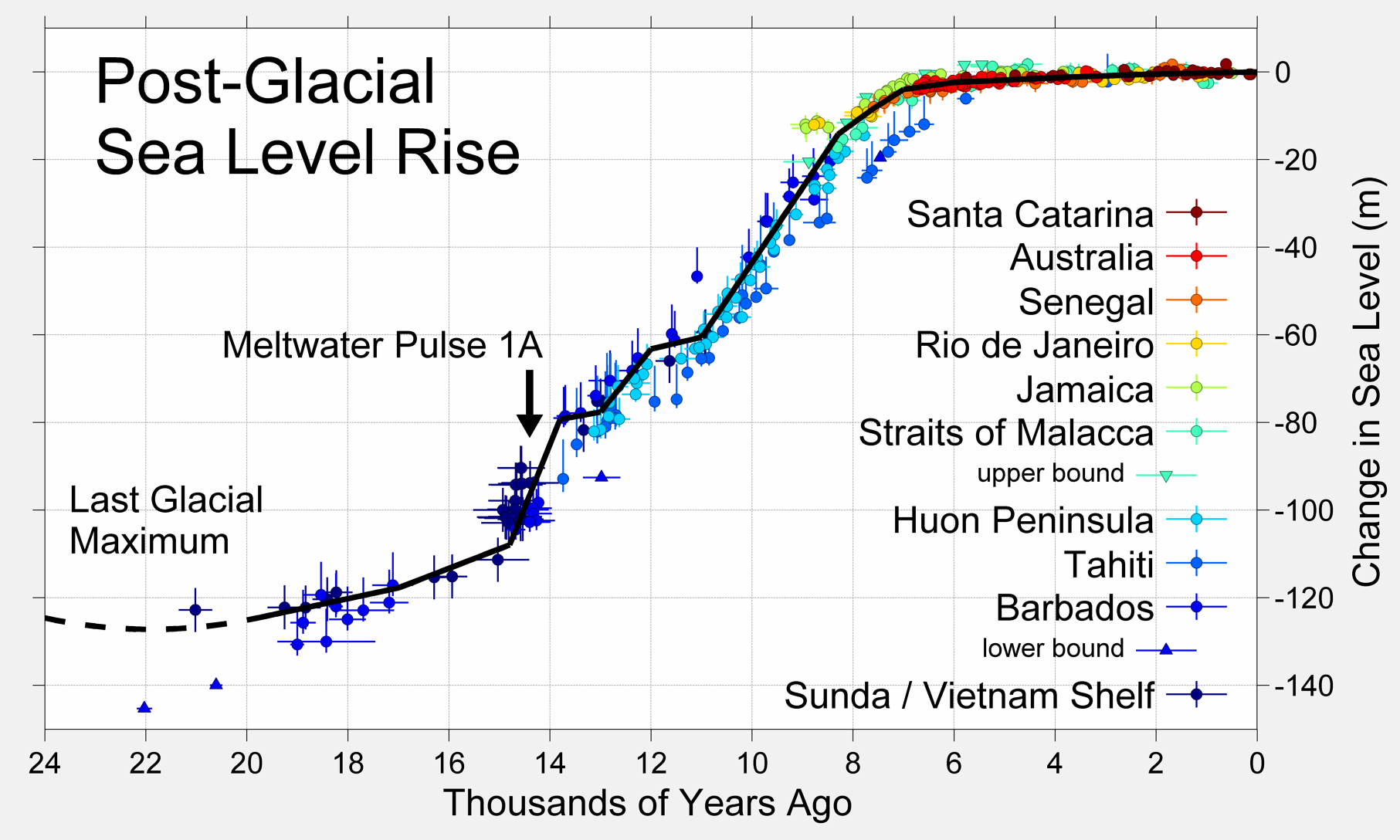
When we look at that period, approximately 13,000 years, we find something surprising. Let's take a look at Shooshmon's example (if that's not too strong a term), the ice caps, as reflected in sea level measurements:


Looks like quite a bit of variation. But look at the x-axis. It's marked in intervals of 50 million years. What does that have to do with anything human? Not much. Next, let's look at the recent past:


Over the last 8,000 years, sea levels have been rock-solid stable. That's the whole of recorded human history; China and Egypt, Judea and Babaylon, the Greeks and the Macedonian and the Roman Empires -- all of it. Prior, sea levels were lower (more ice). They have never been higher in all the time people have been growing their own food. So are higher sea levels safe, because the dinosaurs didn't mind them at all? Of course not. Among other differences, dinosaurs did not live by the hundreds of millions in costal cities and floodplains.

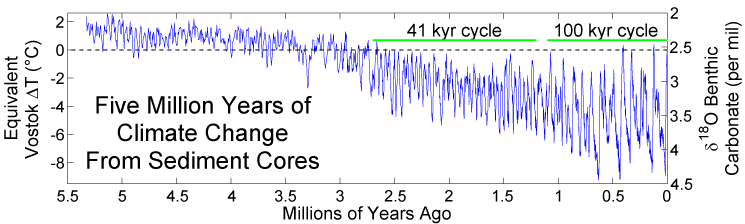
You can identify the same pattern in temperature records:


You can see semi-regular oscillations of several degrees. But always look at your axis. This is five million years of temperature records. The swings that seem to be coming one right after the other are actually occurring at a brisk rate of one every 40,000 to 100,000 years. Now look at it on a human timescale:


All of human civilization has lived in a band of +/- about 0.5C. Until the last decade, in which we've broken through that temperature ceiling headed for parts unknown -- headed, if things keep going on as they are, for conditions not seen on this earth for millions of years, things unknown not just to human civilizations but to the entire history of our species. Unprecedented? Maybe not in the strictest sense. Unsafe? You'd better believe it.

UPDATE: This exchange on The Blackboard captures the above in admirably terse style:

bugs (Comment#52733) September 24th, 2010 at 7:18 am

liza (Comment#52725) September 24th, 2010 at 5:50 am

Bugs, I know what the sea level height was 125,000 years ago because my husband is a geologist and I can google. That graph shows you that “today” isn’t such a big deal.

If you are a rock, or a planet, it’s not big deal.

Sunday, September 12, 2010

WUWT lies like a rug -- where is Ben Lawson?


At the consistently fantastic "Wott's Up With That?" blog, Ben Lawson takes on the Herculean task of documenting and fact-checking the cornucopia of malicious nonsense that is "What's Up With That?" It's a mission I thought I'd be spending a lot more time on when I started this blog. One look at Ben's site convinced me that I could not do it more thoroughly, more tellingly, or with a lighter touch than him.

Lately, though, the effort seems to be taking its toll on Ben, who is often on hiatus, announced or unannounced.

My unsolicited advice; get some underbloggers. One man can shovel only so much treacle.

Monday, June 28, 2010

How it works

Steve Goddard has brought forth another one of his whistling-through-the-graveyard articles on the Arctic sea ice. And in a classic WUWT move, he offers the following two quotes:

From The New York Times, 1969

From the 9th century to the 13th century almost no ice was reported there. This was the period- of Norse colonization of’ Iceland and Greenland. Then, conditions worsened and the Norse colonies declined. After the Little Ice Age of 1650 to 1840 the ice began to vanish near Iceland and had almost disappeared when the trend re versed, disastrously crippling Icelandic fisheries last year.

From The New York Times, 2000

The thick ice that has for ages covered the Arctic Ocean at the pole has turned to water, recent visitors there reported yesterday. At least for the time being, an ice-free patch of ocean about a mile wide has opened at the very top of the world, something that has presumably never before been seen by humans and is more evidence that global warming may be real and already affecting climate. The last time scientists can be certain the pole was awash in water was more than 50 million years ago.

Is it possible that the IPCC is trying to rewrite the history books?


So, do these two news articles published thirty years apart contradict each other? (Not that that would be such an amazing thing if it were true.) As it turns out, no. Follow the quote back to the source and you find:

Col. Joseph O. Fletcher, a retired Air Force polar specialist now with the Rand Corporation in California, has cited the absence of pack ice around Iceland as an index of such trends.

From the 9th century to the 13th century almost no ice was reported there. This was the period- of Norse colonization of’ Iceland and Greenland. Then, conditions worsened and the Norse colonies declined. After the Little Ice Age of 1650 to 1840 the ice began to vanish near Iceland and had almost disappeared when the trend re versed, disastrously crippling Icelandic fisheries last year.


Steven implies that "there" is the Arctic, when "there" is actually "pack ice around Iceland." If this confusion is deliberate, he lied. If accidental, he's lazy and sloppy. As is so often the case with deniers, it's hard to tell which.

Saturday, May 15, 2010

Meditations on sea ice


About a month ago, due to the late arrival of the Arctic melt, something happened which was practically irrelevant but irresistibly exciting to the denialist set: the Arctic sea ice extent (as shown above) flirted with the 1979-2009 average. The response was predictable:

By itself, this is just a small thing, but it is just one more indication that there’s some improvement in the Arctic Ice situation again, and the indications are that we’ll have another summer extent that is higher than the previous year, for the third year in a row. . . .

With nature still not cooperating with “death spiral predictions”, what will be the press release ice meme this year? Color? Texture? Cracks per square kilometer? It will be interesting to watch.


Yes, Watts and dittoheads don't waste any time celebrating short-term fluctuations in the long-term trends caused by warming. And wisely so because, as they must sense on some level, those fluxes flux right back:


As you can see, the data did approach the the 1979-2009 average briefly. And then it abruptly dropped, so that now it is sitting a hairsbreadth from the 2007 trend, the worst year for sea ice (by far) ever recorded.

How did climate scientists respond to this blip in the data? Did the hide it, distort it, lie about it? See for yourself:

During April, Arctic sea ice extent declined at a steady pace, remaining just below the 1979 to 2000 average. Ice extent for April 2010 was the largest for that month in the past decade. At the same time, changing wind patterns have caused older, thicker ice to move south along Greenland’s east coast, where it will likely melt during the summer. Temperatures in the Arctic remained above average. . . .

Arctic sea ice extent averaged 14.69 million square kilometers (5.67 square miles) for the month of April, just 310,000 square kilometers (120,000 square miles) below the 1979 to 2000 average. The rate of ice extent decline for the month was also close to average, at 41,000 kilometers (16,000 square miles) per day. As a result, April 2010 fell well within one standard deviation of the mean for the month, and posted the highest April extent since 2001.


Thus the National Snow and Ice Data Center, which is supported by NASA. Just the facts. The relative increase in the ice is clearly underlined: "April 2010 fell well within one standard deviation of the mean for the month, and posted the highest April extent since 2001."

The ice is described as near average, which is as high as it has been in April for almost ten years. Compare the reaction of Steven Goddard, Watts-ass-licker extraordinaire, to the beginning the the downward trend:


Monday’s NSIDC Arctic ice extent graph took a turn downwards, and is now showing 2010 a little more than 500,000 km2 higher than 2007. . . . In order to look at this closer up, I superimposed the NORSEX 2010 data (red) on the NSIDC 2010 data (blue) at the same scale, and normalised to 2010, and saw some interesting things. The first problem is that they started to diverge right around the first of April, and as of May 2 they disagree by nearly 500,000 km2.


Yep, give Steve data he doesn't like, and the very first thing he does is go looking for another source that gives results he likes better. By the end of his post, which announces its foregone conclusion in its title, "500,000 km2 Discrepancy Between NSIDC and NORSEX," Steve has talking himself into disregarding the awkward numbers from a source he so recently treated as authoritative:

I believe that both groups use SSMI so it is difficult to understand what the problem is. Last year we saw something similar. NORSEX has a history of making adjustments in mid-season, so my sense is that NSIDC is probably more accurate.


Surprise, surprise.

There are a couple of points that occur to me here. First is that we ought to state as a corollary of basic statistics the following principle:

Tracker's First Law: If you track enough different data sets characterized by both short-term fluctuations and long-term trend, some of them will inevitably appear to be "normalizing" as, by chance, the short-term factors oppose the long-term trend.


And, what the heck, a second law:

Tracker's Second Law: If you normalize the current state of affairs as typical (ignoring the changes that have already taken place) you create a false equivalence between things getting worse more slowly than expected, and things getting better.


This is implicit in the way deniers are seeking to use the ice extent average as "normal" (as seen, for example, here).

Spot the fallacy:


Do you see the problem? Sea ice extent has been declining for the last thirty years. The thirty-year average averages include the worst year (2007), the second-worst (2008), and so on. This "average" has approximately 15 years of the long-term decline in the sea ice built into the "average." And that's good science, using a thirty-year average; perfectly kosher, best practice. But the "average" is not "normal." Normal would be what we started with -- the averages in the first decade of satellite measurements, before Arctic amplification of global warming really started to tear it to pieces. And that average is literally millions of km sq greater than we will EVER see again.

Deniers lose on the facts every time, and like a loser at cards, they are always eager to see the next hand dealt. But we can't let deniers ignore the past, which allows them simultanously to gloss over their volumous failures at prediction and to exalt the trend or the data set of the moment above the massive, crushing weight of decades of observation overwhelmingly supporting the science of climate change.

Saturday, April 24, 2010

Minor myths: the Armstrong-Gore climate "bet"

In 2007, Scott Armstrong proposed a ten-year wager to Al Gore -- no warming (Armstrong's prediction) vs. warming (Gore's prediction). Gore declined, saying he doesn't gamble. And there was no wager, so that was the end of it. Kidding! What happened was that it became a minor myth picked up by the likes of Intrade and followed on http://www.theclimatebet.com/. Denialists like to claim that Gore is "losing the bet," a claim that interested me because of the number of lies packed into a simple declarative sentence. I will delve into this at greater length later, but here is a thumbnail sketch of the fallacies involved that sentence:

1. There was no bet, as Gore declined the offer.
2. Gore hasn't given an estimate for future warming, so the denialists chose 0.03C per year, which they claim is the "linear trend" predicted by the third IPCC report.
3. The trend predicted by the IPCC is not linear.
4. The trend is not 0.03C per year. The third IPCC report predicted a warming trend of 0.15C-0.30C/decade over the next several decades. Not only does the "bet" ignore the time frame (see #6), but rather than chose the middle of the range, the deniers have chosen to pretend the higher end of the estimate, the maximum possible, is the "projection" of the IPCC report.
5. The "bet" was proposed in 2007, when the fourth IPCC report came out -- but the denialists went to the out-of-date report for their estimates of warming. (The fourth report does not change things much -- it estimates warming of about 0.2C in coming decades.
6. It's a ten-year bet, yet denialists are tracking meaningless figures like who "won" the year or even who "won" the month (of course, short-term variations caused by solar activity, ENSO, and the like make it impossible to translate a prediction of 0.2C/decade averaged over several decades to a prediction for one decade, let alone a single month or year. Scott Armstrong himself has warned the denialists that this makes no sense, but they persist.
7. Even with these cherry-picked conditions, Gore has "won" six of the last seven months. Intrade gives him a 75% chance to "win" the year. Coincidentally, http://www.theclimatebet.com/ stopped posting updates on the status of the "bet" . . . exactly six months ago.

Tuesday, March 23, 2010

Why is conservatism unable to come to grips with climate change? Part one.

Denialism is primarily a disease of social conservatives. The recent decline in those professing belief in the science is well-known, but what has been less well-emphasized is that almost all of change is a result of a dramatic fall among conservatives:


Four out of ten conservatives who believed in climate change in 2008 no longer do, despite the fact that 2009 was the second-warmest year on record, and the Oughts the hottest decade. Conservatives were equally split on the reality of climate change in 2008, but the worm has turned. It may be useful to consider the forces which seem to have given conservatism a violent shove away from the physical realities of our world.

One of the most important things about this political dichotomy is that it reflects politics as it is practiced in our country today; it reflects the political outlook honed by the Bush administration, which heaped scorn on the "reality-based community." It is a politics that is committed to contesting every point, however trivial, attacking every proposition, no matter how commonsensical, and used a hate-filled vocabulary organized around conspiracy at the back of which are crude dog-whistle messages that the other side is not like us.

I know that it seems like an eternity we've been living with these politics, but in fact, it's only been a few years. Swiftboating, first used to target John Kerry, came on the scene in 2003. In hindsight, it was a foretaste of the strategy conservatives would used to target Obama (Kenyan! Socialist! William Ayers!) and healthcare reform (death panels! socialist!) as well as climate change.

What is characteristic about these attacks is that, like the show trials of Trotskyites, they barely pretend to address the facts of the issue. Often, they seem almost defiantly sloppy. They offer not arguments to convince the skeptical, but thinly-veiled excuses to believe what the subject has always believed about "them." The believers must no on some level that they are being asked to participate in a political lie; not many of Sarah Palin's listeners can actually have believed that the government was planning to set up "death panels" to try the elderly or infirm. But they believed that bad people were up to no good; and by cheering and repeating this obvious lie, they were serving their tribe in good stead. In the 21st century, people are not just passive recipients of bias information; propaganda has gone viral; our self-serving narratives emerge from the cloud.

Denialism is comfortable to conservatives because they have gradually acclaimated themselves to the practice of making the facts bend to the ideology; of embracing whatever narrative gives aid and comfort to the tribe, regardless of how far-fetched it is. This dynamic has been assisted greatly by the internet. No longer does a conspiracy theorist have to air their views in mixed company when they are less than fully formed and hardened in place.

No longer must one push and prod the facts as presented by newspapers or TV to extract those elements which support the conspiracy theory. In the harsh light of 2010, the idea of "spinning" the news is as much an antique as a manual typewriter. The power of the internet and friendly outlets like Fox is that they create their own facts, almost their own world. The facts created are immediately affirmed by like-minded individuals, and arguments are disseminated to those less capable of sophistry under their own steam.

Once, an ideological fugue like this could only exist where there was an entire state apparatus to support it, as in a totalitarian state. Today that's not necessary: the screaming crowds, the nasty slander cumulating in show trials, the censorship of dangerous criticism (whilst tolerating voices that make the other side appear absurd) -- all these things can be created within the right-wing echo chamber (and have their more modest and more primitive equivalents on the far left). And unlike totalitarians, they do not require any coercive force to keep the drones inside the lie: they stay within the circle of their own accord; it's where they feel most comfortable. After all, outside are dangerous people that hate us, that want to seduce us with lies and ruin us . . .

I realize this post has become less about the why, and more about the how, but the how is important too. Because despite my less-than-affectionate perspective on conservatives, they are not the only ones responsible for the present state of affairs. We are all at fault; we have all allowed our public discourse to make truth subject to ideology. The media have gone right along with it; the transition of news organizations from the gatekeepers of facts to the purveyors of branded political and social commentary has made them partners in this degradation. The public, by eagerly consuming partisan rhetoric, and letting themselves become caught up in who was winning the day, winning the issue, winning the race, are also pushing our society along this path to total disconnection with objective truth.

But why climate change? Why did global warming became, along with healthcare, the major lighting rod for conservative mythmaking? After all, if anyone ought to understand that preserving our environment for our children and the generations to come is a moral imperative, it's a conservative. If anyone should understand that radical change to an environment that has sustained us for ten thousand years of human civilization is likely to do severe harm, it's a conservative. If anyone should respect the opinions of the vast majority of working scientists and national and international scientific federations, it's those authority-loving conservatives.

I'll explore the reasons in part two.

Sunday, March 14, 2010

Minor myths, part 2: "Science will save us"


From Terry J:

"Evolution is accepted by everyone but the climate types. The entire earth history says it will change, but does not say any given species will like the change. Adaptation is considered a key factor in evolution, but apparently no longer functions."

Katherine offers:

"It’s a mistake to try to control CO2 to the detriment of prosperity when that prosperity is what would enable people to adapt to climate change–whether for warmer or cooler."

The idea behind this meme is that science, aided by the invisible hand of the marketplace, has overcome all obstacles to achieve our current prosperity, and that to argue that climate change is a serious problem that must be addressed is to foolishly ignore the track record of science and innovation in moving society ever forwards. Science will save us.

One way to examine this thesis would be to look at societies that failed in the past, and ask if we are immune to the same failings because we are richer, with more knowledge of the natural world and better technology. A good examination of this can be found in Diamond's Collapse. Another would be to compare the anticipated effects of global warming with a reasonable projection of the technology we are likely to have when, say, sea level rise threatens every coastal city, town and village in the world with inundation.

But here at theIT, we try to keep things simple, and leave the heavy stuff to the real scientists: see the blogroll for a list. ("The Science of Doom," in particular, is an amazing blog that deserves more traffic. And of course RealClimate, they just go from strength to strength over there.) But here we are. Is there an easier way to refute this argument than to delve into the details of the scope of the problems and the powers and limits of science?

In fact, there is. The we need not dispute the literal truth of the statement, in fact, to do so. Will science save us? I put it to you that science has saved us. It's done.

Consider a society which collapsed due primarily to self-inflicted ecological damage: Easter Island (Diamond again!). They deforested their island, lost the ability to build canoes (because they had no suitable wood), lost much of their ability to fish (no canoes), lost soils to erosion, and eventually lost most of their population and civilization, with evidence of widespread cannibalism.

In the time this was happening to them, the Easter Islander did not know what the deforestation would do, had little concept of soil erosion and other ecological disasters, and had no records or history of societies confronting similar challenges, successfully or unsuccessfully.

Consider our situation. What has science done for us so far?

1. Science has clearly demonstrated the world is warming, and that dangerous consequences will follow from that. Without science, we would not even be able to identify the problem (as happened on Easter Island.)

2. Science has determined the cause of the warming (man-made greenhouse gases).

3. Science has provided us with technologies that allow us to address the problem (which requires us to greatly reduce our output of GHGs) without sacrificing our modern lifestyle: Because of science we have nuclear, solar, and wind power; we have efficient insulation and low-drag vehicles; we have trains and buses; we have the internet.

Science has identified the problem, found the source of the problem, outlined a solution, and provided technology to make the solution relatively painless (an estimated two-tenths of a percent of GDP to transition to a low-carbon economy).

Global warming deniers want to position themselves as optimistic people with great faith in science and the future, but there's an old joke about faith that applies here:


A God-fearing man falls from a ship into the ocean. He is frightened, but he knows God loves him and will save him. He prays to God to save him and focuses on his absolute belief that God will save him. After a while a fishing boat comes by. "Here, grab this line and we'll pull you out of the water!" the captain says. "No, thank you, but God is going to save me" the man says. So the boat leaves, and a rich man's yacht comes by. "Here, grab my hand and we'll pull you in!" they say. "No, thank you, God is going to save me" the man says. Finally a Coast Guard cutter comes by, but the same conversation is repeated again.

Finally the man drowns. And because he is a good man, just a little thick, he goes to heaven and comes before God. And he asks him "God, I loved you and believed in you so much. Why didn't you save me?" And God looks at him and says "Didn't you see the fishing boat, the yacht, and the Coast Guard cutter?"


There is no question of whether science will save us: science has provided us with all the tools we need to save ourselves. Are the solutions science and technology provide free of expense or effort? (Are we talking about science or magic?) Do they alleviate the need for preparation and foresight? A parachute does not work unless you put it on -- preferable before you jump out of the plane. Antibiotics don't work unless you take them. And science won't solve global warming unless you listen to the scientists and use the tools that science has provided to actually solve the problem.

Tuesday, March 2, 2010

Minor myths: "The Arctic sea ice is almost back to normal"

The big dogs do a great job of cataloging the major denialist talking points, the ones with legs, the major hallucinations. See Realclimate's stuff and Skeptical Science's pages. But the work is never done; deniers change memes as often as they change their socks, and for the same reason: at the end of the day, they stink to high heaven.

So this is the first in an occasional series on the minor talking points of the deniers. This week: the claim that after hitting an all-time low in 2007, Arctic ice has "rebounded" and is now "near normal."

You find it on AccuWeather:

So far we have two years of recovery from the 2007 melt. Will it surpass 2007's melt or will it return to normal?


You find it in Watt's echo chamber:


In 2007 the winds caused an anomaly that has been recovering ever since.


[And star idiot Steven Goddard weighs in:]


Ice area is normal and well ahead of 2007 or 2008.


Thirty seconds of looking at the actual data gives the lie to the talking point:


We are running 720,000 square km below the mean. That's far from "normal" or even "near normal." What about the "recovery" part of the myth? Consider the yearly sea ice minimum, still, in 2008 and 2009, far below average levels:


When you look at the chart, you can see what's happened. In 2007 the bottom fell out. No one knows exactly why, but it was a record-shattering year. In the ensuing two years, the summer extent is slightly higher, but every year since 2007 has been far worse than every year prior to 2007. That's a critical point. 2007 remains, so far, an outlier, but the ice has not come back from that decline. Deniers are ignoring that in trying to imagine a recovery to near-normal levels. 2008 and 2009 were the second- and third-worst years for the Arctic ice on record.

Aficionados of idiocy will note that this is the same fallacy that denailists use to argue that 2005 hottest year on record = cooling for the past five years (Sure, and any day Kobe Byrant scores less than 81 points a game (his record, believe it or not) we can say his career is in decline).

We can expect more nasty surprises like 2007 ahead, but in the meantime, we can be buoyed by the denialists' optimistic view that any year that does not set a new record -- whether for temperature or sea ice or glacier loss or whatever -- must mean the trend has reversed itself.