Showing posts with label antarctica. Show all posts

Saturday, October 6, 2012

Three papers on the Antarctic ice


There is a lot of carbon under that ice.
Potential methane reservoirs beneath Antarctica Wadham et al (2012)
Abstract: Once thought to be devoid of life, the ice-covered parts of Antarctica are now known to be a reservoir of metabolically active microbial cells and organic carbon1. The potential for methanogenic archaea to support the degradation of organic carbon to methane beneath the ice, however, has not yet been evaluated. Large sedimentary basins containing marine sequences up to 14 kilometres thick2 and an estimated 21,000 petagrams (1 Pg equals 1015 g) of organic carbon are buried beneath the Antarctic Ice Sheet. No data exist for rates of methanogenesis in sub-Antarctic marine sediments. Here we present experimental data from other subglacial environments that demonstrate the potential for overridden organic matter beneath glacial systems to produce methane. We also numerically simulate the accumulation of methane in Antarctic sedimentary basins using an established one-dimensional hydrate model3 and show that pressure/temperature conditions favour methane hydrate formation down to sediment depths of about 300 metres in West Antarctica and 700 metres in East Antarctica. Our results demonstrate the potential for methane hydrate accumulation in Antarctic sedimentary basins, where the total inventory depends on rates of organic carbon degradation and conditions at the ice-sheet bed. We calculate that the sub-Antarctic hydrate inventory could be of the same order of magnitude as that of recent estimates made for Arctic permafrost. Our findings suggest that the Antarctic Ice Sheet may be a neglected but important component of the global methane budget, with the potential to act as a positive feedback on climate warming during ice-sheet wastage.

That ice is melting faster than we thought it would.


Dynamics of the last glacial maximum Antarctic ice-sheet and its response to ocean forcing -- Fogwill et al (2012)
Abstract: Retreat of the Last Glacial Maximum (LGM) Antarctic ice sheet is thought to have been initiated by changes in ocean heat and eustatic sea level propagated from the Northern Hemisphere (NH) as northern ice sheets melted under rising atmospheric temperatures. The extent to which spatial variability in ice dynamics may have modulated the resultant pattern and timing of decay of the Antarctic ice sheet has so far received little attention, however, despite the growing recognition that dynamic effects account for a sizeable proportion of mass-balance changes observed in modern ice sheets. Here we use a 5-km resolution whole-continent numerical ice-sheet model to assess whether differences in the mechanisms governing ice sheet flow could account for discrepancies between geochronological studies in different parts of the continent. We first simulate the geometry and flow characteristics of an equilibrium LGM ice sheet, using pan-Antarctic terrestrial and marine geological data for constraint, then perturb the system with sea level and ocean heat flux increases to investigate ice-sheet vulnerability. Our results identify that fast-flowing glaciers in the eastern Weddell Sea, the Amundsen Sea, central Ross Sea, and in the Amery Trough respond most rapidly to ocean forcings, in agreement with empirical data. Most significantly, we find that although ocean warming and sea-level rise bring about mainly localized glacier acceleration, concomitant drawdown of ice from neighboring areas leads to widespread thinning of entire glacier catchments—a discovery that has important ramifications for the dynamic changes presently being observed in modern ice sheets.

When that ice melted previously, global carbon dioxide levels rose dramatically over only two hundred years.
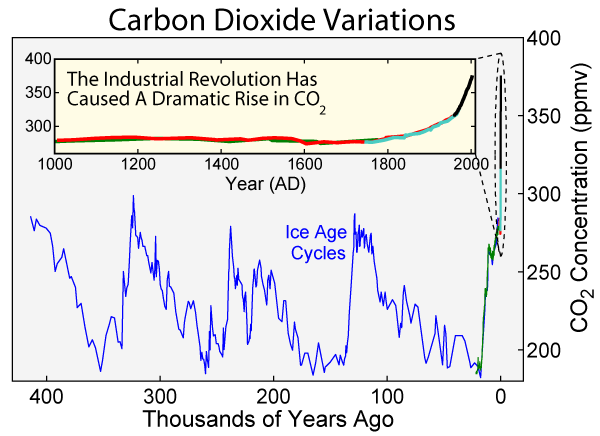

Abrupt change in atmospheric CO2 during the last ice age – Ahn et al. (2012)
Abstract: “During the last glacial period atmospheric carbon dioxide and temperature in Antarctica varied in a similar fashion on millennial time scales, but previous work indicates that these changes were gradual. In a detailed analysis of one event we now find that approximately half of the CO2 increase that occurred during the 1500-year cold period between Dansgaard-Oeschger (DO) events 8 and 9 happened rapidly, over less than two centuries. This rise in CO2 was synchronous with, or slightly later than, a rapid increase of Antarctic temperature inferred from stable isotopes.”
Citation: Ahn, J., E. Brook, A. Schmittner, and K. J. Kreutz (2012), Abrupt change in atmospheric CO2 during the last ice age, Geophys. Res. Lett., doi:10.1029/2012GL053018.
Comment: This is all very new science, but these three very different papers with different subjects and different methods seem together to suggest a coherent narrative; ocean warming rapidly triggers widespread decay of the Antarctic ice sheets, which uncovers significant amount of carbon. That carbon makes its way into the atmosphere, in amounts significant enough to warm the climate further.

The Arctic permafrost feedback appears (to an outsider, like me) to be gaining widespread acceptance as a significant contributor to global warming both in the near term (the next century) and in the longer term (a few centuries.) Now we are trying to nail down the scale of the feedback. Meanwhile, we are starting to get some science that suggests a similar carbon-cycle feedback could unfold in the South, scale and speed unknown.

Sunday, September 2, 2012

The Antarctic carbon feedback: a worst case scenario

It's the single study to end all single studies:
The researchers estimate that 50 per cent of the West Antarctic Ice Sheet (1 million km2) and 25 per cent of the East Antarctic Ice Sheet (2.5 million km2) overlies preglacial sedimentary basins, containing about 21,000 billion tonnes of organic carbon.
If this carbon proves to be vulnerable in the way we now think the northern permafrost carbon is vulnerable, it will mean we could soon be literally incapable of stabilizing the climate without geoengineering.

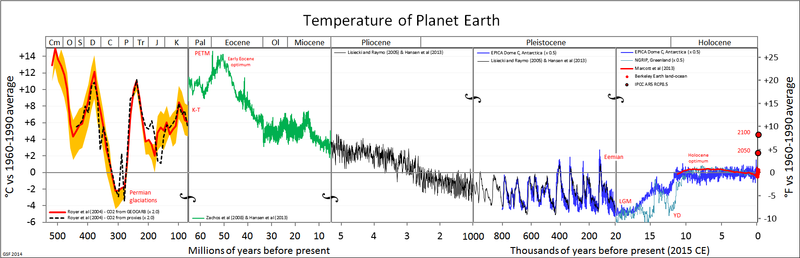
The reason is very simple.  Based on the experience of the Eocene (above), at between 3 and 4 degrees above preindustrial, the Antarctica ice pack can be expected to melt completely (of the course question of exactly what temperature will lead to the deglaciation of Antarctica is a complex scientific question, while the above is an eyeballed guesstimate; see below). If these researchers are right, that will gradually release 21,000 gigatons of carbon.

So let's get down to brass tacks. The carbon is divided between the larger East Antarctic Ice Sheet and the more vulnerable West Antarctic Ice Sheet:
The researchers estimate that 50 per cent of the West Antarctic Ice Sheet (1 million km2) and 25 per cent of the East Antarctic Ice Sheet (2.5 million km2) overlies preglacial sedimentary basins, containing about 21,000 billion tonnes of organic carbon.
Experts place the chances of for the beginning of a total collapse of the WAIS in the next 200 years at upwards of 5%. Estimates of how long such a collapse would take to reach completion range from 300 to 1600 years. The temperature that would trigger that collapse is thought to be somewhere between +1C and +5C compared to 1990 temperatures (2).

Suppose that happened, and, since that's a fairly pessimistic assumption, let's throw in a couple of optimistic assumptions: the EAIS contributes nothing significant, and the northern permafrost and methyl hydrates contribute nothing.

The proportion of the trapped carbon under the WAIS is 4/9 of the total of 21,000 gigatons (about 9,300 gigatons) (1). If the WAIS melts, what proportion of that carbon will enter the atmosphere? Some will obviously remain locked a carbon sink that will develop as the continent warms. Suppose only 60% or so, 6,000 gigatons, ends up in the atmosphere.

A couple hundred billion tons of that will be methane; ignore it. The trapped methane has figured prominently in the news accounts about this research, but compared to the staggering amount of carbon under the ice, most of which would enter the atmosphere as carbon dioxide and the rest of which would be oxidized to carbon dioxide after a brief stint as methane, the news that we have a southern methane time bomb to go with the Arctic one is merely a footnote.

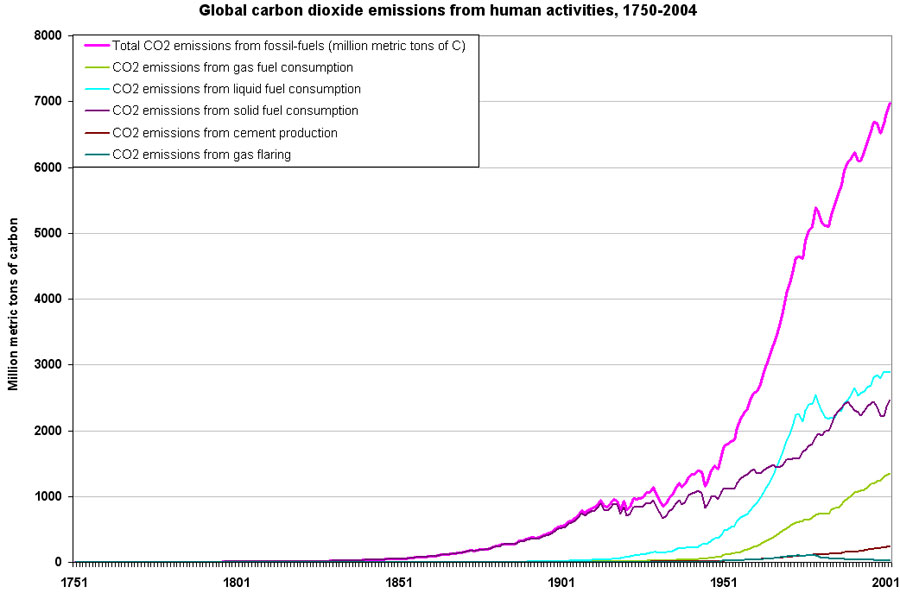
Suppose significant outgassing of the carbon under the WAIS starts in about a hundred years and takes two hundred years to run to completion. Six thousand gigatons over two hundred years is 30 gigatons of carbon per year (on average). By way of comparison, total fossil fuel emissions are running at about 7 gigatons per year:

Source
Thirty gigatons a year is about what the human race is expected to produce at the end of the century is the world economy grows rapidly despite our making no effort to rein in our emissions:

Source
The effect of 6,000 gigatons of carbon entering the atmosphere would be an extinction-level event. One part per million of atmospheric CO2 is equivalent to 2.13 gigatons of carbon. Assuming a 50% airborne fraction (which is incredibly optimistic) 6,000 tons of carbon entering the atmosphere would raise the CO2 concentration by about 1,400ppm. In a worst case in which the carbon sinks finally give up the ghost, the rise is 2,800ppm. Supposing we were at that point at 800ppm and +4C, that would quickly take us to +8C with the EAIS adding its share soon after.

You would be looking at centuries of further warming independent of human emissions -- leading to an increasingly inhospitable climate even if economic collapse reduced the anthropogenic contribution significantly.

There is a large distance between the publication of this one study and a solid scientific case for an Antarctic carbon bomb. The steps along that road are, roughly:

1. Are the authors correct about the scale of the buried carbon?
2. Are the authors right about the distribution of that carbon, specifically about a heavy concentration of it under the most vulnerable part of the ice sheet?
3. Will that ice sheet decay significantly over the next few centuries?
4. If the ice sheet decades, what proportion of the buried carbon will make its way into the atmosphere?
------------------------------------
1. "Potential methane reservoirs beneath Antarctica"  J. L. Wadham, S. Arndt, S. Tulaczyk, M. Stibal,  M. Tranter, J. Telling, G. P. Lis, E. Lawson, A. Ridgwell, A. Dubnick, M. J. Sharp, A. M. Anesio & C. E. H. Butler.  Nature 488, 633–637 (30 August 2012) -- abstract.
2. "The Future of the West Antarctic Ice Sheet: Observed and Predicted Changes, Tipping Points, and Policy Considerations" -- full text.
 ------------------------------------
UPDATE: Round up from around the interwebs.

 "Potential New Methane Risk in Antarctica" -- SustainableBusiness.com News

"Antarctica’s Hidden Carbon Stores Pose Warming Risk in Study" -- Bloomberg

“There’s a potentially large pool of methane hydrate in part of the Earth where we haven’t previously considered it,” Wadham said in a telephone interview. “Depending on where that hydrate is, and how much there is, if the ice thins in those regions, some of that hydrate could come out with a possible feedback on climate.”
"Large methane reservoirs suggested beneath Antarctic ice sheet" -- phys.org

 "Antarctic Methane: A New Factor in the Climate Equation" -- Climate Central
Wadham and her co-authors took soil samples from the margins of glaciers in both Antarctica and Greenland. “We spent a couple of years chain-sawing out sediments frozen into the bottom of the ice,” she said, adding with a connoisseur’s judgment, “They were very nicely preserved.”
They hauled the samples back to the lab and allowed them to thaw under carefully controlled, oxygen-deprived conditions where oxygen-hating, methane-belching bacteria known as methanogens could do their work — assuming they were there. And sure enough, the soil began producing methane.
The same thing should presumably be happening underneath Antarctica’s ice, where heat percolating from the depths of the Earth have prevented sediments from ever having frozen.

Tuesday, July 17, 2012

Dat PIOMAS -- massive ice news roundup


The melting news is not good. First there is the volume of the Arctic sea ice, which has hit a record low for the third year running. Knowing the powerful influence of local weather conditions on the Arctic sea ice, the steady fall is surprising. The warming-driven melt signal is overpowering the year-to-year variations.

And then there's Greenland.

Smack dab in the middle of high convection cell, hotter than Hades (for them). And because slightly distressed snow is a lot darker than fresh/never melted snow, the overall albedo of the entire ice sheet is shifting in the direction of more heat absorption and even more melting:

h/t Neven, via Michael Tobis
Greenlanders got an up-close-and-personal look at the shape of things to come when roaring glacier runoff smashed through the bridges of Kangerlussuaq (h/t Climate Denial Crock of the Week):


Petermann Glacier also lost a chunk of ice twice the size of Manhattan:

h/t Climate Denial Crock of the Week
Wrap up from Neven here.


But all this may turn out to be the warm-up for the really stunning ice news of the week, which is the birth of a third long-term climate record, supplementing the ice cores of Antarctica and Greenland. "Lake E" is Siberia has come up big with 3 million years of sediment records.

Like most real science, the excitement of the press-release-worthy findings is somewhat mitigated by the boring necessity of having other scientists examine the findings, confirm the findings, etc. Some of the interesting stuff in the record, though, is as follows:

1. There seem to be large climate swings in the record which are far too large to be explained by orbital changes or any other known natural forcing. While this will doubtless be trumpeted by the "science knows nothing crowd," this result, if it holds up, would imply positive feedbacks in the climate system so powerful and exquisitely sensitive that they dwarf the original positive forcing. My sense of the recent literature has been that the most likely suspect for those feedbacks would be the carbon cycle (permafrost, changes in soil respiration, methyl hydrates, etc.) The authors of this study think that's not enough -- see #3, below.

2. The Arctic and Antarctic climates are linked. They tend to warm together and cool together.

3. Melting in Antarctica may turn out to trigger melting in Greenland and the rest of the Arctic:

First, they say, reduced glacial ice cover and loss of ice shelves in Antarctica could have limited formation of cold bottom water masses that flow into the North Pacific Ocean and upwell to the surface, resulting in warmer surface waters, higher temperatures and increased precipitation on land.
Alternatively, disintegration of the West Antarctic Ice Sheet may have led to significant global sea level rise and allowed more warm surface water to reach the Arctic Ocean through the Bering Strait.
Lake E's past, say the researchers, could be the key to our global climate future.
4. The loss of ice from Greenland in Antarctica is likely to accelerate (gee, really?)

Point #3 brings to mind something from Eli's place. Fellow amateurs, gird your loins and follow me:

Shakun et al. find that at the end of the last ice age temperature increased immediately in the Arctic but only slightly, probably as a result of increased radiation during the northern hemisphere summer. As a result a small portion of the Arctic ice melted. The melt water had a lower salt concentration and thus was less dense than the surface water and sank although mostly not to great depths. The result was that the AMOC and thus the associated redistribution of heat between the Arctic and the tropics was interrupted. This meant that the temperature in the high northern latitudes no longer rose, but may, in fact, have even decreased slightly. This is exactly what was found in the data. As a result, the temperature rose in the southern tropics and then the southern temperate latitudes and finally in Antarctica. Only then did the data show an increase in CO2. So somehow warming of the southern latitudes leads to increased emissions of CO2. Simultaneous determination of the isotopic ratio (for example, according to RF Anderson, S. Ali, LI Bradtmiller, SHH Nielsen, MQ Fleisher, BE Anderson, and LH Burckle, Wind-Driven Upwelling in the Southern Ocean and the Deglacial Rise in Atmospheric CO2, Science, 323 , 1443-1448 (2009).) suggests that the CO2 source is a consequence of biological fixation of carbon residues, for example in plankton deposited on the ocean floor. This increase in CO2 concentration is more than twice as strong as expected from outgassing of CO2 from warmer sea water alone.  It indicates that the exchange with the Southern Ocean deep water became more intense and carbon deposits were transferred from the depths to the surface. Only after a significant temperature increase in the south and an increase in CO2 concentration, did the temperature rise again in the northern hemisphere. This is interpreted as providing a feedback mechanism for for greenhouse gases to drive global warming.
What if we put that together with the "Lake E" speculations? To wit:
First, they say, reduced glacial ice cover and loss of ice shelves in Antarctica could have limited formation of cold bottom water masses that flow into the North Pacific Ocean and upwell to the surface, resulting in warmer surface waters, higher temperatures and increased precipitation on land.
Alternatively, disintegration of the West Antarctic Ice Sheet may have led to significant global sea level rise and allowed more warm surface water to reach the Arctic Ocean through the Bering Strait.
Lake E's past, say the researchers, could be the key to our global climate future.
 So I tell myself the story: a slight change in solar forcing heats the North, which interrupts warm ocean currents, causing the South to heat. Ice sheets collapse, southern ocean currents change, and by some combination of unearthing plankton carbon, rising sea levels, and/or changing ocean currents, the North warms further, and more greenhouse gases are released.

Interesting story. Warming gets passed back and forth from North to South, until from modest beginnings you have a climate warmer than the present day. So what happens if, instead of a tiny tap on the Northern latitudes with a modest increase in insolation, you instead hammer the entire planet from stem to stern with a massive greenhouse gas forcing? We're about to find out.

UPDATE: The sharp eyes of the Hawk have spotted the Arctic Monitoring and Assessment Programme's (AMAP) 2011 report on Snow, Water, Ice and Permafrost in the Arctic (SWIPA).His summary of the summary is excellent.


Mostly this is stuff that is not news to regular readers; snow and ice are melting faster and faster. The loss of ice and snow is a positive feedback that leads to further warming. Permafrost is melting, releasing more carbon (we don't know how much yet). Greenland will melt faster and faster, but nobody knows how fast yet.